Feast of Saint James, Apostle – Lectionary: 605
The Call to Glory Through Sacrifice
Have you ever longed for greatness in God’s kingdom, only to discover that the path there is lined with suffering, humility, and surrender? Today’s readings, in honor of the Feast of Saint James the Apostle, draw us into this paradox of discipleship—where glory comes not through power or position, but through the cup of Christ: the cup of suffering, service, and ultimate joy.
Saint James, one of the “Sons of Thunder,” was among Jesus’ closest companions and the first Apostle to be martyred (Acts 12:2). Today’s Gospel from Matthew 20 recalls the bold request made on his behalf—that he and his brother John sit at Jesus’ right and left in His kingdom. But Jesus responds with a challenge that defines all Christian discipleship: “Can you drink the cup that I am going to drink?” This cup—symbolic of Jesus’ passion and death—becomes the shared destiny of all who follow Him. In 2 Corinthians 4:7-15, Saint Paul echoes this same mystery, writing that we carry the death of Jesus in our mortal bodies so that His life may be revealed in us. It is a ministry marked by suffering, but also resurrection power. And Psalm 126 reminds us of the joy that follows such labor: “Those who sow in tears will reap with cries of joy.”
Together, these passages reveal the deep rhythm of the Christian life: dying with Christ in order to live with Him, giving our lives in service so others might find life, embracing weakness so His strength can shine through. Saint James shows us that to truly share in the glory of the kingdom, we must first share in the sacrifice of the King. Are you willing to drink that cup?
First Reading – 2 Corinthians 4:7–15
Treasure in Clay
Today’s first reading draws us into the heart of Saint Paul’s theology of suffering, hope, and Christian witness. In his second letter to the Corinthians, Paul is addressing a community riddled with questions about his authority, suffering, and the meaning of discipleship. Corinth was a prosperous, cosmopolitan city where power and prestige were prized—yet Paul writes to remind them that true apostolic authority is marked not by worldly strength, but by the mysterious power of God revealed in human weakness. This passage, part of a larger reflection on ministry and the new covenant, brings us face-to-face with the paradox of the Christian life: that death and resurrection are not merely historical facts, but a daily pattern we are called to live. On the Feast of Saint James the Apostle, this message resonates powerfully—James, once ambitious for glory, ultimately embraced the suffering and martyrdom that made him a true witness (martys) of the Gospel. Through this lens, Paul’s words reveal not only the cost of apostleship, but the hidden glory it contains.
2 Corinthians 4:7-15
New American Bible (Revised Edition)
The Paradox of the Ministry. 7 But we hold this treasure in earthen vessels, that the surpassing power may be of God and not from us. 8 We are afflicted in every way, but not constrained; perplexed, but not driven to despair; 9 persecuted, but not abandoned; struck down, but not destroyed; 10 always carrying about in the body the dying of Jesus, so that the life of Jesus may also be manifested in our body. 11 For we who live are constantly being given up to death for the sake of Jesus, so that the life of Jesus may be manifested in our mortal flesh.
12 So death is at work in us, but life in you. 13 Since, then, we have the same spirit of faith, according to what is written, “I believed, therefore I spoke,” we too believe and therefore speak, 14 knowing that the one who raised the Lord Jesus will raise us also with Jesus and place us with you in his presence. 15 Everything indeed is for you, so that the grace bestowed in abundance on more and more people may cause the thanksgiving to overflow for the glory of God.
Detailed Exegesis
Verse 7 – “But we hold this treasure in earthen vessels, that the surpassing power may be of God and not from us.”
Paul refers to the Gospel as a “treasure”, something infinitely valuable, which God entrusts to fragile, human vessels—our mortal bodies. The metaphor of “earthen vessels” emphasizes humility and imperfection. Just as clay pots are easily cracked, our bodies are susceptible to suffering and death. Yet it is precisely in our fragility that God’s power shines forth. We are not meant to boast in ourselves, but in the Lord who acts through us.
Verse 8 – “We are afflicted in every way, but not constrained; perplexed, but not driven to despair;”
This verse presents a rhythm of tension and resilience. Paul lists the trials he endures but affirms the sustaining grace of God. “Afflicted… but not constrained… perplexed… but not driven to despair” is the language of spiritual endurance. For the believer, suffering is not the end of the story—it is a doorway to deeper trust.
Verse 9 – “Persecuted, but not abandoned; struck down, but not destroyed;”
Paul continues the pattern of contrast, showing how God’s presence makes all the difference. To be persecuted was a lived reality for Paul and for Saint James, who was killed under Herod. Yet even in the face of physical violence, Paul declares he is “not abandoned”. This is the mystery of divine companionship—God is with us in our darkest moments.
Verse 10 – “Always carrying about in the body the dying of Jesus, so that the life of Jesus may also be manifested in our body.”
Here Paul expresses the core mystery of Christian suffering: to bear the dying of Jesus is to also reveal His risen life. This isn’t mere metaphor. For Paul, to suffer as Christ suffered is to share intimately in His redemptive work. The body becomes a living icon of both cross and resurrection.
Verse 11 – “For we who live are constantly being given up to death for the sake of Jesus, so that the life of Jesus may be manifested in our mortal flesh.”
Paul reaffirms the ongoing offering of the Christian—our very lives become a sacrificial participation in Christ’s mission. This echoes the words of Jesus in Matthew 20:22: “Can you drink the cup that I am going to drink?” James would do so literally. We are all called to do so spiritually, letting our mortal flesh become a canvas for His glory.
Verse 12 – “So death is at work in us, but life in you.”
Here, Paul highlights the dynamic of apostolic ministry: the suffering of the apostles nourishes the spiritual life of the Church. Like Saint James, whose martyrdom strengthened the early Christian community, the cost paid by the few brings life to the many. This is the paradox of love.
Verse 13 – “Since, then, we have the same spirit of faith, according to what is written, ‘I believed, therefore I spoke,’ we too believe and therefore speak,”
Paul quotes Psalm 116:10, aligning himself with the faith of the psalmist. Speaking the Gospel is not just a mission—it is the overflow of a heart convicted by belief. Despite all obstacles, Paul continues to proclaim Christ because he knows the truth of the resurrection.
Verse 14 – “Knowing that the one who raised the Lord Jesus will raise us also with Jesus and place us with you in his presence.”
Resurrection is not abstract for Paul—it is the anchor of Christian hope. Just as Jesus was raised, so too will we be raised. For the early Church, this was not wishful thinking but the source of all courage. It empowered saints like James to give their lives in confidence of eternity.
Verse 15 – “Everything indeed is for you, so that the grace bestowed in abundance on more and more people may cause the thanksgiving to overflow for the glory of God.”
This closing line reframes all suffering in terms of grace and glory. Apostolic hardship is not self-serving—it exists to bring others to grace and to magnify God. When we offer our lives in service, our sacrifice becomes a channel of divine abundance.
Teachings of the Church
The Catechism of the Catholic Church confirms this mystery of redemptive suffering: “By his passion and death on the Cross, Christ has given a new meaning to suffering: it can henceforth configure us to him and unite us with his redemptive Passion” (CCC 1505). What Paul expresses in this passage—and what James lived unto death—is the Church’s enduring belief that suffering, offered in union with Christ, becomes salvific. It is not meaningless; it becomes a means of communion with the crucified and risen Lord.
Saint John Paul II deepened this teaching in Salvifici Doloris, writing: “In the Cross of Christ not only is the redemption accomplished through suffering, but also human suffering itself has been redeemed” (SD 19). For Saint Paul and Saint James, this was not theoretical. It was a daily surrender to the pattern of Christ’s Paschal Mystery: death to self, resurrection through grace. This reality turns every trial into an opportunity for transformation.
Historically, the blood of the martyrs—including Saint James—became the seed of the Church. As Tertullian famously wrote, “The blood of the martyrs is the seed of the Church.” The early Christians did not seek suffering, but they embraced it when it came, knowing that the power at work in their weakness would glorify God and convert souls. Paul’s words in 2 Corinthians are not only a personal testimony—they are a map for every believer who desires to follow Christ fully.
Reflection
What would it look like for you to carry the dying of Jesus in your own body today? Maybe it’s not dramatic persecution like James endured, but quiet acts of self-denial, patient endurance, or a willingness to serve without recognition. Are you willing to allow your weakness to become a vessel for God’s glory? This reading invites us to see suffering not as failure, but as participation. When we are struck down, God lifts us up. When we are perplexed, He gives us peace. When we are weary, His Spirit sustains us. Let us live like Saint James and Saint Paul—not fearing the cost, but trusting the promise that the One who raised Jesus will raise us too. Can you drink the cup?
Responsorial Psalm – Psalm 126
The Hopeful Harvest of the Faithful
Psalm 126 is a song of ascent—one of the pilgrim psalms sung by the people of Israel as they made their way to Jerusalem to worship at the Temple. Deeply rooted in the history of exile and return, this psalm recalls the joy of God’s past deliverance and petitions for His continued restoration. Likely written after the Babylonian exile, it captures the emotional journey from captivity to freedom, from sorrow to rejoicing. In today’s liturgy, this psalm fits seamlessly with the theme of sacrificial discipleship. As Saint Paul speaks of dying to self for the sake of Christ, and Jesus invites James to drink the cup of suffering, Psalm 126 assures us that sorrow sown in faith will yield a harvest of joy. It is the cry of every disciple who labors in darkness, trusting in the promise of divine restoration.
Psalm 126
New American Bible (Revised Edition)
The Reversal of Zion’s Fortunes
1 A song of ascents.
When the Lord restored the captives of Zion,
we thought we were dreaming.
2 Then our mouths were filled with laughter;
our tongues sang for joy.
Then it was said among the nations,
“The Lord had done great things for them.”
3 The Lord has done great things for us;
Oh, how happy we were!
4 Restore our captives, Lord,
like the dry stream beds of the Negeb.
5 Those who sow in tears
will reap with cries of joy.
6 Those who go forth weeping,
carrying sacks of seed,
Will return with cries of joy,
carrying their bundled sheaves.
Detailed Exegesis
Verse 1 – “When the Lord restored the captives of Zion, we thought we were dreaming.”
The psalm opens with a memory so joyful it seemed surreal. The return from exile was not merely a political event—it was a spiritual reawakening. Zion, the holy mountain of Jerusalem, symbolizes the covenant relationship between God and His people. Their restoration is an act of divine mercy, a fulfillment of God’s promises. This joy echoes the awe of resurrection and redemption.
Verse 2 – “Then our mouths were filled with laughter; our tongues sang for joy. Then it was said among the nations, ‘The Lord had done great things for them.’”
The rejoicing of Israel becomes a public witness. Even the nations recognize the Lord’s mighty works. This verse underscores how divine restoration not only transforms personal sorrow but also becomes a testimony to the world. It mirrors Saint Paul’s vision in 2 Corinthians: suffering borne in faith reveals the glory of God.
Verse 3 – “The Lord has done great things for us; Oh, how happy we were!”
The psalmist transitions from the voice of the nations to the voice of the people, affirming that their joy is rooted in a lived experience of God’s faithfulness. The phrase “great things” reminds us that God’s interventions are never trivial. His mercies are monumental and unforgettable.
Verse 4 – “Restore our captives, Lord, like the dry stream beds of the Negeb.”
This verse shifts from praise to petition, asking for continued restoration. The Negeb is a desert region in southern Israel, and its dry stream beds would suddenly flow with water during seasonal rains. This striking image conveys how quickly and powerfully God’s grace can transform barren situations. The faithful heart always longs for more of God’s saving action.
Verse 5 – “Those who sow in tears will reap with cries of joy.”
A central verse in today’s theme, this line captures the sacred exchange of suffering for glory. It reflects the core message of discipleship: every sacrifice offered in faith will, in God’s time, be rewarded. It affirms the rhythm of the Paschal Mystery—death leading to resurrection.
Verse 6 – “Those who go forth weeping, carrying sacks of seed, will return with cries of joy, carrying their bundled sheaves.”
This final verse provides an image of the faithful disciple as a laborer. Though sowing is difficult and comes with tears, the harvest will be abundant. It is a promise that no tear shed in trust will be forgotten. Just as Saint James gave his life in labor for the Gospel, every Christian who plants seeds in sorrow will return rejoicing.
Teachings of the Church
The Catechism of the Catholic Church speaks to the transformative power of hope, especially in times of trial: “Hope is the theological virtue by which we desire the kingdom of heaven and eternal life as our happiness… placing our trust in Christ’s promises and relying not on our own strength, but on the help of the grace of the Holy Spirit” (CCC 1817). Psalm 126 embodies this virtue. The Israelites’ journey from exile to restoration is a testimony to God’s fidelity and the fruit of patient hope. Just as their tears became laughter, our own sacrifices in Christ will bear eternal fruit.
Saint Augustine often meditated on the spiritual symbolism of the psalms. Commenting on this passage, he wrote: “Sow in hope, and you will reap in joy. But sow in the field of the Lord, for it is He who gives the harvest” (Enarrationes in Psalmos 126). Augustine understood the psalm not merely as historical memory, but as a spiritual call to endure present trials with eyes fixed on eternal joy. His commentary invites us to see our lives as soil where God is planting something beautiful—even if, at first, all we see is dry ground.
Historically, this psalm has been recited by communities living through oppression, war, and spiritual darkness. For persecuted Christians throughout the ages—from the early martyrs like Saint James to modern believers suffering for their faith—Psalm 126 is both consolation and prophecy. It assures them that their suffering is not wasted. In the words of Pope Benedict XVI: “Christian hope is never something private or individualistic, but it is always hope for others as well. It is an active hope that redeems” (Spe Salvi 34). This psalm, then, becomes a song of solidarity and endurance.
Reflection
What seeds are you sowing in tears today? Maybe it’s unseen service, unspoken prayers, or acts of love that go unnoticed. This psalm encourages you: keep planting. Keep trusting. God is faithful, and the harvest will come. Are you willing to labor in hope even when joy feels far away? Remember, the weeping sower becomes the rejoicing harvester. Let Psalm 126 be your anthem in seasons of discouragement. Sing it as Saint James did—not because the journey is easy, but because the destination is glorious. Will you trust God to turn your tears into joy?
Holy Gospel – Matthew 20:20–28
The Cup and the Crown: Servanthood as the Path to Glory
Today’s Gospel comes from Matthew 20, a pivotal chapter where Jesus begins to reveal the full cost of discipleship. The request made by the mother of James and John reflects a common cultural expectation of the Messiah’s kingdom as one of earthly power and status. In Jewish tradition, to sit at a ruler’s right and left hand signified supreme honor and authority. Yet Jesus subverts this worldly ambition with a radical teaching: in His kingdom, greatness is measured not by rank but by readiness to suffer and serve. This moment is especially significant as we celebrate the Feast of Saint James the Apostle, who would indeed drink Christ’s cup, becoming the first of the Twelve to be martyred. This Gospel challenges us to examine our motives, to embrace the way of the Cross, and to see that the path to glory is paved with humility.
Matthew 20:20-28
New American Bible (Revised Edition)
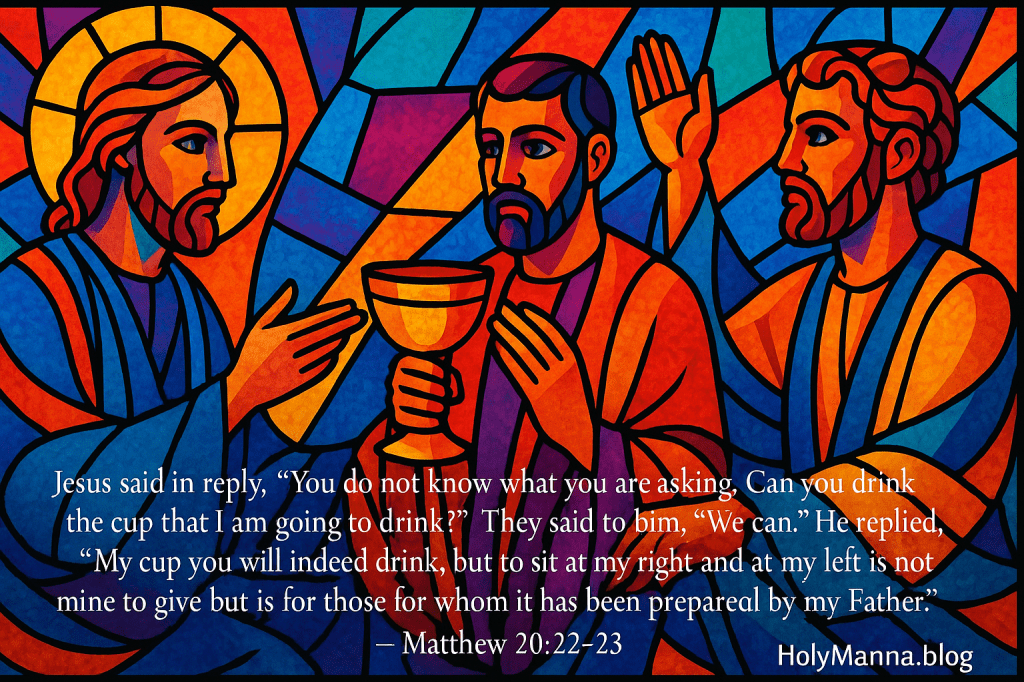
20 Then the mother of the sons of Zebedee approached him with her sons and did him homage, wishing to ask him for something. 21 He said to her, “What do you wish?” She answered him, “Command that these two sons of mine sit, one at your right and the other at your left, in your kingdom.” 22 Jesus said in reply, “You do not know what you are asking. Can you drink the cup that I am going to drink?” They said to him, “We can.” 23 He replied, “My cup you will indeed drink, but to sit at my right and at my left [, this] is not mine to give but is for those for whom it has been prepared by my Father.” 24 When the ten heard this, they became indignant at the two brothers. 25 But Jesus summoned them and said, “You know that the rulers of the Gentiles lord it over them, and the great ones make their authority over them felt. 26 But it shall not be so among you. Rather, whoever wishes to be great among you shall be your servant; 27 whoever wishes to be first among you shall be your slave. 28 Just so, the Son of Man did not come to be served but to serve and to give his life as a ransom for many.”
Detailed Exegesis
Verse 20 – “Then the mother of the sons of Zebedee approached him with her sons and did him homage, wishing to ask him for something.”
Salome, traditionally identified as the mother of James and John, honors Jesus and approaches Him with boldness. Her gesture of homage signals respect, but her request reveals a lingering misunderstanding of Jesus’ mission. Like many Jews at the time, she likely expected a Messianic reign marked by political power.
Verse 21 – “He said to her, ‘What do you wish?’ She answered him, ‘Command that these two sons of mine sit, one at your right and the other at your left, in your kingdom.’”
Her request reflects ambition cloaked in devotion. She believes in Jesus’ kingdom—but envisions it in earthly terms. The “right and left” are not only positions of closeness, but of power. Ironically, the only time Matthew’s Gospel mentions people at Jesus’ right and left in His glory is during the Crucifixion (Matthew 27:38), where criminals hang on crosses.
Verse 22 – “Jesus said in reply, ‘You do not know what you are asking. Can you drink the cup that I am going to drink?’ They said to him, ‘We can.’”
Jesus redirects the conversation from status to suffering. The “cup” is a loaded image—frequently used in the Old Testament to refer to both God’s wrath and one’s appointed fate (see Isaiah 51:17, Psalm 75:9). Jesus would use the same language in Gethsemane: “My Father, if it is possible, let this cup pass from me” (Matthew 26:39). James and John boldly say “we can,” not yet understanding that this cup means martyrdom.
Verse 23 – “He replied, ‘My cup you will indeed drink, but to sit at my right and at my left, this is not mine to give but is for those for whom it has been prepared by my Father.’”
Jesus affirms their future suffering—James will be martyred by the sword (Acts 12:2), and John will suffer exile and persecution—but reminds them that glory is not a prize to be claimed, but a gift assigned by the Father. This verse underlines the sovereignty of God and the cost of true discipleship.
Verse 24 – “When the ten heard this, they became indignant at the two brothers.”
The other disciples’ indignation suggests their own desire for status. Their reaction is not rooted in righteous correction, but in jealousy. Jesus, ever the Good Teacher, uses this tension to reveal the deeper call of the apostolic life—not rivalry, but sacrificial love.
Verse 25 – “But Jesus summoned them and said, ‘You know that the rulers of the Gentiles lord it over them, and the great ones make their authority over them felt.’”
Jesus contrasts worldly power with Kingdom leadership. In the Roman world, dominance defined greatness. Authority was exercised through coercion, not compassion. Jesus condemns this model outright. His kingdom operates by a completely different logic—one of love and kenosis (self-emptying).
Verse 26 – “But it shall not be so among you. Rather, whoever wishes to be great among you shall be your servant;”
Here Jesus offers His counter-cultural teaching: true greatness is rooted in service. The Greek word for “servant” (diakonos) implies one who ministers to others. Leadership in the Church is not about climbing a ladder, but descending to wash feet.
Verse 27 – “Whoever wishes to be first among you shall be your slave.”
Jesus goes even further—using the word “slave” (doulos), which in His culture implied total submission. This is not about demeaning oneself but about radical love that lays down one’s life for others. James would fulfill this call in blood, laying down his life for Christ and His Church.
Verse 28 – “Just so, the Son of Man did not come to be served but to serve and to give his life as a ransom for many.”
This final verse is the theological heart of the passage. Jesus models what He commands. As the “Son of Man” (a Messianic title from Daniel 7), He embodies divine authority—yet uses it not to dominate but to deliver. The word “ransom” (lytron) points to the sacrificial nature of His mission. He frees us not by force, but by offering His life in love.
Teachings of the Church
The Catechism of the Catholic Church affirms this passage’s message in its discussion of Christ’s redemptive mission: “The Son of Man did not come to be served but to serve, and to give his life as a ransom for many” (CCC 608). This verse is quoted directly, anchoring Catholic understanding of Jesus’ death as a salvific offering. Our lives as Christians must echo this pattern of generous, sacrificial love. In following Christ, we participate in His mission not only through faith, but through acts of service and surrender.
Saint John Chrysostom beautifully taught: “If you wish to rank first, seek to be last of all, to be the servant of all. For this is to be above all. To descend is to ascend.” In a world obsessed with achievement, the Church teaches us to imitate Christ’s downward path—becoming servants to win souls. This is the essence of apostolic greatness. James learned this in time, moving from ambition to abandonment, from thrones to thorns.
Throughout history, this Gospel has inspired countless saints and martyrs to embrace humility and service. Saint Teresa of Calcutta often echoed Jesus’ words when she said, “A life not lived for others is not a life.” Her whole mission was founded on this Gospel truth: that to love as Jesus loved is to give until it hurts. Saint James’ martyrdom in Jerusalem became a seed for the Church, a reminder that those who serve with Christ will one day reign with Him.
Reflection
Do you desire greatness in the eyes of God or in the eyes of the world? Jesus invites us to redefine our ambitions. True greatness is not found in being admired, but in being poured out. What does it mean for you to drink the cup of Christ? Perhaps it means embracing a hidden vocation, forgiving someone who has hurt you, or serving when no one notices. This Gospel calls us to move from entitlement to Eucharist—from asking for thrones to sharing in the Cross. Let us look to Saint James, who followed Jesus all the way to martyrdom, and ask ourselves: Am I ready to serve as He served? Am I ready to give my life as a ransom for many?
The Way of the Apostle
Today’s readings and the Feast of Saint James the Apostle draw us into the heart of Christian discipleship—a journey not of worldly triumph but of transformation through suffering, humility, and love. In 2 Corinthians, Saint Paul reminds us that the power of God shines brightest through our fragility. Our sufferings are not setbacks; they are sacred spaces where the dying and rising of Jesus become visible in our lives. Psalm 126 echoes this truth, proclaiming that “those who sow in tears will reap with cries of joy”—a promise that our faithful endurance will be met with divine fulfillment. Then, in The Gospel of Matthew, Jesus invites James, John, and each of us to drink His cup—the cup of sacrificial love—and reveals that greatness in the Kingdom is measured by our willingness to serve and suffer for others.
Saint James answered this call not with perfection, but with love. Once ambitious for honor, he became the first Apostle to lay down his life for Christ. His journey mirrors our own: from misunderstanding to mission, from comfort to courage. His witness challenges us to reject self-promotion and instead embrace the Cross—not as a burden, but as the path to joy and eternal glory. Jesus doesn’t promise ease, but He promises His presence—and that is everything.
Are you willing to drink the cup? Whatever challenges or sacrifices lie before you, trust that they can be offered for God’s glory and others’ good. Let the life of Saint James inspire you to live boldly, serve humbly, and love completely. God is still writing His story through your faithfulness. Step forward, carry the treasure of Christ in your earthen vessel, and sow seeds—even with tears—believing that the harvest will be joy beyond imagining. Will you follow Him to the end?
Engage with Us!
We’d love to hear how today’s Scriptures touched your heart. Share your thoughts in the comments—whether it’s a personal insight, a prayer intention, or how the life of Saint James challenges and inspires you today. Your reflection could be the encouragement someone else needs!
Reflection Questions:
First Reading – 2 Corinthians 4:7–15:
Where in your life do you feel like an “earthen vessel”? How might God be using your weakness to show His strength? Are you willing to carry “the dying of Jesus” in your daily routine, so that His life can be visible in you?
Responsorial Psalm – Psalm 126:
What “seeds” have you been sowing in tears lately? Do you believe that God can bring joy from your sorrow? How has God restored your hope in the past—and how can you cling to that memory today?
Holy Gospel – Matthew 20:20–28:
What “cup” is Jesus asking you to drink right now? Are there areas where you’re seeking recognition instead of humble service? How can you imitate Christ today by serving someone without expecting anything in return?
Keep planting seeds of love, even when no one sees. Keep showing up with faith, even when it’s hard. Keep walking the road of the Cross, knowing it leads to glory. Let every moment—whether joyful or painful—be offered with the mercy, humility, and love that Jesus showed us. You were made to live fully, serve freely, and love fiercely, just like the Apostles. Let’s keep following Him—together.
Follow us on Instagram and Facebook for more insights and reflections on living a faith-filled life.

 Holy Manna!
Leave a comment