Thursday of the Sixteenth Week in Ordinary Time – Lectionary: 398
Seeing God with Purified Eyes
Have you ever stood in awe before a thunderstorm—its skies brooding with cloud and fire, its sound rumbling deep in your chest—feeling at once terrified and transfixed? Today’s readings invite us to that kind of sacred trembling. They speak of a God who reveals Himself not as a distant idea but as a consuming presence. In Exodus 19, Israel stands at the foot of Mount Sinai, trembling as God descends in fire, cloud, and trumpet blasts. But before that divine encounter, the people are told to prepare: to sanctify themselves, to wash their garments, and to wait. Revelation doesn’t come casually—it demands reverence, purification, and humility.
This same truth echoes in The Gospel of Matthew, where Jesus explains to His disciples why He teaches in parables. “Because knowledge of the mysteries of the kingdom of heaven has been granted to you, but to them it has not been granted” (Matthew 13:11). God reveals the secrets of His heart to those ready to receive them, but hides them from the hardened and indifferent. Jesus quotes Isaiah’s haunting words about spiritual blindness and deafness—warning us that seeing and hearing are not merely physical acts, but spiritual capacities formed by faith. Revelation, again, is a gift—but one that can only be received by the openhearted.
In between these awe-filled scenes stands the Canticle from Daniel, a hymn of unceasing praise to the God whose glory fills the temple, the heavens, and even the depths. “Blessed are you who look into the depths from your throne upon the cherubim” (Daniel 3:55). This doxology reminds us that even when God is veiled—behind clouds at Sinai, or parables in Galilee—He is worthy of adoration. The unifying thread through all these readings is clear: God reveals Himself in power and mystery, but only to the purified, the humble, and the faithful. Are we ready to approach the mountain? Have we prepared our hearts to hear the voice that still thunders in love?
First Reading – Exodus 19:1–2, 9–11, 16–20
When God Comes Down in Fire
This passage from Exodus places us at the very edge of one of the most defining moments in salvation history—the divine revelation at Mount Sinai. After being liberated from slavery in Egypt, the Israelites arrive at the foot of a mountain where something more terrifying and glorious than Pharaoh awaits: the living God. Exodus, traditionally attributed to Moses, is a foundational book for Jewish and Christian faith alike. It not only recounts Israel’s deliverance but also their consecration as God’s covenant people. Today’s reading fits beautifully into our theme of divine revelation being granted to the prepared. God is about to speak directly to His people, but only after they sanctify themselves. The encounter is dramatic—marked by fire, thunder, cloud, and trumpet blasts—yet it is not meant to frighten them away, but to draw them into awe-filled obedience. As we read each verse, we’re invited to meditate on what it means to stand at the foot of God’s holy mountain with reverence and readiness.
Exodus 19:1-2, 9-11, 16-20
New American Bible (Revised Edition)
Arrival at Sinai. 1 In the third month after the Israelites’ departure from the land of Egypt, on the first day, they came to the wilderness of Sinai. 2 After they made the journey from Rephidim and entered the wilderness of Sinai, they then pitched camp in the wilderness.
While Israel was encamped there in front of the mountain,
9 The Lord said to Moses: I am coming to you now in a dense cloud, so that when the people hear me speaking with you, they will also remain faithful to you.
When Moses, then, had reported the response of the people to the Lord, 10 the Lord said to Moses: Go to the people and have them sanctify themselves today and tomorrow. Have them wash their garments 11 and be ready for the third day; for on the third day the Lord will come down on Mount Sinai in the sight of all the people.
The Great Theophany. 16 On the morning of the third day there were peals of thunder and lightning, and a heavy cloud over the mountain, and a very loud blast of the shofar, so that all the people in the camp trembled. 17 But Moses led the people out of the camp to meet God, and they stationed themselves at the foot of the mountain. 18 Now Mount Sinai was completely enveloped in smoke, because the Lord had come down upon it in fire. The smoke rose from it as though from a kiln, and the whole mountain trembled violently. 19 The blast of the shofar grew louder and louder, while Moses was speaking and God was answering him with thunder.
20 When the Lord came down upon Mount Sinai, to the top of the mountain, the Lord summoned Moses to the top of the mountain, and Moses went up.
Detailed Exagesis
Verse 1 – “In the third month after the Israelites’ departure from the land of Egypt, on the first day, they came to the wilderness of Sinai.”
This verse establishes the timeline: it has been three months since the Israelites walked through the Red Sea. The “wilderness of Sinai” is not just a geographical marker—it represents a spiritual space of testing, dependence, and encounter. In biblical tradition, the wilderness is often where God purifies and speaks to His people.
Verse 2 – “After they made the journey from Rephidim and entered the wilderness of Sinai, they then pitched camp in the wilderness. While Israel was encamped there in front of the mountain…”
This positioning—in front of the mountain—is not accidental. The people are facing the place where God will descend. The mountain becomes a stage for divine-human interaction, and Israel’s encampment before it signifies an intentional pause to receive something sacred.
Verse 9 – “The Lord said to Moses: I am coming to you now in a dense cloud, so that when the people hear me speaking with you, they will also remain faithful to you.”
God chooses to come in a “dense cloud”—a common biblical image for His hidden yet overwhelming presence (see 1 Kings 8:10–12). The goal is both relational and reverential: the people will hear God’s voice and know that Moses truly speaks for Him. This sets the precedent for prophetic authority.
Verse 10 – “The Lord said to Moses: Go to the people and have them sanctify themselves today and tomorrow. Have them wash their garments.”
Before God reveals Himself, He commands a period of preparation. “Sanctify” here refers to ritual purification and inward readiness. Washing garments is an external sign of internal cleansing, reminding us of the need for purity to approach the holy (see Hebrews 12:14).
Verse 11 – “Be ready for the third day; for on the third day the Lord will come down on Mount Sinai in the sight of all the people.”
The mention of the “third day” points ahead to resurrection themes in the New Testament. But here, it marks a moment of divine self-disclosure. God does not wish to remain hidden forever—He comes in the sight of all to establish covenant and communion.
Verse 16 – “On the morning of the third day there were peals of thunder and lightning, and a heavy cloud over the mountain, and a very loud blast of the shofar, so that all the people in the camp trembled.”
This is a theophany—a visible manifestation of God. The “shofar” was a ram’s horn used to signal sacred events. The trembling of the people reflects appropriate fear before divine majesty. This is not terror but awe—what the Bible calls the fear of the Lord.
Verse 17 – “But Moses led the people out of the camp to meet God, and they stationed themselves at the foot of the mountain.”
Moses, as mediator, brings the people toward God—but only so far. They remain at the foot, emphasizing the distance that sin and unholiness place between humanity and divinity. Yet even this proximity is profound—they are invited to “meet God.”
Verse 18 – “Now Mount Sinai was completely enveloped in smoke, because the Lord had come down upon it in fire. The smoke rose from it as though from a kiln, and the whole mountain trembled violently.”
God’s descent is marked by fire and trembling—symbols of purification and divine energy. Fire consumes impurity; the trembling mountain reflects creation’s response to its Creator. This is sacred drama, echoing Psalm 114:7: “Tremble, O earth, before the Lord”.
Verse 19 – “The blast of the shofar grew louder and louder, while Moses was speaking and God was answering him with thunder.”
This verse shows a deep intimacy between God and Moses. While all Israel hears the thunder, Moses receives intelligible response. The growing sound underscores the growing holiness of the moment. Heaven and earth are in dialogue.
Verse 20 – “When the Lord came down upon Mount Sinai, to the top of the mountain, the Lord summoned Moses to the top of the mountain, and Moses went up.”
God calls Moses higher, into deeper intimacy. This ascent is symbolic of the soul’s journey toward God—through faith, obedience, and purification. Moses becomes a prototype of Christ the Mediator, who will one day ascend not a mountain but the Cross and the heavens (Hebrews 8:6).
Teachings from the Church
This passage is rich in theological significance, echoed in the Catechism of the Catholic Church, which teaches: “The divine pedagogy appears especially in the gift of the Law. God gave the Law as a pedagogue to lead his people to Christ” (CCC 1964). Sinai is not the end—it is preparation. As Saint Gregory of Nyssa explains, the ascent of the mountain signifies the soul’s constant progress toward the infinite God: “The one who climbs never stops going from beginning to beginning, through beginnings that have no end.” The fire and smoke are not meant to frighten us away but to purify and draw us deeper into relationship. The Israelites’ trembling before God finds fulfillment in our own awe before the Blessed Sacrament, where God still “comes down” hidden in mystery.
This sacred moment at Sinai also prefigures Pentecost. In both events, God descends upon His people amid wind and fire. But at Sinai, the Law is written on stone; at Pentecost, the Law is written on hearts. As CCC 731 teaches, “On the day of Pentecost … Christ’s Passover is fulfilled in the outpouring of the Holy Spirit.” Just as the Israelites prepared for the third day, the Apostles waited in the upper room. God still comes—but now through grace and Spirit rather than cloud and thunder.
Historically, the Church Fathers saw Sinai as the prototype of sacred liturgy. The people prepare, the mountain becomes holy ground, God descends, and a mediator brings the people into covenant. Saint John Chrysostom likened it to the Mass, where we too are called to approach with washed garments—our souls cleansed in confession—and stand ready to hear the voice of God through the Liturgy of the Word and encounter Him in the Eucharist. Revelation continues—but only for those who prepare.
Reflection
What does it mean for us to “wash our garments” today? How can we better prepare our souls to encounter God not just at Mass, but in the quiet moments of our daily lives? This reading reminds us that God still speaks—but often from behind the cloud, through mystery, and only to those who have sanctified their hearts. Have we taken the time to quiet our distractions, confess our sins, and open ourselves to hear His voice? Let us make space for reverence. Let us stand again at the foot of the mountain with the wonder of children, ready to meet the God who still descends in glory.
Responsorial Psalm – Daniel 3:52–56
A Song from the Furnace of Glory
Today’s responsorial psalm is not from the Book of Psalms but from the Book of Daniel, specifically from the prayer of the three young men—Shadrach, Meshach, and Abednego—who were cast into the fiery furnace by King Nebuchadnezzar for refusing to worship a golden idol. This canticle is a beautiful example of praise rising from trial. Rather than begging for rescue, these young men glorify God from within the flames, demonstrating that divine revelation is not limited to mountaintops like Sinai, but can also be received in the furnace of suffering. This passage reflects the theme of God revealing Himself to those who are faithful and purified—those who see with eyes of trust even in affliction. As the smoke surrounded Mount Sinai in Exodus, so too does it surround the furnace in Daniel, but instead of fear, these verses ring with song. This moment of heavenly praise arising from earthly danger bridges beautifully to our Gospel theme: only hearts attuned to God—hearts not hardened by fear or pride—can sing like this and see what others do not.
Daniel 3:52-56
New American Bible (Revised Edition)
52 “Blessed are you, O Lord, the God of our ancestors,
praiseworthy and exalted above all forever;
And blessed is your holy and glorious name,
praiseworthy and exalted above all for all ages.
53 Blessed are you in the temple of your holy glory,
praiseworthy and glorious above all forever.
54 Blessed are you on the throne of your kingdom,
praiseworthy and exalted above all forever.
55 Blessed are you who look into the depths
from your throne upon the cherubim,
praiseworthy and exalted above all forever.
56 Blessed are you in the firmament of heaven,
praiseworthy and glorious forever.
Detailed Exagesis
Verse 52 – “Blessed are you, O Lord, the God of our ancestors, praiseworthy and exalted above all forever; And blessed is your holy and glorious name, praiseworthy and exalted above all for all ages.”
The young men begin their hymn with a blessing that acknowledges God’s faithfulness throughout history. “The God of our ancestors” ties their present suffering to the memory of God’s saving deeds for Israel—especially in the Exodus. This echoes Exodus 3:15, where God identifies Himself as “the God of Abraham, the God of Isaac, and the God of Jacob”. To praise God’s name is to acknowledge His essence, His holiness, and His unchanging glory, even in the midst of trial.
Verse 53 – “Blessed are you in the temple of your holy glory, praiseworthy and glorious above all forever.”
Though they are exiled in Babylon and far from the physical Temple in Jerusalem, the young men proclaim God’s presence as dwelling in holy glory. This verse reveals a deeper truth: God is not limited to physical spaces. His presence sanctifies even a furnace when hearts turn to Him in praise. This anticipates the words of Jesus in John 4:23, that true worship is in spirit and truth.
Verse 54 – “Blessed are you on the throne of your kingdom, praiseworthy and exalted above all forever.”
God is not a tribal deity nor a distant observer—He reigns from His throne over all creation. In a foreign land under a pagan king, these young men proclaim that true kingship belongs to the Lord. Their praise boldly subverts the authority of Nebuchadnezzar by lifting up the eternal Kingship of God.
Verse 55 – “Blessed are you who look into the depths from your throne upon the cherubim, praiseworthy and exalted above all forever.”
Here, the majesty and intimacy of God are united. He is enthroned upon the cherubim—imagery from the Ark of the Covenant (see Exodus 25:22)—yet He “looks into the depths.” God sees not only the heights of heaven but the depths of human suffering. His gaze reaches the furnace, the heart, the hidden places.
Verse 56 – “Blessed are you in the firmament of heaven, praiseworthy and glorious forever.”
The song ends with a cosmic vision of God’s glory stretching through the heavens. The firmament is the dome of the sky—a poetic symbol of the heavens above. Even while the young men are on earth surrounded by flames, their eyes are lifted to the heavens. Their praise pierces the firmament and joins the unending liturgy of heaven.
Teachings from the Church
This canticle is a profound example of what the Catechism of the Catholic Church calls the “sacrifice of praise.” CCC 2639 teaches: “Praise is the form of prayer which recognizes most immediately that God is God. It lauds God for His own sake and gives Him glory quite beyond what He does, but simply because HE IS.” The three youths in the furnace do not praise God because they were rescued—this song begins before the miracle. Their praise is pure, focused solely on who God is, not what He can do for them. This is the kind of praise that opens the heart to divine intimacy.
Saint Augustine writes in his Confessions, “A Christian should be an Alleluia from head to foot.” The canticle in Daniel 3 models that total praise—even when life burns. This unshakable joy in God’s glory is also echoed by Saint John of the Cross, who said: “In the dark night of the soul, bright flows the river of God.” This brightness is visible only to hearts purified by faith. Like the disciples in today’s Gospel who “see and hear” what others miss, the three young men are able to glorify God not despite their suffering, but through it.
Liturgically, this canticle is prayed during the Liturgy of the Hours, especially during feasts and solemnities. It reminds the Church that true worship is not confined to time or place but can rise from prisons, deserts, and even furnaces. God is enthroned in heaven, yes—but He also walks among the flames with His faithful ones. In the early Church, martyrs sang this hymn as they faced death, and monks in deserts sang it to unite heaven and earth in song. It is the cry of the prepared soul—the one who sees God’s glory through the smoke.
Reflection
This psalm challenges us to examine our posture of praise. Do we only bless God when things are going well, or can we offer a sacrifice of praise from our own fiery trials? The young men in the furnace teach us that God does not wait for us outside of the flames—He is with us in them. Can you find reasons to praise God even in the middle of suffering, uncertainty, or dryness in prayer? When you feel far from God, do you lift your eyes to the firmament or fix them on the fire? Let this song become your own: a litany of trust, a declaration that God’s glory remains unshaken even when everything around you burns. And let us never forget—every true revelation begins with praise.
Holy Gospel – Matthew 13:10–17
Eyes to See, Ears to Hear
In today’s Gospel, Jesus opens a window into the mystery of how God reveals Himself—and why some receive that revelation while others do not. The Gospel of Matthew was written primarily for a Jewish-Christian audience and presents Jesus as the fulfillment of the Law and the prophets. Chapter 13 is a pivotal moment in the narrative, marking a shift in Jesus’ teaching style as He begins to speak in parables more deliberately. The disciples, puzzled by this, ask why He hides His meaning from the crowds. Jesus’ answer draws us into a sobering reality: not everyone who hears the Word will understand it. Spiritual receptivity, not simply physical hearing, determines whether the seed of truth will take root. This Gospel passage dovetails beautifully with the themes from Exodus and Daniel—God reveals Himself in mystery, but only those with purified hearts and open eyes can perceive Him. The truth is not absent—it is veiled, waiting to be unveiled by faith.
Matthew 13:10-17
New American Bible (Revised Edition)
The Purpose of Parables. 10 The disciples approached him and said, “Why do you speak to them in parables?” 11 He said to them in reply, “Because knowledge of the mysteries of the kingdom of heaven has been granted to you, but to them it has not been granted. 12 To anyone who has, more will be given and he will grow rich; from anyone who has not, even what he has will be taken away. 13 This is why I speak to them in parables, because ‘they look but do not see and hear but do not listen or understand.’ 14 Isaiah’s prophecy is fulfilled in them, which says:
‘You shall indeed hear but not understand,
you shall indeed look but never see.
15 Gross is the heart of this people,
they will hardly hear with their ears,
they have closed their eyes,
lest they see with their eyes
and hear with their ears
and understand with their heart and be converted,
and I heal them.’
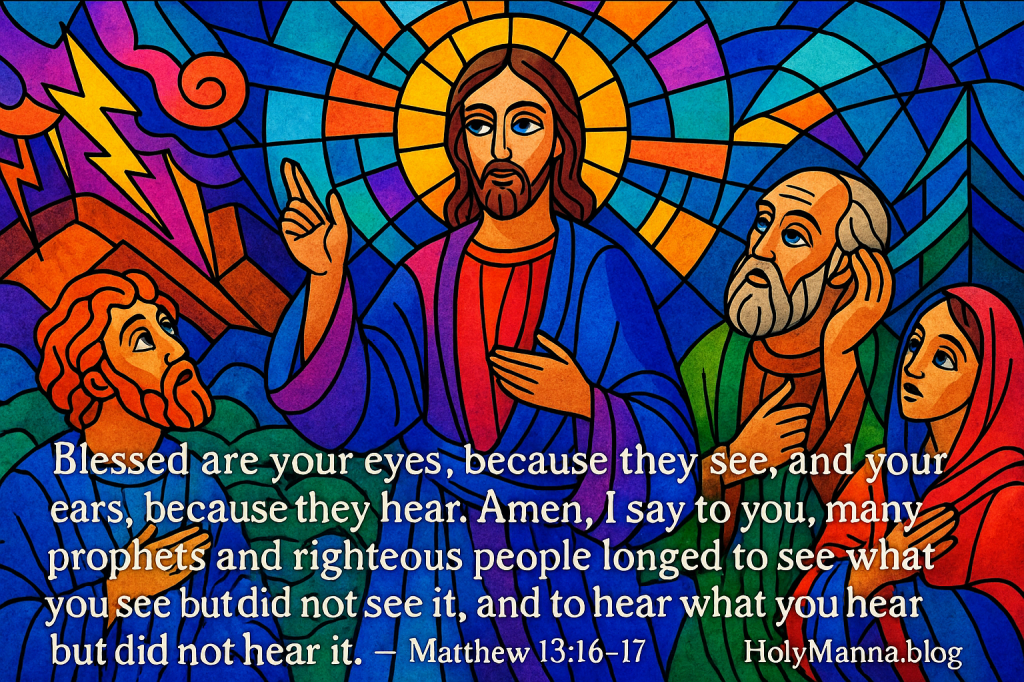
The Privilege of Discipleship. 16 “But blessed are your eyes, because they see, and your ears, because they hear. 17 Amen, I say to you, many prophets and righteous people longed to see what you see but did not see it, and to hear what you hear but did not hear it.
Detailed Exegesis
Verse 10 – “The disciples approached him and said, ‘Why do you speak to them in parables?’”
The disciples’ question reflects a deep curiosity. Jesus had just shared the Parable of the Sower, and instead of clarifying His message for the crowds, He speaks in riddles. In Jewish culture, teaching through parables was common, but the disciples sense that something deeper is happening here—a revelation that not all are meant to grasp at once.
Verse 11 – “He said to them in reply, ‘Because knowledge of the mysteries of the kingdom of heaven has been granted to you, but to them it has not been granted.’”
Jesus reveals a startling truth: understanding is a grace. The “mysteries of the kingdom” (Greek mystēria) are not puzzles to be solved but sacred truths meant to be received with humility. Those in close relationship with Jesus—those who follow, listen, and seek—are given access to what others cannot perceive.
Verse 12 – “To anyone who has, more will be given and he will grow rich; from anyone who has not, even what he has will be taken away.”
This verse may sound harsh, but it expresses a spiritual law: those who respond to grace receive more, while those who reject it lose even the little they had. It echoes the warning in Revelation 3:16: “Because you are lukewarm… I will spit you out of my mouth.” Indifference to grace is not neutral—it’s spiritually corrosive.
Verse 13 – “This is why I speak to them in parables, because ‘they look but do not see and hear but do not listen or understand.’”
Jesus draws directly from the prophecy of Isaiah, highlighting the tragic condition of hardened hearts. The parables are not meant to confuse the humble—they are meant to conceal the truth from the arrogant, whose pride blinds them to God’s voice. This echoes the cloud at Sinai and the fire in the furnace—only the prepared recognize the presence of God.
Verse 14 – “Isaiah’s prophecy is fulfilled in them, which says: ‘You shall indeed hear but not understand, you shall indeed look but never see.’”
This is a warning more than a condemnation. Jesus identifies spiritual blindness as a fulfillment of prophetic vision—not because God withholds light, but because people shut their eyes to it. It reminds us of Pharaoh, who hardened his heart even as wonders unfolded before him.
Verse 15 – “Gross is the heart of this people, they will hardly hear with their ears, they have closed their eyes, lest they see with their eyes and hear with their ears and understand with their heart and be converted, and I heal them.”
Here Jesus expresses divine sorrow. The people’s spiritual dullness is self-inflicted. “Gross” in this context means calloused or fat—unable to feel. Their eyes are not blind by nature but deliberately shut. God desires to heal and convert, but He will not force open a closed heart.
Verse 16 – “But blessed are your eyes, because they see, and your ears, because they hear.”
In contrast to the crowds, the disciples are called “blessed” (Greek makarioi), the same word used in the Beatitudes. Their spiritual openness allows them to receive what others cannot. Seeing and hearing here are signs of faith-filled perception. They witness the unfolding mystery of God.
Verse 17 – “Amen, I say to you, many prophets and righteous people longed to see what you see but did not see it, and to hear what you hear but did not hear it.”
This verse connects the disciples to the entire story of salvation. The prophets and saints of old yearned for this moment of revelation. What had been longed for is now present—but only those who are spiritually prepared can recognize it. Jesus is the fulfillment of every longing heart.
Teachings from the Church
The Catechism of the Catholic Church affirms the gift of divine revelation through parables and sacred mysteries: “Through all the words of Sacred Scripture, God speaks only one single Word, his one Utterance in whom he expresses himself completely” (CCC 102). Jesus is that Word, and His parables are vessels carrying eternal truths. Those truths are not for the casual listener, but for the one who approaches the Word with reverence and perseverance. The parables both reveal and conceal—depending on the disposition of the listener.
Saint Thomas Aquinas explains this twofold purpose in his Commentary on Matthew: “Christ spoke in parables so that those who were not disposed might not understand, and thus incur greater judgment.” In other words, Jesus respects human freedom—even to the point of allowing misunderstanding. Parables are an invitation, not a coercion. The deeper one leans in, the more the meaning unfolds. This reflects God’s pedagogy throughout salvation history: He gives according to our readiness to receive.
Saint John Paul II often emphasized the need for interior readiness in understanding God’s Word. In Catechesi Tradendae, he wrote: “Faith is nourished when it is understood, and it is understood when it is lived.” This Gospel reminds us that comprehension of divine truth is not merely intellectual but relational. The disciples understood Jesus not because they were clever, but because they followed Him, loved Him, and listened closely. Their seeing and hearing were fruits of communion.
Reflection
This Gospel challenges us to examine the condition of our own hearts. Do I come to God’s Word with a posture of humility or pride? Am I listening to be transformed, or just to be informed? Jesus’ words urge us not to take divine revelation for granted. We live in a time when access to Scripture, the Catechism, and the teachings of the Church is unprecedented—yet our hearts can still be “gross” and our ears closed. Have we become desensitized to the voice of the Lord? Let us ask for the grace to have eyes that truly see and ears that joyfully hear. Let us lean into the parables, into the mysteries of the kingdom, with reverent curiosity. For blessed are we—if only we are willing to receive.
Hearts That Tremble, Eyes That See
Today’s readings draw us into the sacred rhythm of revelation: God desires to make Himself known—but only to hearts that are ready. From the trembling Israelites at the base of Sinai to the three faithful youths praising God in the furnace, to the disciples whose eyes and ears are blessed to receive the mysteries of the Kingdom, we see a pattern emerge: God does not reveal Himself through force or spectacle alone, but through fire, cloud, and mystery—received only by the humble, the pure, and the listening.
In Exodus 19, we are reminded that God’s presence is not something we can casually encounter. “Be ready for the third day” meant preparing body and soul to receive the God who comes in thunder and fire. In Daniel 3, praise becomes the language of intimacy with God even in affliction: “Blessed are you who look into the depths” is the song of a soul that knows it is seen. And in Matthew 13, Jesus reveals that the mysteries of the Kingdom are not puzzles to be solved but truths entrusted to those who have eyes to see, ears to hear, and hearts ready to be converted.
Are you ready to stand at the foot of the mountain? Will you lift your voice in praise from the middle of your furnace? Will you ask Jesus to open your eyes to what prophets and saints longed to see? God is not silent—He is speaking in the cloud, in the fire, and in your heart. Today, prepare yourself anew. Wash the garments of your soul in the confessional. Open the Scriptures. Adore the hidden God in the Eucharist. He still descends for the prepared. Let your heart tremble—and then listen.
Engage with Us!
We’d love to hear how today’s readings touched your heart. Share your thoughts, inspirations, or questions in the comments below—your voice might be the encouragement someone else needs today. Let’s grow together as a community seeking God’s glory with open eyes and faithful hearts.
Reflection Questions:
First Reading – Exodus 19:1–2, 9–11, 16–20
What areas of your life need to be “washed” or sanctified before you can truly encounter God? Have you ever experienced awe or holy fear in prayer or nature that reminded you of God’s majesty?
Responsorial Psalm – Daniel 3:52–56
How can you praise God even in the midst of trials or uncertainty? Which verse of this canticle spoke most deeply to your current spiritual journey?
Holy Gospel – Matthew 13:10–17
Are you listening with a heart that is open, or have you become spiritually “dull” in some areas? What can you do this week to become more attentive to the mysteries God is trying to reveal to you?
Go forth today with faith that is ready, praise that is constant, and eyes that are open to the divine in the ordinary. Let everything you do be rooted in the love and mercy that Jesus so patiently teaches. Revelation is near—may we never grow tired of seeking the face of God.
Follow us on Instagram and Facebook for more insights and reflections on living a faith-filled life.

 Holy Manna!
Leave a comment