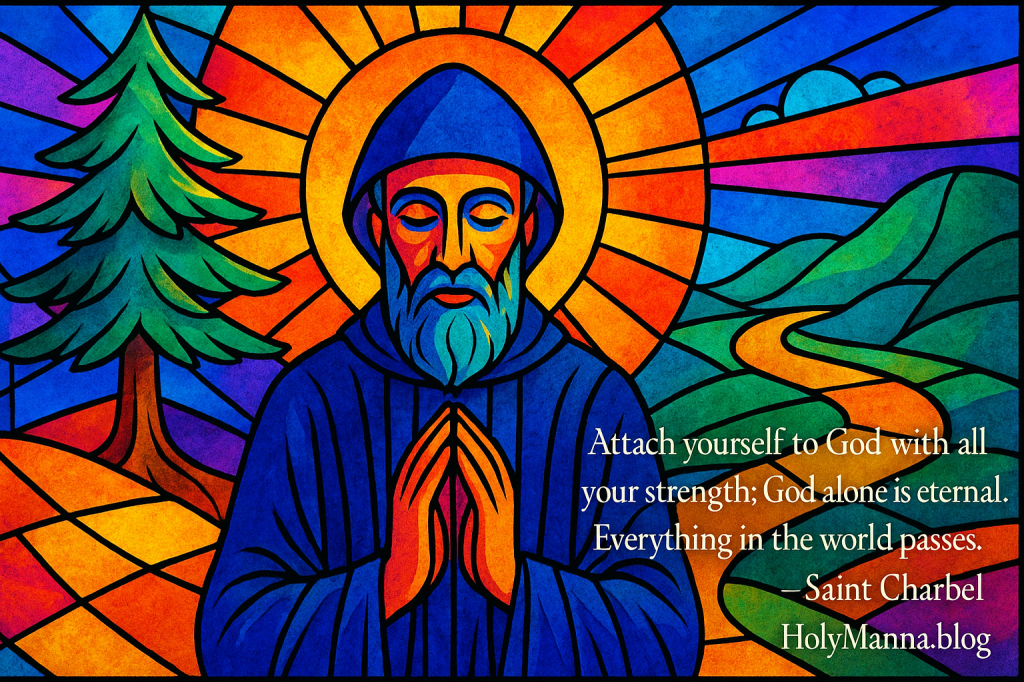
The Hidden Flame
In an age that elevates the loud, the seen, and the celebrated, the Church offers us a quiet giant whose holiness burned most brightly in hiddenness. Saint Charbel Makhlouf, a 19th-century Lebanese Maronite monk and priest, lived a life almost entirely veiled from the world. Yet after his death, heaven lifted that veil and let his sanctity shine forth. Known today as the “Miracle Monk of Lebanon,” his name has become synonymous with healing, conversion, and divine power. Countless miracles—both during his life and after—testify to the immense spiritual power of a soul completely surrendered to God. His profound silence, unwavering asceticism, and love for the Eucharist make him a radiant light not only for the Maronite Church but for the universal Church. He reminds us that God works powerfully through those who embrace humility and choose the narrow road.
A Child of the Cedars
Born on May 8, 1828, in the mountainous village of Bekaa Kafra, Lebanon, Youssef Antoun Makhlouf was the fifth child in a devout Maronite Catholic family. His childhood was marked by simplicity, prayer, and hardship. When he was only three years old, his father was taken from the family, conscripted into the Ottoman army and dying soon thereafter. His mother, widowed and with five children, remained steadfast in faith, raising her children to rely on God. The Maronite tradition—rooted in monasticism and Eastern spirituality—formed the air young Youssef breathed. From an early age, he showed a rare seriousness in prayer and a profound draw to solitude. He often retreated to a grotto near his home where he would kneel for hours before an icon of the Blessed Virgin Mary.
The call to a deeper, more radical discipleship was unmistakable. At the age of 23, Youssef left his family and village without even saying goodbye. He entered the Lebanese Maronite Order at the Monastery of Our Lady of Mayfouq, later taking the religious name “Charbel” in honor of a second-century martyr. He then transferred to the Monastery of Saint Maron in Annaya where he was ordained to the priesthood in 1859. For sixteen years, he lived a life of obedience, manual labor, communal prayer, and study. But his heart longed for something deeper—a solitude that allowed for uninterrupted communion with God. In 1875, he was granted permission to live as a hermit at the Monastery’s nearby hermitage of Saints Peter and Paul. There, for the final 23 years of his life, he embraced a radical life of penance, fasting, silence, and ceaseless prayer. His food was sparse, his sleep was brief, and his only joy seemed to be in offering everything to Jesus through Mary.
Charbel is most known for his total devotion to the Eucharist. Witnesses say he would spend entire nights in adoration, kneeling in tears. His celebration of the Divine Liturgy was marked with such intensity and reverence that it seemed as though he were conversing face-to-face with Christ Himself. He lived out Saint Paul’s words in Galatians 2:20: “It is no longer I who live, but Christ who lives in me.”
Miracles That Stirred the Silence
Though his life was hidden, the supernatural seemed to glow from within him. The miracles associated with Saint Charbel during his earthly life were subtle yet profound. His prayers were often sought by those who were sick or in distress, and he was believed to have the gift of healing even while alive. On more than one occasion, people reported being cured after receiving his blessing or being remembered in his prayers. But Charbel never sought recognition. He was, by all accounts, a man of few words—choosing instead to let his prayers and sacrifices speak.
One of the most extraordinary moments of his life occurred during the Divine Liturgy on December 16, 1898. As he consecrated the Eucharist, he was struck with a paralysis on one side of his body. He collapsed at the altar, clutching the chalice, and could no longer continue. For eight days he lay in silent suffering, offering every moment to God. He died on Christmas Eve, December 24, 1898. Yet in that quiet death, a blaze was lit that would set hearts aflame around the world.
From the Grave, a River of Grace
Not long after Charbel was buried, something astonishing began to occur. A bright, supernatural light was seen streaming from his tomb each night for 45 consecutive nights. This phenomenon attracted villagers, pilgrims, and eventually Church authorities. When his body was exhumed, it was found to be completely incorrupt—intact, flexible, and seeping a mysterious, blood-like fluid. Despite being buried in ordinary soil with no embalming, his remains continued to display these signs for decades, baffling medical professionals who examined them. This extraordinary grace was seen not just as a testament to his purity, but as a sign of God’s glory working through His humble servant.
It was after his death that the floodgates of miracles truly burst open. Pilgrims from across Lebanon and eventually from across the world flocked to the Monastery of Saint Maron in Annaya. Christians and non-Christians alike—Muslims, Druze, and agnostics—reported miraculous healings and conversions through the intercession of Saint Charbel. The stories are staggering in both number and detail. In one of the most widely known cases, Nohad El Shami, a Lebanese woman, suffered from a paralyzing stroke in 1993. Charbel appeared to her in a dream, performed what she described as a “surgery,” and she awoke completely healed—bearing two physical scars on her neck to this day. Medical professionals had no explanation.
Thousands of similar cases have been documented, including the healing of cancer patients, the restoration of eyesight, the curing of heart disease, and the resolution of infertility. These miracles are rigorously documented and recorded at the Monastery, which receives tens of thousands of letters each year from the faithful seeking his intercession. The site of his tomb has become one of the most visited pilgrimage destinations in the Middle East, and his name continues to bring hope and healing to the suffering.
The Holy Weight of Silence
Saint Charbel’s life was a long and deliberate offering of himself to God. Though he was not martyred by execution, he underwent what the Church calls “white martyrdom”—a daily dying to self, a quiet but total surrender. Every luxury was forsaken, every comfort refused. He slept on the floor, wore the same simple habit year-round, fasted rigorously, and limited his speech to what was strictly necessary. He was known to engage in fierce spiritual combat, especially during the night, when demonic voices and apparitions would torment him in his hermitage. But he never fled or despaired. Instead, he turned to Christ with unwavering trust.
His hardships were not seen as burdens but as graces. He believed that suffering united him more deeply to the Cross of Christ. As The Catechism of the Catholic Church reminds us in CCC 2015, “The way of perfection passes by way of the Cross. There is no holiness without renunciation and spiritual battle.” Charbel lived this reality with purity and peace. His death was as quiet and holy as his life, surrounded not by crowds but by silence and prayer.
The Saint for a Noisy World
The modern world is full of stimulation—digital noise, screens, endless tasks, and constant distraction. In the midst of this whirlwind, Saint Charbel stands like a still cedar in the forest, reminding us that holiness is often born in silence. His life is a bold call to slow down, to simplify, and to seek God in the quiet of our hearts. He shows us that it is not necessary to travel far, preach widely, or perform great deeds in the eyes of the world to become a saint. It is enough to give everything to God, in secret, with love.
His spiritual legacy continues to inspire conversions and renew vocations to monastic life and the priesthood. His miracles point to a God who still acts powerfully in our world—through the prayers of the humble. His incorrupt body is a reminder of the resurrection promised in Romans 6:5: “If we have been united with Him in a death like His, we shall certainly be united with Him in a resurrection like His.”
Saint Charbel is a saint for every soul longing for deeper intimacy with God. He is a model for those who feel hidden or forgotten, for those suffering illness, for those struggling with noise and anxiety. His life whispers the truth: that the heart of God is found in silence, in surrender, and in sacrificial love.
How Can We Live Like Charbel Today?
The example of Saint Charbel is not reserved for monks in hermitages. His holiness is a call to each of us—whether we are students, workers, parents, or priests. We too can create space for God, even in the midst of our daily lives. By beginning each morning with silent prayer, by turning off our phones to sit with Scripture, by embracing moments of solitude instead of escaping them, we make room for grace. Fasting from noise, comfort, and ego—even for a short time—opens our hearts to the whisper of the Holy Spirit. And when we face sickness, loss, or spiritual dryness, we can turn to Charbel, asking him to teach us how to suffer with hope.
Do you hunger for deeper intimacy with God, but feel too distracted to listen?
What would it look like for you to give God more space and silence today?
Where is He calling you to a hidden, quiet act of holiness?
Engage with Us!
Let’s journey together in faith. Share in the comments:
- What aspect of Saint Charbel’s life most inspires you?
- How can you incorporate more silence and prayer into your daily routine?
- Have you or someone you know experienced a healing or answered prayer through Saint Charbel’s intercession?
Together, let’s support one another in faith. May we strive to live with love, humility, and courage—just as our Lord Jesus Christ did. And may Saint Charbel intercede for us on our pilgrimage to Heaven.
Saint Charbel, pray for us! 🌲
Follow us on Instagram and Facebook for more insights and reflections on living a faith-filled life.

 Holy Manna!
Leave a comment