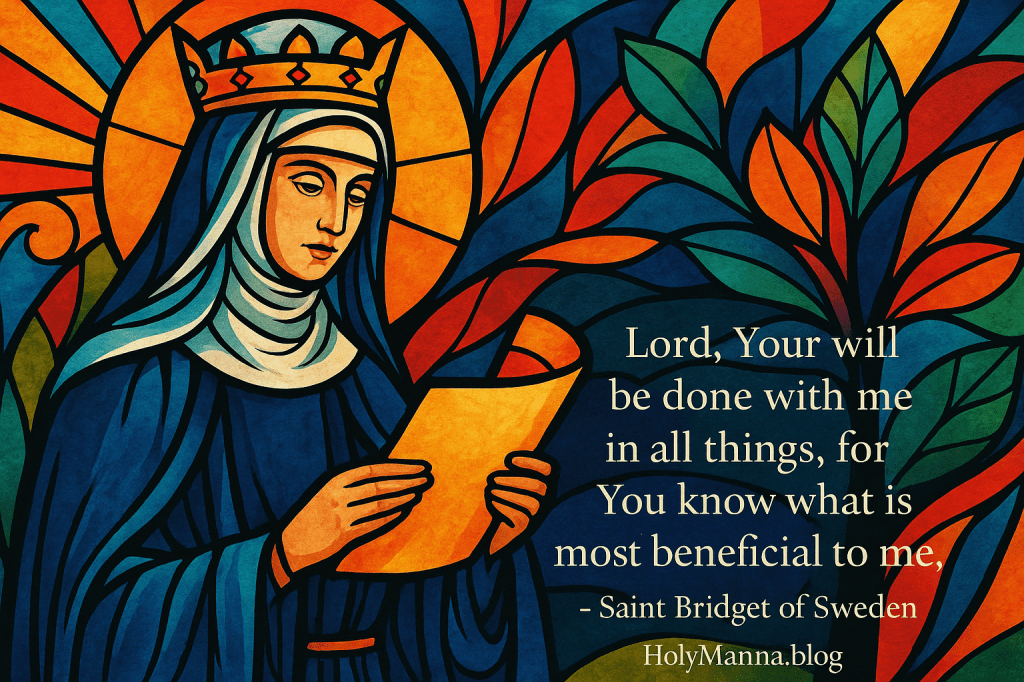
A Mystic for All Seasons
Saint Bridget of Sweden (1303–1373) is one of the Church’s most extraordinary figures—a woman of noble birth who became a wife, mother, mystic, reformer, and founder. Her spiritual influence reached across Europe, from the royal courts of Sweden to the seat of the papacy in Rome. She is widely known for her Revelations, a collection of mystical messages she received from Christ and the Blessed Virgin, which offered both comfort and prophetic rebuke to a Church in crisis. A passionate advocate for spiritual renewal and moral integrity, Saint Bridget lived a life fully surrendered to the will of God. She was canonized in 1391 and later named one of the co-patron saints of Europe by Pope Saint John Paul II, who called her a “woman of the Church.” Her life stands as a timeless reminder that holiness is not confined to monasteries but can—and must—flourish in every state of life.
From Nobility to Holiness
Bridget was born into wealth and privilege in Uppsala, Sweden, the daughter of Birger Persson, a knight and governor, and Ingeborg Bengtsdotter, a woman of deep Christian devotion. From her earliest years, Bridget’s life was marked by grace. At age seven, she received a vision of the crucified Christ so vivid and sorrowful that it would become the central meditation of her life. Rather than turn inward with this gift, she was taught by her devout aunt to love Scripture and to serve the poor. At thirteen, Bridget entered into marriage with Ulf Gudmarsson, a nobleman with whom she would have eight children. Their marriage was characterized by mutual respect, spiritual devotion, and a shared commitment to works of mercy. Among their children was Saint Catherine of Sweden, who would carry on her mother’s legacy.
Bridget’s life took a decisive turn after her husband’s death. Having already made a pilgrimage together to Santiago de Compostela, Bridget now devoted herself completely to prayer, penance, and service to the Church. It was during this period that her mystical experiences intensified. She began receiving frequent and detailed visions from Christ and the Blessed Mother—visions that were not only personal but deeply ecclesial, calling for the moral reform of individuals and institutions. Her obedience to these heavenly messages, despite political and ecclesiastical resistance, shaped her into one of the most powerful prophetic voices of her time. Her courage and clarity were fueled not by personal ambition but by a burning love for Christ crucified and for His wounded Church.
A Vessel of Revelation
Saint Bridget’s life was not merely contemplative—her visions compelled her to act. One of her most urgent heavenly assignments was to found a new religious order, the Order of the Most Holy Savior, better known as the Bridgettines. This unique community of both monks and nuns lived in separate quarters but were united in prayer and mission, under the governance of an abbess. The order emphasized devotion to the Passion of Christ, liturgical prayer, and service to the poor. Bridget believed that through this rhythm of contemplation and action, the Church could be renewed from within.
Her mystical experiences were often startling in their accuracy and theological depth. She received vivid revelations about the sufferings of Christ, many of which formed the basis for devotional practices still embraced today, such as the Fifteen Prayers of Saint Bridget and meditations on the wounds of Christ. Though she is not typically associated with dramatic physical miracles like healing or bilocation, her spiritual insight and prophetic courage were widely seen as supernatural gifts. One well-documented occurrence involved her foretelling the death of a Swedish prince, which came to pass exactly as she described. These revelations, rather than being flights of spiritual fancy, consistently urged the faithful to deeper conversion, repentance, and reverence for the Eucharist and the Blessed Virgin Mary.
Her letters to kings, queens, and even the pope were bold and urgent. She called rulers to reform their corrupt courts and live as Christian leaders. She chastised bishops for neglecting their flocks and implored Pope Clement VI to leave Avignon and return the papacy to Rome, as God willed. That she did all this as a woman in the 14th century is nothing short of miraculous. Her voice, forged in prayer and suffering, resonated with divine authority. Bridget became, in every sense, a mouthpiece of heaven.
Faith Under Fire
Though she never shed blood as a martyr, Saint Bridget lived a life steeped in suffering. Her trials came in the form of grief, rejection, and poverty. She buried her beloved husband and several of her children. She was often misunderstood, even despised, for the boldness of her prophetic words. Many clergy dismissed her visions as hysteria, and some considered her a threat to their worldly influence. Still, she never ceased to proclaim the truth God placed on her heart.
When the Lord instructed her to leave Sweden and go to Rome to advocate for Church reform, she obeyed without hesitation. The transition was painful—Bridget left behind her home and family for a life of poverty in a foreign land. She lived simply in a small house in Rome, serving the poor and praying fervently for the renewal of the Church. Her tireless efforts included a pilgrimage to the Holy Land, undertaken despite her age and declining health. She longed to walk where Christ had walked, to suffer where He had suffered. Her body was frail, but her soul was on fire.
She returned from that pilgrimage exhausted and ill, and died in Rome on July 23, 1373. Her body was transported back to Vadstena, Sweden, where it was interred in the abbey of her order. She died not in comfort, but in total surrender to the will of God—having spent herself completely for the sake of Christ and His Church.
Heaven Responds
The holiness of Saint Bridget did not cease with her passing—it only intensified. Pilgrims began flocking to her tomb in Vadstena, many reporting miraculous healings and favors obtained through her intercession. Crippled bodies were restored, fevers vanished, and broken hearts found peace. The miracles attributed to her after death were investigated by the Church and found to be genuine, leading to her canonization by Pope Boniface IX in 1391.
Her writings, particularly her Revelations, were translated into Latin and disseminated across Europe. Though initially met with some skepticism, these texts were eventually affirmed by theologians and used to promote spiritual renewal in a deeply troubled Church. The Revelations offered insights not only into mystical theology but also into the daily life of prayer and the urgency of repentance. Today, they remain a treasured part of the Church’s mystical tradition.
Saint Bridget’s house in Rome has become a renowned place of pilgrimage. Operated by her spiritual daughters, it welcomes visitors from around the world who seek healing, clarity, and peace. Her relics, especially in Vadstena, continue to draw pilgrims and those longing for the courage to live boldly for Christ. When Pope Saint John Paul II declared her co-patroness of Europe in 1999, he praised her as a light for the modern world—a woman whose voice still echoes across centuries with truth, beauty, and fearless love.
A Soul on Fire
Saint Bridget of Sweden invites us to a deeper, bolder Catholicism—one rooted in prayer, shaped by love for the Passion of Christ, and expressed through action. Her life shows us that holiness does not require a perfect path—it requires a surrendered heart. She was a noblewoman, wife, widow, mother, mystic, and reformer. In each role, she allowed Christ to speak and act through her.
We, too, are called to be prophetic witnesses in a world that often forgets God. Like Bridget, we can be instruments of reform in our homes, parishes, and communities—not through anger or pride, but through holiness, humility, and perseverance. Her life reminds us that suffering can be redemptive, that silence is not the absence of mission, and that the Eucharist is our daily manna.
Make space for God’s voice. Let your prayer deepen, your courage rise, and your heart be pierced by the Passion of Christ. Live your vocation—whatever it is—with the same total yes that Saint Bridget gave. And never forget: one life fully given to God can change the world.
Engage with Us!
We’d love to hear your thoughts on Saint Bridget’s story. Has she impacted your faith journey? Are you inspired by her courage and mysticism? Share in the comments below!
Reflection Questions:
- Where in your life is God asking you to be more courageous in speaking truth?
- What practices can help you grow in prayer and deepen your ability to hear God’s voice like Saint Bridget did?
- Have you experienced spiritual dryness or opposition in your walk with Christ? How might Saint Bridget’s perseverance inspire you?
Let’s continue to pray for one another and support each other in our walk with Christ. May we, like Saint Bridget of Sweden, do everything with love, courage, and mercy—just as our Lord Jesus taught us.
Saint Bridget of Sweden, pray for us!
Follow us on Instagram and Facebook for more insights and reflections on living a faith-filled life.

 Holy Manna!
Leave a comment