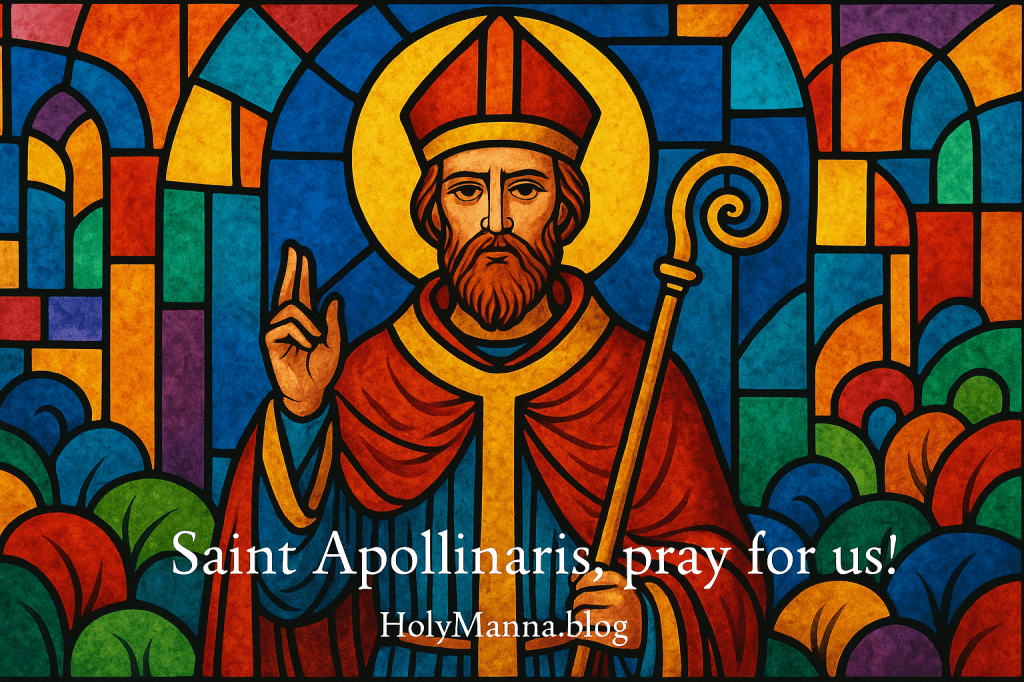
Defender of the Early Church
In the early centuries of Christianity—when to follow Christ was to invite persecution—there arose bold men and women who risked everything to proclaim the Gospel. Among them shines Saint Apollinaris, the first Bishop of Ravenna, Italy, and a fearless disciple of Saint Peter. He is remembered not only for the miracles attributed to his intercession, but also for his relentless preaching, tender love for his flock, and courageous endurance of brutal persecution. Saint Apollinaris lived during a time when proclaiming the name of Jesus could—and often did—lead to death. Yet he shepherded his people with unwavering love, enduring beatings, imprisonments, and ultimately martyrdom rather than betray the faith entrusted to him. His legacy echoes down through the centuries as a call to all of us: Will you remain faithful even when the world turns against you?
A Bishop Commissioned by Peter
The details of Saint Apollinaris’s early life are veiled in history, but tradition places his birth in Antioch, a prominent city in early Christianity and the same place where believers were first called “Christians” (Acts 11:26). While we do not know much about his family background, what we do know is compelling: he was a disciple of Saint Peter, the Prince of the Apostles. Imagine the spiritual formation he would have received at the feet of the one to whom Christ said, “Feed my sheep” (John 21:17). Peter, seeing the holiness, zeal, and courage in Apollinaris, ordained him bishop and entrusted him with a daunting mission: to bring the Gospel to Ravenna, a city under the iron grip of Roman paganism and imperial cult worship.
Upon arriving in Ravenna, Apollinaris quickly made himself known—not by political power or eloquence, but through the authority of Christ and the witness of the Holy Spirit. He preached boldly, healed the sick, drove out demons, and brought many souls to faith. His apostolic mission was not welcomed by the authorities, but the people—especially the poor and afflicted—found in him the heart of a true shepherd. As Saint Peter had once risked everything to proclaim Christ in Rome, so Saint Apollinaris bore witness to the Gospel in Ravenna, ultimately following in the footsteps of his mentor unto death.
A Ministry of Healing and Deliverance
The life of Saint Apollinaris was marked not only by courageous preaching but by supernatural signs that testified to the truth of the Gospel he proclaimed. Numerous accounts, drawn from ancient Christian tradition, describe miracles performed by the saint that led to conversions and confounded his enemies. In one striking story, a noble Roman woman lay gravely ill. Physicians had given up hope. Apollinaris, moved with compassion, visited her, laid hands upon her, and prayed in the name of Jesus Christ. Immediately, she was healed—her strength restored, her spirit revived. This miracle led her entire household to receive baptism.
In another episode, Apollinaris cast out demons from several possessed individuals. These acts of spiritual warfare not only revealed his authority as a bishop but also demonstrated the power of Jesus Christ to free the captives. People came from neighboring towns to see him, and the Church in Ravenna began to grow. His life became a living testimony of the words in The Gospel of Mark: “These signs will accompany those who believe… they will lay their hands on the sick, and they will recover” (Mark 16:17–18).
Despite the opposition and threats from local officials, Saint Apollinaris never ceased to work miracles or proclaim the Kingdom. He did not shrink back from controversy or persecution, for he believed, as Saint Paul did, that “we are more than conquerors through him who loved us” (Romans 8:37).
Blood and Witness: Suffering in the Name of Christ
As his ministry flourished, so did the fury of those who opposed the Gospel. Pagan priests, jealous of his growing influence and fearful of losing worshipers to this new faith, stirred up mobs and pressured Roman officials to act. Saint Apollinaris was arrested, beaten, and imprisoned several times throughout his episcopate. Each time he was exiled, he returned. Each time he was beaten, he forgave. His courage came not from human strength, but from a deep intimacy with Christ crucified.
According to tradition, during one of his exiles, he traveled through the surrounding regions, continuing to preach and work miracles. He was eventually captured again, and this time the punishment was brutal. He was flogged, tortured, and left for dead outside the city gates. Though he lingered for some time, weakened and battered, he never stopped interceding for his flock. It is believed that he died of his wounds, offering his final breath for the Church he loved and the people he shepherded.
His martyrdom was not just a tragic end—it was a triumphant culmination of a life wholly given to Christ. Like the Good Shepherd, he laid down his life for his sheep (John 10:11), sealing his mission with his blood. In doing so, Saint Apollinaris joined the glorious cloud of witnesses who remind us that “the Church is built on the foundation of the apostles and prophets, Christ Jesus himself being the cornerstone” (Ephesians 2:20).
Heaven Still Moves
Death did not end the impact of Saint Apollinaris. Rather, it magnified it. From the moment of his burial, his tomb became a place of miracles, healings, and conversions. Devotees who prayed at his resting place reported being cured of physical ailments and delivered from spiritual afflictions. His relics were revered with profound devotion, and stories of his posthumous intercession began to spread rapidly across the Italian peninsula.
In the 6th century, a majestic basilica—Sant’Apollinare in Classe—was built in his honor just outside Ravenna. The church, adorned with stunning mosaics that reflect both Byzantine beauty and Western reverence, remains one of the most significant monuments to early Christianity. Pilgrims from all over Europe traveled to venerate his relics, and he became one of the most beloved patron saints of northern Italy.
His memory lives on not just in stone and mosaic but in the spiritual lineage of bishops, pastors, and missionaries who continue to draw inspiration from his example. His name is invoked against epilepsy, throat ailments, and spiritual oppression, and his feast day is still celebrated with processions, Masses, and prayers for healing and courage.
Shepherd of Courage
What does the life of Saint Apollinaris mean for us today, nearly two millennia later? In a time when fear and comfort often silence truth, this bishop-martyr invites us to live our faith boldly, to speak the name of Jesus with courage, and to shepherd those around us with love—even when the cost is high. His life is a challenge to every believer: Will you follow Christ even when it’s uncomfortable? Will you return good for evil, truth for hatred, and healing for injury?
Like Apollinaris, we are called to be missionaries in our homes, parishes, and communities. That may not mean exile or martyrdom, but it does mean sacrifice. It means standing up for the teachings of Christ in a world that often rejects them. It means praying for those who hurt us, healing those around us, and returning—again and again—to those who need us, even when they resist us.
Let us pray through the intercession of Saint Apollinaris for courage, patience, and deep love. May we, too, live and die for the sake of Christ, and may our lives become living miracles that draw others to the Gospel.
Engage with Us!
We’d love to hear your thoughts on the incredible life of Saint Apollinaris! Let’s grow together in faith and boldness.
Reflection Questions:
- What fear or obstacle is keeping you from living your faith boldly, as Saint Apollinaris did?
- How can you be a spiritual shepherd in your home, workplace, or community?
- When have you seen God bring healing—physical, emotional, or spiritual—through your prayers or actions?
May we, like Saint Apollinaris, love without fear, serve without hesitation, and lay down our lives in love for Christ and His Church. Let’s continue supporting each other in our journey of faith—and always strive to do everything with love, as our Lord Jesus did.
Saint Apollinaris, pray for us!
Follow us on Instagram and Facebook for more insights and reflections on living a faith-filled life.

 Holy Manna!
Leave a comment