Wednesday of the Sixteenth Week in Ordinary Time – Lectionary: 397
Daily Bread and the Soil of the Heart
Have you ever felt like you were in a spiritual wilderness—hungry for answers, direction, or peace—and wondered if God was really going to show up? Today’s readings lead us straight into that desert place, where longing and doubt meet the promise of divine provision. In the silence of scarcity, God reveals His abundance, not only in material sustenance, but in the grace that feeds the soul. Whether we’re craving bread, clarity, or comfort, the Lord offers something far greater: Himself. But the real question isn’t whether God provides—it’s whether our hearts are ready to receive.
In Exodus 16, the Israelites grumble as they wander through the wilderness of Sin, convinced that their past slavery in Egypt was better than their present uncertainty with God. Yet in their complaint, God answers with compassion, raining down both quail and “bread from heaven” (Ex 16:4). This miracle isn’t just about food; it’s a test of trust, a call to believe that the Lord is truly their God, even when the way forward is unclear. The Psalm echoes this memory: “They tested God in their hearts, demanding the food they craved” (Psalm 78:18), yet God still sent the “bread of angels” (Psalm 78:25). We are invited to remember that divine providence is never a reward for perfection, but a gift rooted in God’s unshakable love.
Then, in The Gospel of Matthew, Jesus speaks of another kind of nourishment: the Word of God, sown generously like seed by a divine Sower. But not every heart receives it the same way. Some are hardened, others distracted or shallow. Only the rich soil—the heart that trusts, listens, and obeys—can produce lasting fruit. Just like the Israelites had to gather manna daily, so we are called to till the soil of our hearts each day, making space for grace to take root. What kind of soil is your heart today? Are you ready to be fed, even in the wilderness?
First Reading – Exodus 16:1-5, 9-15
Heaven’s Bread in the Desert of Doubt
The Book of Exodus is the foundational story of Israel’s liberation—a journey from slavery to covenant, from despair to divine promise. Today’s passage picks up in the harsh terrain of the wilderness of Sin, shortly after the Israelites’ dramatic deliverance from Egypt through the Red Sea. Historically, this desert lies between Elim and Mount Sinai, a barren and dry place where physical hunger becomes the backdrop for spiritual testing. Here, God is not only leading His people to a promised land but teaching them to live by faith, one day at a time. In the midst of their grumbling, God answers not with punishment, but with sustenance—revealing His nature as Provider and Teacher. This story becomes a foreshadowing of the Eucharist, and the heart of today’s theme: God’s daily provision requires hearts that trust and obey.
Exodus 16:1-5, 9-15
New American Bible (Revised Edition)
The Wilderness of Sin. 1 Having set out from Elim, the whole Israelite community came into the wilderness of Sin, which is between Elim and Sinai, on the fifteenth day of the second month after their departure from the land of Egypt. 2 Here in the wilderness the whole Israelite community grumbled against Moses and Aaron. 3 The Israelites said to them, “If only we had died at the Lord’s hand in the land of Egypt, as we sat by our kettles of meat and ate our fill of bread! But you have led us into this wilderness to make this whole assembly die of famine!”
The Quail and the Manna. 4 Then the Lord said to Moses: I am going to rain down bread from heaven for you. Each day the people are to go out and gather their daily portion; thus will I test them, to see whether they follow my instructions or not. 5 On the sixth day, however, when they prepare what they bring in, let it be twice as much as they gather on the other days.
9 Then Moses said to Aaron, “Tell the whole Israelite community: Approach the Lord, for he has heard your grumbling.” 10 But while Aaron was speaking to the whole Israelite community, they turned in the direction of the wilderness, and there the glory of the Lord appeared in the cloud! 11 The Lord said to Moses: 12 I have heard the grumbling of the Israelites. Tell them: In the evening twilight you will eat meat, and in the morning you will have your fill of bread, and then you will know that I, the Lord, am your God.
13 In the evening, quail came up and covered the camp. In the morning there was a layer of dew all about the camp, 14 and when the layer of dew evaporated, fine flakes were on the surface of the wilderness, fine flakes like hoarfrost on the ground. 15 On seeing it, the Israelites asked one another, “What is this?” for they did not know what it was. But Moses told them, “It is the bread which the Lord has given you to eat.
Detailed Exegesis
Verse 1 – “Having set out from Elim, the whole Israelite community came into the wilderness of Sin, which is between Elim and Sinai, on the fifteenth day of the second month after their departure from the land of Egypt.”
The people of Israel have only been journeying for a month and a half, yet they’ve already forgotten the wonders of the Red Sea. Elim, an oasis of water and shade, is behind them; ahead lies the daunting wilderness. The number fifteen is significant—it suggests a transition point, halfway through the month, much like Israel is in-between physical deliverance and spiritual maturity.
Verse 2 – “Here in the wilderness the whole Israelite community grumbled against Moses and Aaron.”
This verse introduces a recurring theme in Exodus: the murmuring of the people. Despite being freed from slavery, they now complain, revealing how hardship often tempts us to romanticize past bondage. Their grumbling isn’t just about discomfort—it’s a failure to trust God’s plan.
Verse 3 – “The Israelites said to them, ‘If only we had died at the Lord’s hand in the land of Egypt, as we sat by our kettles of meat and ate our fill of bread! But you have led us into this wilderness to make this whole assembly die of famine!’”
Nostalgia for Egypt reveals a dangerous spiritual blindness. The people would rather die with full stomachs in slavery than live in freedom with uncertainty. It echoes how we sometimes prefer familiar sin over the difficult journey toward holiness. Their exaggeration—“we ate our fill”—is a distortion of reality rooted in fear.
Verse 4 – “Then the Lord said to Moses: I am going to rain down bread from heaven for you. Each day the people are to go out and gather their daily portion; thus will I test them, to see whether they follow my instructions or not.”
God’s response is both merciful and formative. The gift of manna is not just food—it is a test, a spiritual discipline. Like the Lord’s Prayer petitions for “our daily bread”, this daily gathering cultivates dependence and obedience. The phrase “bread from heaven” foreshadows Jesus, the true Bread of Life.
Verse 5 – “On the sixth day, however, when they prepare what they bring in, let it be twice as much as they gather on the other days.”
This detail introduces the rhythm of the Sabbath. The double portion anticipates a day of rest and worship. The gift of manna isn’t chaotic; it’s structured to teach the people the order and holiness of time as God intends.
Verse 9 – “Then Moses said to Aaron, ‘Tell the whole Israelite community: Approach the Lord, for he has heard your grumbling.’”
Despite their complaints, God still invites His people to draw near. The call to “approach” mirrors liturgical language—a call to worship. God’s hearing is not passive; it leads to action rooted in love.
Verse 10 – “But while Aaron was speaking to the whole Israelite community, they turned in the direction of the wilderness, and there the glory of the Lord appeared in the cloud!”
Theophany—God’s visible manifestation—appears in the form of a cloud. Though they look toward the wilderness in fear, they see divine glory. God reveals His presence not in comfort but in the place of testing.
Verse 11 – “The Lord said to Moses:”
A simple but powerful phrase. Every time the Lord speaks in Exodus, it confirms divine initiative. God is not reacting—He is leading.
Verse 12 – “I have heard the grumbling of the Israelites. Tell them: In the evening twilight you will eat meat, and in the morning you will have your fill of bread, and then you will know that I, the Lord, am your God.”
God responds to disbelief with evidence. By providing meat and bread, He reaffirms His identity as their true God. The timing—twilight and morning—also echoes the structure of Jewish worship and daily sacrifice.
Verse 13 – “In the evening, quail came up and covered the camp. In the morning there was a layer of dew all about the camp.”
God fulfills His word precisely. Quail, likely migrating birds, are blown in by divine timing. The dew prepares the ground for manna, which appears miraculously as the dew lifts. God provides through both nature and supernatural means.
Verse 14 – “And when the layer of dew evaporated, fine flakes were on the surface of the wilderness, fine flakes like hoarfrost on the ground.”
The description invites awe and mystery. The manna isn’t just food—it’s unfamiliar, heavenly. The fine flakes signal both delicacy and divine design.
Verse 15 – “On seeing it, the Israelites asked one another, ‘What is this?’ for they did not know what it was. But Moses told them, ‘It is the bread which the Lord has given you to eat.’”
“Manna” literally means “What is it?” Their confusion highlights how often God’s gifts come in unexpected forms. Moses interprets the miracle: this strange provision is God’s nourishment. In the Christian tradition, this prefigures the Eucharist—Jesus, the Bread of Life, who also appeared in humble, unfamiliar form.
Teachings
The Catechism of the Catholic Church connects this passage to the Eucharist: “The manna in the desert prefigured the Eucharist, the ‘true bread from heaven’ (Jn 6:32).” (CCC 1094). The miracle of manna was not just a physical provision, but a spiritual preparation for Christ. As CCC 1334 teaches, “In the Old Covenant bread and wine were offered in sacrifice… Above all the manna in the desert, when the Israelites were nourished with it daily by God, prefigures the Eucharist, the ‘true bread from heaven.’”
Saint Ambrose echoed this in the 4th century: “That bread is daily bread; take it daily, that it may profit you daily.” God does not nourish us just once; He invites us to return again and again, day by day, to His table. Just as the Israelites were instructed to gather their portion each morning, so too are we invited to receive spiritual nourishment in the Eucharist and through daily prayer.
Saint John Chrysostom reminds us that God used the wilderness to teach the people faith: “God permitted them to hunger… that He might make them sensible of their need and lead them to trust in Him.” This hunger was not a curse—it was a gift, forming a people who depend not on Egypt, but on their Redeemer. The same lesson applies to us today: our discomfort may be the very soil in which God cultivates trust.
Reflection
How often do we romanticize the “comfort” of our former sins when we feel lost or spiritually dry? Today’s reading challenges us to reflect: Do I trust that God will provide what I need each day, even when I can’t see how? Am I willing to be tested, to gather the grace of each morning with reverence, instead of demanding guarantees? In our wilderness moments—whether it’s doubt, suffering, or confusion—God is not absent. He may be teaching us to hunger rightly, so we can feast on what truly satisfies. Make room for silence today, and listen for the dewfall of heaven. Your manna is coming.
Responsorial Psalm – Psalm 78:18-19, 23-28
Craving or Trusting?
Psalm 78 is a powerful historical psalm, recounting Israel’s repeated failures to trust in God despite His abundant miracles. It’s attributed to Asaph, a temple musician and prophet during the reigns of David and Solomon. This psalm is not a personal lament or praise—it is communal instruction, a poetic catechesis meant to stir repentance and remembrance. Today’s verses remind us of a pivotal moment in Israel’s wilderness journey: the gift of manna and quail. Though the people were provided for, their hearts remained restless and rebellious. This reading echoes the Exodus 16 narrative and deepens today’s central theme: God provides faithfully, but our hearts must be rightly ordered to receive. As we pray these verses, we are invited to examine whether we are seeking God’s hand—or His heart.
Psalm 78:18-19, 23-28
New American Bible (Revised Edition)
18 They tested God in their hearts,
demanding the food they craved.
19 They spoke against God, and said,
“Can God spread a table in the wilderness?
23 So he commanded the clouds above;
and opened the doors of heaven.
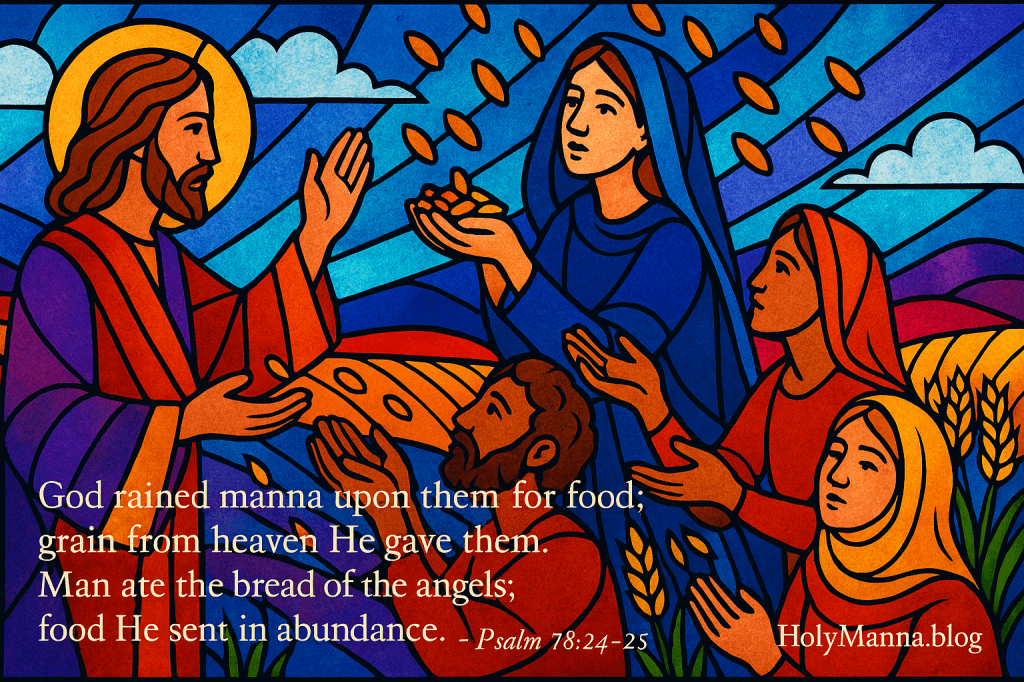
24 God rained manna upon them for food;
grain from heaven he gave them.
25 Man ate the bread of the angels;
food he sent in abundance.
26 He stirred up the east wind in the skies;
by his might God brought on the south wind.
27 He rained meat upon them like dust,
winged fowl like the sands of the sea,
28 They fell down in the midst of their camp,
all round their dwellings.
Detailed Exegesis
Verse 18 – “They tested God in their hearts, demanding the food they craved.”
This verse cuts to the root of sin: interior rebellion. The Israelites were not just hungry—they were spiritually dissatisfied. Their craving reveals an idol of comfort, as if God’s presence were not enough. The testing of God, condemned repeatedly in Scripture, reveals a lack of reverence. According to Deuteronomy 6:16, “You shall not put the Lord, your God, to the test.” The heart, in biblical language, is the seat of the will and trust. Their testing began there, long before any outward complaint.
Verse 19 – “They spoke against God, and said, ‘Can God spread a table in the wilderness?’”
This cynical question challenges God’s power and provision. The image of a “table” in the wilderness symbolizes abundance and stability—a direct contrast to the barrenness around them. The real issue isn’t physical hunger; it’s spiritual amnesia. They forget who delivered them, doubting whether He can sustain them. This verse warns us that complaint often masks a deeper unbelief.
Verse 23 – “So he commanded the clouds above; and opened the doors of heaven.”
In majestic imagery, God is portrayed as the King of heaven, commanding even the skies. The phrase “doors of heaven” evokes wonder and divine generosity. This is no ordinary meal—this is bread from another realm. It invites us to consider the Eucharistic fulfillment, when heaven truly opened and the Bread of Life came down.
Verse 24 – “God rained manna upon them for food; grain from heaven he gave them.”
This line recounts the miracle described in Exodus 16. The imagery of rain reinforces the gift-nature of manna: it was unearned, unexpected, and abundant. The phrase “grain from heaven” underscores its divine origin. It was not the fruit of human toil, but a sacramental sign of God’s mercy and faithfulness.
Verse 25 – “Man ate the bread of the angels; food he sent in abundance.”
The phrase “bread of the angels” has inspired centuries of liturgical reflection. The Church Fathers saw in this verse a clear allusion to the Eucharist. Though angels are pure spirits and do not eat, the expression suggests heavenly sustenance—spiritual nourishment beyond earthly food. God didn’t just meet their needs—He overwhelmed them with abundance.
Verse 26 – “He stirred up the east wind in the skies; by his might God brought on the south wind.”
Here we see God’s orchestration of nature. The winds symbolize divine authority and precision. The quail were not a random occurrence; they came at God’s command. Every detail of their provision was carefully directed, reminding us that nothing in our lives is too small for God’s providence.
Verse 27 – “He rained meat upon them like dust, winged fowl like the sands of the sea,”
This verse recalls Exodus 16:13, where quail covered the camp. The hyperbolic imagery—“like dust”, “like the sands of the sea”—emphasizes the overwhelming generosity of God. He did not give sparingly, but in staggering abundance. Even in their ungratefulness, He showed mercy.
Verse 28 – “They fell down in the midst of their camp, all round their dwellings.”
The miracle reaches its climax: the people didn’t even have to search. The quail fell right at their tents. God’s provision was intimate and immediate. This final image confronts us with the truth: if God’s gifts are falling all around us, are we receiving them with awe—or with entitlement?
Teachings
The Catechism of the Catholic Church interprets this Psalm, especially verse 25, in Eucharistic light: “The manna in the desert prefigured the Eucharist, the ‘true bread from heaven.’” (CCC 1094). The psalmist’s poetic retelling becomes theological prophecy. When we hear that “man ate the bread of the angels”, the Church hears an echo of the liturgy: “Panis angelicus, fit panis hominum”—“the bread of angels becomes the bread of men.” The Fathers of the Church, like Origen and Augustine, consistently interpreted Psalm 78 as a shadow of the heavenly banquet made present in the Eucharist.
Saint Thomas Aquinas meditated deeply on this psalm in his Office for Corpus Christi. He wrote that God feeds His people in two ways: through natural reason and supernatural revelation. The manna, he said, satisfies only the body, but “the Eucharist feeds the soul, unites us to Christ, and prepares us for eternal life.” Thus, Psalm 78 is not just historical—it is sacramental. It reminds us that the same God who fed the Israelites in the wilderness now feeds His Church at the altar.
This psalm also warns against spiritual hardness. In CCC 2119, we are told: “Tempting God consists in putting his goodness and almighty power to the test by word or deed. The challenge contained in such testing wounds the respect and trust we owe our Creator and Lord.” When we ask, “Can God spread a table in the wilderness?”, we aren’t just doubting provision—we are doubting His very identity. Trust must begin in the heart, or even the most miraculous gifts will not satisfy.
Reflection
Do I seek God only when I want something from Him, or do I seek Him for who He is? Psalm 78 invites us to reflect on the posture of our hearts. Are we praying from trust—or from demand? God’s provision is never lacking, but our receptivity often is. Like the Israelites, we are constantly surrounded by signs of God’s presence: in the Eucharist, in Scripture, in unexpected blessings. Yet when our desires dominate, we fail to see the grace falling right outside our door.
Today, take time to name the ways God has already provided for you. Then, ask Him to reorder your cravings—to turn them from self-satisfaction to divine communion. Are you testing God today, or trusting Him? The psalm urges us to choose trust, to remember, and to worship the One who still spreads a table in the wilderness.
Holy Gospel – Matthew 13:1-9
Receiving Heaven’s Seed
The Gospel of Matthew was written primarily for a Jewish audience to present Jesus as the long-awaited Messiah and the fulfillment of the Law and the Prophets. Chapter 13 marks a pivotal moment in Jesus’ public ministry—He begins to teach in parables, a method rich with layered meaning, drawn from everyday life yet brimming with divine truth. Today’s Gospel introduces the Parable of the Sower, the first and foundational parable of the Kingdom. Spoken beside the Sea of Galilee, to a large crowd, it reveals a mystery about how God’s Word is sown into the hearts of listeners—and how the condition of those hearts determines the fruitfulness of grace. In connection with today’s readings from Exodus and Psalm 78, this Gospel passage shifts the spotlight inward: while God rains down manna and scatters divine seed, our response determines whether it nourishes us or is wasted. Will we receive with trust or with resistance?
Matthew 13:1-9
New American Bible (Revised Edition)
The Parable of the Sower. 1 On that day, Jesus went out of the house and sat down by the sea. 2 Such large crowds gathered around him that he got into a boat and sat down, and the whole crowd stood along the shore. 3 And he spoke to them at length in parables, saying: “A sower went out to sow. 4 And as he sowed, some seed fell on the path, and birds came and ate it up. 5 Some fell on rocky ground, where it had little soil. It sprang up at once because the soil was not deep, 6 and when the sun rose it was scorched, and it withered for lack of roots. 7 Some seed fell among thorns, and the thorns grew up and choked it. 8 But some seed fell on rich soil, and produced fruit, a hundred or sixty or thirtyfold. 9 Whoever has ears ought to hear.”
Detailed Exegesis
Verse 1 – “On that day, Jesus went out of the house and sat down by the sea.”
This setting is deliberate. Jesus leaves the house (often a symbol of the Church or Israel) and goes to the sea—a place of mystery, chaos, and divine calling. The sea has deep biblical symbolism, and sitting by the water evokes both rabbinic teaching posture and echoes of creation, where God brings order from the deep.
Verse 2 – “Such large crowds gathered around him that he got into a boat and sat down, and the whole crowd stood along the shore.”
The crowd’s size indicates Jesus’ growing fame. He enters a boat to teach—a natural amphitheater created by the water’s acoustics. This imagery also recalls Noah’s ark and Peter’s fishing boat: vessels of salvation. The people stand, listening—symbolizing readiness, yet Jesus will soon challenge what kind of “soil” their hearts truly are.
Verse 3 – “And he spoke to them at length in parables, saying: ‘A sower went out to sow.’”
Jesus begins the first of seven parables in this chapter. Parables are both revelations and veils—clear to the humble, but confusing to the proud. The image of the sower is God Himself, generously scattering seed (His Word) without discrimination. The act of sowing reflects divine abundance—He does not hold back His grace.
Verse 4 – “And as he sowed, some seed fell on the path, and birds came and ate it up.”
The path represents the hardened heart—trampled by traffic, closed to penetration. The seed never enters. The birds, later interpreted as the evil one, snatch away the Word before it has a chance to sink in. This warns us that spiritual deafness is real, and that distraction or cynicism can rob us of grace.
Verse 5 – “Some fell on rocky ground, where it had little soil. It sprang up at once because the soil was not deep.”
The rocky ground symbolizes shallow enthusiasm. The Word is received emotionally, not deeply. There’s quick growth—but without roots, it cannot endure trials. Many converts begin here—full of zeal, but lacking formation. Jesus is calling for a deeper conversion, not just an emotional reaction.
Verse 6 – “And when the sun rose it was scorched, and it withered for lack of roots.”
The sun—often symbolic of trials or persecution—tests the reality of our discipleship. Without spiritual roots (prayer, sacraments, doctrine), faith withers. This verse warns against spiritual immaturity. Christianity is not just initial joy—it is daily endurance and growth.
Verse 7 – “Some seed fell among thorns, and the thorns grew up and choked it.”
Thorns represent worldly anxiety, materialism, and distractions. The seed begins to grow but cannot compete with rival desires. The soul may go to Mass, pray occasionally, yet remain dominated by comfort, wealth, or busyness. This is perhaps the most common soil today—divided hearts choking out grace.
Verse 8 – “But some seed fell on rich soil, and produced fruit, a hundred or sixty or thirtyfold.”
This is the goal: fertile, receptive hearts. Rich soil is cultivated—tilled through repentance, watered through grace. The Word enters, takes root, and bears fruit. The multiplication—thirty, sixty, a hundredfold—is miraculous. In Genesis, normal harvests yielded sevenfold—so this fruitfulness is divine.
Verse 9 – “Whoever has ears ought to hear.”
Jesus ends with a solemn call to attention. This phrase isn’t about physical hearing—it’s about spiritual attentiveness. It echoes Deuteronomy 6:4, “Hear, O Israel!”. It demands an interior response. Jesus is not just telling a story—He’s offering an invitation to transformation.
Teachings
The Catechism of the Catholic Church teaches that “The parables are like mirrors for man: Will he be hard soil or good earth for the word?” (CCC 546). Jesus uses these stories not to entertain, but to sift hearts. Those who are humble and open will understand; those who are proud or indifferent will miss the message. This parable reminds us that the Word of God is alive and powerful—but it will only bear fruit in a heart prepared by grace.
In CCC 2707, the Church urges the faithful to meditate on Scripture as fertile ground for transformation: “There is no surer way to learn to pray than by meditating on the Word of God, and particularly on the Gospel, in order to root it in our hearts.” Just as the Israelites gathered manna each morning, we are called to receive God’s Word daily, letting it take root in our thoughts, desires, and choices. The fruit—virtue, peace, and love—grows slowly, but surely, in cultivated hearts.
The Fathers of the Church often identified the “good soil” with Mary, who is the perfect hearer of the Word. Saint Augustine wrote: “Mary conceived the Word in her heart before she conceived Him in her womb.” This reading urges us to become like her—pondering God’s Word, protecting it from worldly weeds, and allowing it to reshape our lives. When our hearts become Marian—humble, receptive, obedient—the Word can grow, flourish, and transform the world.
Reflection
What kind of soil is my heart today? Am I distracted, shallow, hardened—or am I receptive to God’s voice, even when it challenges me? The Parable of the Sower reminds us that grace is never lacking; it is our openness that determines the harvest. Do I make time each day to receive the Word of God, or is it choked out by lesser priorities? Let today be a time to renew your commitment to daily Scripture, silent prayer, and spiritual formation. Till the soil of your heart. Uproot the thorns. Ask the Lord to break up the hardened ground of pride, fear, or indifference. The Sower is generous. He is scattering seed into your life today. Will it bear fruit?
Heaven Still Feeds the Hungry
Today’s readings trace a journey from wilderness hunger to fertile hearts—from the outer desert of Sinai to the inner terrain of the soul. In Exodus, we met the Israelites, freshly freed yet quickly forgetful, craving the comforts of Egypt while doubting the providence of God. And yet, God answered their grumbling not with punishment, but with provision: “I am going to rain down bread from heaven for you.” (Exodus 16:4). The Psalm echoed this miracle, recalling that even when the people tested Him, God “opened the doors of heaven” (Psalm 78:23) and “rained manna upon them for food.” (Psalm 78:24). Finally, in The Gospel of Matthew, Jesus sowed the Word of God like seed, revealing that His gifts—like the manna—must fall on good soil to bear fruit.
The thread tying all of these together is simple but profound: God always provides, but our ability to receive depends on the disposition of our hearts. He offers not only bread for the body, but truth for the soul. Yet this divine generosity requires a response. It asks us to trust, to remember, to listen, to receive. Whether God is raining manna or sowing seed, He is constantly reaching toward us—wanting not just to sustain us, but to transform us.
How is God feeding you today? What seed is He trying to plant in your life? Don’t let it fall on a hardened or distracted heart. Take time to pray with the Scriptures, to receive the Eucharist with deeper hunger, and to ask the Holy Spirit to cultivate your soul into rich, fruitful ground. The same God who fed Israel in the desert and spoke beside the Sea of Galilee is speaking to you now. “Whoever has ears ought to hear.” (Matthew 13:9).
Engage with Us!
We’d love to hear how today’s Word is speaking to your heart. Share your thoughts, struggles, or moments of insight in the comments below—your story might be the encouragement someone else needs today. Let’s walk this journey of faith together, one day at a time, nourished by the Bread of Heaven and rooted in God’s Word.
Reflection Questions:
First Reading – Exodus 16:1-5, 9-15
When have you grumbled in the midst of God’s provision? Are there ways you’re still clinging to “Egypt” instead of trusting God in your present wilderness? What “daily manna” is God placing before you today that you might be overlooking?
Responsorial Psalm – Psalm 78:18-19, 23-28
Do you trust that God can “spread a table” in your current trials? What cravings or distractions are choking your ability to recognize God’s abundance? Where have you seen God’s provision in surprising ways?
Holy Gospel – Matthew 13:1-9
What kind of soil is your heart right now—hard, shallow, thorny, or rich? What concrete step can you take this week to till and enrich the soil of your soul? How are you being called to receive the Word more deeply and bear lasting fruit?
May you live today with the confidence that God sees you, hears you, and provides for you. Trust Him with your hunger. Receive His Word with an open heart. And go forth doing everything with the love and mercy that Jesus taught us—patiently, faithfully, and generously.
Follow us on Instagram and Facebook for more insights and reflections on living a faith-filled life.

 Holy Manna!
Leave a comment