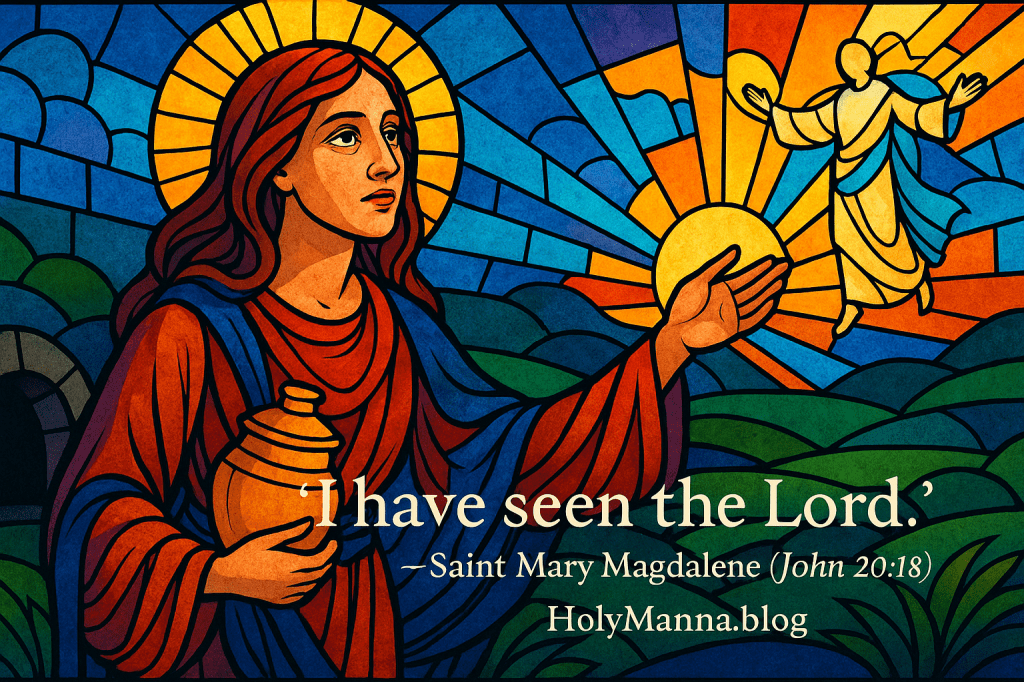
The Apostle to the Apostles
A Witness to the Risen Son
In the communion of saints, few figures are as enigmatic and luminous as Saint Mary Magdalene. Known to every Christian as the first person to encounter the Risen Christ, she has been revered for centuries as a model of conversion, faithful discipleship, and courageous proclamation. The Church gives her the title “Apostle to the Apostles,” a phrase first used by Saint Thomas Aquinas, in recognition of her unique role in salvation history. Far from being a secondary character, Mary Magdalene stands at the very heart of the Gospel. She is there at the Cross when most had fled. She is there at the tomb when all seemed lost. And she is the first to hear the triumphant message of resurrection from the lips of Jesus Himself.
On July 22, the Church celebrates her feast day, not merely as a remembrance of a historical figure, but as an invitation to live with the same passion, gratitude, and undivided love that characterized her life. Mary Magdalene’s story is one of deep healing and even deeper love—a reminder that the Gospel is not just about doctrines, but about the personal transformation that happens when one encounters Jesus Christ.
From Demons to Discipleship
Mary Magdalene’s name tells us she was likely from Magdala, a small fishing village on the western side of the Sea of Galilee. Although her early life is not detailed in the Gospels, we do know that she was tormented by seven demons before meeting Christ (Luke 8:2; Mark 16:9). This number likely symbolizes a total possession—body, mind, and soul—pointing to how profoundly broken her life had been before Jesus healed her. But what the Gospels emphasize is not her past, but the new identity she received through Jesus’ healing. She becomes a faithful follower, part of a group of women who accompanied Jesus and His disciples and supported His ministry financially (Luke 8:1–3).
It’s important to clarify that while Mary Magdalene was for centuries mistakenly conflated with the unnamed sinful woman who anointed Jesus’ feet in Luke 7, the Church today recognizes them as distinct individuals. Rather than being remembered as the repentant prostitute, Mary Magdalene should be seen as a woman set free by Christ, who then gave everything to follow Him.
Mary’s conversion wasn’t just from demonic oppression—it was a total redirection of her life, marked by unceasing love and presence. From the moment she was healed, she never left Jesus’ side. She followed Him throughout His public ministry, stood by Him in His agony, and ultimately was the first to proclaim the most joyful truth the world has ever heard: He is risen!
At the Tomb and Beyond
Mary Magdalene’s life is woven directly into the most sacred moments of Christ’s Passion and Resurrection. When the male disciples scattered, Mary stood firm at the foot of the Cross (John 19:25), refusing to abandon the One who had transformed her life. Her fidelity did not end with Jesus’ death. Early on the first day of the week, while it was still dark, she went to the tomb to anoint His body (John 20:1). What she found instead was an empty tomb—and soon after, the Risen Lord Himself.
The Gospel of John recounts this intimate and powerful moment in striking detail. Distraught and weeping, Mary encounters a man she assumes is the gardener. But when He calls her by name—“Mary”—everything changes. Her eyes are opened, and she recognizes Him: “Rabbouni!” (John 20:16). It was in the calling of her name that she recognized her Savior. This moment reflects the truth that Jesus knows each of us personally, and it is by name that He invites us into a relationship with Him.
Then came the mission: “Go to my brothers and say to them, ‘I am ascending to my Father and your Father, to my God and your God.’” (John 20:17). Mary obeyed immediately. She became the first evangelist of the Resurrection, boldly proclaiming the message that would change the world. This act of being sent by Christ Himself is why she is honored with the title Apostle to the Apostles. Her life was a miracle not just because of the demons that were cast out, but because of the faith, courage, and joy that filled her once she encountered the living God.
Exile, Prayer, and Perseverance
Though the Gospels do not detail what happened to Mary Magdalene after Pentecost, Church tradition fills in the story with devotion and awe. Several early Christian traditions hold that she continued to spread the Gospel with zeal and prayerful witness. One of the most ancient traditions claims she journeyed to Ephesus, where she lived under the care of Saint John the Apostle, alongside the Blessed Virgin Mary. Another beloved Western tradition places her in southern France, in the region of Provence. According to this tradition, Mary Magdalene evangelized the area, and eventually withdrew to a cave in the Sainte-Baume mountains, where she lived in penance and deep communion with God.
Though not martyred by blood, Mary Magdalene endured a form of white martyrdom—a life marked by suffering, isolation, and the total offering of herself to God in prayer. Her penance in the cave, her perseverance through misunderstanding and obscurity, and her commitment to solitude out of love for Christ, all speak to a martyrdom of the heart. Her hardships are not tales of earthly violence, but of spiritual refinement.
She is often depicted in sacred art with long flowing hair, a jar of ointment (symbolizing the myrrh-bearing women), or in a cave, lost in contemplation. These images remind us that holiness is often hidden, and that sometimes, the greatest evangelization comes through quiet fidelity and prayer.
A Voice Echoing Through Time
The veneration of Mary Magdalene began early in the Church, especially in the Eastern Christian tradition. By the 9th century, her relics were revered in Constantinople. In the West, her cult grew significantly in medieval France, particularly after her supposed relics were discovered in Saint-Maximin-la-Sainte-Baume in the 13th century.
Pilgrims have traveled for centuries to the Grotto of Sainte-Baume, the cave believed to be her hermitage. Many have reported miracles of healing, conversions, and answered prayers at this holy site. The basilica built in her honor holds her relics, including what is believed to be her skull, encased in gold and crowned with a halo of stars.
One powerful miracle attributed to her intercession involved the healing of a noblewoman who had lost the ability to speak. After praying at the site of Mary Magdalene’s relics, the woman’s speech was restored. Throughout the centuries, many who have felt lost, ashamed, or in despair have turned to Saint Mary Magdalene for comfort, trusting that she, who knew the depths of sorrow and the heights of grace, could understand and intercede with compassion.
Even now, her witness continues to speak. Her life—once shattered by darkness, then consumed by divine love—calls each of us to believe that no one is beyond redemption, and that every life can be transformed by Christ.
From Brokenness to Boldness
Saint Mary Magdalene is more than a figure from the pages of Scripture. She is a living mirror of what God can do with a human heart that says yes to grace. In her we see not only the mercy of Christ but the bold response of a woman who would never stop proclaiming His name.
How many times have we allowed our past to define us, rather than God’s promises? Mary reminds us that identity in Christ is stronger than shame, and that love is more powerful than sin. Her presence at the Cross teaches us how to suffer with love. Her tears at the tomb teach us how to seek Christ even when hope seems lost. Her joy in meeting the Risen Lord teaches us what it means to be truly alive.
In our own lives, we may carry wounds, addictions, or past mistakes that make us feel unworthy of God’s love. But the story of Mary Magdalene proclaims the opposite: “Where sin increased, grace abounded all the more” (Romans 5:20). Like her, we are called not just to be forgiven, but to be transformed—and then sent out into the world to tell others what we have seen and heard.
Let us strive to imitate her passionate love for Jesus. Let us proclaim His resurrection not only with our words, but with our lives. And let us never doubt that, even in our darkest moments, Christ is near—calling us by name.
Engage with Us!
What part of Saint Mary Magdalene’s life speaks most deeply to your heart? How has God transformed your life from darkness into light? Let’s journey together in faith, following the path of love and mercy.
Reflection Questions:
- When have I experienced the healing mercy of Jesus like Mary Magdalene did?
- How can I be more courageous in proclaiming the Good News, like she was?
- What “tombs” in my life still need the light of Christ’s Resurrection to break through?
Let’s support one another as we walk this path of discipleship, holding fast to the hope that Mary Magdalene so boldly proclaimed: He is Risen! May we live every moment with the faith, devotion, and love that marked her life—and may we do it all for the glory of God.
Saint Mary Magdalene, pray for us! 🔥
Follow us on Instagram and Facebook for more insights and reflections on living a faith-filled life.

 Holy Manna!
Leave a comment