Feast of Saint Mary Magdalene – Lectionary: 603
Longing, Love, and the Voice That Calls Our Name
Have you ever searched for something—or someone—with such aching desire that nothing else in the world seemed to matter? That kind of pursuit, driven by love and thirst, is at the heart of today’s liturgy. On this Feast of Saint Mary Magdalene, the Church invites us into the tender drama of longing and discovery, of seeking and being found. Today’s readings—from Song of Songs, Psalm 63, and The Gospel of John—form a radiant tapestry of yearning, devotion, and intimate encounter with the living God. They stir the soul to remember that love doesn’t just wait passively for God; it seeks Him out through darkness, confusion, and tears until it hears His voice.
The Church, in her wisdom, pairs Song of Songs 3:1–4 with John 20:1–18 to highlight Mary Magdalene not just as a repentant sinner, but as the icon of the loving soul in search of her Beloved. Early Church Fathers saw in the Song of Songs a mystical portrayal of the soul’s relationship with God—passionate, persistent, and deeply personal. In Mary’s weeping at the tomb and her desperate question, “They have taken my Lord, and I don’t know where they laid him”, we hear the cry of the bride in the night, searching through the streets. Her encounter with the Risen Christ, when He calls her by name—“Mary!”—is the fulfillment of that restless longing, the divine answer to the soul’s deepest thirst.
This same thirst echoes in Psalm 63: “For you my body yearns; for you my soul thirsts, in a land parched, lifeless, and without water”. The psalmist gives voice to the desire that lives within every human heart: to see God’s face, to hear His voice, to cling to Him and never let go. And that is what Mary does. Her witness reminds us that it is love, not power or intellect, that leads us to the Resurrection. Her tears were not weakness but worship. As the “apostle to the apostles,” she shows us what it means to seek Christ in the darkness and to rejoice in the light when we find Him. Are we ready to search for the One our soul loves—even when we cannot yet see Him?
First Reading – Song of Songs 3:1–4
The Soul’s Restless Search for God
The Song of Songs, also known as the Canticle of Canticles, is one of the most mysterious and poetic books in all of Scripture. Attributed traditionally to King Solomon, this collection of love poems has long been interpreted by the Church not merely as romantic literature but as a profound allegory of the relationship between God and the soul—or Christ and His Bride, the Church. Today’s reading brings us into a scene of deep longing, where the lover seeks her beloved through the darkness of night. It’s no coincidence that the Church chose this passage for the Feast of Saint Mary Magdalene. Just as the bride in Song of Songs rises in the night and searches the city for “him whom my soul loves”, so too does Mary Magdalene rise early, before dawn, to seek the body of her crucified Lord. Both are women driven by love, not obligation. Their search is raw, personal, and relentless—a model for how every Christian soul ought to pursue Christ.
Song of Songs 3:1-4
New American Bible (Revised Edition)
Loss and Discovery
1 W On my bed at night I sought him
whom my soul loves—
I sought him but I did not find him.
2 “Let me rise then and go about the city,
through the streets and squares;
Let me seek him whom my soul loves.”
I sought him but I did not find him.
3 The watchmen found me,
as they made their rounds in the city:
“Him whom my soul loves—have you seen him?”
4 Hardly had I left them
when I found him whom my soul loves.
I held him and would not let him go
until I had brought him to my mother’s house,
to the chamber of her who conceived me.
Detailed Exegesis
Verse 1 – “On my bed at night I sought him whom my soul loves— I sought him but I did not find him.”
This verse opens in the darkness of absence. The soul lies awake, restless in the night, yearning for the presence of the beloved. Night often symbolizes spiritual dryness, confusion, or loss. The repetition of “I sought him” emphasizes not only desire but pain. Like Mary Magdalene outside the empty tomb, the soul cries out, Where is He? Why is He gone?
Verse 2 – “Let me rise then and go about the city, through the streets and squares; Let me seek him whom my soul loves.” I sought him but I did not find him.
This verse shows movement—rising, going out, searching. The soul doesn’t remain passive in its longing; it actively pursues. This mirrors Mary Magdalene’s actions in John 20, when she runs to find Peter and John and then returns to the tomb. The streets and squares suggest a public dimension to the search; sometimes, we must search for Christ not just in private prayer but in the world, the Church, and the community of believers.
Verse 3 – “The watchmen found me, as they made their rounds in the city: ‘Him whom my soul loves—have you seen him?’”
The watchmen represent spiritual guides, perhaps clergy, teachers, or even angels. But they do not have the answer. The soul must still continue its own search. Mary, too, speaks to the angels in the tomb and asks them, “They have taken my Lord, and I don’t know where they laid him” (John 20:13). The soul must ask the question openly: Have you seen Him? Do you know where He is? But the answer cannot always be given by others—it must come through encounter.
Verse 4 – “Hardly had I left them when I found him whom my soul loves. I held him and would not let him go until I had brought him to my mother’s house, to the chamber of her who conceived me.”
Here, the joy of discovery arrives suddenly and intimately. Once the soul passes through intermediaries and continues the search alone, it finds the Beloved. The response is immediate: embrace and return. The mention of “my mother’s house” and “the chamber” alludes to returning to the place of origin, of covenant and communion. It reflects the deep desire not only to find God but to dwell with Him in the intimacy of the heart. Likewise, when Jesus says “Mary!”, she clings to Him until He gently tells her not to hold on, for there is more yet to come.
Teachings of the Church: A Soul in Pursuit of Her Spouse
The Church has always interpreted the Song of Songs through a mystical and theological lens. Saint Bernard of Clairvaux wrote extensive sermons on this book, explaining: “The kiss of the mouth signifies the most intimate knowledge of the Word, infused not by man but by God. This is not taught; it is tasted.” (Sermon 1 on the Song of Songs). Mary Magdalene’s experience at the tomb becomes a living illustration of this mystical knowledge: not academic, but incarnational, experiential, and deeply personal. According to CCC 2715, “Contemplation is a gaze of faith, fixed on Jesus. ‘I look at him and he looks at me’: this is what a certain peasant of Ars in the time of his holy Curé used to say while praying before the tabernacle.” This gaze is what the bride in the Song of Songs seeks—and what Mary receives.
The Song of Songs also carries nuptial imagery that the Church sees as a reflection of the covenant between Christ and the Church. CCC 1617 affirms this: “The entire Christian life bears the mark of the spousal love of Christ and the Church.” In Mary Magdalene’s faithfulness and affection, we see the Church in her purest form: seeking the Lord, not for what He gives, but for who He is. This is echoed in Saint Gregory the Great’s reflection: “She loved Him when He was dead on the cross; she sought Him as He lay in the tomb; and was not to be checked by fear. And so she merited to be the first to see Him risen.”
Historically, mystics like Saint Teresa of Ávila and Saint John of the Cross drew heavily from this book to describe the soul’s journey toward union with God. It is a path marked by longing, loss, perseverance, and ecstasy. Mary Magdalene embodies this journey. In a world that often prioritizes utility and productivity, she reminds us that the most important thing is not what we do for Jesus—but how we love Him. She is the icon of pure devotion—of a soul that would search through the night, just to be near Him again.
Reflection: Where Is the One My Soul Loves?
What might this reading say to us today? Perhaps we have felt the absence of God in the night of suffering, grief, or spiritual dryness. Have we, like the bride and like Mary Magdalene, gotten up to seek Him anyway? Love doesn’t wait until the sun rises—it ventures into the dark streets, into the unanswered questions, into the pain. Are we willing to search, to ask, to cry out: “Have you seen Him whom my soul loves?” And when we find Him—often when we least expect—do we cling to Him? This reading calls us not just to admire the longing of the saints, but to cultivate that same hunger in our daily lives: in prayer, in silence, in the sacraments, and especially in those moments when He seems absent. It is then that our love proves itself real.
Responsorial Psalm – Psalm 63:2–6, 8–9
Thirsting for God
Written by David while in the wilderness of Judah, Psalm 63 is a deeply intimate cry from the heart of a soul who longs for God. The psalm belongs to the category of individual laments and meditations found throughout the Psalter—yet it stands apart for its language of personal love and spiritual desire. David, pursued and hunted, finds himself in a barren land, yet it is his spiritual thirst—not merely physical hardship—that dominates his prayer. He does not plead first for safety or victory, but for the presence of God Himself. This psalm beautifully complements the themes of Song of Songs and John 20: the longing for the Beloved, the desire to see Him, to cling to Him, to be filled not with food or comfort, but with the presence of the Lord. On the Feast of Saint Mary Magdalene, it perfectly captures her yearning: one who rises before dawn, weeping and searching, not for what God gives—but for God Himself.
Psalm 63:2-6, 8-9
New American Bible (Revised Edition)
2 O God, you are my God—
it is you I seek!
For you my body yearns;
for you my soul thirsts,
In a land parched, lifeless,
and without water.
3 I look to you in the sanctuary
to see your power and glory.
4 For your love is better than life;
my lips shall ever praise you!
5 I will bless you as long as I live;
I will lift up my hands, calling on your name.
6 My soul shall be sated as with choice food,
with joyous lips my mouth shall praise you!
8 You indeed are my savior,
and in the shadow of your wings I shout for joy.
9 My soul clings fast to you;
your right hand upholds me.
Detailed Exegesis
Verse 2 – “O God, you are my God— it is you I seek! For you my body yearns; for you my soul thirsts, In a land parched, lifeless, and without water.”
David begins with a bold declaration of possession and pursuit: “You are my God”—not merely “God,” but my God. This is the cry of someone in covenant relationship. His yearning involves both body and soul, showing that true longing for God touches every part of us. The desert imagery—“a land parched, lifeless, and without water”—is not just geographic, but spiritual. It reflects times of desolation when God’s presence feels distant. Mary Magdalene also enters such a wilderness: the tomb is empty, and her world seems void of the One she loves. Yet she stays.
Verse 3 – “I look to you in the sanctuary to see your power and glory.”
Even while in exile, David recalls the sanctuary—where he once beheld God’s glory. The memory of God’s presence becomes fuel for present hope. Mary Magdalene’s return to the tomb can be seen in a similar light: she goes to the place where she last encountered the Lord’s body, in the hope of being close to Him once more. When we feel far from God, do we return to the sanctuary of memory, to the place where we last saw His glory?
Verse 4 – “For your love is better than life; my lips shall ever praise you!”
This line is one of the most stunning declarations in all of Scripture. David claims that God’s love—hesed, His faithful covenant love—is more valuable than life itself. In this, Mary Magdalene stands as a living testimony. She is unafraid of soldiers, tombs, or ridicule. Her love is rooted not in comfort or self-preservation, but in total abandonment to the One she calls “Teacher.” She would rather be near the tomb of Christ than live a safe life without Him.
Verse 5 – “I will bless you as long as I live; I will lift up my hands, calling on your name.”
This verse expresses liturgical worship—hands lifted, lips opened in praise. It affirms that longing does not silence us, but gives birth to worship. Mary Magdalene, after encountering the Risen Christ, becomes the first evangelist. Her mourning turns to praise. True love of God does not stay hidden; it overflows in proclamation.
Verse 6 – “My soul shall be sated as with choice food, with joyous lips my mouth shall praise you!”
God is the true nourishment of the soul. This verse proclaims that communion with Him satisfies more than the richest feast. Saint Mary Magdalene knew this well. She had tasted and seen that the Lord is good—and nothing else would do.
Verse 8 – “You indeed are my savior, and in the shadow of your wings I shout for joy.”
This image of shelter under God’s wings echoes the language of the Temple and the cherubim atop the Ark. It is both maternal and majestic, offering intimacy and protection. Mary, who met angels at the tomb, is surrounded by divine care even in her grief. The soul that clings to God is never unprotected.
Verse 9 – “My soul clings fast to you; your right hand upholds me.”
The psalm ends in profound intimacy: the soul clings, and God upholds. This is the mystical union sought by every saint. It is the moment Mary hears her name—“Mary!”—and she clings to Christ. But He says, “Stop holding on to me”, not to reject her love, but to prepare her for a greater communion through faith and mission. To cling spiritually means to trust that even when we cannot hold Him physically, His right hand still upholds us.
Teachings of the Church: Desire that Leads to Worship
The Church teaches that our thirst for God is itself a sign of His initiative. As CCC 2560 states: “If you knew the gift of God! The wonder of prayer is revealed beside the well where we come seeking water: there, Christ comes to meet every human being. It is He who first seeks us and asks us for a drink. Jesus thirsts; His asking arises from the depths of God’s desire for us.” In other words, our longing for God is a response to His greater longing for us. The very thirst we feel is a grace.
Saint Augustine famously wrote in his Confessions: “You have made us for Yourself, O Lord, and our hearts are restless until they rest in You.” Psalm 63 echoes this restlessness. Mary Magdalene embodies it. Her tears, her presence at the tomb, her unwavering devotion—all of these are manifestations of a heart made to rest in Christ. The Saints show us that the desire for God is not a weakness or emotionalism, but a path to sanctity.
Liturgically, this psalm is often prayed in the Liturgy of the Hours during Morning Prayer, reminding the Church that our first act each day should be one of seeking God. This ties beautifully to the Gospel scene: “On the first day of the week, Mary of Magdala came to the tomb early in the morning” (John 20:1). She is the psalmist in action. She rises early, thirsts, weeps, and is ultimately satisfied. Her story invites us to begin each day not with anxiety or routine, but with spiritual hunger and praise.
Reflection: Thirsting in a Dry Land
This psalm speaks deeply to those who feel spiritually dry, lost, or distant from God. Do we thirst for Him like this? Do we wake up seeking Him as the first desire of our day? Many of us are tempted to fill our longing with distractions—news, noise, work, even spiritual busyness. But Psalm 63 reminds us that only God can satisfy the soul. Like Mary Magdalene, we must return again and again to the tomb of prayer, even when it seems empty, trusting that if we seek Him with love, we will find Him. What would it look like for you to make space each morning for this kind of yearning? When have you heard Him call your name? Let this psalm become your prayer—especially in the wilderness seasons—until your soul too can say, “Your love is better than life.”
Holy Gospel – John 20:1–2, 11–18
The First Witness: Love That Sees the Risen Lord
Today’s Gospel brings us to the garden tomb on Easter morning, and to the heart of one of the most intimate moments in all of Scripture. In The Gospel of John, we find a theological depth and spiritual tenderness unlike any other account. John, the beloved disciple, writes with poetic clarity about light and darkness, seeing and believing, and above all, love. It is fitting that John devotes such care to telling us the story of Saint Mary Magdalene, a woman transformed by Jesus’ mercy and chosen to be the first witness of the Resurrection. In a culture where the testimony of women was not even legally valid, the Risen Christ entrusts the most world-changing announcement not to kings, not to priests, not even to the Twelve—but to a woman who had been possessed by seven demons and was now wholly possessed by love. This is not incidental; it is a radical proclamation of divine mercy and the dignity Christ restores. The entire Gospel scene today is a lived answer to the longing expressed in Song of Songs and Psalm 63: the soul that thirsts, seeks, and clings will be the first to hear Him call her name.
John 20:1-2, 11-18
New American Bible (Revised Edition)
The Empty Tomb. 1 On the first day of the week, Mary of Magdala came to the tomb early in the morning, while it was still dark, and saw the stone removed from the tomb. 2 So she ran and went to Simon Peter and to the other disciple whom Jesus loved, and told them, “They have taken the Lord from the tomb, and we don’t know where they put him.”
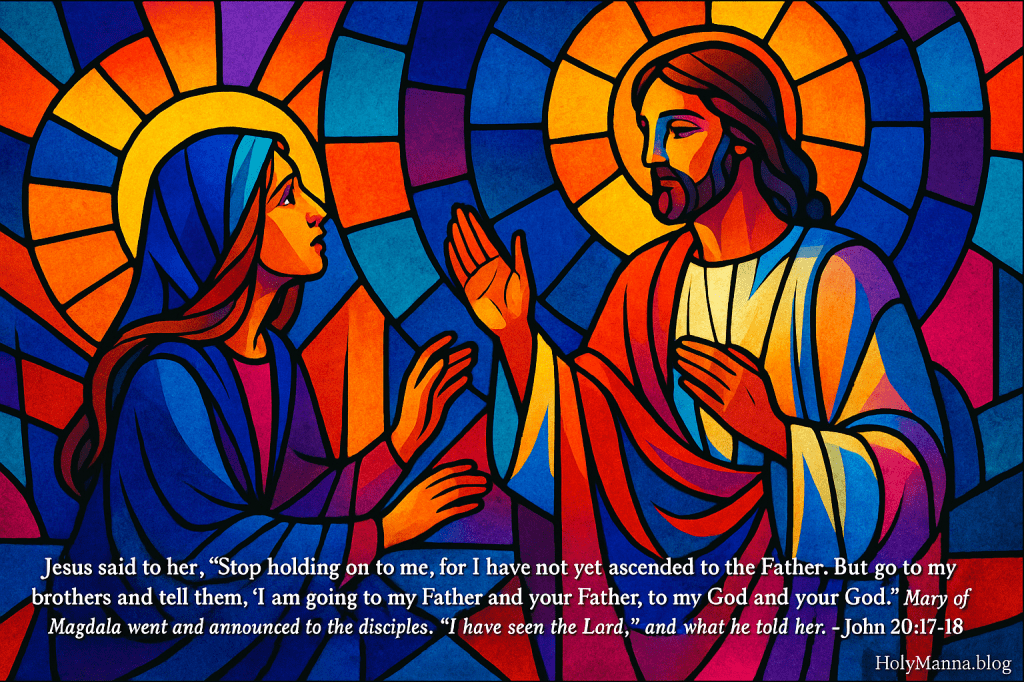
11 But Mary stayed outside the tomb weeping. And as she wept, she bent over into the tomb 12 and saw two angels in white sitting there, one at the head and one at the feet where the body of Jesus had been. 13 And they said to her, “Woman, why are you weeping?” She said to them, “They have taken my Lord, and I don’t know where they laid him.” 14 When she had said this, she turned around and saw Jesus there, but did not know it was Jesus. 15 Jesus said to her, “Woman, why are you weeping? Whom are you looking for?” She thought it was the gardener and said to him, “Sir, if you carried him away, tell me where you laid him, and I will take him.” 16 Jesus said to her, “Mary!” She turned and said to him in Hebrew, “Rabbouni,” which means Teacher. 17 Jesus said to her, “Stop holding on to me, for I have not yet ascended to the Father. But go to my brothers and tell them, ‘I am going to my Father and your Father, to my God and your God.’” 18 Mary of Magdala went and announced to the disciples, “I have seen the Lord,” and what he told her.
Detailed Exegesis
Verse 1 – “On the first day of the week, Mary of Magdala came to the tomb early in the morning, while it was still dark, and saw the stone removed from the tomb.”
Mary’s arrival “while it was still dark” points not just to the early hour but to the spiritual darkness of loss. This mirrors the bride in Song of Songs, who searches through the night. The rolled-away stone signals something miraculous, but she does not yet understand. Her love drives her, not her comprehension.
Verse 2 – “So she ran and went to Simon Peter and to the other disciple whom Jesus loved, and told them, ‘They have taken the Lord from the tomb, and we don’t know where they put him.’”
Mary’s response is immediate: she runs. The urgency of love is on full display. Her conclusion is human and grief-stricken—“they have taken the Lord”—showing that even deep love does not always grasp divine reality right away. But love keeps moving, keeps seeking.
Verse 11 – “But Mary stayed outside the tomb weeping. And as she wept, she bent over into the tomb.”
She remains. The Greek implies a deliberate, active staying—she refuses to leave. Her tears are not weakness but evidence of a heart that won’t let go. Weeping, bending, peering—this posture of longing sets the stage for encounter.
Verse 12 – “And saw two angels in white sitting there, one at the head and one at the feet where the body of Jesus had been.”
This angelic scene mirrors the Ark of the Covenant—cherubim flanking the mercy seat—indicating that the tomb has become the new Holy of Holies. Mary is standing at the very heart of the new covenant, though she does not yet see it fully.
Verse 13 – “And they said to her, ‘Woman, why are you weeping?’ She said to them, ‘They have taken my Lord, and I don’t know where they laid him.’”
The question from the angels is not a rebuke but an invitation to reflect: Why do you weep, when the victory has already been won? But Mary still interprets everything through the lens of loss. Her answer repeats the pain of verse 2, and yet—she calls Him “my Lord.”
Verse 14 – “When she had said this, she turned around and saw Jesus there, but did not know it was Jesus.”
Mary sees Him—but doesn’t recognize Him. Grief and expectation can cloud our vision. She was looking for a corpse; instead, she encounters Life itself. Sometimes, we miss Christ because we are not looking for Him in the right form.
Verse 15 – “Jesus said to her, ‘Woman, why are you weeping? Whom are you looking for?’ She thought it was the gardener and said to him, ‘Sir, if you carried him away, tell me where you laid him, and I will take him.’”
Jesus asks two profound questions. The first echoes the angels. The second is key: Whom are you looking for—not what. Mary is so focused on the absence of the body that she does not yet perceive the presence of the Person. Mistaking Him for the gardener is deeply symbolic—Jesus is, indeed, the New Adam, the Gardener of the new creation.
Verse 16 – “Jesus said to her, ‘Mary!’ She turned and said to him in Hebrew, ‘Rabbouni,’ which means Teacher.”
Everything changes with a name. The Good Shepherd calls His sheep, and she knows His voice. This is the turning point. Recognition flows not from sight, but from being known. Her response, “Rabbouni”, is not just a title; it is a cry of the heart, full of reverence and affection.
Verse 17 – “Jesus said to her, ‘Stop holding on to me, for I have not yet ascended to the Father. But go to my brothers and tell them, ‘I am going to my Father and your Father, to my God and your God.’”
Jesus gently redirects her love from clinging to mission. The Resurrection is not the end—it is the beginning of a new relationship with God. His words—“my Father and your Father, my God and your God”—extend His Sonship to us. The barriers are broken. We now share in His divine intimacy.
Verse 18 – “Mary of Magdala went and announced to the disciples, ‘I have seen the Lord,’ and what he told her.”
This is the birth of Christian witness. Mary becomes the apostola apostolorum, the apostle to the apostles. Her proclamation is simple and radiant: “I have seen the Lord.” The one who sought in tears now speaks in joy.
Teachings of the Church: The Apostle of Love and the Resurrection
Saint Mary Magdalene holds a privileged place in the Tradition of the Church. Pope Saint Gregory the Great identified her with the repentant woman of Luke 7, and though scholars may debate that identification, the Church has never doubted her significance. In 2016, Pope Francis elevated her memorial to the rank of a feast, affirming that she is “the apostle to the apostles.” The Preface for her feast proclaims: “In the garden He appeared to Mary Magdalene, who loved Him in life, who witnessed His death on the cross, who sought Him as He lay in the tomb, who was the first to adore Him when He rose from the dead, and whose apostolic duty was honored by the apostles themselves.”
The Catechism of the Catholic Church teaches that the Resurrection is the crowning truth of our faith: “The Resurrection above all constitutes the confirmation of all Christ’s works and teachings. All truths, even those most inaccessible to human reason, find their justification if Christ by His Resurrection has given the definitive proof of His divine authority” (CCC 651). And yet, this most glorious mystery was first entrusted to a woman who came weeping. In this, we learn that God often reveals His glory to the heart that loves most deeply.
Saint Thomas Aquinas wrote: “It is a greater thing to be an apostle to the apostles than to be an apostle to the Gentiles.” Mary Magdalene shows us that love, not status or learning, is what qualifies a person to proclaim Christ. She is the model of contemplative encounter turned into active mission. Her search was rewarded because she persevered in love. Her announcement—“I have seen the Lord”—remains the heart of Christian testimony.
Reflection: Recognized by Love, Sent with Joy
This Gospel pierces the heart. Do we love Jesus like Mary did—enough to rise early, to weep, to stay, to search? So often we expect resurrection joy without going through the tomb of loss, or we want spiritual vision without the tears of longing. Do we allow Jesus to call us by name? That is the turning point for Mary—and for us. We are not just part of a Church; we are personally known, loved, and sent. What might it mean for you today to hear Him say your name? And like Mary, are you ready to go and tell the world: “I have seen the Lord”? Let us sit with this Gospel in silence, letting His voice echo in our hearts, until love turns our weeping into witness.
Found by Love
Today’s liturgy draws us into the sacred drama of longing and love—a love that seeks, that weeps, that refuses to let go until it finds the One it desires. From the haunting verses of Song of Songs, where the soul rises in the night to search for “him whom my soul loves”, to Psalm 63, where David cries out in the wilderness, “For you my body yearns; for you my soul thirsts”, we are invited to recognize in our own hearts the echo of this holy hunger. The climax of this spiritual journey is found in The Gospel of John, when the Risen Christ calls Mary by name and she answers with a love that overflows into joyful witness: “I have seen the Lord.”
The Feast of Saint Mary Magdalene reminds us that God’s greatest revelations are not given to the powerful or the perfect, but to the ones who love Him with undivided hearts. Mary’s tears were not in vain—they were the pathway to resurrection joy. She searched, she stayed, and she saw. Her story shows us that every soul who clings to Christ in darkness will one day be called by name and sent into the world radiant with hope.
Are you seeking Him today? Are you thirsting for His presence in the dry places of your life? Then rise. Search. Stay. Let today be the day you allow yourself to be found by the One who has already gone ahead to prepare a place for you. Let your soul respond to His voice, and go forth like Mary Magdalene—with eyes that have seen the Lord and a heart that cannot help but proclaim Him.
Engage with Us!
We’d love to hear how today’s Scriptures touched your heart. Share your thoughts, experiences, or prayers in the comments below—your reflection might inspire someone else on their journey of faith. Take a moment with the questions below and let the Holy Spirit guide your response.
First Reading – Song of Songs 3:1–4
What are the “nighttime” moments in your life where you’ve found yourself seeking Christ? How do you respond when it feels like God is absent? Do you keep searching like the bride? What does it mean to you to hold onto Him and not let go?
Responsorial Psalm – Psalm 63:2–6, 8–9
What in your life competes with your thirst for God? Can you recall a time when God’s love truly felt “better than life”? How can you begin each day like Mary Magdalene—with a heart that rises early to seek the Lord?
Holy Gospel – John 20:1–2, 11–18
Have you heard Jesus call your name in prayer, Scripture, or silence? What might you need to let go of to hear Him more clearly or follow Him more freely? How is He calling you, like Mary, to share the Good News in your daily life?
May the example of Saint Mary Magdalene lead us to love Jesus with boldness, seek Him with perseverance, and proclaim Him with joy. Let us live every day with the faith of the saints and the tenderness of the Gospel—doing everything with the love and mercy Jesus has shown us.
Follow us on Instagram and Facebook for more insights and reflections on living a faith-filled life.

 Holy Manna!
Leave a comment