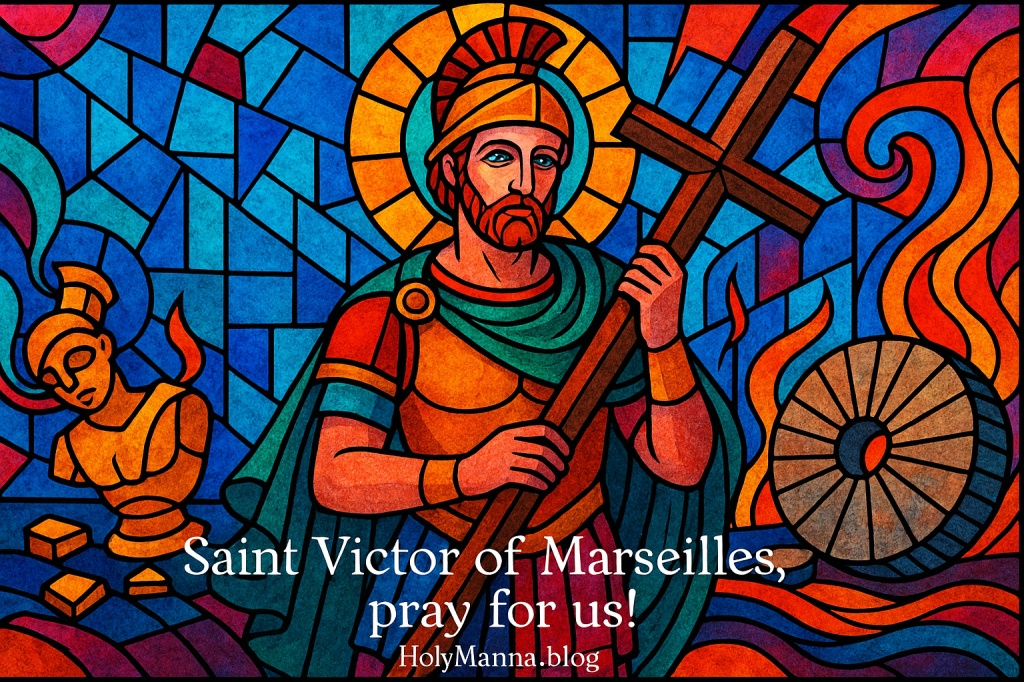
A Roman Soldier Turned Champion for Christ
In the heart of Roman Gaul, during a time of violent persecution and spiritual fear, one man chose to raise the banner of Christ in defiance of an empire. Saint Victor of Marseilles is celebrated not only as a martyr, but as a courageous and unyielding soldier of God, whose bold witness shook the very foundations of pagan authority. His name endures not just because he died for his faith—but because he lived it with such fire and integrity that it lit a path for generations of Christians.
While many early believers kept to the shadows to avoid the wrath of Rome, Victor stood tall in his convictions, a Roman officer who turned his back on imperial idolatry and embraced the scandal of the Cross. He reminds us that holiness is not found in comfort, but in conflict—the kind that purifies the heart and exposes what we truly worship. Through his life, his miracles, his martyrdom, and the many graces that followed his death, Saint Victor continues to inspire all who long to live and die for Christ.
From the Ranks of Rome to the Kingdom of Heaven
Born in the late 2nd century, likely to a noble Roman family in or around Marseilles, Victor was raised in the privileges and expectations of Roman military life. As a soldier of high rank, he was entrusted with power, duty, and a sense of loyalty to the empire. Yet within him stirred a deeper call—a voice that pointed not to Caesar, but to Christ. His conversion was not sudden, but grew stronger as he encountered Christians who bore their chains with joy and met death with hope.
Moved by their witness, Victor made the radical choice to openly embrace the Christian faith. This was no small decision. To be a Christian in the Roman army during the reign of Emperor Maximian meant choosing rejection, suffering, and likely execution. But Victor’s heart was set on a different kind of glory. He began to encourage fellow Christians in secret, offering them food, comfort, and spiritual strength while they were imprisoned for their faith.
Soon, he could no longer remain hidden. He openly proclaimed himself a follower of Jesus Christ, and his defiance of the imperial gods marked him as a traitor in the eyes of Rome. But in heaven, it marked him as a saint. His reputation grew quickly. Christians revered him for his courage and leadership. Pagans feared him for his boldness and his challenge to the religious status quo. He became known as a protector of the persecuted and a man who loved Christ more than life itself.
Grace in the Midst of Suffering
Though little is written in detail about Saint Victor’s miracles during his life, his endurance through waves of horrific torture was seen by the early Church as supernatural. His courage, peace, and even joy in the face of brutality caused many to believe he was strengthened by the Holy Spirit in extraordinary ways.
One of the most dramatic moments in his story came when he was forced before a pagan altar and commanded to offer incense to Jupiter. Refusing to betray Christ, Victor instead kicked the altar with such force that it shattered into pieces, sending fragments flying and stunning those present. This bold act of desecrating a Roman idol was not only a public rejection of the empire’s gods—it was also perceived as a direct sign that the power of Christ could break any stronghold.
This act enraged the Roman officials, who saw it as both sacrilegious and seditious. But to Christians watching from the shadows, it was a declaration: the old gods had no power here—only Christ reigned supreme. Though this event led to further punishment, it also solidified Victor’s place as a fearless witness to divine truth. It reminded Christians everywhere that God’s strength is made perfect in weakness, and that miracles often arise not from dramatic signs, but from the quiet, immovable stance of a faithful heart.
Triumph Through Torture
Victor’s final days were marked by brutality and brilliance—a radiance of faith that only intensified under the pressure of persecution. Dragged through the streets of Marseilles, Victor was beaten, imprisoned, and tortured repeatedly, all in an effort to force him to renounce Christ. He was offered every chance to save his life—if only he would burn incense to the emperor or whisper a single word of allegiance to the Roman gods. But Victor would not yield.
His refusal to conform provoked the ultimate punishment. In a grim display of Roman cruelty, Victor was tied to a millstone and crushed. This slow and merciless death was intended to send a message to other Christians: resist Rome, and this will be your fate. But Victor’s martyrdom became a message of hope instead—a seed planted in blood that would blossom into a harvest of faith.
His strength in death echoed the words of Psalm 34:19: “Many are the afflictions of the righteous, but the Lord delivers him out of them all.” Victor was not spared suffering, but he was delivered into eternal life. The Church would later call him not only a martyr, but a champion—a soldier of heaven who fought the good fight and finished the race.
Miracles That Did Not Die
After his body was recovered by devout Christians and buried with great reverence, the site of his tomb quickly became a center of miraculous activity. The faithful gathered to pray at his resting place, and healings began to occur. The blind received sight, the sick were made whole, and many were delivered from demonic oppression—all through the intercession of the one who had died for Christ.
The sacred ground would later become the site of the Abbey of Saint Victor, founded in the early 5th century by Saint John Cassian, a spiritual giant of the early monastic tradition. This abbey would go on to become one of the most influential centers of Christian life and learning in medieval Europe, attracting pilgrims, monks, and scholars from across the continent.
The crypt of the abbey, where Saint Victor’s relics remain, continues to draw the faithful to this day. Candles flicker in silent reverence. Prayers echo in ancient stone. And still, people come—longing for healing, strength, or the courage to stand for their faith in a hostile world. The miracles haven’t stopped. Saint Victor’s legacy is alive, not just in history, but in the hearts of all who call upon him with faith.
Courage in Our Own Battlefields
Saint Victor’s life was not just a historical account—it is a living blueprint for every Christian who wants to follow Christ without compromise. In a culture where faith is often mocked, where truth is distorted, and where silence is praised over courage, Saint Victor reminds us that discipleship is not about comfort—it is about the Cross.
What idols are we being asked to stand against today? Where is God calling us to speak truth even when it costs us something? Whether we face social pressure, career risks, or internal fears, we are each called to take up our Cross and follow Christ.
“Whoever is ashamed of me and of my words, of him will the Son of Man be ashamed” (Luke 9:26). These words were etched into the life of Saint Victor. He was not ashamed. He did not retreat. And in doing so, he brought light into darkness.
To live like Victor is to pray with boldness, to serve with compassion, and to speak with conviction. It means loving the truth more than popularity, and loving God more than life itself. It may not lead to martyrdom—but it will certainly lead to holiness.
Engage with Us!
We’d love to hear how Saint Victor’s life has inspired you. Share your thoughts in the comments!
Reflection Questions:
- What “altars” of compromise or comfort am I being called to destroy in my life to serve Christ more fully?
- How can I encourage and support others who are enduring persecution, ridicule, or discouragement in their faith?
- What does it mean to be a “soldier for Christ” in my everyday life?
Let’s lift one another up in prayer and strive to live out our faith with love, courage, and unwavering trust in Jesus—just like Saint Victor did.
Saint Victor of Marseilles, pray for us! ✝️
Follow us on Instagram and Facebook for more insights and reflections on living a faith-filled life.

 Holy Manna!
Leave a comment