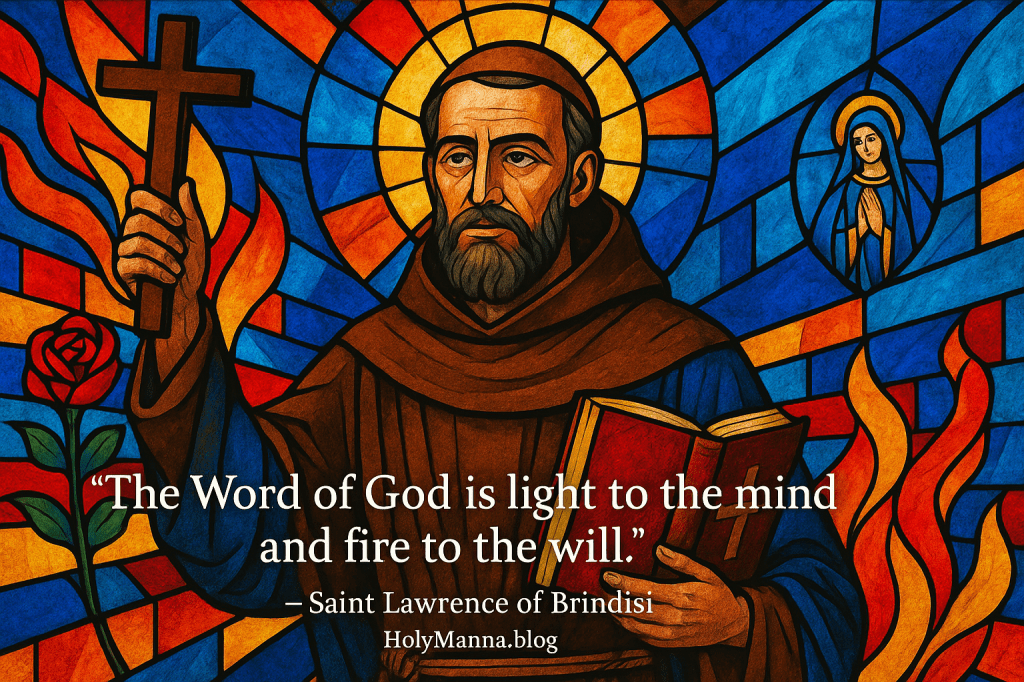
The Capuchin Warrior of the Word
Saint Lawrence of Brindisi, born Giulio Cesare Russo on July 22, 1559, in the city of Brindisi in southern Italy, came into the world during a time of spiritual renewal in the Church following the Council of Trent. From an early age, Lawrence showed an exceptional intellectual capacity and deep sensitivity to the things of God. His parents were devout Catholics who died when he was only a boy, leaving him in the care of his uncle in Venice. There, he studied at the College of Saint Mark and later at the University of Padua, developing a love for languages, Scripture, and philosophy. His heart, however, longed for more than academic greatness—it longed for holiness.
At just sixteen years old, he joined the Capuchin branch of the Franciscan Order, a movement known for its radical poverty and intense devotion. Taking the name Lawrence, he committed himself wholly to God, modeling his life after Saint Francis of Assisi. His gift for languages blossomed within the order. He became fluent not only in Italian and Latin but also in Hebrew, Greek, German, Spanish, French, and Syriac. This linguistic skill would later become a vital asset in his preaching and missionary endeavors.
Saint Lawrence was not merely a scholar—he was a preacher with fire in his bones. After his ordination in 1582, he was quickly recognized for his powerful sermons, which stirred hearts to repentance and renewed faith. He preached with such authority and clarity that both the learned and the simple were moved to tears. Throughout his life, he would serve in many roles: teacher, novice master, minister provincial, papal emissary, and ultimately, Minister General of the Capuchins. Yet in all these positions, his heart remained rooted in his first love: Jesus Christ in the Eucharist, Sacred Scripture, and Our Lady, whom he called his “sweetest mother.” He embodied the mission of 2 Timothy 4:2: “Preach the word, be urgent in season and out of season, convince, rebuke, and exhort, be unfailing in patience and in teaching.”
Heaven Breaks Through: Miracles of a Living Saint
Even while alive, Saint Lawrence of Brindisi was recognized as a conduit of divine grace and power. Though he himself was deeply humble and never sought attention for supernatural occurrences, countless people testified to miracles that accompanied his ministry. These were not simply occasional signs but recurring evidences of God’s favor working through His servant.
One of the most remarkable moments occurred during the siege of Stuhlweissenburg in Hungary in 1601. The Christian forces were demoralized and outnumbered by the advancing Ottoman army. Lawrence, appointed as chaplain to the troops, did not take up arms, but mounted a horse, held aloft a crucifix, and rode at the front lines while fervently praying. His very presence emboldened the soldiers, and against all odds, the Christian army triumphed. After the battle, soldiers and commanders alike credited the victory not to their weapons, but to Lawrence’s intercession and the power of the Cross.
In Austria and Bohemia, his care for the poor and sick became legendary. In one instance, while preaching a mission in an area struck by famine, Lawrence prayed over a storehouse of grain that had nearly run dry. Miraculously, the supplies multiplied, and the friars were able to feed the hungry for many more weeks. In another region, a woman possessed by demons was brought to him. With calm prayer and the authority of Christ, he exorcised the evil spirits, restoring her to peace and health.
He was also known to heal the gravely ill, often through simple acts of faith—a touch, a blessing, or the laying on of his Capuchin mantle. Yet in all this, Lawrence pointed not to himself, but to the Lord, echoing the words of Psalm 115:1: “Not to us, O Lord, not to us, but to your name give glory.”
A Cross-Bearer in the Courtroom and on the Battlefield
Though he was never martyred by the sword, Saint Lawrence of Brindisi bore immense hardship for the sake of the Gospel. As a preacher and theologian confronting Protestant reformers in Germany, he faced hostility, accusations of heresy, and physical threats. In many towns, he was met with suspicion and even violence, but his gentle spirit and razor-sharp intellect often won over not only the people but even his opponents.
His greatest trials, however, came not from heretics, but from within the Church and political structures. As a papal diplomat, he was sent on delicate missions across Europe to mediate conflicts between kings and princes—often walking into courts filled with suspicion and manipulation. In some cases, his attempts to uphold justice for oppressed peoples were met with ridicule or resistance from the very leaders who called upon him.
In his final mission, Lawrence traveled to Spain on behalf of the Kingdom of Naples to plead the case of the Neapolitans who were suffering under harsh rule. The journey was long and taxing. Already aging and physically weakened, Lawrence persisted out of love for his people and faith in the mission entrusted to him. Not long after arriving in Lisbon, he fell gravely ill. Worn down by fatigue and hardship, he surrendered his soul to God on July 22, 1619—his 60th birthday.
His endurance was heroic, mirroring 2 Corinthians 4:8-9: “We are afflicted in every way, but not crushed; perplexed, but not driven to despair… struck down, but not destroyed.” He suffered not for his own sake, but for the sake of Christ and His Church.
He Still Walks With Us: Grace Beyond the Grave
After his death, the miracles did not cease. Saint Lawrence of Brindisi’s tomb in Lisbon and later in Brindisi became a place of prayer and healing. Pilgrims reported physical cures, spiritual conversions, and answered prayers. His Capuchin brothers carefully preserved his writings, especially his sermons and theological treatises, which span over 15 volumes and delve deeply into Christology, Mariology, and Sacred Scripture.
One remarkable posthumous miracle occurred when a deadly plague swept through a town that had erected a chapel in his honor. The townspeople turned to Saint Lawrence with fervent prayers, and within days, the plague receded. The local bishop declared it a miraculous intervention through the saint’s intercession.
Devotion to Lawrence spread across Italy, Germany, Austria, and Hungary. His relics, particularly his breviary and crucifix, were venerated and became associated with several reported healings. Even in our own time, faithful Catholics turn to him as a patron of missionaries, preachers, and those in public service. His title as Doctor Apostolicus, granted by Pope Saint John XXIII in 1959, reflects the Church’s recognition of his contribution not just in miracle-working, but in shaping the Church’s intellectual and pastoral life.
He is living proof of Wisdom 3:1: “The souls of the righteous are in the hand of God, and no torment shall touch them.”
A Life to Imitate: Zeal, Wisdom, and Total Trust
Saint Lawrence of Brindisi invites every Catholic—whether priest, layperson, scholar, or soldier—to give everything to God. He shows us that holiness is not confined to the cloister or pulpit, but can transform courts, battlefields, and even the most hardened of hearts. His life is a testament to the Church’s mission to proclaim the Gospel in every language, to every nation, and with every fiber of one’s being.
What holds us back from proclaiming the Word with such fervor?
Do we see the Scriptures as the living voice of God, capable of healing, convicting, and transforming?
Are we willing to stand firm in faith even when surrounded by indifference or hostility?
We can begin to imitate Saint Lawrence by immersing ourselves daily in Sacred Scripture (CCC 133), praying for the gifts of the Holy Spirit (Isaiah 11:2), and entrusting our daily work to Our Lady, as Lawrence always did. His devotion to the Blessed Virgin was not sentimental but deeply theological. He defended her Immaculate Conception centuries before it became dogma, declaring her the “Spouse of the Holy Spirit” and the “Ark of the New Covenant.”
Let us ask Saint Lawrence to teach us how to live with fiery charity, to preach the truth with tenderness and courage, and to offer every suffering for the glory of God.
Engage with Us!
We’d love to hear how the life of Saint Lawrence of Brindisi inspires you! Share your thoughts in the comments and support one another in faith.
Reflection Questions:
- How can you grow in courage to speak the truth of the Gospel in your daily life?
- In what areas of your life is God calling you to greater zeal and trust in His Word?
- How can you deepen your knowledge of Scripture and theology like Saint Lawrence, even in small ways?
Let us walk together in faith, uplift each other, and strive to do everything with love—just as our Lord Jesus Christ and His servant, Saint Lawrence of Brindisi, did.
Saint Lawrence of Brindisi, pray for us! ⚔️
Follow us on Instagram and Facebook for more insights and reflections on living a faith-filled life.

 Holy Manna!
Leave a comment