Monday of the Sixteenth Week in Ordinary Time – Lectionary: 395
When the Sea Is in Front of You
Have you ever found yourself staring at an impossible situation, wondering how God could possibly show up? Today’s readings speak powerfully to those moments when fear rises, faith is tested, and God’s saving hand is closer than we think. From the edge of the Red Sea to the hardened hearts of skeptics, Scripture today invites us to remember who fights our battles—and to trust even when the signs are hidden or the waters haven’t parted yet.
In Exodus 14, we find the Israelites freshly liberated from slavery, only to face a terrifying trap: the sea before them and Pharaoh’s army behind. Their panic is understandable—after centuries of oppression, this felt like a cruel ending. Yet Moses, in a moment of profound spiritual leadership, tells them: “The Lord will fight for you; you have only to keep still” (Exodus 14:14). What follows is one of the greatest moments of salvation in the Old Testament—the parting of the Red Sea—a divine act meant not just to save, but to glorify God before both Egypt and Israel. The Responsorial Psalm (from Exodus 15) becomes a song of victory and remembrance: “I will sing to the Lord, for he is gloriously triumphant; horse and chariot he has cast into the sea” (Exodus 15:1). This is the liturgy of the rescued—a song of those who have seen God work wonders.
Fast forward to The Gospel of Matthew (12:38–42), and we find the scribes and Pharisees demanding another sign from Jesus, blind to the fact that God Himself stands before them. Jesus points instead to the “sign of Jonah”—His coming death and resurrection—as the only sign they’ll receive. Just as the Israelites stood at the sea in fear, and just as Nineveh repented at Jonah’s preaching, we too are called to trust and respond—not to demand proofs. The central thread across these passages is clear: God saves, but not always on our terms. He calls us to faith in action—to step forward into the waters, to trust His promises, and to see with the eyes of the Spirit. What seas lie before you today—and will you trust Him to lead you through?
First Reading – Exodus 14:5–18
Trusting God at the Brink
Today’s first reading plunges us into one of the most dramatic moments in salvation history—the crossing of the Red Sea. Taken from the Book of Exodus, this passage recounts Israel’s climactic flight from slavery in Egypt. Exodus is not only the second book of the Bible but a foundational narrative of God’s covenantal relationship with His people. Through Moses, God leads the Israelites out of bondage, revealing Himself as both Deliverer and Warrior. This story would later serve as a spiritual template for liberation, echoed in Christian baptism, which the Church calls our “passage through the Red Sea” (CCC 1221). Historically, the Israelites had just left Egypt after a series of miraculous plagues, and their journey seemed to be a triumphant escape. But suddenly, they find themselves pinned between Pharaoh’s pursuing army and the sea, forced to either trust or despair. It is here that faith is either born or abandoned. In light of today’s theme, this reading invites us to reflect on the moments when God calls us forward—even when the path ahead looks like death itself.
Exodus 14:5-18
New American Bible (Revised Edition)
5 When it was reported to the king of Egypt that the people had fled, Pharaoh and his servants had a change of heart about the people. “What in the world have we done!” they said. “We have released Israel from our service!” 6 So Pharaoh harnessed his chariots and took his army with him. 7 He took six hundred select chariots and all the chariots of Egypt, with officers on all of them. 8 The Lord hardened the heart of Pharaoh, king of Egypt, so that he pursued the Israelites while they were going out in triumph. 9 The Egyptians pursued them—all Pharaoh’s horses, his chariots, his horsemen, and his army—and caught up with them as they lay encamped by the sea, at Pi-hahiroth, in front of Baal-zephon.
Crossing the Red Sea. 10 Now Pharaoh was near when the Israelites looked up and saw that the Egyptians had set out after them. Greatly frightened, the Israelites cried out to the Lord. 11 To Moses they said, “Were there no burial places in Egypt that you brought us to die in the wilderness? What have you done to us, bringing us out of Egypt? 12 Did we not tell you this in Egypt, when we said, ‘Leave us alone that we may serve the Egyptians’? Far better for us to serve the Egyptians than to die in the wilderness.” 13 But Moses answered the people, “Do not fear! Stand your ground and see the victory the Lord will win for you today. For these Egyptians whom you see today you will never see again. 14 The Lord will fight for you; you have only to keep still.”
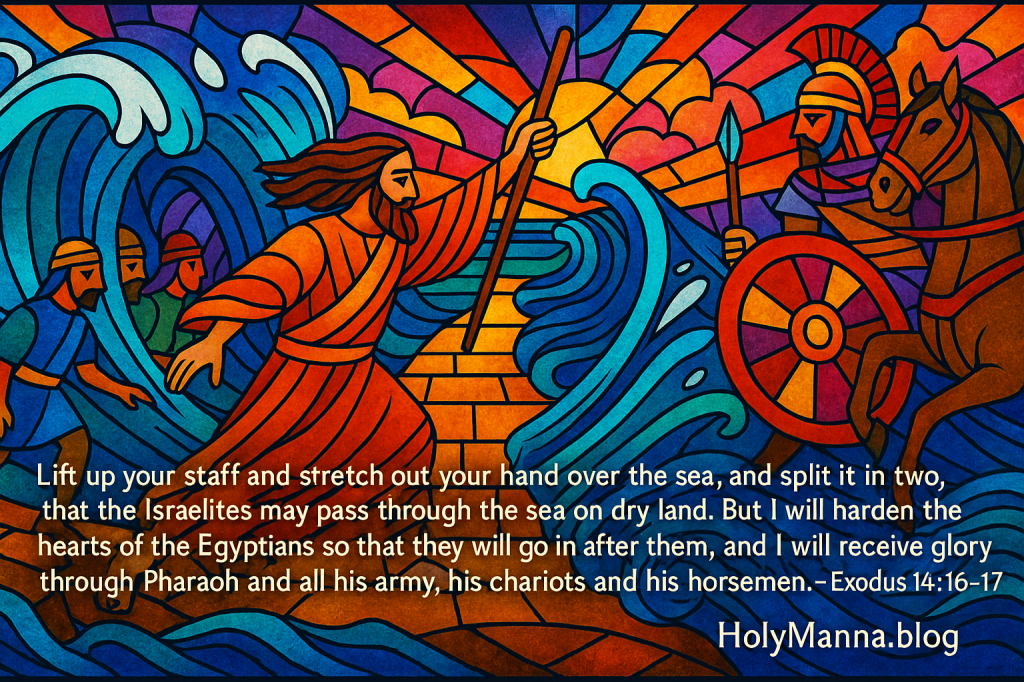
15 Then the Lord said to Moses: Why are you crying out to me? Tell the Israelites to set out. 16 And you, lift up your staff and stretch out your hand over the sea, and split it in two, that the Israelites may pass through the sea on dry land. 17 But I will harden the hearts of the Egyptians so that they will go in after them, and I will receive glory through Pharaoh and all his army, his chariots and his horsemen. 18 The Egyptians will know that I am the Lord, when I receive glory through Pharaoh, his chariots, and his horsemen.
Detailed Exegesis
Verse 5 – “When it was reported to the king of Egypt that the people had fled, Pharaoh and his servants had a change of heart about the people. ‘What in the world have we done!’ they said. ‘We have released Israel from our service!’”
Pharaoh’s reversal is rooted in fear and pride. Despite having witnessed the ten plagues, his heart is once again hardened—a theme repeated throughout Exodus. He regrets releasing the Israelites, not because of any spiritual insight, but because of economic loss. The Israelites, who had served as Egypt’s slave labor force, are now viewed not as human beings but as property lost. This reflects a spiritual blindness that sees others only in terms of utility, not dignity.
Verse 6 – “So Pharaoh harnessed his chariots and took his army with him.”
This verse shows the might of Egypt—the chariot was the most advanced military technology of the time. Pharaoh prepares for war, trusting in worldly strength and not heeding the divine signs he has already witnessed. His reaction reveals a heart that values domination over discernment.
Verse 7 – “He took six hundred select chariots and all the chariots of Egypt, with officers on all of them.”
The emphasis on “six hundred select chariots” heightens the sense of danger Israel faces. Humanly speaking, this is a hopeless situation. These elite forces were trained for swift annihilation, signaling that Pharaoh is not just chasing runaway slaves—he is attempting to obliterate them entirely.
Verse 8 – “The Lord hardened the heart of Pharaoh, king of Egypt, so that he pursued the Israelites while they were going out in triumph.”
This often misunderstood verse does not mean that God forced Pharaoh to sin, but that He allowed Pharaoh’s heart to follow its chosen path, thereby fulfilling divine justice. As St. Augustine teaches, “God does not harden by creating malice in hearts, but by not giving mercy.” (De Gratia et Libero Arbitrio, 21). The Israelites, meanwhile, go out “in triumph”—yet that confidence is about to be tested.
Verse 9 – “The Egyptians pursued them—all Pharaoh’s horses, his chariots, his horsemen, and his army—and caught up with them as they lay encamped by the sea, at Pi-hahiroth, in front of Baal-zephon.”
The location underscores Israel’s helplessness. They are surrounded—Pharaoh’s forces at their back and the sea at their front. Baal-zephon, a Canaanite deity, may have been worshipped in that area, symbolizing the false powers that Israel is about to see conquered by the one true God.
Verse 10 – “Now Pharaoh was near when the Israelites looked up and saw that the Egyptians had set out after them. Greatly frightened, the Israelites cried out to the Lord.”
The Israelites, like us, vacillate between trust and terror. Their fear is understandable but reveals their still-fragile faith. This verse marks the first of many moments when Israel will struggle to believe, even after experiencing miracles.
Verse 11 – “To Moses they said, ‘Were there no burial places in Egypt that you brought us to die in the wilderness? What have you done to us, bringing us out of Egypt?’”
This biting sarcasm is meant to shame Moses—and indirectly, God. The reference to “burial places” echoes Egypt’s obsession with tombs and afterlife, suggesting that death under Pharaoh was preferable to trust in the unknown. It’s a stunning rejection of divine liberation.
Verse 12 – “Did we not tell you this in Egypt, when we said, ‘Leave us alone that we may serve the Egyptians’? Far better for us to serve the Egyptians than to die in the wilderness.”
Here we see the seductive nature of slavery. Fear convinces the people that servitude is safer than freedom. St. John Chrysostom remarks, “They preferred their chains to the promises of God, as many do who cling to sin out of fear of repentance.”
Verse 13 – “But Moses answered the people, ‘Do not fear! Stand your ground and see the victory the Lord will win for you today. For these Egyptians whom you see today you will never see again.’”
This is a turning point. Moses’ response is one of bold faith. He does not propose a military strategy or negotiation—he simply invites them to witness God’s salvation. It’s the call of every believer: to stand firm in faith and wait upon the Lord.
Verse 14 – “The Lord will fight for you; you have only to keep still.”
This is perhaps one of the most consoling verses in all of Scripture. Stillness is not passivity—it is trust. In moments of chaos, our call is not to control, but to surrender. CCC 2737 reminds us: “‘Do not be troubled if you do not immediately receive from God what you ask him; for he desires to do something even greater for you.’” (St. Evagrius, quoted in CCC 2737).
Verse 15 – “Then the Lord said to Moses: Why are you crying out to me? Tell the Israelites to set out.”
God now tells Moses that prayer must turn into action. There is a time for stillness, and a time to move. This is holy obedience—not activism, but faithful movement in response to God’s command.
Verse 16 – “And you, lift up your staff and stretch out your hand over the sea, and split it in two, that the Israelites may pass through the sea on dry land.”
The staff is the same one used during the plagues—it represents divine authority. The miracle here is not symbolic. It is real, historical, and foundational. The Catechism teaches that this event prefigures baptism: “The crossing of the Red Sea, truly the liberation of Israel from the slavery of Egypt, announces the liberation wrought by Baptism” (CCC 1221).
Verse 17 – “But I will harden the hearts of the Egyptians so that they will go in after them, and I will receive glory through Pharaoh and all his army, his chariots and his horsemen.”
This verse emphasizes that God is not merely delivering Israel—He is revealing His glory. Pharaoh’s pride becomes the stage for God’s justice and might. All will know who the true Lord is.
Verse 18 – “The Egyptians will know that I am the Lord, when I receive glory through Pharaoh, his chariots, and his horsemen.”
This verse closes the passage with the central message: God acts not only to save, but to reveal Himself. His glory is not ego—but truth breaking through illusion. The false gods of Egypt will be exposed by the might of the living God.
Teachings from the Heart of the Church
The Church has always understood the crossing of the Red Sea as a symbol of Christian baptism. The Catechism of the Catholic Church teaches: “The liberation of Israel from the slavery of Egypt announces the liberation wrought by Baptism” (CCC 1221). Just as Israel passed through water into freedom, so too do we pass through the waters of baptism into new life in Christ. This is no mere metaphor—this is sacramental reality. Our baptism is not just a washing but a death and resurrection, just as the Israelites passed from the shadow of death into the light of God’s promise.
St. Ambrose echoes this teaching in his catechetical writings, saying: “You were in slavery, but through the water you were set free.” He calls the Red Sea a type of the font, where the enemy is drowned and the faithful emerge victorious. Likewise, St. Gregory of Nyssa wrote: “The Egyptians who pursued them are an image of sin, which is buried in the waters and does not rise again.” This is the mystery of divine justice and mercy—that God delivers not only from outward enemies but from the interior slavery of sin.
Historically, this reading was used in the Easter Vigil, underscoring its deep connection to the Resurrection. The Church places it among the essential stories of salvation history, reminding the faithful that the same God who delivered Israel delivers us—if we are willing to walk forward in trust, even when the waters haven’t yet parted. God does not always remove the obstacle immediately, but He always leads His people through.
Reflection: Walking Forward into the Unknown
This reading invites us to locate ourselves spiritually on the edge of the sea. What fear, addiction, habit, or situation has you feeling trapped today? Do you look back longingly at the false comfort of old sins, as Israel looked back at Egypt? Or are you willing to move forward—even if it feels terrifying—because you trust that God is already working ahead of you? How often do we ask for deliverance while remaining unwilling to take the first step of obedience?
Perhaps you’re in a season of stillness—God’s voice is quiet, and you feel paralyzed. Exodus 14:14 speaks directly to that heart: “The Lord will fight for you; you have only to keep still.” But then comes verse 15, when God says, “Tell the Israelites to set out.” There is a time to rest and a time to walk. Wisdom is knowing which God is asking of you right now.
Today, let’s ask for the grace to trust God on both sides of the sea—when the armies are approaching and the water has not yet parted, and when we are walking through the impossible with walls of water on either side. Where is God inviting you to lift your staff and move forward in faith?
Responsorial Psalm – Exodus 15:1–6
A Song of Deliverance
The Responsorial Psalm for today is not a typical psalm from the Book of Psalms, but a song of victory from Exodus 15, known traditionally as the “Song of the Sea.” It is the first recorded song of praise in Scripture, sung by Moses and the Israelites immediately after their miraculous deliverance through the Red Sea. This canticle is both poetic and theological—praising God’s triumph over evil, exalting Him as Savior, and anchoring Israel’s identity in worship and remembrance. In Jewish tradition, this song is considered one of the Ten Songs of Scripture. In Christian liturgy, it has often been chanted at the Easter Vigil, symbolizing our own victory through the waters of baptism. Today, this psalm forms the heart’s response to the First Reading. Where fear once gripped the people, now joy and awe erupt into worship. It reminds us that praise is not just something we offer when life is easy—it is the proper response to seeing God’s hand at work.
Exodus 15:1-6
New American Bible (Revised Edition)
1 Then Moses and the Israelites sang this song to the Lord:
I will sing to the Lord, for he is gloriously triumphant;
horse and chariot he has cast into the sea.
2 My strength and my refuge is the Lord,
and he has become my savior.
This is my God, I praise him;
the God of my father, I extol him.
3 The Lord is a warrior,
Lord is his name!
4 Pharaoh’s chariots and army he hurled into the sea;
the elite of his officers were drowned in the Red Sea.
5 The flood waters covered them,
they sank into the depths like a stone.
6 Your right hand, O Lord, magnificent in power,
your right hand, O Lord, shattered the enemy.
Detailed Exegesis
Verse 1 – “Then Moses and the Israelites sang this song to the Lord: ‘I will sing to the Lord, for he is gloriously triumphant; horse and chariot he has cast into the sea.’”
This opening line is both a declaration and a doxology. The Hebrew verb for “sing” is future-tense, implying an ongoing promise to praise. The song attributes victory not to Israel’s efforts, but solely to God. The phrase “horse and chariot he has cast into the sea” deliberately reverses the natural order of power—God drowns what the world deems unstoppable.
Verse 2 – “My strength and my refuge is the Lord, and he has become my savior. This is my God, I praise him; the God of my father, I extol him.”
This verse personalizes salvation: “my strength…my refuge…my savior.” It is a proclamation of intimacy with God rooted in collective memory: “the God of my father.” Worship becomes the response to both present deliverance and ancestral promise. The word “refuge” evokes the Psalms and the safety God provides to His people in times of trouble.
Verse 3 – “The Lord is a warrior, Lord is his name!”
Here God is portrayed as a divine warrior, not in cruelty but in justice. This is not about violence for its own sake but the righteous defense of the innocent and oppressed. The Catechism echoes this balance, teaching that “God is the sovereign master of his plan. But to carry it out he also makes use of his creatures’ cooperation” (CCC 306)—even if that means overturning evil by force.
Verse 4 – “Pharaoh’s chariots and army he hurled into the sea; the elite of his officers were drowned in the Red Sea.”
This line continues the theme of reversal. The most feared and powerful men of Egypt—the elite—are brought down not by battle but by divine intervention. God’s justice is exact, and His glory is not limited by earthly hierarchies.
Verse 5 – “The flood waters covered them, they sank into the depths like a stone.”
The poetic imagery here is stark and sobering. “Like a stone” emphasizes the finality of God’s judgment. It also contrasts with the Israelites walking on dry land—those who walk with God do not sink, but are upheld. St. Peter, recalling a similar scene, begins to sink only when he doubts. This verse subtly teaches that trust is the path to stability.
Verse 6 – “Your right hand, O Lord, magnificent in power, your right hand, O Lord, shattered the enemy.”
The repetition of “your right hand” emphasizes God’s power and favor. In Scripture, the right hand symbolizes authority and blessing. The Church often invokes this imagery in the liturgy, especially in reference to Christ seated at the right hand of the Father. Here, God’s hand is not passive—it is “magnificent in power”, actively shattering what seeks to enslave His people.
Teachings from the Heart of the Church
The Catechism of the Catholic Church draws a direct line between this ancient song and the new life we receive through Christ. It teaches: “By Baptism all sins are forgiven… and the person becomes ‘a new creature,’ an adopted son of God” (CCC 1265). The Song of the Sea is more than historical celebration—it is spiritual prophecy. Just as the Israelites rose from the waters as a free people, so do we rise from the baptismal font as citizens of the Kingdom of God.
St. Basil the Great, reflecting on the Red Sea, wrote: “We are not washed in mere water, but in the blood and power of the Crucified One.” For him, this song was fulfilled not only in deliverance from Pharaoh but in Christ’s victory over sin and death. Likewise, Origen, one of the early Fathers, noted that “Pharaoh is a figure of the devil; his chariots and horsemen are demons, and the sea is the water of baptism that drowns the enemy.”
This psalm also teaches us something essential about the nature of liturgy. After divine action comes human response. The Song of the Sea models how worship should follow wonder. Sacrosanctum Concilium, Vatican II’s constitution on the sacred liturgy, teaches: “In the liturgy, God speaks to His people and Christ is still proclaiming His Gospel. The people respond to God both by song and prayer.” (SC 33). True worship is born not from performance but from encounter—and this is exactly what the Israelites model for us on the other side of the sea.
Reflection: Worship as a Weapon
This psalm challenges us to reflect: Do I celebrate God’s victories in my life? Or do I rush past them, always focused on the next struggle? The Israelites, freshly saved, don’t move forward without stopping to worship. Their song teaches us that praise is not optional—it is the natural breath of a soul that has seen God act.
We live in a time where gratitude often gets lost in anxiety. But the Church calls us to pause and sing—to proclaim that the Lord is both Warrior and Savior. When was the last time you sang to God—not just with lips, but with a heart full of wonder? Do you allow your prayer life to include joy, awe, and triumph? Today’s psalm reminds us that after every storm, a song is waiting. May we be ready to sing it when God brings us through.
Holy Gospel – Matthew 12:38–42
The Sign of Jonah
Today’s Gospel brings us to a tense exchange between Jesus and some of the scribes and Pharisees—religious leaders who, despite witnessing healings and miracles, remain spiritually blind and demand further proof. Set in The Gospel of Matthew, a text written to a Jewish-Christian audience, this passage resonates deeply with the recurring theme of hardened hearts and reluctant faith. Just as Pharaoh demanded signs but ignored their meaning, so too do these leaders ask Jesus for a spectacle rather than embrace the Savior. Jesus does not entertain their request but redirects them to a prophetic sign—the story of Jonah. This passage fits seamlessly into today’s theme: the call to trust God’s plan even when we don’t understand it, to move forward not because we see clearly, but because we believe firmly. The Gospel invites us to ask not What sign do I demand from God? but rather, Am I willing to trust in the sign already given?
Matthew 12:38-42
New American Bible (Revised Edition)
38 Then some of the scribes and Pharisees said to him, “Teacher, we wish to see a sign from you.” 39 He said to them in reply, “An evil and unfaithful generation seeks a sign, but no sign will be given it except the sign of Jonah the prophet. 40 Just as Jonah was in the belly of the whale three days and three nights, so will the Son of Man be in the heart of the earth three days and three nights. 41 At the judgment, the men of Nineveh will arise with this generation and condemn it, because they repented at the preaching of Jonah; and there is something greater than Jonah here. 42 At the judgment the queen of the south will arise with this generation and condemn it, because she came from the ends of the earth to hear the wisdom of Solomon; and there is something greater than Solomon here.
Detailed Exegesis
Verse 38 – “Then some of the scribes and Pharisees said to him, ‘Teacher, we wish to see a sign from you.’”
The request may seem innocent, but it is rooted in skepticism. Despite having witnessed miracles—including exorcisms and healings—the scribes and Pharisees ask for something more, likely a dramatic, undeniable cosmic sign. Their request reveals not faith, but resistance veiled in religious language. In Scripture, those who truly seek signs from God often do so in humility. These men, however, ask from a place of control and pride.
Verse 39 – “He said to them in reply, ‘An evil and unfaithful generation seeks a sign, but no sign will be given it except the sign of Jonah the prophet.’”
Jesus’ response is strong. He labels their generation “evil and unfaithful”—language reserved for Israel during periods of deep rebellion. This harshness is not cruelty, but a prophetic urgency. The “sign of Jonah” refers to Jonah’s three days in the belly of the great fish, which becomes a foreshadowing of Jesus’ death, burial, and resurrection. The true sign will not be a sky-opening wonder, but the paradoxical path of suffering and glory.
Verse 40 – “Just as Jonah was in the belly of the whale three days and three nights, so will the Son of Man be in the heart of the earth three days and three nights.”
Here Jesus makes the typology explicit. Jonah’s descent into the sea creature and emergence alive symbolizes Jesus’ Passion and Resurrection. “Three days and three nights” is a Jewish idiom meaning a full period of death. The “heart of the earth” refers to the tomb. Jesus is saying: the sign you will receive is not flashy, but redemptive. His Resurrection will be the ultimate divine signature, one that requires faith to receive.
Verse 41 – “At the judgment, the men of Nineveh will arise with this generation and condemn it, because they repented at the preaching of Jonah; and there is something greater than Jonah here.”
The Ninevites, Gentiles who repented after Jonah’s reluctant prophecy, will serve as witnesses against the religious elite who rejected Christ. Jesus is not only comparing, but contrasting: the pagan city listened to a flawed prophet, yet the chosen people ignore the Word made flesh. His statement underscores that receptivity to God’s message matters more than status or heritage.
Verse 42 – “At the judgment the queen of the south will arise with this generation and condemn it, because she came from the ends of the earth to hear the wisdom of Solomon; and there is something greater than Solomon here.”
Again, Jesus contrasts faith from outside Israel with unbelief within it. The Queen of Sheba sought wisdom from Solomon with great effort. Jesus, who is the Wisdom of God incarnate (1 Corinthians 1:24), stands before them—and they remain unmoved. The implication is sobering: judgment will come not based on how much we know, but how we respond to what we have been given.
Teachings from the Heart of the Church
The Church teaches that Jesus’ death and resurrection are the definitive signs of God’s love and power. The Catechism of the Catholic Church states: “The Paschal mystery of Christ’s cross and Resurrection stands at the center of the Good News… God’s saving plan was accomplished ‘once for all’ by the redemptive death of his Son Jesus Christ” (CCC 571). The sign of Jonah is not merely a foreshadowing—it is the centerpiece of salvation history. When we demand signs apart from the Cross, we misunderstand how God works: not always in power, but in love and sacrifice.
St. Augustine reflects on this Gospel when he writes, “You seek signs, but the sign has already been given: the Lord’s Resurrection is the foundation of our faith” (Sermon 229E). For the early Church, this truth was central. They preached not moral rules or clever arguments, but Christ crucified and risen. As St. Paul says, “Jews demand signs and Greeks seek wisdom, but we preach Christ crucified” (1 Corinthians 1:22–23). Jesus is the sign, and the call is to believe, not bargain.
The desire for miraculous signs is not wrong in itself, but becomes disordered when it replaces the trust that faith demands. CCC 548 clarifies: “Miracles strengthen faith in the One who does His Father’s works; they bear witness that He is the Son of God. But miracles can also be occasions for ‘offense.’ They are not intended to satisfy people’s curiosity or desire for magic.” Faith requires humility—a willingness to accept the sign already given, rather than demanding one on our own terms.
Reflection: The Sign Has Already Been Given
This Gospel reading challenges us to ask: Am I still waiting for God to prove Himself? What signs am I demanding before I trust, obey, or forgive? Like the Pharisees, we can hide our fear and doubt behind religious questions. But Jesus calls us deeper. He has already gone into the “belly of the whale”—the tomb—for us. Will we let that be enough?
We often think faith would be easier if we saw more signs. But Scripture tells a different story: people saw seas part and still doubted; they saw Lazarus raised and still plotted to kill Jesus. The issue is not God’s silence—it is often our unwillingness to see. Do you live your life in response to the Resurrection? Or are you still waiting for another reason to believe?
Today, Christ invites us to remember that “there is something greater than Jonah here”—and He is alive. The greatest sign has already been given, and it is not written in the sky but engraved on the wood of the Cross and the empty tomb. What more do we need to surrender our hearts in faith?
Through the Waters and Beyond the Tomb
Today’s readings speak with one voice—a voice calling us to trust in God’s power even when we feel trapped, overwhelmed, or doubtful. From the Israelites trembling at the sea’s edge, to Moses declaring “The Lord will fight for you; you have only to keep still” (Exodus 14:14), to the Song of the Sea rejoicing in a God who shatters our enemies and carries us through on dry ground, to Jesus pointing us toward the sign of Jonah—His own death and resurrection—we are reminded that God’s way of saving us often begins where our way ends.
Each passage calls us to see not with the eyes of fear or control, but with the eyes of faith. The Israelites were called to walk forward into what seemed like certain death. The Ninevites repented without seeing a miracle. The Queen of Sheba journeyed far just to hear wisdom. And we—living on the other side of the Cross and the Resurrection—have been given the ultimate sign: Jesus Christ crucified and risen, who calls us to believe and follow even when the waters have not yet parted.
Where is God asking you to trust Him today? What tomb are you standing in front of, waiting for resurrection? Do not wait for a more convenient miracle. The sign has already been given. Now is the time to walk forward. Let us praise Him not only after the storm, but even while the waves are rising. Let us be a generation who remembers the power of God, sings of His faithfulness, and steps into the unknown with courage. For He is still parting seas. He is still raising the dead. And He is still calling each of us—today—to deeper trust, deeper obedience, and deeper love.
Engage with Us!
We’d love to hear how today’s readings moved your heart. Share your thoughts, insights, or questions in the comments—your voice could be the encouragement someone else needs today! Take a moment to reflect and respond to the questions below, and let’s grow in faith together as a community rooted in the Word of God.
First Reading – Exodus 14:5–18
Have you ever found yourself “between Pharaoh and the sea”? How did you respond? What does “The Lord will fight for you; you have only to keep still” mean in your life right now? What fears or attachments might still have you longing for “Egypt” rather than walking toward freedom?
Responsorial Psalm – Exodus 15:1–6
When was the last time you praised God for a victory, big or small? Do you allow worship to follow your moments of deliverance—or do you move on too quickly? How can your daily life become a song of thanksgiving?
Holy Gospel – Matthew 12:38–42
Are you still waiting for a sign from God before fully surrendering to Him? What would it look like to live as if the Resurrection is already enough? Which “small” sign of God’s love have you overlooked in your life recently?
Go forward today with faith that walks even when the waters haven’t yet parted, with praise that rises even in uncertainty, and with trust in the sign of Jonah—Christ crucified and risen for you. Live boldly, love deeply, and let every action be marked by the mercy and truth Jesus taught us. Amen.
Follow us on Instagram and Facebook for more insights and reflections on living a faith-filled life.

 Holy Manna!
Leave a comment