A Saint Whose Silence Screams of Christ’s Power
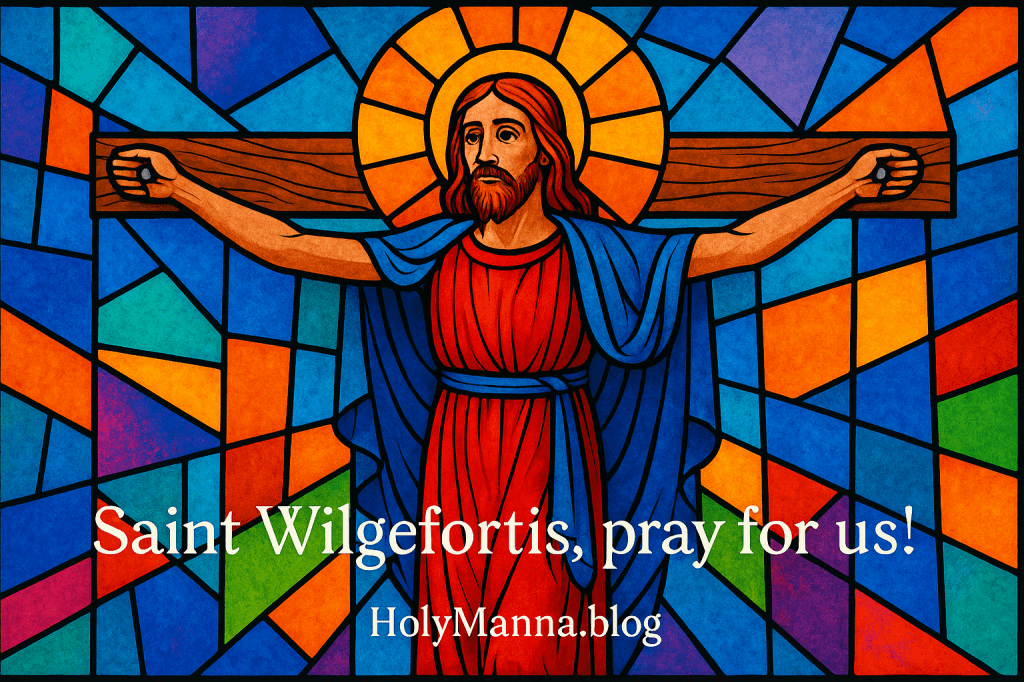
Saint Wilgefortis may be one of the most mysterious and visually startling saints in Christian tradition. Often depicted crucified and wearing a beard, she became a powerful symbol of spiritual resistance and purity during the Middle Ages. While her story is more legendary than historically verified, the depth of its meaning left a profound impression on Catholic devotion—especially among women seeking deliverance from forced marriages or abusive relationships. Known by different names in different countries—Kümmernis in Germany, Liberata in Italy, and Uncumber in England—Wilgefortis is remembered as a courageous virgin martyr who chose Christ over comfort, honor, and even her own life.
Born a Princess, Claimed by Christ
Tradition tells us that Wilgefortis was born into royalty, the daughter of a pagan king in either Portugal or northern Italy, depending on the variation of the legend. Raised in wealth and privilege, she encountered the Christian faith through a missionary or tutor—again, the details vary—but the result was profound: her heart was utterly captivated by Christ. Inspired by the Gospel and likely familiar with The Acts of the Martyrs, she made a secret vow of perpetual virginity, offering her body, mind, and soul to her divine Spouse. In doing so, she aligned herself with an ancient and noble tradition in the Church: the consecrated virgins who, as The Catechism teaches, “live in the world” and “dedicate themselves with undivided heart to the Lord” (CCC 923–924).
Her serene faith was soon tested. Her father, ignorant of her vow, arranged for her to marry a wealthy pagan ruler to solidify a political alliance. The match was strategic, lucrative—and completely contrary to the vow she had made. In her distress, Wilgefortis turned to the Lord in prayer. She begged Him to intervene and preserve her purity. And in a miraculous response to her petition, her face was transformed: she grew a full beard. This physical sign of masculine appearance made her grotesque in the eyes of her would-be husband, who swiftly called off the engagement.
Her father, enraged by the embarrassment and the failed alliance, flew into a violent fury. In a tragic parallel to her Bridegroom, she was condemned to die by crucifixion. Thus, Wilgefortis became not only a virgin martyr but one who shared uniquely in Christ’s Passion—nailed to the cross in literal imitation of His sacrificial love.
Heaven’s Strange Mercy in a Beard
Unlike many other saints whose lives were marked by works of charity or signs and wonders, Saint Wilgefortis’ story revolves around a single, dramatic miracle: her beard. While it may seem bizarre or even comical to modern minds, the miracle was understood by medieval Christians as a profound work of divine mercy and protection. The beard became a visible sign of her inward consecration and her refusal to be claimed by anyone other than Christ.
It was not merely a distortion of her beauty—it was a heavenly armor. In the cultural mindset of the time, beauty was a form of currency and power, especially for noblewomen. To lose it was to lose status and opportunity. Yet for Wilgefortis, this transformation was her salvation. Her beard freed her from a forced union and preserved her virginity, which she had pledged to God.
This miracle reminds us that divine intervention doesn’t always look like we expect. Sometimes God answers our prayers not by removing the suffering but by transforming us in ways that shock the world. As Saint Paul wrote, “God chose what is foolish in the world to shame the wise” (1 Corinthians 1:27). Wilgefortis’ beard became a symbol of radical holiness—of a soul willing to become unattractive in the world’s eyes to remain beautiful before God.
The Crown of Thorns Comes with a Cross
The martyrdom of Saint Wilgefortis was as shocking as her miracle. Her own father, once her protector, became her persecutor. Her crime? Fidelity to Jesus. Her cross was not metaphorical—it was wooden, brutal, and real. She was stripped, tied to the beams, and crucified, just like the Savior she loved. There are no surviving words from her execution, but her silent witness echoes loudly through the centuries.
In her death, Wilgefortis not only fulfilled her vow of virginity but also bore powerful witness to the cost of discipleship. Her story brings to life Jesus’ warning in The Gospel of Matthew: “Whoever loves father or mother more than me is not worthy of me… and whoever does not take up his cross and follow me is not worthy of me.” (Matthew 10:37–38)
Her pain was immense, but so was her love. She chose the eternal crown of glory over the fleeting honor of a throne. She bore her father’s rejection and the cruelty of crucifixion with the grace of one whose identity was anchored in Christ. Through her, we see that the path to heaven often leads through the fire of suffering—but that fire refines and sanctifies.
The Saint Who Frees the Bound
After her martyrdom, devotion to Saint Wilgefortis grew rapidly, especially in parts of Germany, Austria, and France. Her image—a crucified woman with a beard—was placed in churches and shrines where pilgrims came to seek liberation, especially from abusive or forced marriages. In some places, women who were victims of violence or oppression tied pieces of metal or string to her image—symbols of the chains they sought to break.
Many legends arose of miraculous answers to prayer. Some claimed that when women prayed before her crucified image, their cruel husbands were converted or that they were granted legal separation. Others reported being healed of sickness, spiritual affliction, or despair. Though her relics are difficult to authenticate, sites dedicated to her memory became places of consolation and hope.
In particular, her shrine in Saint-Côme-et-Saint-Damien in France became a sanctuary for those seeking spiritual freedom. Her intercession was sought by the poor, the marginalized, and especially by women who felt voiceless. To them, Wilgefortis was a sister who understood the pain of being silenced—and who proved that holiness is not confined to cultural expectations or physical appearances.
Her Silence Speaks
What can we, modern Catholics, learn from the strange and beautiful story of Saint Wilgefortis? First, we learn that faithfulness to Christ may cost us comfort, acceptance, and even our safety—but that it is always worth it. Her story challenges our cultural obsession with outward beauty and control. In her holy beard, we see that true beauty is found in sacrifice, obedience, and courage.
Second, Wilgefortis reminds us that God answers prayer in surprising ways. Are we willing to accept the unexpected path if it leads us closer to Him? Her beard was not her shame—it was her protection. Sometimes the very thing we fear or resist becomes the means by which God preserves us.
Third, her crucifixion shows us the depth of Christian witness. She didn’t die in protest—she died in fidelity. Like her, we must ask ourselves: What worldly pressures are we being asked to resist today? Are we willing to suffer for our spiritual integrity, even if no one else understands it?
As The Catechism teaches, “Martyrdom is the supreme witness given to the truth of the faith: it means bearing witness even unto death.” (CCC 2473) Saint Wilgefortis bore that witness not with sermons or miracles, but through the stillness of the cross and the strangeness of her sanctity. May we, too, choose to live boldly for Christ—even if the world calls us foolish, odd, or out of place.
Engage with Us!
What are your thoughts on the legend of Saint Wilgefortis? Have you ever experienced pressure to compromise your faith or values? We’d love to hear from you.
Reflection Questions:
- What part of Saint Wilgefortis’ story challenges or inspires you the most?
- How can you embrace spiritual courage in your own life right now?
- What does it mean for you to carry your cross daily in today’s world?
Let’s walk together in this journey of faith—encouraging one another to be brave, pure, and loving in a world that often pushes us to conform. May we all, like Saint Wilgefortis, do everything with love, as our Lord Jesus Christ did.
Saint Wilgefortis, pray for us! ✝️
Follow us on Instagram and Facebook for more insights and reflections on living a faith-filled life.

 Holy Manna!
Leave a comment