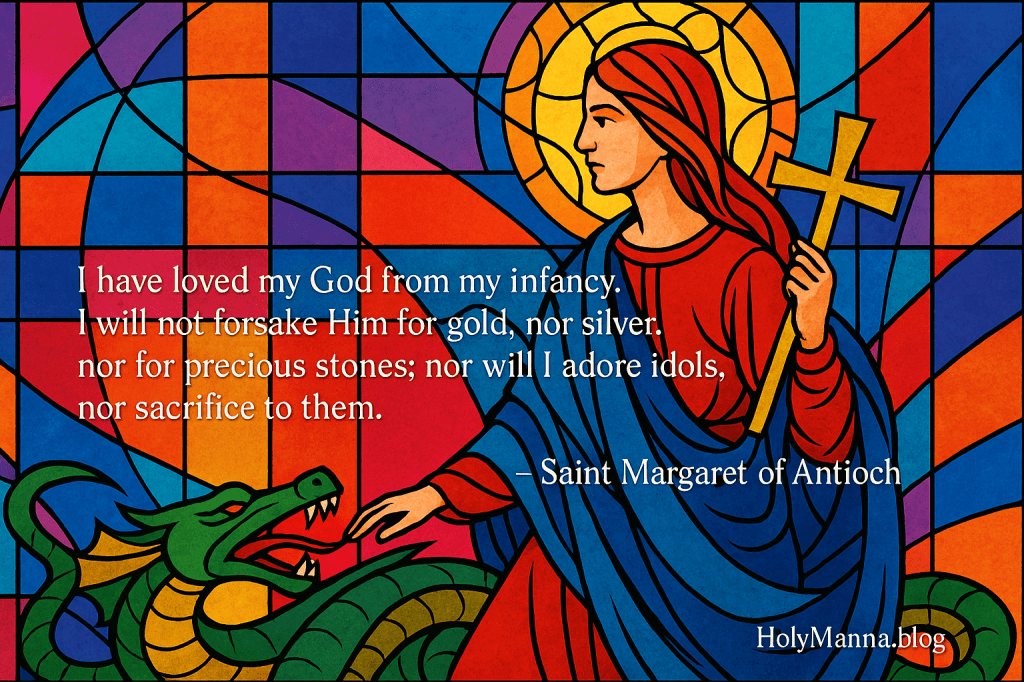
The Fiery Virgin
In the rich tapestry of Catholic saints, few inspire the imagination and fortify the heart quite like Saint Margaret of Antioch. Though her historicity has been debated by scholars, her spiritual legacy as a young virgin-martyr has left a permanent mark on the heart of the Church. Known as one of the Fourteen Holy Helpers, she was especially invoked during the Black Plague and became a patroness for expectant mothers and those facing unjust trials. Her narrative—saturated with dramatic visions, miraculous survival, and unshakable faith—was so beloved that it was included in The Golden Legend, a 13th-century compilation of saintly lives that shaped medieval piety.
Her story reminds us that the path of holiness often passes through fire, rejection, and suffering. And yet, as Psalm 34:19 promises, “Many are the afflictions of the righteous, but the Lord delivers him out of them all.” Saint Margaret’s unwavering courage in the face of torture and death elevated her into a powerful intercessor for those who suffer, especially women in labor and Christians under persecution. She did not seek glory, but the Bridegroom, and in losing her life, she found eternal honor.
Daughter of Idols, Child of Grace
Saint Margaret’s story begins in Antioch of Pisidia, a bustling city in Asia Minor during the Roman Empire. Born into a prominent pagan family, she was the daughter of Aedesius, a high priest of the local gods. Her life, by all worldly accounts, should have followed a trajectory of privilege, marriage, and religious conformity. But God had other plans. As Providence would have it, Margaret was raised by a Christian nurse, who secretly introduced her to the Gospel and baptized her into the Christian faith. This seed of truth, planted in her heart during her formative years, would grow into a tree of unshakable conviction.
As Margaret grew in age and beauty, so too did her spiritual maturity. Her heart longed not for the comforts of Roman nobility or the gods of stone, but for intimacy with Christ. She made a vow of perpetual virginity, not out of disdain for marriage, but to consecrate her entire being to her Divine Spouse. This radical commitment provoked anger in her father, who disowned her and forced her to live in poverty, tending sheep in the countryside. But Margaret accepted this exile with serenity, seeing it as a form of spiritual retreat where she could dwell in prayer and union with her Savior.
Her virtue soon attracted the attention of Olybrius, the Roman prefect of the region. Captivated by her beauty, he proposed marriage—on the condition that she renounce Christ and worship the Roman gods. Margaret’s response was clear and fearless: she belonged to Christ and Christ alone. She declared, “I am the servant of Jesus Christ, the Son of God, and I refuse to deny Him.” With this holy defiance, Margaret signed her own death warrant and began the final trial that would seal her as a martyr and saint.
The Dragon in the Dungeon
The most captivating part of Saint Margaret’s story takes place not in palaces or cathedrals, but in the dark chambers of a prison. After refusing to marry Olybrius or deny her faith, Margaret was arrested and cast into a dungeon. It was there that she experienced a series of mystical encounters that became legendary. Most famously, she was said to have been confronted by Satan, who appeared to her in the form of a ferocious dragon. The beast swallowed her whole—but Margaret, clinging tightly to her cross, made the sign of the Cross from within its belly. Miraculously, the dragon’s stomach split open, and she emerged unharmed.
This miraculous vision, though symbolic, became an enduring icon of Christian spiritual warfare. It echoed the truth of Psalm 91:13: “You will tread on the lion and the cobra; you will trample the great lion and the serpent.” It wasn’t merely about escaping physical death—it was a testament to the power of faith over the powers of hell. Margaret’s cross, her weapon of choice, became the sign of victory over every form of temptation, oppression, and spiritual attack.
In another vision during her imprisonment, Satan reappeared—this time in human form—mocking her for trusting in a crucified Savior. But Margaret rebuked him and drove him away with her prayers. These visions inspired countless Christians over the centuries to stand firm against evil, trusting in the protection of Christ, no matter how dire the circumstances.
The Final Witness
After her imprisonment, Margaret endured brutal torture at the hands of the Roman authorities. She was scourged until her flesh was torn, burned with flaming torches, and stretched on the rack—all to persuade her to abandon the faith. But instead of breaking, she proclaimed the name of Jesus all the louder. Witnesses were astonished to see her miraculously healed overnight, her body made whole again. These signs caused many onlookers to convert to Christianity, a phenomenon that infuriated Olybrius even further.
Eventually, the governor ordered her execution by beheading. Margaret, far from frightened, rejoiced at the prospect of entering into eternal union with Christ. Before she died, she prayed aloud, asking that all who remembered her in prayer—especially women in childbirth—would be protected and comforted. She then bowed her head and received the martyr’s crown.
Her death embodied the words of Revelation 2:10: “Be faithful unto death, and I will give you the crown of life.” Though she died in obscurity, her name would soon be sung in churches and whispered by mothers in labor throughout the Christian world.
A Light That Would Not Go Out
After her martyrdom, devotion to Saint Margaret exploded, particularly in Europe during the Middle Ages. Her relics were dispersed to various churches, where they became the sites of numerous miraculous healings. Midwives and pregnant women especially began invoking her name during labor, and countless stories spread of safe deliveries attributed to her heavenly intercession.
One of the most notable historical references to her comes from Saint Joan of Arc, who testified that Saint Margaret appeared to her in visions, along with Saint Catherine of Alexandria and Saint Michael the Archangel. These visions strengthened Joan’s resolve and guided her as she led armies and faced martyrdom herself.
Despite being removed from the General Roman Calendar in 1969, Saint Margaret’s feast on July 20th is still celebrated in many places, and she remains listed in the Martyrologium Romanum. Her image—often holding a cross and trampling a dragon—continues to speak to the enduring Christian hope that no evil, no matter how terrifying, can overcome the love of Christ. As CCC 956 reminds us, “Being more closely united to Christ, those who dwell in heaven fix the whole Church more firmly in holiness… their intercession is their most exalted service to God’s plan.”
Even in the silence of time, the echo of Saint Margaret’s prayers still resounds in the Church. Her name has become a shield for the weak, a battle cry for the faithful, and a song of victory for the pure in heart.
Lessons from a Lionhearted Saint
In our contemporary society, where virtue is often mocked and truth is treated as relative, the story of Saint Margaret of Antioch is more relevant than ever. Her unwavering faith, virginal purity, and spiritual authority in the face of evil reveal a pathway of holiness that speaks directly to our age.
What does it mean to face dragons today? They may not look like beasts in dungeons—but they often come in the form of anxiety, impurity, injustice, ridicule, or spiritual dryness. Saint Margaret teaches us that we do not need to fight these battles alone. With the Cross in hand, the sacraments as armor, and prayer as our sword, we can walk into any fire and emerge with grace.
Are we ready to stand for Christ when it costs us popularity, comfort, or worldly success? Are we willing to trust in His strength when we are surrounded by pressure to conform? Can we, like Margaret, joyfully embrace our trials as opportunities for deeper union with the Crucified?
Let us imitate her courage, her fidelity, and above all, her passionate love for Jesus. Let us teach our daughters and sons to value spiritual strength over status and holiness over hype. And when we are afraid, may we cry out to her with faith: “Saint Margaret of Antioch, pray for us!”
Engage with Us!
We’d love to hear your thoughts and reflections:
- What “dragons” in your life is God asking you to face with courage and faith?
- How can Saint Margaret’s example inspire you to live with greater purity and boldness?
- Have you ever experienced God’s protection or deliverance in a difficult moment?
Share your story in the comments! Let’s support one another in our faith journey—and strive to do everything with love, as our Lord Jesus did.
Saint Margaret of Antioch, pray for us! ✝️
Follow us on Instagram and Facebook for more insights and reflections on living a faith-filled life.

 Holy Manna!
Leave a comment