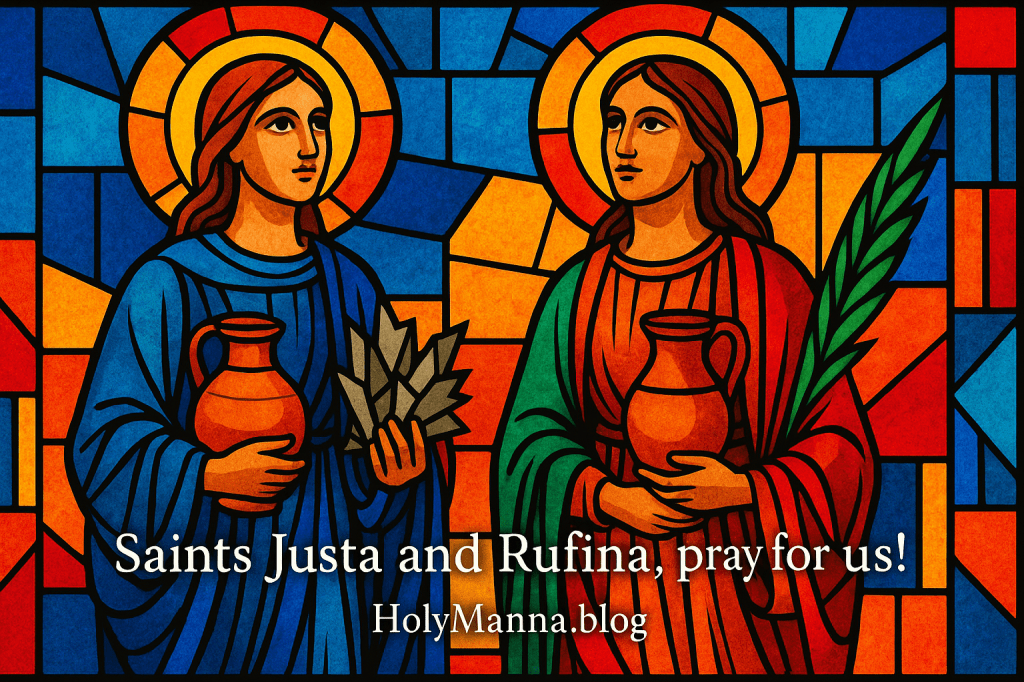
Clay and Courage
In an age when the Roman Empire glorified power, pagan deities, and social conformity, two sisters from Seville stood out—not because they wielded influence or came from noble families, but because they chose to give their entire lives to Christ. Saints Justa and Rufina, celebrated each year on July 19, remind us that courage, purity, and fidelity to the Gospel often come from the most unexpected places: a pottery shop in a bustling marketplace, run by two Christian virgins. These sisters, co-patronesses of Seville, were not cloistered mystics or high-profile evangelists; they were artisans, workers with clay, whose faith shaped their lives more profoundly than any kiln could mold their vessels. Revered for their refusal to participate in pagan idol worship and their steadfastness in the face of torture, their witness continues to speak volumes today. They show us that holiness is not reserved for the powerful or the famous—it begins in the home, in humble labor, and in saying “yes” to Christ in both the quiet and the dangerous moments of life.
Molded by Grace
Saints Justa and Rufina were born into a modest Christian household in Seville, Spain, around the middle of the third century. From childhood, their lives were shaped by the teachings of Christ and the Gospel values passed down in their family. Seville at that time was under Roman rule, where Christians were often marginalized, harassed, or outright persecuted. Despite these risks, their parents raised them in the truth of the faith, and the sisters internalized it deeply. Rather than seek marriage, comfort, or social standing, Justa and Rufina chose to live as consecrated virgins, dedicating themselves to Christ with both their hearts and hands.
Their work as potters was more than a trade—it was a vocation. They crafted and sold clay vessels, not just for sustenance, but as a means to live honorably and generously. They were known for their charity to the poor and their quiet but bold witness to the faith. Their faith was not born out of a dramatic conversion moment, but rather matured over years of simple, faithful living in a pagan world. When the time came to defend their beliefs publicly, their response was not sudden or impulsive—it was the fruit of lives already rooted in Christ. The defining moment came when they refused to sell their pottery for use in a pagan festival dedicated to the goddess Venus. When the idol was brought through the streets and the people demanded that the sisters honor it, they responded with holy indignation and broke the statue. This was not a reckless act of rebellion, but a prophetic witness to the truth: “You shall have no other gods before me” (Exodus 20:3). In doing so, they declared not only their love for Christ but their refusal to compromise, no matter the cost.
Vessels of the Holy Spirit
Though no extensive catalog of their lifetime miracles survives, the courage and divine strength displayed by Saints Justa and Rufina during their lives were miraculous in themselves. One story particularly preserved in tradition tells of how, after they shattered the idol of Venus, they were not immediately lynched by the angry mob, as might have been expected. Their momentary protection was seen as a sign of divine intervention, a pause granted by God to allow them to fully witness to the truth before their final offering of martyrdom.
Their most powerful “miracle,” however, was their unwavering refusal to renounce their faith under brutal pressure. Despite being arrested and brought before the Roman prefect Diogenian, they held fast to their belief in Christ. Neither promises of freedom nor the threat of torture could move them. Even when starved and mutilated, their souls remained unshaken. This strength was not of their own making. It was the presence of the Holy Spirit—just as Jesus promised: “When they hand you over, do not worry about how you are to speak or what you are to say…for it will not be you who speak but the Spirit of your Father speaking through you” (Matthew 10:19–20). Justa and Rufina became living vessels of that Spirit, testifying with their actions and silence more powerfully than any miracle of healing or prophecy.
Fire and Clay
The response of Roman authorities to the sisters’ actions was swift and merciless. The prefect Diogenian saw in them a threat—not because they had political ambitions, but because their courage exposed the emptiness of Rome’s gods. As punishment for their “blasphemy,” the sisters were sentenced to increasingly brutal torments. First, they were ordered to walk barefoot over sharp stones—a torment that drew blood and pierced their tender feet. This agony, often depicted in sacred art, symbolized not only their suffering but their path of sanctity. As the Letter to the Hebrews reminds us, “Let us run with perseverance the race marked out for us, fixing our eyes on Jesus… who endured the cross, scorning its shame” (Hebrews 12:1–2).
Still refusing to deny Christ, they were imprisoned without food or water. Their fingernails were torn out, and their flesh lacerated. Rufina eventually succumbed to her wounds and the relentless starvation. Justa, who remained, was later executed by being thrown into a well—an image both horrific and deeply symbolic. Wells in Scripture often signify divine encounter and life (see John 4:6–14), but here, the well becomes her tomb—a place of martyrdom from which her soul rose to eternal life. Their deaths were not in vain; they became a seed planted in the soil of Seville, a witness that would bear fruit for centuries. As Tertullian once wrote, “The blood of the martyrs is the seed of the Church.”
From Earth to Heaven
Though their bodies were broken in life, their souls radiated with holiness, and that light continued to shine long after their deaths. Devotion to Saints Justa and Rufina grew rapidly in Seville and beyond. Their relics were preserved, venerated, and believed to possess healing properties. Christians began to invoke them for protection and intercession, particularly during times of trial.
One of the most remarkable stories attributed to their heavenly protection occurred centuries later during the earthquake of 1504 in Seville. As buildings shook and chaos spread, the faithful turned to the memory of these steadfast sisters. Miraculously, the Cathedral of Seville—a towering symbol of Christian faith—was spared from destruction. The people credited Saints Justa and Rufina for this divine intervention. From that moment, their role as co-patronesses of the city was firmly established. Pilgrimages to churches dedicated to them increased, and artists began to depict them in elaborate paintings holding pottery, palm branches, and even miniature models of the cathedral they were believed to have saved.
To this day, processions in their honor fill the streets of Seville every July. The clink of clay vessels and the chanting of litanies resound through the city, as faithful men and women ask these sisters for courage, strength, and the grace to follow Christ with similar resolve.
Clay in the Potter’s Hands
The story of Saints Justa and Rufina is more than a relic of Church history—it is a mirror for our own spiritual lives. In a world increasingly hostile to authentic faith, their witness offers us a model of humble courage. They did not have platforms, titles, or grand audiences. They had their hands, their prayers, and their clay. And they allowed all three to glorify God.
What can we learn from these potter-saints? First, that every kind of honest work can become holy when offered to the Lord. Whether we create, teach, clean, or lead—when we do it in love and truth, our labor becomes a liturgy. Second, we are reminded that faithfulness in the small things prepares us for greatness. The sisters’ dramatic stand against idolatry was only possible because they had already spent years saying “yes” to God in the hidden corners of daily life. And lastly, their lives challenge us to identify the idols in our own hearts and culture—comfort, popularity, autonomy—and smash them, even at a cost.
Saints Justa and Rufina also remind us that we never walk alone. They faced death as sisters, shoulder to shoulder, encouraging each other until the very end. Do we have someone in our lives who strengthens our faith like that? Are we that person for someone else?
Their lives are proof that grace strengthens the weak, that holiness can emerge from a potter’s workshop, and that death itself cannot silence the voice of truth.
Are we willing to be shaped like clay in the hands of the Divine Potter? Will we allow our lives to reflect His beauty, even when the furnace of suffering gets hot?
Let us, like Saints Justa and Rufina, become vessels of grace—formed by Christ, filled with His Spirit, and poured out for the life of the world.
Engage with Us!
Have Saints Justa and Rufina inspired you? Share your thoughts in the comments below—we’d love to hear how their story speaks to you.
Reflection Questions:
- What “idols” in your life might God be asking you to confront or let go of?
- How can you make your daily work an offering to God like Saints Justa and Rufina did?
- Who is someone in your life that strengthens your faith like a spiritual sister or brother?
Let us support one another in this journey and strive, like Saints Justa and Rufina, to do everything with courage, love, and trust in Jesus.
Saints Justa and Rufina, pray for us! 🏺
Follow us on Instagram and Facebook for more insights and reflections on living a faith-filled life.

 Holy Manna!
Leave a comment