Saturday of the Fifteenth Week in Ordinary Time – Lectionary: 394
Mercy on the Move
Have you ever been rescued so deeply that the memory of it changes how you live forever? Today’s readings immerse us in that kind of divine rescue—one that moves with mercy, delivers with power, and heals with quiet authority. From the hurried footsteps of the Israelites fleeing slavery to the hidden steps of Jesus retreating from danger, we see a God who leads His people out of bondage, not only with a mighty hand but with a merciful heart.
The First Reading from Exodus 12 gives us the iconic image of the Israelites departing Egypt under the cover of night. After 430 years of suffering, God’s promise is fulfilled—not just for the Hebrews, but for a “crowd of mixed ancestry” who also follow (Ex 12:38). This moment, memorialized in the Jewish Passover, reminds us that salvation history is not confined to one moment or one people—it’s an unfolding drama of deliverance that echoes throughout Scripture. Psalm 136 answers this scene with a litany of praise: “His mercy endures forever” becomes the heartbeat of history. Even in acts of judgment—like striking down Egypt’s firstborn or drowning Pharaoh’s army—the psalmist sees God’s enduring mercy at work, liberating His people for a new life.
Fast forward to The Gospel of Matthew, and we see another kind of Exodus underway. Jesus, God’s Chosen Servant, is quietly liberating souls—not with plagues or parting seas, but with healing hands and words of hope. In fulfillment of Isaiah’s prophecy, He avoids confrontation, “a bruised reed he will not break”, yet still “brings justice to victory” (Matthew 12:20). The mercy that split the Red Sea now walks among the people, restoring what is broken and offering hope not only to Israel but to the Gentiles as well. Today’s readings invite us to recognize that God’s deliverance isn’t just a story from the past—it is alive, present, and deeply personal. What kind of bondage is the Lord inviting you to walk out of today—and are you ready to follow Him into freedom?
First Reading – Exodus 12:37–42
The Night God Moved
The Book of Exodus is the Church’s great epic of liberation—God revealing Himself not only as Creator but as Redeemer. It recounts Israel’s journey from slavery to freedom, showing that God does not remain distant in human suffering. Today’s reading takes us to the climactic moment of that journey: the departure from Egypt. After generations of labor, oppression, and unanswered prayers, the Lord moves swiftly and powerfully. This moment is the birth of Israel as a nation, carried not by chariots, but by the arm of God. The unleavened bread, the hurried departure, and the command to keep vigil all tell us this isn’t just a historical exit—it’s a liturgical event. For Catholics, this moment also prefigures the Paschal Mystery of Christ. Just as Israel is saved by the blood of the lamb and called into a new covenant, we too are saved through Christ, our Paschal Lamb, and drawn into a life of freedom and worship. Exodus 12 invites us to stand at the threshold of bondage and liberation and ask, What has God done for us in the night?
Exodus 12:37-42
New American Bible (Revised Edition)
Departure from Egypt. 37 The Israelites set out from Rameses for Succoth, about six hundred thousand men on foot, not counting the children. 38 A crowd of mixed ancestry also went up with them, with livestock in great abundance, both flocks and herds. 39 The dough they had brought out of Egypt they baked into unleavened loaves. It was not leavened, because they had been driven out of Egypt and could not wait. They did not even prepare food for the journey.
40 The time the Israelites had stayed in Egypt was four hundred and thirty years. 41 At the end of four hundred and thirty years, on this very date, all the armies of the Lord left the land of Egypt. 42 This was a night of vigil for the Lord, when he brought them out of the land of Egypt; so on this night all Israelites must keep a vigil for the Lord throughout their generations.
Detailed Exegesis
Verse 37 – “The Israelites set out from Rameses for Succoth, about six hundred thousand men on foot, not counting the children.”
This massive movement of people reveals the sheer scale of God’s work. Rameses was a central city of oppression—built by Israelite slave labor—and now becomes the starting point of divine reversal. Succoth, whose name means “booths” or “shelters,” symbolizes the temporary nature of the journey: they are pilgrims now. The mention of six hundred thousand men suggests a population of well over two million, emphasizing the miracle that a people so vast could move in unity and faith.
Verse 38 – “A crowd of mixed ancestry also went up with them, with livestock in great abundance, both flocks and herds.”
The Exodus was not limited to ethnic Israelites. This “crowd of mixed ancestry” includes Egyptians and others who had come to believe in the God of Israel—an early sign that salvation is not exclusive but expansive. This points forward to Matthew 12:21, where it is prophesied: “In his name the Gentiles will hope.” The livestock and herds also show that this was not a flight of desperation, but a departure under divine favor and provision.
Verse 39 – “The dough they had brought out of Egypt they baked into unleavened loaves. It was not leavened, because they had been driven out of Egypt and could not wait. They did not even prepare food for the journey.”
The unleavened bread becomes a powerful symbol of haste, readiness, and faith. It shows their obedience—they left when God said go. This bread, later remembered at every Passover and ultimately fulfilled in the Eucharist, is the food of those who trust that God will provide on the way. It reminds us to travel light and rely on the Lord.
Verse 40 – “The time the Israelites had stayed in Egypt was four hundred and thirty years.”
This verse reinforces the gravity of what’s taking place. After 430 years—generations born and buried under Pharaoh’s shadow—God moves. The long delay was not forgetfulness; it was preparation. CCC 314 reminds us: “We firmly believe that God is master of the world and of its history. But the ways of his providence are often unknown to us. Only at the end… will we fully know the ways by which—even through the dramas of evil and sin—God has guided his creation to that definitive sabbath rest.”
Verse 41 – “At the end of four hundred and thirty years, on this very date, all the armies of the Lord left the land of Egypt.”
The people of Israel are called “the armies of the Lord”, not because they are soldiers but because they are now organized, led, and empowered by God Himself. The term reminds us that they are not wandering aimlessly—they are on a divinely ordered mission. It is no coincidence that this moment falls on the exact date. God’s timing is perfect.
Verse 42 – “This was a night of vigil for the Lord, when he brought them out of the land of Egypt; so on this night all Israelites must keep a vigil for the Lord throughout their generations.”
Here the theological meaning of the Exodus becomes liturgical. God’s action demands memory. The “night of vigil” becomes a sacred obligation—one that points to our own Easter Vigil, when Christ passed from death to life. This night must never be forgotten, because the Lord’s mercy is not a passing favor but an eternal covenant.
Teachings of the Church
The Catechism of the Catholic Church teaches us that these Old Testament events are not just stories, but “types” that find their fulfillment in Christ. CCC 1094 states: “The New Testament lies hidden in the Old and the Old Testament is unveiled in the New.” The Exodus is the prototype of all deliverance. Just as Israel is saved through the blood of the Passover lamb, so are we saved through the blood of Christ, the true Lamb of God. Saint Augustine writes, “The events of the Old Testament were figures of what was to come; they were written for our instruction, upon whom the end of the ages has come.”
Saint Cyril of Alexandria adds a beautiful insight: “The sacrifice of the lamb and the anointing of the doorposts prefigured the precious blood of Christ. The angel who destroyed the firstborn saw the blood and passed over. That is why it is called the Passover. The blood was a sign and a shield.” This illustrates that even the smallest gestures in salvation history—like a hurried meal or smeared blood—become means by which God prepares us for deeper mysteries.
Historically, the Exodus story has been a rallying cry for countless movements of liberation. But the Church reminds us that the deeper slavery is sin, and the greater Exodus is Christ leading us into eternal life. In the Easter liturgy, the Exsultet sings: “This is the night when Christ broke the prison-bars of death and rose victorious from the underworld.” Every deliverance is a participation in that first, great mercy. We are all invited to pass over—from old life to new.
Reflection
This reading reminds us that God is never idle, even when the silence is long. He keeps His promises—precisely, powerfully, and personally. What areas of bondage have we lived in for far too long? Have we become too comfortable in Egypt, forgetting that we were made to be free? God’s deliverance often begins in the night, in haste, with little time to prepare. Are we ready to move when He says go? Today, let us keep vigil—not only in memory but in expectation. The same God who moved the waters of the Red Sea is still moving in our lives. The question is: Will we follow when He leads us out?
Responsorial Psalm – Psalm 136:1, 10–15, 23–24
Singing the Story of Salvation
The Book of Psalms is the prayer book of Israel—and of the Church. Psalm 136 is known as the “Great Hallel,” a hymn of thanksgiving traditionally sung during Jewish feasts, including Passover. Its refrain—“for his mercy endures forever”—pounds like a heartbeat throughout, anchoring every divine action in the character of God Himself. In today’s liturgy, this psalm serves as the people’s response to the mighty work of the Exodus described in Exodus 12. It transforms memory into worship, history into doxology. By recalling specific moments—striking Egypt’s firstborn, parting the Red Sea, rescuing Israel from its enemies—this psalm trains the soul to see God’s hand not only in glory but in struggle. In a world that often forgets the past or rewrites it, Psalm 136 calls us to remember rightly: not simply the events, but the mercy woven into them. Have we learned to look back and sing, not with bitterness, but with gratitude?
Psalm 136:1, 10-15, 23-24
New American Bible (Revised Edition)
Hymn of Thanksgiving for God’s Everlasting Mercy
1 Praise the Lord, for he is good;
for his mercy endures forever;
10 Who struck down the firstborn of Egypt,
for his mercy endures forever;
11 And led Israel from their midst,
for his mercy endures forever;
12 With mighty hand and outstretched arm,
for his mercy endures forever;
13 Who split in two the Red Sea,
for his mercy endures forever;
14 And led Israel through its midst,
for his mercy endures forever;
15 But swept Pharaoh and his army into the Red Sea,
for his mercy endures forever;
23 The Lord remembered us in our low estate,
for his mercy endures forever;
24 Freed us from our foes,
for his mercy endures forever;
Detailed Exegesis
Verse 1 – “Praise the Lord, for he is good; for his mercy endures forever.”
This opening verse establishes the foundation of Israel’s praise: not just what God has done, but who He is. The goodness of the Lord is not an abstract idea—it is revealed in concrete acts of love and rescue. The Hebrew word for “mercy” here is ḥesed, meaning covenantal, steadfast love. This is not sentimental kindness; it is faithful, enduring love that binds God to His people.
Verse 10 – “Who struck down the firstborn of Egypt, for his mercy endures forever.”
At first glance, this act may seem harsh, but it must be seen in context. Pharaoh’s repeated refusals hardened his heart against God, and judgment finally came to protect God’s firstborn, Israel (see Exodus 4:22). Even acts of divine justice are understood as merciful because they serve the larger purpose of liberation.
Verse 11 – “And led Israel from their midst, for his mercy endures forever.”
This verse focuses on the act of deliverance. God did not abandon His people in slavery—He entered into history to lead them out. This recalls the truth proclaimed in CCC 2577: “From the midst of the burning bush he calls Moses to be his servant, an instrument of his compassion, his work of salvation.”
Verse 12 – “With mighty hand and outstretched arm, for his mercy endures forever.”
These words are often repeated in Scripture as a way of describing divine power. The “mighty hand” and “outstretched arm” symbolize not only strength but divine intimacy. God is not distant—He reaches into the mess of human history to act decisively.
Verse 13 – “Who split in two the Red Sea, for his mercy endures forever.”
One of the most iconic moments in salvation history: God makes a way where there is no way. This act becomes a defining memory for Israel. As Isaiah 43:16 later proclaims, “Thus says the Lord, who makes a way in the sea, a path in the mighty waters.”
Verse 14 – “And led Israel through its midst, for his mercy endures forever.”
This is not just about parting waters but about guidance. God doesn’t merely deliver—He walks with. This prefigures Christ, who not only saves us but says, “I am the way” (John 14:6). Israel walks forward not by their own might, but by God’s presence.
Verse 15 – “But swept Pharaoh and his army into the Red Sea, for his mercy endures forever.”
Justice and mercy meet here. Pharaoh’s oppression and violence are brought to an end—not out of vengeance, but to defend God’s people and establish peace. Divine mercy sometimes looks like the removal of evil’s power.
Verse 23 – “The Lord remembered us in our low estate, for his mercy endures forever.”
To be remembered by God in Scripture means to be seen, cared for, and acted upon. Israel was not forgotten in their suffering. Neither are we. This verse echoes Luke 1:54, where Mary proclaims in the Magnificat: “He has helped Israel his servant, remembering his mercy.”
Verse 24 – “Freed us from our foes, for his mercy endures forever.”
Here the psalm comes full circle—freedom is the fruit of mercy. The foes may be literal or spiritual, but God is always acting to liberate us from anything that hinders love.
Teachings of the Church
The Church has always seen in the psalms the voice of Christ and His Body, the Church. CCC 2586 teaches: “The Psalms nourish and express the prayer of the People of God… whether they evoke the events of the past or the hopes of the future, the Psalms sing of God’s faithful love, revealed in his mighty works.” Psalm 136 is the archetype of this, repeating with every breath the foundational truth: God’s mercy is not temporary, but eternal.
Saint John Paul II frequently meditated on the mercy of God as the definitive attribute of His relationship with mankind. In Dives in Misericordia, he writes: “Mercy is love’s second name… It is the force that reawakens us to new life and instills in us the courage to look to the future with hope.” This resonates with Psalm 136, which helps us develop the spiritual discipline of remembering rightly—not with despair, but with gratitude.
Liturgically, the Church uses this psalm in the Easter Vigil and other great feasts, because it teaches us how to proclaim God’s greatness without forgetting our littleness. It invites us to name every trial, every rescue, every mercy, and answer it with a confident: “His mercy endures forever.” As Saint Bede the Venerable once wrote: “The repetition of this refrain is not dull; it is deliberate, so that the mind is soaked in the truth.”
Reflection
This psalm teaches us to pray from memory. Do we take time to name the moments of deliverance in our lives? Do we trace God’s mercy in our history, even when it came through trial or loss? By repeating “His mercy endures forever”, we are trained not just to remember facts, but to remember the love behind them. Try this today: recall three moments in your life where you felt delivered—no matter how small—and after each one, speak aloud: “His mercy endures forever.” Let praise become your lens. Let mercy become your story. What would our day look like if we walked through it with this refrain in our hearts? Could we learn to see the Red Sea parting even in our smallest victories?
Holy Gospel – Matthew 12:14–21
The Silent Power of Mercy
The Gospel of Matthew is often called the “Gospel of the Kingdom” because it presents Jesus as the long-awaited Messiah who fulfills the Law and the Prophets. In Matthew 12, tension between Jesus and the Pharisees escalates after He heals on the Sabbath, challenging their rigid interpretations. Today’s passage picks up in the aftermath: while His enemies conspire, Jesus withdraws—not out of fear, but in fulfillment of prophecy. The Gospel quotes Isaiah 42, revealing Jesus as the Servant of the Lord: chosen, gentle, and endowed with the Spirit. In contrast to the drama of the Exodus, where God’s power splits seas and strikes down enemies, here the same divine mercy walks softly among the wounded. He does not break the bruised reed; He heals it. He does not quench the smoldering wick; He fans it into flame. This Servant brings justice not with noise, but with compassion. In the grand arc of salvation history, Jesus shows that mercy is not weakness—it is the quiet force that brings eternal victory. What kind of justice are we hoping for—and are we willing to receive it through the hands of a Servant-King?
Matthew 12:14-21
New American Bible (Revised Edition)
14 But the Pharisees went out and took counsel against him to put him to death.
The Chosen Servant. 15 When Jesus realized this, he withdrew from that place. Many [people] followed him, and he cured them all, 16 but he warned them not to make him known. 17 This was to fulfill what had been spoken through Isaiah the prophet:
18 “Behold, my servant whom I have chosen,
my beloved in whom I delight;
I shall place my spirit upon him,
and he will proclaim justice to the Gentiles.
19 He will not contend or cry out,
nor will anyone hear his voice in the streets.
20 A bruised reed he will not break,
a smoldering wick he will not quench,
until he brings justice to victory.
21 And in his name the Gentiles will hope.”
Detailed Exegesis
Verse 14 – “But the Pharisees went out and took counsel against him to put him to death.”
This stark verse reveals the growing hostility toward Jesus. Ironically, the ones who should recognize the Messiah—the religious leaders—plot to destroy Him. Their hardness of heart contrasts sharply with the tenderness Jesus shows to the sick and broken. This moment foreshadows the Passion and affirms that mercy often provokes resistance in those attached to power and control.
Verse 15 – “When Jesus realized this, he withdrew from that place. Many [people] followed him, and he cured them all.”
Jesus’ withdrawal is not cowardice; it is purposeful. He avoids premature confrontation so that His mission of healing and teaching may continue. The phrase “he cured them all” reinforces that His mercy knows no bounds. He is not selective in His compassion—His justice includes healing, not just legal righteousness.
Verse 16 – “But he warned them not to make him known.”
This echoes the recurring “Messianic Secret” in the Gospels. Jesus seeks to avoid misunderstanding of His identity—He is not a political revolutionary, but the Suffering Servant. His miracles are not for spectacle; they are signs pointing to the Kingdom of God, which unfolds quietly, like leaven in dough.
Verse 17 – “This was to fulfill what had been spoken through Isaiah the prophet.”
Matthew consistently emphasizes that Jesus fulfills Old Testament prophecy. This anchors Jesus’ mission in the continuity of God’s saving plan. The citation from Isaiah 42 links Him explicitly with the Servant Songs—a portrait of a figure anointed by the Spirit to bring justice through gentleness.
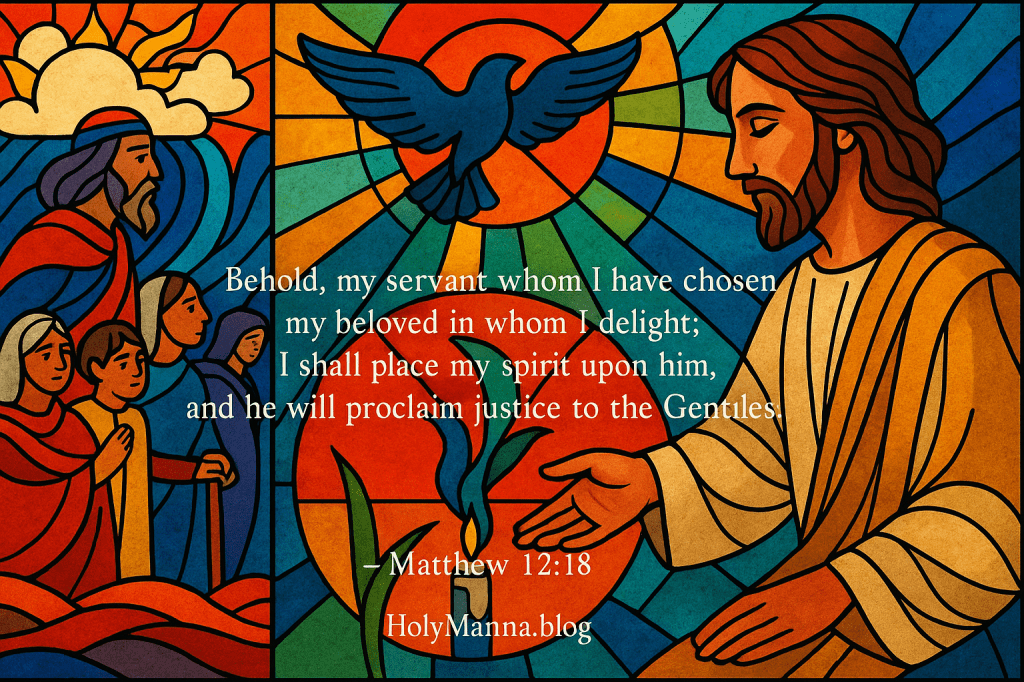
Verse 18 – “Behold, my servant whom I have chosen, my beloved in whom I delight; I shall place my spirit upon him, and he will proclaim justice to the Gentiles.”
This is the Father’s voice introducing His Servant, echoing the baptism of Jesus: “This is my beloved Son, with whom I am well pleased” (Matthew 3:17). The phrase “proclaim justice to the Gentiles” reveals the universality of Jesus’ mission. He is not just the Redeemer of Israel, but of all nations.
Verse 19 – “He will not contend or cry out, nor will anyone hear his voice in the streets.”
This description emphasizes Jesus’ humility. Unlike worldly leaders who assert power with noise and dominance, Jesus brings about change without public spectacle. His authority is quiet, yet irresistible. This is the mercy that knocks, not the force that breaks down the door.
Verse 20 – “A bruised reed he will not break, a smoldering wick he will not quench, until he brings justice to victory.”
This is one of the most tender verses in all of Scripture. The “bruised reed” and “smoldering wick” symbolize the weak, the broken, the discouraged—people who feel like they have nothing left. Jesus does not discard them. He restores them. His justice is not merely retributive; it is restorative. Victory comes not through domination, but through love.
Verse 21 – “And in his name the Gentiles will hope.”
This final verse echoes the missionary scope of Christ’s work. The name of Jesus—Yeshua, meaning “God saves”—is not only for Israel but for the whole world. Hope is not rooted in a political system or earthly ruler, but in the person of Christ, who embodies God’s enduring mercy.
Teachings of the Church
The Church teaches that Jesus is the perfect fulfillment of Isaiah’s Servant—gentle, obedient, and redemptive. CCC 713 explains: “The Messiah’s characteristics are revealed above all in the ‘Servant songs.’ Jesus identifies himself with this servant… Above all, Jesus fulfills the prophetic mission of the servant by his redemptive Passion.” What was foreshadowed in Exodus and sung in Psalm 136 becomes flesh in Jesus—mercy made visible.
Saint Thérèse of Lisieux beautifully reflects this truth when she writes: “What a joy to remember that He is just—that He makes allowances for all our foibles, that He knows perfectly our frailty, and that gently, without compulsion, He draws us to Himself.” Her “Little Way” embodies the Servant Spirit of Christ, trusting that God works through smallness and quiet faithfulness. This is the heart of Gospel justice: not crushing the weak, but lifting them.
Historically, this passage has inspired countless saints and missionaries to model their ministry on Christ’s gentleness. Saint Francis Xavier brought the Gospel to distant lands, proclaiming Jesus not with violence or coercion but with zeal and tenderness. The prophecy “In his name the Gentiles will hope” continues to be fulfilled every time the Church extends mercy to the forgotten, the broken, the far away. As Pope Benedict XVI said: “The world offers you comfort. But you were not made for comfort. You were made for greatness.” And greatness, in the Gospel, looks like humility.
Reflection
In a world loud with outrage and noise, today’s Gospel invites us to walk with Jesus in the silence of mercy. Where are the bruised reeds around us—those people barely holding on? Where are the smoldering wicks—those souls nearly extinguished by grief, addiction, fear, or shame? And perhaps more urgently—are we the bruised reed today? The Servant comes not to break us, but to strengthen us. His justice is not delayed; it is working now—in hospitals, confessionals, quiet prayers, and acts of kindness. Let us imitate His gentleness, especially when we are tempted to criticize or control. What if our justice looked like mercy? What if our greatness looked like healing? In the name of Jesus, there is still hope—for the Gentiles, for the Church, and for us.
Mercy in Motion
From the dusty road out of Egypt to the healing hands of Jesus in Galilee, today’s readings invite us to trust in a God whose mercy doesn’t just remain in heaven—it moves. It rescues, it heals, it remembers. In Exodus 12, we witnessed the dramatic beginning of Israel’s liberation, a divine intervention remembered for generations as a night of vigil. Psalm 136 transformed that memory into praise, teaching us to repeat with confidence: “His mercy endures forever.” And in The Gospel of Matthew, we met the Servant—gentle, Spirit-filled, quiet in strength—who brings that same mercy to its fulfillment in the person of Christ. He does not crush us in our weakness. He comes to restore.
These three readings don’t just tell stories of the past. They reveal the pattern of God’s heart: He hears, He acts, and He stays with us. The justice He brings is not born of vengeance but of love that lifts, heals, and redeems. Whether you feel like a bruised reed, or you’re being called to be a channel of healing for someone else, God is already on the move. He is the same yesterday, today, and forever—leading us out of bondage, singing over us with mercy, and walking beside us with quiet strength.
So what about you? Will you keep vigil tonight, remembering what the Lord has already done for you? Will you join your voice to the chorus of the redeemed and proclaim His mercy? Will you follow the Servant-King who does not dominate, but delivers? Today, let mercy move you—into praise, into compassion, into trust. The journey of faith is not always loud, but it is always led by Love.
Engage with Us!
We’d love to hear how today’s readings spoke to your heart. Share your thoughts, prayers, and reflections in the comments below—your words may be the encouragement someone else needs today. Let’s walk this journey of faith together, united in the mercy of God.
Reflection Questions:
First Reading – Exodus 12:37–42
What is your “Egypt”—a place of bondage or fear that God is inviting you to leave behind? Have you ever experienced God’s deliverance in a way that changed how you live or pray? Are you keeping spiritual vigil in your life, staying alert to the ways God is moving?
Responsorial Psalm – Psalm 136:1, 10–15, 23–24
What moments of your life can you look back on and say, “His mercy endures forever”? How can you develop a habit of gratitude and remembrance in your daily prayer? Do you see God’s mercy even in His justice?
Holy Gospel – Matthew 12:14–21
Have you ever felt like a “bruised reed” or a “smoldering wick”? How has Jesus met you there? What does it mean to you that God brings justice through gentleness rather than force? How can you imitate Christ’s quiet mercy in your relationships this week?
Stay faithful. Stay watchful. Stay merciful. In every step you take today, do it with the love and gentleness Jesus has shown you. Let His enduring mercy be the rhythm of your life—and the light you carry into the world.
Follow us on Instagram and Facebook for more insights and reflections on living a faith-filled life.

 Holy Manna!
Leave a comment