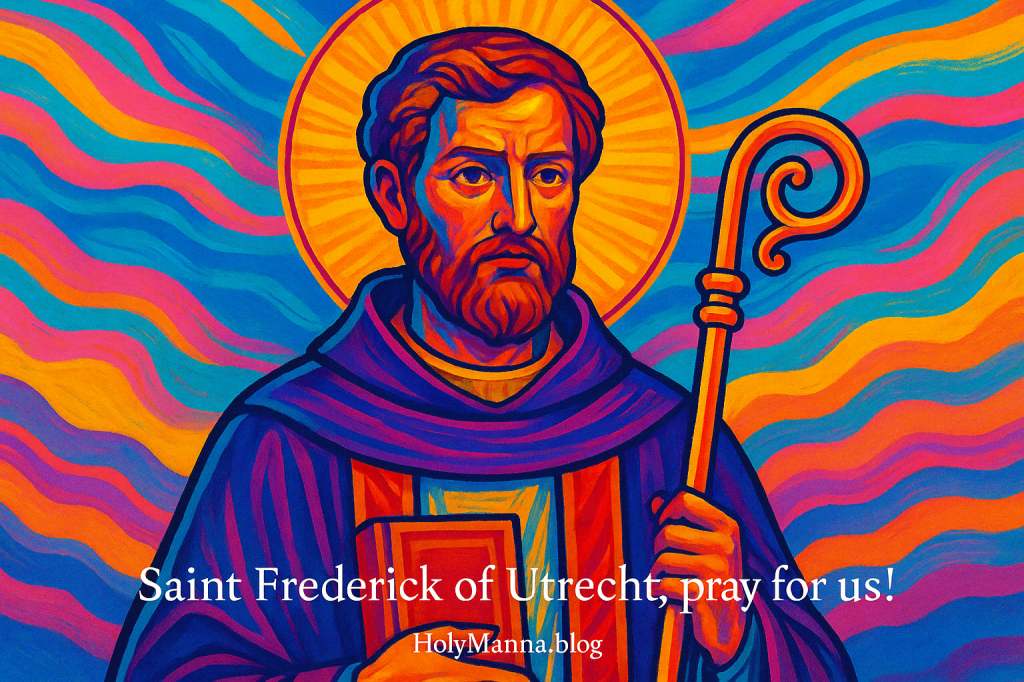
A Light in the Netherlands’ Darkest Hour
In the early ninth century, during the reign of the Carolingian Empire, the Church in the northern regions of Europe stood at a critical juncture. Pagan traditions still clung to coastal lands, moral corruption had crept into royal courts, and the tension between political power and spiritual authority was reaching new heights. Into this environment stepped Saint Frederick of Utrecht, a holy bishop who dared to confront the moral decay around him—not with rage, but with the gentleness of Christ and the firmness of apostolic conviction. His life, marked by pastoral care, missionary zeal, and fearless proclamation of truth, stands as a timeless example of what it means to love Christ more than comfort, position, or even one’s own safety.
Saint Frederick’s legacy may not be as widely celebrated as others, but his martyrdom speaks volumes. He wasn’t slain in the heat of battle or during a sweeping persecution; he was martyred for doing the simple and profoundly difficult task of a bishop: teaching the truth in love. His unwavering commitment to the Gospel, even in the face of imperial opposition, led to his violent death—making him a true martyr in odium fidei, “in hatred of the faith.” Today, we look to his life as a model for every Christian who longs to remain faithful in a world that often prefers silence to truth.
The Defender of Truth
Saint Frederick was born around 780 A.D. in or near Utrecht, in what is now the Netherlands. The region was part of the Carolingian Empire—a time of relative peace and Christian expansion, but also one rife with internal decay. While few records exist about Frederick’s early family life, we know he received his education at the cathedral school of Utrecht, a vital intellectual and spiritual hub in the Low Countries. There, under the mentorship of Bishop Ricfried, he immersed himself in Scripture, theology, philosophy, and pastoral studies, preparing for the sacred duties of holy orders.
Ordained first as a deacon and then a priest, Frederick distinguished himself through prayerful discipline, theological clarity, and a deep love for the people of God. He was not interested in honors or positions of prestige, but when Bishop Ricfried died around 825 A.D., the clergy and laity alike called upon Frederick to assume the role of bishop. Reluctantly, but obediently, he accepted.
As Bishop of Utrecht, Frederick faced challenges on multiple fronts. On one side were the pagan Frisians in the northern territories, still clinging to their ancestral gods. On the other, the moral laxity of Christian leaders—including those in imperial positions—threatened to undermine the Gospel itself. Yet Frederick carried out his duties with fatherly concern and spiritual tenacity. He sent missionaries to Friesland, reformed clerical discipline, and preached the Gospel with purity and power. Perhaps most notably, he publicly denounced the scandalous behavior of Empress Judith, wife of Emperor Louis the Pious, who was rumored to have lived in moral compromise. This act would cost him everything—but he considered the price worth paying.
Frederick’s Spiritual Fruit
While no spectacular, headline-grabbing miracles are attributed to Saint Frederick during his earthly life, that doesn’t mean divine power was absent. Sometimes, the greatest miracles are not the visible ones, but those wrought in the secret places of the heart. Frederick’s miracle was his fearless fidelity in a culture that wanted a tame Church and a silent Gospel.
In the mission fields of Friesland, where barbarism and idolatry had long resisted Christian light, Frederick sent missionaries who preached, baptized, and planted seeds of faith in difficult soil. Their success was due, in part, to Frederick’s strategic leadership and his own prayers. He governed with a blend of charity and strength, never coercing, but always inviting. The conversions that followed were spiritual resurrections—souls coming to life in Christ.
In Utrecht itself, Frederick worked to reform the clergy, not with iron fists but with exhortation and example. He led by living the truth. As Saint Gregory the Great once said, “The lips preach, but the life shouts.” Frederick’s life shouted holiness, and his people listened. This quiet transformation of hearts and structures was a miracle of grace—a hidden but powerful testimony to the working of the Holy Spirit through humble, obedient servants.
Blood on the Altar
Saint Frederick’s greatest challenge—and his final test—came when he confronted the sins of the powerful. Historical sources tell us that he publicly called out Empress Judith, accusing her of moral impropriety. Some say he confronted her directly; others say he preached boldly about the sins of the court from the pulpit. Either way, he would not be silenced. His fidelity to truth earned him enemies.
On the morning of July 18, 838 A.D., as he finished celebrating the Holy Sacrifice of the Mass, two assassins approached and fatally stabbed him. Many believe they were sent by agents of the empress or her court, though no one was ever formally charged. What matters more than the politics of his death is the purity of his heart in meeting it. He had no sword, no army, no protection—only Christ.
He died as he lived: a shepherd laying down his life for his sheep. His blood was shed not for rebellion or insurrection, but for truth. He joined the great company of martyrs who echo the words of Jesus: “Greater love has no man than this, that he lay down his life for his friends” (John 15:13). His martyrdom became the seal of his mission, proving that truth is not merely spoken—it is suffered for.
The Legacy of a Martyr Bishop
After his martyrdom, Frederick’s tomb in Utrecht became a place of pilgrimage. Though he was never formally canonized—an uncommon process at the time—his name entered into the local martyrologies, and devotion to him spread throughout the Low Countries. People came to pray near his relics, and stories emerged of healing, spiritual consolation, and divine protection granted through his intercession.
Pilgrims reported physical healings and renewed spiritual fervor. Frederick’s example also gave courage to future bishops who would face their own trials—reminding them that the bishop’s staff is not a symbol of worldly power, but a call to spiritual fatherhood and sacrificial love. Churches were named in his honor, and local feasts commemorated his life and witness.
His posthumous miracles were simple, but profound: the healing of the soul, the strengthening of the Church, and the vindication of those who walk in integrity. He is a hidden giant of the faith—one who did not seek to be remembered, but who was remembered because he was faithful.
The Courage to Speak
In our own day, truth is often treated as subjective, love is reduced to sentimentality, and courage is mistaken for aggression. Saint Frederick offers a radiant antidote: a love that is grounded in truth, a truth that is inseparable from Christ, and a courage that is not prideful but sacrificial.
The Catechism of the Catholic Church reminds us: “Martyrdom is the supreme witness given to the truth of the faith: it means bearing witness even unto death” (CCC 2473). This doesn’t only mean physical death—it also includes dying to popularity, to comfort, to social approval. Are we willing to speak the truth in our workplaces, our friendships, or even our families, when doing so might cost us?
Saint Frederick challenges us to examine our silence. Do we remain quiet when injustice happens, for fear of being disliked? Do we water down the Gospel so we don’t seem “judgmental”? Or are we willing to be gentle and bold like him—truthful and loving, no matter the cost?
To live like Saint Frederick is to live with eternity in mind. It is to put Christ first and allow the Holy Spirit to guide our words, our tone, and our actions. We may not face the sword, but we do face the pressure to conform. May his intercession strengthen us to follow the Shepherd who gave His life for us—so that we too might be willing to give our lives, day by day, word by word, for Him.
Engage with Us!
We’d love to hear how Saint Frederick’s life speaks to your heart. Share your thoughts in the comments below, and let’s support one another in our walk with Christ!
Here are three reflection questions to deepen your prayer:
- Where in your life are you being called to speak the truth with love, even when it’s uncomfortable?
- How do you react when faced with moral or spiritual compromise around you? Do you confront it or avoid it?
- What spiritual disciplines can help you grow in boldness, like Saint Frederick, so you can become a more courageous witness for Christ?
Let us walk this road together, supporting one another in faith, and striving to do everything with love, just as our Lord Jesus Christ did.
Saint Frederick of Utrecht, pray for us!
Follow us on Instagram and Facebook for more insights and reflections on living a faith-filled life.

 Holy Manna!
Leave a comment