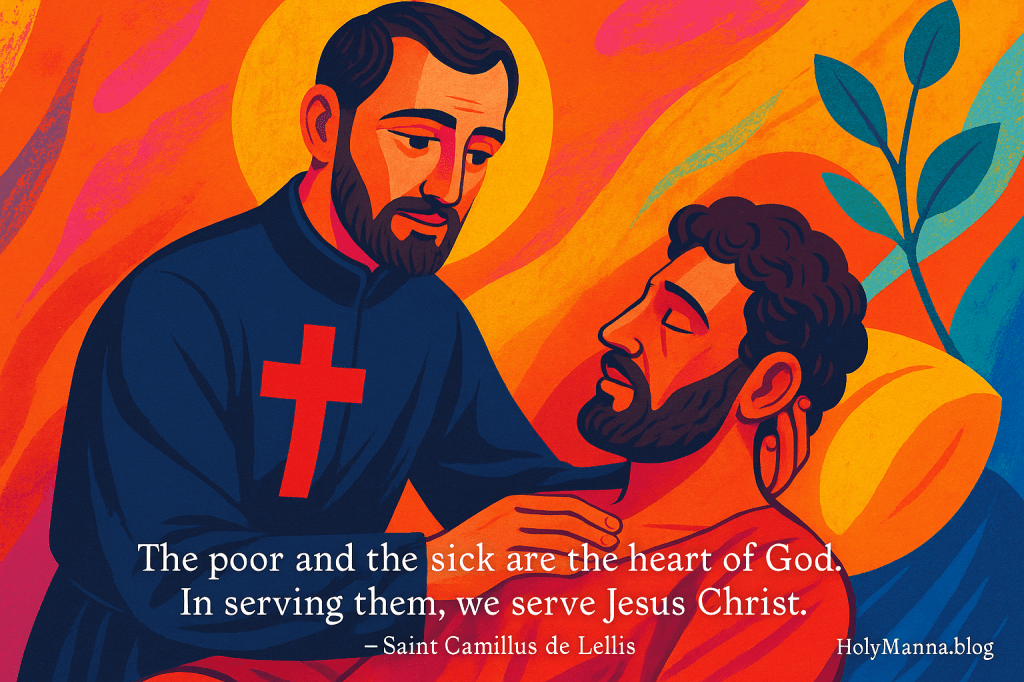
Healing with the Heart of Christ
An Unlikely Apostle of Mercy
In the grand tapestry of the saints, few threads are as unexpected and luminous as that of Saint Camillus de Lellis. A towering man both physically and spiritually, Camillus was not born a saint. In fact, his early life was marked by vice, violence, and vice again. And yet, God used even his wounds—especially his wounds—to form in him a heart that beat with unmatched tenderness for the sick and the dying. Known today as the patron saint of the sick, hospitals, nurses, and physicians, Camillus not only brought compassion to the bedside—he institutionalized it. He founded a religious order that served the ill with such devotion that their red cross became the precursor to the modern symbol of emergency medical aid. His life challenges us to ask: What if our deepest pains are God’s training ground for our greatest mission?
The Soldier Who Gambled with Grace
Camillus de Lellis was born on May 25, 1550, in the rugged, mountainous village of Bucchianico, in central Italy. His father, Giovanni de Lellis, was a soldier who spent most of his time at war. His mother, Camilla Compelli, was a devout woman who tried to raise her only son in the faith, but she died while Camillus was still a child. With no one to guide him, Camillus fell into a life of recklessness and sin. He was tall, strong, and combative by nature—traits that served him well when he joined the Venetian army at the age of 17 to fight in battles against the Turks. But his military discipline did little to tame his wild habits. He developed a crippling addiction to gambling, losing not only his possessions but also his sense of direction in life.
At one point, he became so impoverished that he was forced to beg on the streets. In desperation, he took a job at the San Giacomo Hospital for Incurables in Rome—first out of necessity, not compassion. His behavior there was so poor that he was fired. Yet God’s mercy was quietly at work. A leg wound he had received during his military years continued to fester, forcing him to return to the hospital as a patient. It was there, in that humbling environment, that the first seeds of his conversion were planted.
Camillus’s true spiritual rebirth came when he met Saint Philip Neri, the great Apostle of Rome. Under Philip’s spiritual direction, Camillus began to experience deep contrition and a desire to reform his life entirely. He gave up gambling, devoted himself to prayer and penance, and was eventually readmitted to San Giacomo—not as a patient this time, but as a devoted caregiver. Seeing the poor treatment that many sick patients received, he became convinced that the care of the sick should be a mission of love, not merely a job. In time, Camillus discerned a call to the priesthood and was ordained in 1584, at the age of 34. But he wasn’t done. Inspired by divine charity, he gathered a group of men who shared his vision, and together they founded a new religious community: the Clerks Regular, Ministers of the Infirm. Their mission? To serve Christ in the sick and suffering with body, mind, and soul.
Love that Heals
Camillus’s miracles were not the kind that drew crowds or headlines—but they were no less miraculous. His entire life became a living icon of divine love made visible through human compassion. As he and his brothers tended to patients, often in the most wretched conditions, people began to notice something extraordinary. “Wherever Camillus went, peace and healing followed,” one witness recounted. Many observed that the sick recovered more quickly under his care, and even those near death would find unexpected comfort in his presence.
During a terrible plague in Rome, when fear drove many to flee, Camillus and his men entered the infected zones with fearless love. Day after day, they carried the dying in their arms, washed their wounds, consoled the frightened, and prayed over the souls departing this world. They offered not only medical help, but spiritual healing—confession, the last rites, and the tender reassurance that Christ was near. Some contemporaries even reported visions of angels assisting the Camillians as they worked in plague hospitals.
Camillus also possessed remarkable spiritual gifts. He had the ability to read hearts and anticipate needs before they were spoken. He often walked into a room and named a patient’s hidden fear or unspoken sin, inviting healing through confession and prayer. One nurse in his order later testified: “Father Camillus healed more with his love than with any medicine.”
Pain Transformed
While Camillus was not martyred by sword or fire, his life was a continuous act of martyrdom—a white martyrdom, the kind that slowly pours out one’s life for love. For over forty years, he suffered from the same festering leg wound he had received during his military career. It never healed, and often caused him excruciating pain. Yet he never complained. Instead, he used his suffering as fuel for his ministry. “Pain,” he once said, “teaches the heart how to love deeper.”
His trials were not limited to physical agony. He faced tremendous opposition from religious and civil authorities, who doubted his intentions and questioned the need for his new order. Some thought it was imprudent to combine religious life with hospital service. Others objected to his inclusion of men who, like himself, had lived disordered lives before their conversion. But Camillus pressed on. He trusted that if God had called him, then God would make the way.
As the years passed, Camillus continued to serve despite increasing illness. By the end of his life, his body was riddled with disease, yet his spirit remained radiant. He died on July 14, 1614, in Rome. His last words were “May the face of Christ shine upon me.” The room where he died was filled with peace, and even the sick who had once been afraid of death now welcomed it with joy, having seen in Camillus the face of Christ Himself.
A Legacy of Healing
Death did not diminish Saint Camillus’s power to heal. On the contrary, it only magnified it. Not long after his passing, countless miracles of healing were reported through his intercession. Families prayed at his tomb and found their loved ones restored to health. Physicians and nurses invoked his name during medical crises and reported extraordinary recoveries. In 1624, his cause for canonization was officially opened. He was beatified by Pope Benedict XIV in 1742 and canonized just four years later in 1746.
The miracles didn’t stop there. Over the centuries, Camillus has been invoked in hospitals, battlefields, and homes, especially during epidemics and disasters. In 1886, Pope Leo XIII named him the Patron of the Sick, and Pope Pius XI later added that he is also the Patron of Doctors and Nurses. His relics are venerated at the Church of Saint Mary Magdalene in Rome, where many pilgrims still come seeking physical and spiritual healing.
Today, the order he founded—the Camillians—continues to serve in over 40 countries, tending to the sick, the poor, and the abandoned. Their motto echoes the heart of their founder: “The sick are the suffering members of Jesus Christ.”
What Wounded Hands Can Do
Saint Camillus de Lellis teaches us that our wounds do not disqualify us from holiness—they may in fact be the very thing God uses to make us saints. His story invites us to examine our own brokenness and consider: How might God want to use my pain to heal someone else?
Camillus’s fourth vow—to serve the sick even at the risk of death—challenges the modern world’s obsession with self-preservation. It invites us to see Christian love as something radical, self-emptying, and incarnational. As The Catechism of the Catholic Church reminds us, “Human life is sacred because from its beginning it involves the creative action of God” (CCC 2258). Camillus lived this truth by treating each patient not as a burden, but as Christ Himself.
You don’t have to work in a hospital to follow his example. Are there sick relatives you’ve avoided visiting? Elderly neighbors you’ve forgotten? A friend with a chronic illness who needs your presence more than your words? Saint Camillus reminds us that holiness begins at the bedside, with love in your hands and Christ in your heart.
He also teaches us that conversion is possible, no matter how lost we feel. A gambler, a brawler, and a wounded soldier became one of the Church’s greatest saints. What might God want to do with your story?
Engage with Us!
We’d love to hear your thoughts and reflections. Let’s grow together in faith and charity.
- How can I serve the sick or vulnerable in my own community with greater love?
- Have I allowed my own wounds or failures to become a source of grace for others?
- What does it mean to take up a “fourth vow” in the modern world—to love and serve without counting the cost?
Let’s encourage each other to live with compassion, pray for the sick, and strive always to do everything with love, as our Lord Jesus did.
Saint Camillus de Lellis, pray for us! ✝️
Follow us on Instagram and Facebook for more insights and reflections on living a faith-filled life.

 Holy Manna!
Leave a comment