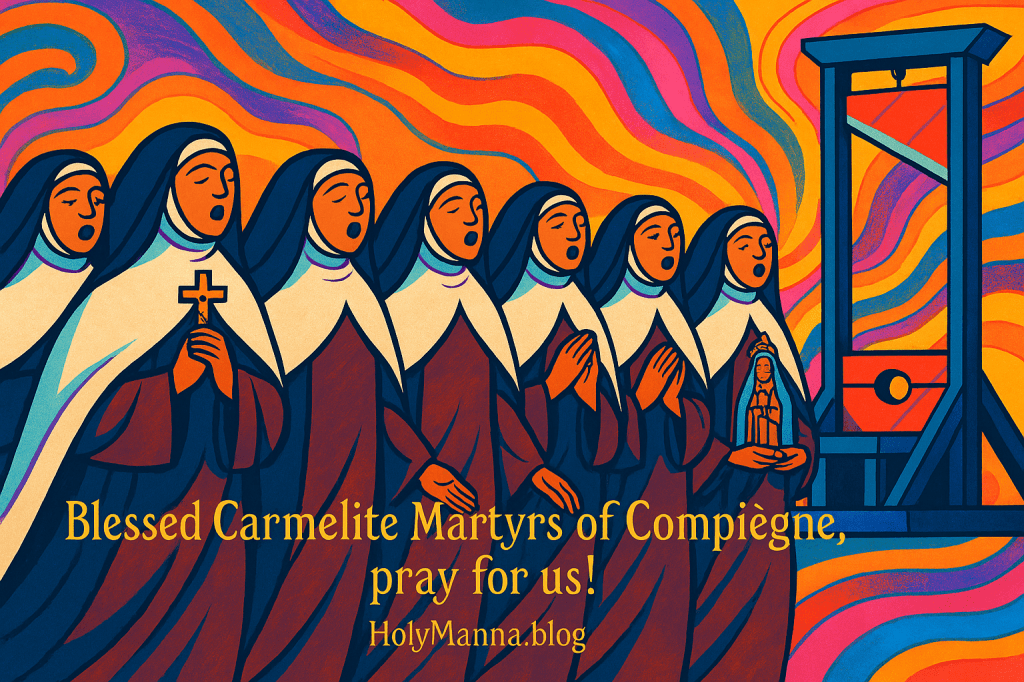
The Carmelite Nuns Who Sang Their Way to Heaven
Hidden Voices in a Revolution
On July 17th, the Church raises up the memory of the Blessed Carmelite Martyrs of Compiègne—sixteen brave women whose cloistered silence turned into a loud proclamation of faith in the midst of revolutionary terror. These nuns were not fiery preachers or miracle workers; they were contemplatives who lived in hidden service to God. Yet when the time came, their witness thundered across history. Clad in their humble brown habits and white mantles, they approached the guillotine not with fear, but singing hymns of joy, love, and surrender.
Theirs was a victory not measured in political power or public acclaim, but in unwavering fidelity to Jesus Christ. They embraced suffering with supernatural peace, offering their lives as a sacrifice for the Church and for France during one of its darkest chapters. Their courage stunned crowds, softened hardened hearts, and may have even hastened the fall of the Reign of Terror. Beatified by Pope St. Pius X in 1906, they are a reminder that the quiet souls who give themselves wholly to God can change the course of history—even in death.
Whispers of Fire
The sixteen martyrs came from diverse walks of life—nobles, peasants, teachers, and servants—but all found their true vocation in the quiet cloisters of the Carmelite convent of Compiègne. The monastery, located just north of Paris, was a place of deep prayer and penance, following the reform of St. Teresa of Avila. In this Carmelite family, their lives were filled with silence, work, fasting, and ceaseless prayer for the world they rarely saw but deeply loved.
Even before the persecution began, these women had offered themselves as spiritual victims. As revolutionary violence grew, they saw their faith and way of life outlawed. Their monastery was seized in 1790, and by 1792 they were forced to leave and live in small groups under surveillance. But they continued to live their vows as best they could, secretly gathering to pray and wear their habits, knowing full well that they risked imprisonment or death.
In a profound moment of grace, the prioress, Mother Teresa of St. Augustine, proposed a spiritual offering: that the community offer their lives as a holocaust to God, that peace might be restored to the Church and to France. Each Sister signed this offering. It was a quiet “yes” to martyrdom long before the blade fell. These women are most known today not only for their ultimate sacrifice, but for the holy intention with which they prepared for it. Their faith was not a last-minute show of courage—it was a lifestyle of surrender that bore fruit in the moment of crisis.
The Miracle of Peace
The Blessed Martyrs of Compiègne did not perform the kinds of spectacular miracles often recorded in the lives of saints—healings, bilocations, or levitations. Yet their lives themselves were miracles. At a time when even priests were hiding, these nuns lived a supernatural serenity. They comforted neighbors, shared their rations with the poor, and remained joyful, even cheerful, as persecution loomed.
One of the most astonishing miracles they performed was the conversion of hearts. Eyewitnesses to their arrest and final days were moved by their peace. One jailer remarked that he had never seen such radiant calm. A Revolutionary guard later said he saw angels around them as they were led to trial. When they were condemned, the Sisters showed no panic. Instead, they knelt in thanksgiving to God, blessing their judges and embracing their calling.
Their final procession was like a liturgical celebration. As they were taken to the scaffold, they sang the Te Deum, the Salve Regina, and the Miserere. Each Sister approached Mother Teresa of St. Augustine, kissed her hands, and asked permission to die. They were radiant. Their joy and dignity melted the hearts of even the most hardened revolutionaries. They bore a peace the world could not understand, fulfilling Christ’s promise in John 14:27: “Peace I leave with you; my peace I give to you… not as the world gives do I give to you.”
A Symphony of Blood
Their arrest came on June 22, 1794. They were accused of living in an outlawed religious community, possessing images of the Sacred Heart, and refusing to conform to the anti-Catholic mandates of the revolutionary regime. They were taken to the Conciergerie prison in Paris, where they spent several weeks in appalling conditions. Yet during that time, they continued to live as a community—praying the Divine Office as best they could, making acts of love and forgiveness, and preparing for death.
On July 17, they were taken in a dung cart through the streets of Paris. Crowds gathered, expecting spectacle. What they saw instead was a procession of peace and song. The youngest, Sister Constance, led the group in singing Laudate Dominum, her voice strong and clear. One by one, the Sisters mounted the scaffold, kissed a small statue of the Blessed Virgin Mary, and died with the words of love on their lips.
The last to die was Mother Teresa of St. Augustine. As the blade fell, all sixteen had given their lives. Within ten days, Robespierre and the architects of the Reign of Terror were themselves arrested and executed. The Terror ended. The storm broke. And many believe that the blood of these quiet martyrs helped end the flood of violence in France. “Greater love has no one than this, that someone lay down his life for his friends” (John 15:13). These women gave their lives not only for each other, but for a nation in spiritual crisis.
Echoes in Eternity
Though canonization has not yet occurred, the Blessed Martyrs of Compiègne are widely venerated throughout the world. Their relics are preserved in Carmelite monasteries, and their story has inspired countless religious vocations and works of art. Their impact on the Church has only grown in the centuries since their martyrdom.
Their story was brought to life in The Song at the Scaffold by Gertrud von Le Fort, a literary masterpiece that imagines the internal struggle of a fictional noblewoman who joins them in death. This work, in turn, inspired Dialogues des Carmélites, an opera by Francis Poulenc based on Georges Bernanos’ screenplay. The opera has been performed on stages around the world and has moved both secular and religious audiences with its haunting beauty and powerful depiction of grace in the face of death.
Pilgrimages are made to Compiègne and to the sites associated with their martyrdom. Young women discerning religious life often turn to the Carmelite martyrs as companions and intercessors. Though we do not yet have Vatican-approved miracles for their canonization, their heavenly influence is deeply felt in the Church. Their offering continues to bear fruit in the hidden hearts of those who, like them, say “yes” to God in silence, humility, and love.
Cloistered Thunder
In a world that prizes power, noise, and public recognition, the Carmelite Martyrs of Compiègne call us to a different kind of heroism. They teach us that silence can be louder than shouts, and that fidelity in the small things can prepare us for victory in the greatest trials. They remind us that we are never forgotten by God, even when the world turns against us.
Their story asks us hard but beautiful questions: Are we willing to die to ourselves for the sake of others? Are we brave enough to remain faithful to Christ in a world that mocks the cross? Can we find joy even in suffering, trusting that God is at work in every moment?
They did not wait for the perfect moment to be saints—they simply lived their vocations with love, day by day, until love itself demanded everything. Like the wise virgins of Matthew 25, their lamps were full when the Bridegroom came. Let us learn from them to say yes to God in the quiet places of our lives—because when the time comes, our small “yeses” might become a hymn that echoes into eternity.
Engage with Us!
We’d love to hear your thoughts and prayers in the comments below. Let the courage of the Carmelite Martyrs of Compiègne inspire you to live your faith with boldness, peace, and charity.
Reflection Questions:
- What areas of your life require deeper trust and surrender to God’s will, even when it feels difficult or risky?
- How can you respond to adversity with love and peace instead of fear or anger, following the example of the Carmelite Martyrs?
- Are there “little” daily sacrifices you can offer for the Church, your country, or someone in need today?
Let’s support each other in this faith journey and strive to do everything with love, as our Lord Jesus did.
Blessed Carmelite Martyrs of Compiègne, pray for us! ✝️
Follow us on Instagram and Facebook for more insights and reflections on living a faith-filled life.

 Holy Manna!
Leave a comment