Thursday of the Fifteenth Week in Ordinary Time – Lectionary: 392
Rest for the Weary, Strength for the Journey
Have you ever felt the weight of life pressing down on your shoulders—burdens too heavy to carry, questions too big to answer, and a deep longing for rest that the world just can’t seem to satisfy? Today’s readings gently invite us into the heart of a God who sees, who knows, and who comes down to deliver. From the burning bush of Exodus to the gentle voice of Jesus in The Gospel of Matthew, we encounter the same divine presence: a God who enters human history not to dominate, but to redeem—and who offers true rest to those who walk with Him.
In Exodus 3, we witness the awe-inspiring moment when God reveals His name to Moses: “I AM who I AM”. This isn’t just a cryptic phrase—it’s a profound declaration of God’s eternal, unchanging, and self-sufficient nature. For the enslaved Israelites, this name was a promise that the God of their ancestors had not forgotten them. Paired with Psalm 105, which praises God’s covenant faithfulness and the miraculous signs He performed through Moses and Aaron, we see a pattern: God does not forget His promises, and He never abandons His people in their suffering. His mighty hand is at work even in the darkest of times.
But the climax of today’s readings comes in the tender voice of Jesus: “Come to me, all you who labor and are burdened, and I will give you rest” (Matthew 11:28). This is the same God who spoke to Moses, now clothed in human flesh, inviting all who are weary to find peace—not in escape, but in relationship. The Lord who once delivered Israel with power now delivers hearts with gentleness. The burden of slavery has become the burden of sin and sorrow, and the promised land has become the rest of the soul in Christ. Will you let Him carry your burdens today? Will you trust the “I AM” to be enough for your journey?
First Reading – Exodus 3:13–20
The Name That Frees
The Book of Exodus is one of the most pivotal texts in all of Scripture. It not only recounts the foundational story of Israel’s deliverance from slavery in Egypt but also reveals, for the first time, God’s personal name—YHWH, rendered as “I AM”. Today’s passage takes us into that sacred moment when Moses, a fugitive shepherd on Mount Horeb, encounters the living God in a burning bush. This encounter is not just a call to mission—it is a divine revelation of identity and covenantal promise. In the midst of political oppression and spiritual despair, God identifies Himself not as a distant deity, but as the One who is eternally present, faithful, and intimately involved in human suffering. Within the context of today’s theme—God’s faithful presence and saving power bringing rest to the oppressed—this reading reminds us that the answer to our deepest burdens begins not with a command but with the comforting revelation of who God is.
Exodus 3:13-20
New American Bible (Revised Edition)
13 “But,” said Moses to God, “if I go to the Israelites and say to them, ‘The God of your ancestors has sent me to you,’ and they ask me, ‘What is his name?’ what do I tell them?” 14 God replied to Moses: I am who I am. Then he added: This is what you will tell the Israelites: I AM has sent me to you.
15 God spoke further to Moses: This is what you will say to the Israelites: The Lord, the God of your ancestors, the God of Abraham, the God of Isaac, and the God of Jacob, has sent me to you.
This is my name forever;
this is my title for all generations.
16 Go and gather the elders of the Israelites, and tell them, The Lord, the God of your ancestors, the God of Abraham, Isaac, and Jacob, has appeared to me and said: I have observed you and what is being done to you in Egypt; 17 so I have decided to lead you up out of your affliction in Egypt into the land of the Canaanites, the Hittites, the Amorites, the Perizzites, the Girgashites, the Hivites and the Jebusites, a land flowing with milk and honey. 18 They will listen to you. Then you and the elders of Israel will go to the king of Egypt and say to him: The Lord, the God of the Hebrews, has come to meet us. So now, let us go a three days’ journey in the wilderness to offer sacrifice to the Lord, our God. 19 Yet I know that the king of Egypt will not allow you to go unless his hand is forced. 20 So I will stretch out my hand and strike Egypt with all the wondrous deeds I will do in its midst. After that he will let you go.
Detailed Exegesis
Verse 13 – “But,” said Moses to God, “if I go to the Israelites and say to them, ‘The God of your ancestors has sent me to you,’ and they ask me, ‘What is his name?’ what do I tell them?”
Moses anticipates the skepticism of the people. They have been enslaved for generations, and the memory of God’s covenant likely feels distant. By asking God’s name, Moses seeks authority and assurance. In the ancient world, names signified identity, power, and presence. This question isn’t merely logistical—it’s theological.
Verse 14 – God replied to Moses: “I am who I am.” Then he added: “This is what you will tell the Israelites: I AM has sent me to you.”
This is one of the most profound declarations in all of Scripture. The Hebrew phrase Ehyeh Asher Ehyeh can also be translated as “I will be who I will be.” God is not defined by human terms or limited by time. He is being itself—pure existence. “I AM” indicates absolute presence, eternal reality, and unchanging faithfulness. For a people enslaved and forgotten by the world, this is a revelation of ultimate hope: God is, and He is with them.
Verse 15 – God spoke further to Moses: “This is what you will say to the Israelites: The Lord, the God of your ancestors, the God of Abraham, the God of Isaac, and the God of Jacob, has sent me to you. This is my name forever; this is my title for all generations.”
God roots His identity in relationship. He is not a new or foreign deity; He is the covenantal God of their forefathers. This reference to the patriarchs reaffirms continuity and trust. He is the same God who made promises, and He is now fulfilling them.
Verse 16 – “Go and gather the elders of the Israelites, and tell them, ‘The Lord, the God of your ancestors, the God of Abraham, Isaac, and Jacob, has appeared to me and said: I have observed you and what is being done to you in Egypt;’”
Here, God instructs Moses to begin with the elders—Israel’s tribal leaders. He affirms that He sees their affliction. This verse reveals a key characteristic of God: He is not indifferent to suffering. He watches, listens, and responds.
Verse 17 – “so I have decided to lead you up out of your affliction in Egypt into the land of the Canaanites, the Hittites, the Amorites, the Perizzites, the Girgashites, the Hivites and the Jebusites, a land flowing with milk and honey.”
God’s plan is not just liberation, but abundant life. The list of nations shows that this will be a real, historical, and challenging journey—but the promise of a land “flowing with milk and honey” signifies fruitfulness and blessing. This is a God who saves with purpose.
Verse 18 – “They will listen to you. Then you and the elders of Israel will go to the king of Egypt and say to him: ‘The Lord, the God of the Hebrews, has come to meet us. So now, let us go a three days’ journey in the wilderness to offer sacrifice to the Lord, our God.’”
This request for a pilgrimage foreshadows the greater Exodus. It also reveals that worship—right relationship with God—is the ultimate goal of freedom. Liberation isn’t just about escaping oppression; it’s about returning to right worship.
Verse 19 – “Yet I know that the king of Egypt will not allow you to go unless his hand is forced.”
God forewarns Moses of resistance. Pharaoh’s hardness of heart will become a backdrop against which God’s might will be revealed. Deliverance will not be easy—but it is guaranteed.
Verse 20 – “So I will stretch out my hand and strike Egypt with all the wondrous deeds I will do in its midst. After that he will let you go.”
God promises signs and wonders—the same ones remembered in Psalm 105. His “outstretched hand” becomes a recurring image throughout Scripture, symbolizing divine power and saving intervention. It is the hand that lifts burdens.
Teachings of the Church
The Catechism of the Catholic Church teaches that God’s name, as revealed to Moses, is central to our faith: “God revealed himself to his people Israel by making his name known to them… In revealing his mysterious name, YHWH (‘I AM HE WHO IS,’ ‘I AM WHO AM’ or ‘I AM WHAT I AM’), God says who he is and by what name he is to be called. This divine name is mysterious just as God is mystery” (CCC 206). Knowing God’s name is not about having control over Him—it is an invitation into communion with Him, to trust His presence even when the path is uncertain.
Saint Augustine marveled at this revelation, proclaiming: “God is not called ‘I was,’ but ‘I am,’ because He is always present. There is no past nor future in God, only an eternal present.” This is crucial for us. In our own trials and seasons of spiritual dryness, we often assume God is distant or unconcerned. But “I AM” assures us that God is already there, fully present, before we even cry out. He does not just act in history—He acts in our hearts today.
Historically, the Jewish reverence for the divine name was so intense that it was not spoken aloud. This awe underscores the holiness and intimacy of the name revealed to Moses. When Jesus uses the divine “I AM” in The Gospel of John (especially in John 8:58—“Before Abraham was, I AM”), He directly identifies Himself with the God of the burning bush. The liberator of Israel has come again—not just to free from political bondage, but from the bondage of sin, fear, and death.
Reflection
This passage is an invitation to rediscover the God who is present. When we are overwhelmed by the burdens of our lives—when we feel stuck, unseen, or hopeless—God reminds us that He sees and He acts. The first step in our healing is not self-reliance, but turning toward the One who is. Have you paused today to acknowledge God’s presence in your life? Do you trust that His name—“I AM”—is a promise that you are not alone?
Each of us is called, like Moses, to carry the name of God into the world—not by force, but through humble obedience and confident faith. That might look like interceding for a friend, standing for truth in a difficult workplace, or simply trusting God in an uncertain future. And as Moses learned, God equips those He calls.
What is your Egypt? What burden do you need to surrender to the God who sees and saves? Let this reading be your burning bush moment. God is not far. He is “I AM”—and He is enough.
Responsorial Psalm – Psalm 105:1, 5, 8–9, 24–27
Remembering the God Who Delivers
The Psalms are the songbook of Israel—poetry born out of covenantal memory, collective lament, and deep joy in God’s faithfulness. Psalm 105 is a historical psalm, recounting the wonders God has worked for His people, especially during the Exodus. It serves as both thanksgiving and testimony: an invitation to praise the Lord by remembering what He has done. In the liturgy, the psalm acts as a response to the first reading, echoing and magnifying its message. After Moses receives the revelation of God’s name and mission, Psalm 105 calls us to respond with grateful trust. In today’s context, this Psalm reinforces the theme that God’s faithful presence and saving power brings rest to the oppressed. By remembering the works of the Lord, the psalmist teaches us how to rest in God—not by forgetting our burdens, but by remembering His strength.
Psalm 105:1, 5, 8-9, 24-27
New American Bible (Revised Edition)
God’s Fidelity to the Promise
1 Give thanks to the Lord, invoke his name;
make known among the peoples his deeds!
5 Recall the wondrous deeds he has done,
his wonders and words of judgment,
8 He remembers forever his covenant,
the word he commanded for a thousand generations,
9 Which he made with Abraham,
and swore to Isaac,
24 God greatly increased his people,
made them more numerous than their foes.
25 He turned their hearts to hate his people,
to treat his servants deceitfully.
26 He sent his servant Moses,
and Aaron whom he had chosen.
27 They worked his signs in Egypt
and wonders in the land of Ham.
Detailed Exegesis
Verse 1 – “Give thanks to the Lord, invoke his name; make known among the peoples his deeds!”
This opening line is both a command and a cry of joy. To “invoke his name” ties directly to the revelation of “I AM” in Exodus 3. God’s name is not a secret to be hidden but a gift to be proclaimed. Gratitude leads to mission: by remembering His deeds, we become witnesses of His glory to the nations.
Verse 5 – “Recall the wondrous deeds he has done, his wonders and words of judgment,”
Memory in the biblical sense is not passive recollection—it is active participation. To “recall” is to allow God’s past faithfulness to shape present trust. The “words of judgment” refer not only to punishment but to God’s justice, His righteous interventions in favor of His people. Recalling His wonders becomes an act of spiritual warfare against despair.
Verse 8 – “He remembers forever his covenant, the word he commanded for a thousand generations,”
This verse flips the lens: it is not only we who remember—God remembers. The covenant with Abraham, renewed through Moses, is not a relic of the past but an eternal commitment. A “thousand generations” signifies limitless fidelity. God’s memory is redemptive; He never forgets the oppressed.
Verse 9 – “Which he made with Abraham, and swore to Isaac,”
The psalmist zooms in on the patriarchs, grounding God’s actions in historical relationship. This verse affirms the continuity of salvation history: the God who speaks to Moses is the same One who made promises to Abraham and Isaac. This covenantal thread assures us that we are not forgotten.
Verse 24 – “God greatly increased his people, made them more numerous than their foes.”
This verse reflects the growth of the Israelites in Egypt, even under oppression. It is a sign of God’s silent but powerful presence. Fruitfulness amid suffering is one of God’s paradoxical blessings. He strengthens His people in hidden ways.
Verse 25 – “He turned their hearts to hate his people, to treat his servants deceitfully.”
This verse may be troubling at first glance. It reflects the mystery of divine providence: even the hatred of Egypt becomes part of the narrative of redemption. The hardened hearts of the oppressors will become the backdrop against which God’s justice will shine.
Verse 26 – “He sent his servant Moses, and Aaron whom he had chosen.”
God doesn’t just observe—He sends. This verse emphasizes that God acts through human agents, chosen and commissioned. Moses and Aaron are not saviors in themselves, but instruments of divine salvation.
Verse 27 – “They worked his signs in Egypt and wonders in the land of Ham.”
This concludes the selected verses with a reminder of divine power. The signs and wonders are not magic tricks but divine acts of justice, meant to liberate and reveal. “The land of Ham” is an ancient term for Egypt, connecting the story to a broader biblical geography and moral context.
Teachings of the Church
The Catechism of the Catholic Church speaks beautifully of the value of memory in the life of faith: “The remembrance of the wonderful works of God… forms the heart of the celebration of the liturgy” (CCC 1363). This is not just about recalling the past but about reliving and participating in it. The liturgy becomes a place where the Exodus—and all God’s saving deeds—become present to us. Psalm 105 exemplifies this: by remembering God’s wonders, we are drawn into the rhythm of His mercy.
Saint John Paul II often spoke of “the memory of the heart,” which for the people of God is formed by Scripture and liturgy. He said: “In remembering, the people of God finds its identity… it is by remembering the Exodus, the covenant, the works of the Lord, that Israel knows who it is.” For Christians, this memory is deepened by Christ, who brings the Exodus to fulfillment. In fact, the Eucharist itself is Christ’s command to “do this in memory of me.” Our spiritual rest comes from remembering who God is and what He has done for us.
The Church also emphasizes that this act of remembering must lead to mission. As Dei Verbum teaches, “Sacred Scripture must be read and interpreted in the light of the same Spirit by whom it was written” (DV 12). That same Spirit urges us to proclaim God’s deeds “among the peoples.” In a world overwhelmed by noise and forgetfulness, our witness rooted in covenantal memory becomes a radical act of hope.
Reflection
So often, we are burdened not only by external pressures but by forgetfulness—forgetting who God is, what He has done, and who we are in Him. Psalm 105 teaches us that remembering is a spiritual discipline. Have you taken time today to recall the Lord’s past faithfulness in your life? Do you let His past mercies shape your present peace? When anxiety creeps in or when burdens grow heavy, gratitude becomes our weapon and remembrance our rest.
This Psalm also challenges us to be storytellers of God’s faithfulness. When we share how God has acted in our lives, we echo the psalmist’s cry to “make known among the peoples his deeds.” This could be as simple as a testimony to a friend, a journal entry, or a prayer of thanksgiving. Let your memory become a source of courage.
How can you cultivate a heart that remembers? How might the act of recalling God’s wonders give you strength for today’s trials? As we carry our yokes, Psalm 105 gently reminds us: we do not walk alone. The God who saved Israel is still at work, still faithful, still present.
Holy Gospel – Matthew 11:28–30
The Gentle Rest of the Savior
Nestled within The Gospel of Matthew, this passage is a rare and intimate glimpse into the heart of Jesus. Unlike other Gospel moments where Christ teaches in parables or confronts religious hypocrisy, here He simply extends an invitation. This is not just a call to follow—it is a promise of rest, a revelation of His very character: “meek and humble of heart.” The historical context of this passage places it after Jesus has denounced the unrepentant cities of Chorazin, Bethsaida, and Capernaum. The crowds are burdened—not just by Roman occupation, but by religious legalism, spiritual fatigue, and personal sin. Into this setting, Jesus echoes the divine initiative we saw in Exodus: the God who hears the cries of His people now speaks with a human voice, offering rest not in escape, but in communion. In light of today’s theme—God’s faithful presence and saving power brings rest to the oppressed—this Gospel is the heart of the promise fulfilled.
Matthew 11:28-30
New American Bible (Revised Edition)
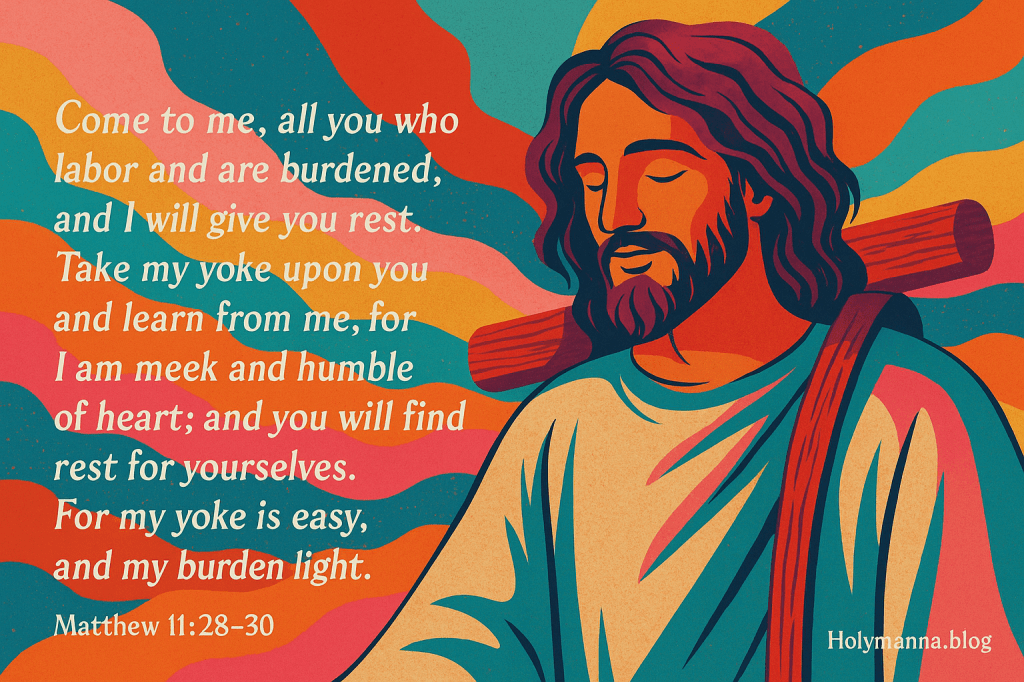
The Gentle Mastery of Christ. 28 “Come to me, all you who labor and are burdened, and I will give you rest. 29 Take my yoke upon you and learn from me, for I am meek and humble of heart; and you will find rest for yourselves. 30 For my yoke is easy, and my burden light.”
Detailed Exegesis
Verse 28 – “Come to me, all you who labor and are burdened, and I will give you rest.”
This is one of the most tender invitations in all of Scripture. Jesus is addressing the weary of every generation—those burdened by sin, by religious obligation devoid of grace, by sorrow, or by the pressures of life. The Greek word for “rest” (anapausis) implies not just relief but refreshment. This is the kind of rest only God can give—the rest promised in Exodus, now fulfilled in the person of Christ.
Verse 29 – “Take my yoke upon you and learn from me, for I am meek and humble of heart; and you will find rest for yourselves.”
The “yoke” was a symbol of submission and obedience, often associated with the Law. But Jesus redefines the yoke—not as a heavy burden, but as a path to freedom. His meekness (gentleness) and humility are not weaknesses but revelations of divine strength that does not crush. To “learn from me” suggests discipleship rooted in imitation, not fear. True rest comes not from abandoning responsibility but from walking in step with the heart of God.
Verse 30 – “For my yoke is easy, and my burden light.”
This final assurance contrasts sharply with the crushing religious burdens imposed by the Pharisees (see Matthew 23:4). The word “easy” in Greek (chrestos) also means “well-fitting.” Christ’s yoke is tailored to our shoulders. This is not the absence of difficulty, but the presence of grace. In Christ, burdens become bearable because we are no longer carrying them alone.
Teachings of the Church
The Catechism of the Catholic Church beautifully affirms this truth in the context of Christ’s life and ministry: “To become a child in relation to God is the condition for entering the kingdom… His exclamation, ‘Come to me…’ is the prayer of the humble, who recognizes that only Jesus can lift the burden that overwhelms them” (CCC 2785). Jesus’ invitation is not only spiritual poetry—it is an anchor for the soul. He does not erase our suffering but transforms it through His love.
Saint Thérèse of Lisieux, who embodied childlike trust, once wrote: “Jesus does not demand great actions from us but simply surrender and gratitude.” She understood that Christ’s yoke is not about performance but dependence. The rest He offers is interior peace, not worldly comfort. For Thérèse and countless saints, the heart of Christianity is not striving to earn love, but resting in the love that has already been poured out.
The Fathers of the Church, especially Saint Augustine, saw in this passage the culmination of God’s redemptive plan. Augustine writes, “You have made us for yourself, O Lord, and our hearts are restless until they rest in you.” This Gospel is the fulfillment of that restlessness. It connects the cry of the Israelites in Exodus, the praise of the Psalmist, and the yearning of every human heart for a burden that is not crushing, but shared.
Reflection
We live in an age where weariness runs deep—physically, emotionally, and spiritually. We try to carry it all alone: our responsibilities, anxieties, failures, and fears. Jesus speaks into that chaos with a quiet invitation: “Come to me.” Not fix yourself, not prove your worth, not earn my love—just come. Have you accepted His invitation, or are you still trying to carry your burdens by yourself?
This passage challenges our assumptions about strength. True strength is not stoic independence—it’s humble surrender. Taking Christ’s yoke means we move through life in step with Him: praying with Him, trusting in Him, letting Him define our pace and purpose. That is where rest is found. What parts of your life feel heavy right now? What would it look like to place those burdens into Jesus’ hands today?
In our daily lives, this might mean returning to prayer when we feel overwhelmed, choosing silence over striving, or receiving the sacraments as channels of divine strength. The “easy yoke” is not about comfort—it’s about communion. When we walk with the meek and humble Jesus, we discover a rest the world cannot give. Will you come to Him today? Will you trust that His yoke truly fits you? The God who said “I AM” now says “Come.” The choice—and the rest—is yours.
Walking with the God Who Sees
Today’s readings draw a powerful arc—from the fiery revelation of God’s name on Mount Horeb, to the psalmist’s joyous remembrance of His mighty works, to the gentle, soul-stirring invitation of Jesus to find rest in Him. In each passage, we meet the same God: eternally present, deeply personal, and profoundly faithful. He is “I AM”—not distant or abstract, but near to the oppressed, attentive to the weary, and mighty to save.
In Exodus, we saw the God who hears the cry of His people and promises deliverance through signs and wonders. Psalm 105 urged us to remember these deeds—not as relics of the past, but as living testimonies that our God keeps His covenant forever. And in The Gospel of Matthew, we encountered Jesus—the fulfillment of every promise—inviting us to come to Him and receive the rest our hearts desperately need. He does not remove every hardship but shares our yoke with a heart that is “meek and humble.”
So what is God saying to you today? Where are you burdened, and where might He be offering you rest? He is still the same God who called Moses, who multiplied His people in Egypt, who lifted up the lowly, and who now calls each of us by name. He invites us to trust—not in our own strength, but in His presence. Will you respond to His voice? Will you walk with the One who sees, who saves, and who stays? Today, rest in Him. Let His name be your strength, His deeds your memory, and His yoke your peace.
Engage with Us!
We’d love to hear how today’s readings spoke to your heart. Share your thoughts, prayers, or moments of grace in the comments below. Your reflections might be just the encouragement someone else needs today!
Reflection Questions:
First Reading – Exodus 3:13–20:
What does God’s name—“I AM”—mean to you personally? Where in your life do you need to trust that God sees and is present in your suffering?
Responsorial Psalm – Psalm 105:1, 5, 8–9, 24–27:
What are some “wondrous deeds” of God you can remember from your own life? How can you practice active remembrance as a way to deepen your trust in God?
Holy Gospel – Matthew 11:28–30:
What burdens are you carrying today that Christ is asking you to surrender? What does it mean for you to take on Jesus’ “yoke” in your current circumstances?
May these reflections lead you to deeper peace, renewed hope, and a living relationship with the God who walks beside you. Remember: everything you do today—whether in joy or in trial—can be done with the love and mercy Jesus taught us. Let His heart be your home, and His grace your strength.
Follow us on Instagram and Facebook for more insights and reflections on living a faith-filled life.

 Holy Manna!
Leave a comment