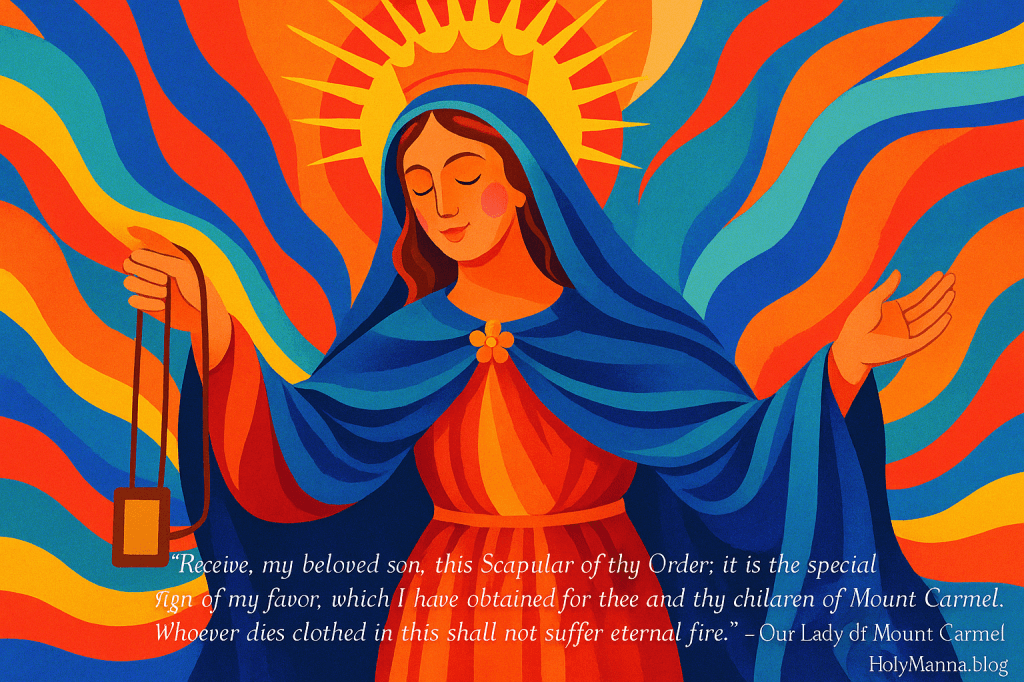
Mantle of Mercy
The Scapular Promise of Our Lady of Mount Carmel
Each year on July 16, the Catholic Church lifts its gaze to the heights of Mount Carmel and honors the Blessed Virgin Mary under one of her most ancient and powerful titles: Our Lady of Mount Carmel. This feast commemorates not just an event, but a way of life—a relationship between the Mother of God and a people consecrated to contemplative prayer, interior silence, and trust in divine providence.
Mount Carmel is no ordinary mountain. It is a place of fire and prophecy, where Elijah called upon the one true God and waited for the faint cloud—a symbol the Church would later see as a foreshadowing of Mary (cf. 1 Kings 18:44). Centuries later, this mountain became the home of Christian hermits who dedicated their lives to prayer in imitation of the prophet Elijah and in honor of the Virgin Mary. Their spirituality—marked by simplicity, detachment, and devotion—gave rise to what would become the Carmelite Order.
This feast is not centered on a single dramatic apparition, but on something even deeper: the enduring maternal presence of Mary throughout the history of the Church. Through her gift of the Brown Scapular, she extends her mantle of protection over all who desire to belong to her Son and live lives of purity, humility, and charity. The Feast of Our Lady of Mount Carmel invites the faithful to entrust themselves to Mary’s care and to take up the life of discipleship with renewed courage.
What does it mean to be truly wrapped in Mary’s mantle today? How can her presence guide your daily walk with Christ?
The Origin of the Carmelite Devotion
The roots of this feast reach back to the dramatic and holy landscape of Mount Carmel, a place rich in biblical symbolism. In 1 Kings 18, we encounter the prophet Elijah standing alone against the false prophets of Baal. In a moment of fiery vindication, he calls upon the Lord, who sends fire from heaven to consume the offering. After this, Elijah climbs higher and waits in silence until he sees a small cloud rising from the sea—no bigger than a man’s hand—ushering in rain after a long drought.
By the 12th century, Christian hermits inspired by Elijah settled on this very mountain. They built a chapel dedicated to the Virgin Mary and lived lives of penance and prayer. These were the first Carmelites. When Muslim invaders made life dangerous in the Holy Land, many of them fled to Europe, where they struggled to survive amid ecclesial and social upheaval. Their identity as a religious order was questioned, and their very survival was uncertain.
In the midst of this crisis, Mary revealed herself once again as a Mother of mercy. On July 16, 1251, she appeared to St. Simon Stock, the Prior General of the Carmelites in England. In this vision, she handed him a scapular—a simple piece of cloth worn over the shoulders—and made a promise: “Receive, my beloved son, this Scapular of thy Order: it is the special sign of my favor, which I have obtained for thee and thy children of Mount Carmel. Whoever dies clothed in this shall not suffer eternal fire.”
This moment wasn’t just a personal consolation for St. Simon—it was a turning point for the Order and for the Church. It signified Mary’s abiding care and her desire to draw all people into the heart of Christ through a simple, tangible sign of devotion.
How might God be using the simplicity of your daily life to reveal something sacred and eternal?
Clothed in Grace
The Brown Scapular is not a talisman or a lucky charm. It is a sacramental, meaning it is a sacred sign that prepares us to receive grace and disposes us to cooperate with it. Through the scapular, Mary calls her children to live in close union with her Son, in purity of heart and simplicity of life. To wear the scapular is to say: I belong to Mary, and through her, to Jesus.
Our Lady’s promise to St. Simon Stock was not a blanket guarantee of salvation but an invitation to walk a path of holiness under her maternal guidance. The scapular is a symbol of consecration, a habit of grace that marks one’s desire to live in the spirit of the Gospel. Those enrolled in the scapular commit to prayer, chastity according to one’s state in life, devotion to the Blessed Virgin, and faithfulness to the Church.
Throughout history, saints and popes have embraced this devotion. Pope Pius XII affirmed the scapular as “a sign of consecration to the Immaculate Heart of Mary.” St. John Paul II wore it faithfully throughout his life and urged the faithful not to dismiss its spiritual importance. He said: “The Scapular is essentially a ‘habit’… it is a sign of the constant protection of the Blessed Virgin, not only on life’s journey but also at the moment of passing into eternal life.”
Even in other apparitions, Our Lady affirmed the scapular’s importance. At Fatima, during the final apparition on October 13, 1917, she appeared holding the Brown Scapular, urging the faithful to pray the Rosary and wear this sign of grace. In Lourdes, though not mentioned explicitly, the Carmelite spirit of simplicity and penance resonates deeply with Mary’s call to conversion.
What might the scapular mean for your spiritual life? Have you allowed Mary to clothe you in the habit of grace and surrender?
Mary as Model and Mother
The Feast of Our Lady of Mount Carmel offers a window into Marian theology in action. In honoring Mary under this title, the Church proclaims her as Mother, Intercessor, and Spiritual Guide—one who actively participates in the sanctification of souls.
As The Catechism teaches: “From the most ancient times the Blessed Virgin has been honored with the title of ‘Mother of God,’ to whose protection the faithful fly in all their dangers and needs.” (CCC 971). The scapular is one way we live out this confidence in her protection.
Theologically, this feast underscores Mary’s role in the spiritual formation of the Christian. She doesn’t just intercede from afar—she nurtures, protects, and leads. As the model disciple, Mary shows us how to listen, how to wait, and how to say “Fiat” even when the path ahead is unknown. The Carmelite tradition, rich in mysticism and silence, finds in her its anchor and horizon.
The scapular also serves as a visible sign of the universal call to holiness. It reminds us that every person—no matter their vocation or state in life—is invited to become a contemplative in action, to live with eyes fixed on Christ and hearts resting in His peace.
How can Mary’s example of silence, courage, and trust transform your own response to God’s call?
Pilgrimage of the Heart
Devotion to Our Lady of Mount Carmel has given rise to some of the most beautiful shrines, pilgrimages, and practices in the Church. In Haifa, Israel, the Stella Maris Monastery sits near the site where Elijah dwelt in the cave. Pilgrims from all over the world visit to reconnect with the ancient Carmelite roots and to entrust themselves once again to Mary.
In Aylesford, England, where St. Simon Stock received the scapular, the Carmelite Shrine remains a place of peace and renewal. In Middletown, New York, the National Shrine of Our Lady of Mount Carmel offers retreats, liturgies, and spiritual direction in the Carmelite tradition.
Enrollment in the Brown Scapular is still widely practiced today. The ceremony is simple but powerful, often performed by a priest or Carmelite friar. After the initial enrollment, one may replace the cloth scapular with a blessed scapular medal, though the cloth is still preferred when possible. Many also practice daily prayer of the Rosary, participate in First Saturday devotions, and seek to imitate Mary in their everyday decisions.
The scapular is a habit for the heart. It is an outward sign of an interior relationship—a sign that Mary is your Mother and guide in the journey to holiness.
Have you visited a Marian shrine or experienced Mary’s closeness in a moment of prayer? Could now be the time to enroll in the scapular and walk more closely with her?
A Worldwide Celebration of Love and Legacy
Around the globe, the Feast of Our Lady of Mount Carmel is celebrated with awe and affection. In Naples, fireworks light up the sky as processions carry her statue through the streets amid prayers and Marian hymns. In Sicily, the faithful shout “Viva Maria!” as boats are blessed and the sea is entrusted to her care. In Spain, particularly in fishing communities, Our Lady is honored as the patroness of sailors, and her statue is carried into harbors to bless the waters.
In Peru, Colombia, and Chile, entire towns pause for spiritual renewal. Families gather for Mass, novenas echo through mountain villages, and banners of Mary hang from balconies. In the Philippines, she is called Ina ng Karmelo, and July 16 marks a day of joyful reverence, adorned with flowers, songs, and love.
These cultural expressions are not merely tradition—they are theology incarnate. They proclaim that Mary is not a distant figure from the past, but a living mother who walks with her people. In every language and landscape, her presence speaks the same message: “Do whatever He tells you.” (cf. John 2:5)
What would your community look like if it were fully devoted to Mary? What kind of joy and transformation might unfold under her care?
Engage with Us!
We’d love to hear how Our Lady of Mount Carmel has touched your life. Have you worn the scapular? Are you learning about this devotion for the first time?
Reflection Questions:
- What does the image of Mary clothing you in the scapular mean to you spiritually?
- How can you cultivate more silence and prayer in your daily life, like the Carmelite saints?
- What is one habit you can adopt this week to imitate Mary’s example of faith and surrender?
Let us grow together in holiness, clothed in the grace of Our Lady of Mount Carmel, and united in her unshakeable love.
Our Lady of Mount Carmel, pray for us! ✨
Follow us on Instagram and Facebook for more insights and reflections on living a faith-filled life.

 Holy Manna!
Leave a comment