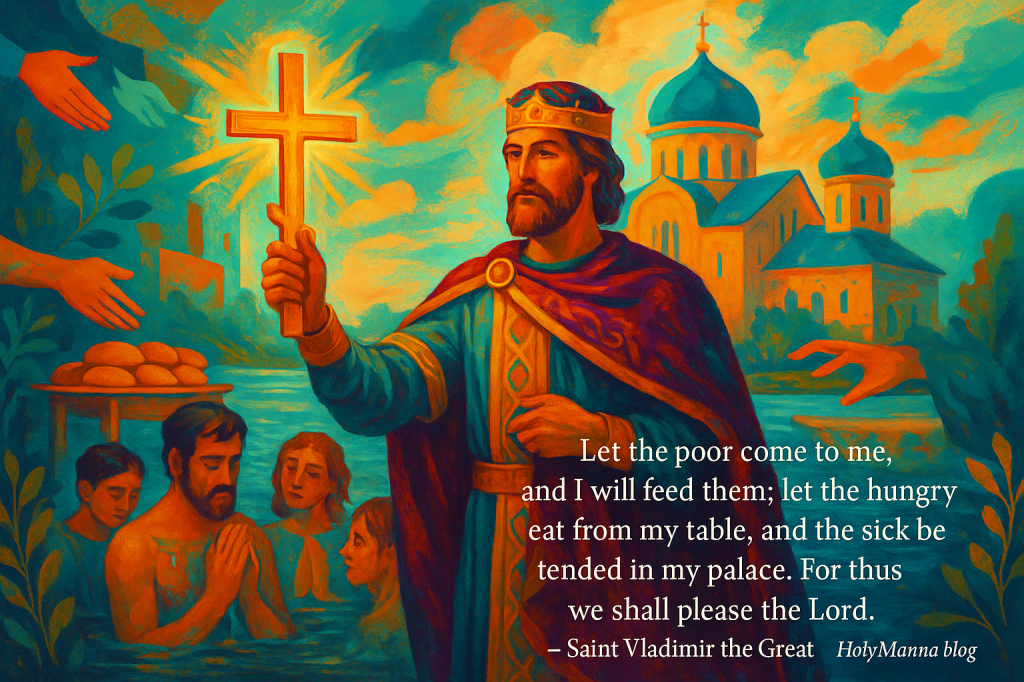
The Apostle of the Slavs
Saint Vladimir the Great stands among the giants of Christian history, not merely for his political accomplishments, but for the spiritual revolution he ushered in for an entire civilization. Known as the Baptizer of Kievan Rus’, he is credited with bringing Christianity to the Slavic peoples of Eastern Europe in a sweeping conversion that reshaped the region’s religious, cultural, and political identity. His impact is still felt today in modern Ukraine, Russia, and Belarus. A once-pagan prince who ruled with violence, lust, and ruthless ambition, Saint Vladimir is a vivid testament to the power of grace to transform the hardest of hearts. His feast is celebrated on July 15 in the Roman Catholic Church, where he is honored not just for his deeds, but for the miracle of his conversion—a miracle that became the doorway to salvation for millions.
From Pagan Prince to Spiritual Patriarch
Born around 956 AD in the city of Budyatychi (present-day Ukraine), Vladimir was the illegitimate son of Sviatoslav I of Kiev and his servant Malusha. Raised in the brutal world of 10th-century politics, Vladimir rose through cunning, force, and fraternal bloodshed. He seized the throne of Kiev by ousting his own brother and established himself as a powerful pagan ruler. His early reign was marked by unrestrained polygamy—having as many as 800 concubines—idol worship, and violent military campaigns. He constructed pagan shrines throughout his lands, including one to the god Perun, and lived without remorse for his cruelty.
But beneath this dark exterior stirred a restless soul. The Lord was already at work in his heart. According to the Primary Chronicle, a key source of early Eastern Slavic history, Vladimir began searching for a better way of life. Intrigued by stories of other religions, he sent emissaries to examine the practices of Muslims in Volga Bulgaria, Jews in the Khazar Empire, Latin Christians in Germany, and Greek Orthodox Christians in Constantinople.
It was the emissaries’ visit to the Hagia Sophia that became the turning point. When they returned, they said, “We no longer knew whether we were in heaven or on earth. Nor such beauty, and we know not how to tell of it.” Struck by this testimony, Vladimir recognized that Christianity held a truth and beauty his pagan gods could never offer. In 988 AD, he accepted baptism in Chersonesus (modern-day Crimea), taking the Christian name Basil, likely in honor of Emperor Basil II of Byzantium, whose sister Anna he was to marry.
His conversion was not symbolic or superficial. Immediately, Vladimir began to live differently. He destroyed pagan idols, promoted Christian ethics, and ordered the mass baptism of his people in the Dnieper River. This single act became the foundation of Christianity in Eastern Europe. The once fearsome prince became a spiritual father to his people, shepherding them into the light of Christ.
A Living Miracle
Though Saint Vladimir did not work dramatic miracles like healing the sick or raising the dead, his life itself became a miracle of divine grace. The contrast between the man he was and the man he became is astonishing. After his baptism, Vladimir dismissed his numerous concubines, established Christian marriages, and sought to rule with justice and mercy. His transformation stunned the court and citizens alike. Those who had feared him as a tyrant now saw him feeding the hungry, freeing prisoners, and founding churches.
He ordered the construction of the Church of the Tithes in Kiev—the first stone church in Kievan Rus’—dedicating it to the Virgin Mary. He brought in priests and missionaries from Byzantium to educate and catechize the newly baptized people. Schools, orphanages, and charitable institutions flourished under his patronage.
One of the most touching traditions tells of Vladimir opening his palace gates to the poor and sick, refusing to eat unless he had first ensured they were fed. “Christ dwells among the poor,” he would say. His rule became a reflection of Matthew 25:40: “Whatever you did for one of these least brothers of mine, you did for me.”
In a time when rulers glorified themselves with wealth and power, Vladimir’s embrace of humility, mercy, and Christian virtue became the clearest sign of the Gospel at work.
Battles Within and Without
Although Saint Vladimir did not suffer martyrdom, his post-conversion life was not without spiritual and political battles. The Christianization of Kievan Rus’ was not universally welcomed. Many nobles and citizens clung fiercely to their pagan customs. The destruction of the idols of Perun and other gods sparked unrest, and there were threats of rebellion in various regions of his kingdom.
But Vladimir endured these challenges not with brute force—as he might have in his younger days—but with patience and conviction. He persisted in preaching, building churches, and encouraging moral reform. His political allies questioned his gentler leadership, yet he held fast to his new principles. For a man once known for violence and pride, this was itself a kind of hidden martyrdom—a daily death to the old self.
His reign ended peacefully in 1015, but not without sorrow. His sons fought violently for succession, and civil war soon followed his death. Yet Vladimir’s legacy remained untarnished. He had changed the spiritual course of his people forever. The trials he bore as a Christian ruler gave his sainthood depth, showing us that holiness often comes not through spectacular suffering, but in the quiet, determined fidelity to Christ amid the world’s resistance.
A Saint for the Nations
Saint Vladimir’s sanctity was recognized quickly after his death. He was canonized by popular acclaim in both the Catholic and Orthodox traditions, and his tomb in the Church of the Tithes became a sacred place of pilgrimage. Stories of healings and divine intercessions began to circulate among the faithful.
Though his physical relics were scattered and some lost during centuries of war and upheaval, veneration of Saint Vladimir never faded. His image became iconic across Eastern Europe—depicted in mosaics, frescoes, and statues. Churches bearing his name were built from Kiev to Paris, from Moscow to Manhattan. For centuries, he has been invoked as a patron of Christian unity, moral transformation, and national conversion.
The greatest miracle, however, is ongoing: the Christian faith of the Slavic peoples endures. Every baptism, every prayer, every liturgy offered in those lands traces its lineage back to that day in 988 when Saint Vladimir walked into the waters of the Dnieper and emerged a new man.
Becoming Saints Like Vladimir
Saint Vladimir’s story challenges all of us to examine the idols in our own lives—power, lust, pride, control—and to surrender them at the foot of the Cross. His life shows that no one is beyond the reach of Christ. The Catechism reminds us that “the grace of Baptism does not deliver us from all the weakness of human nature, nor from the inclination to sin” (CCC 978), but through ongoing conversion, we are “called to live as children of God” (CCC 1692).
Saint Vladimir didn’t just say “yes” to baptism—he said “yes” every day to a new life in Christ. We are invited to do the same.
What old ways of thinking or living do you need to let go of today?
What might happen if you allowed God to work a miracle of transformation in your life, as He did in Vladimir’s?
Who in your life could be changed forever if you led them to the waters of faith?
Let us be reminded that sainthood is not for the perfect, but for the willing. Saint Vladimir was not born a saint—he became one through grace, surrender, and daily courage. So can we.
Engage with Us!
We’d love to hear your reflections on Saint Vladimir’s powerful conversion and legacy. Let’s build each other up in faith and strive to do everything with love, just as our Lord Jesus Christ taught us.
Reflection Questions:
- What part of Saint Vladimir’s transformation speaks most deeply to you?
- How can you, like Vladimir, influence your family or community through your own conversion?
- What “pagan idols” still have a hold on your heart, and how can you begin surrendering them to Jesus today?
Let’s walk together in the light of Christ and be unafraid to be transformed by His love.
Saint Vladimir the Great, pray for us! ⚔️
Follow us on Instagram and Facebook for more insights and reflections on living a faith-filled life.

 Holy Manna!
Leave a comment