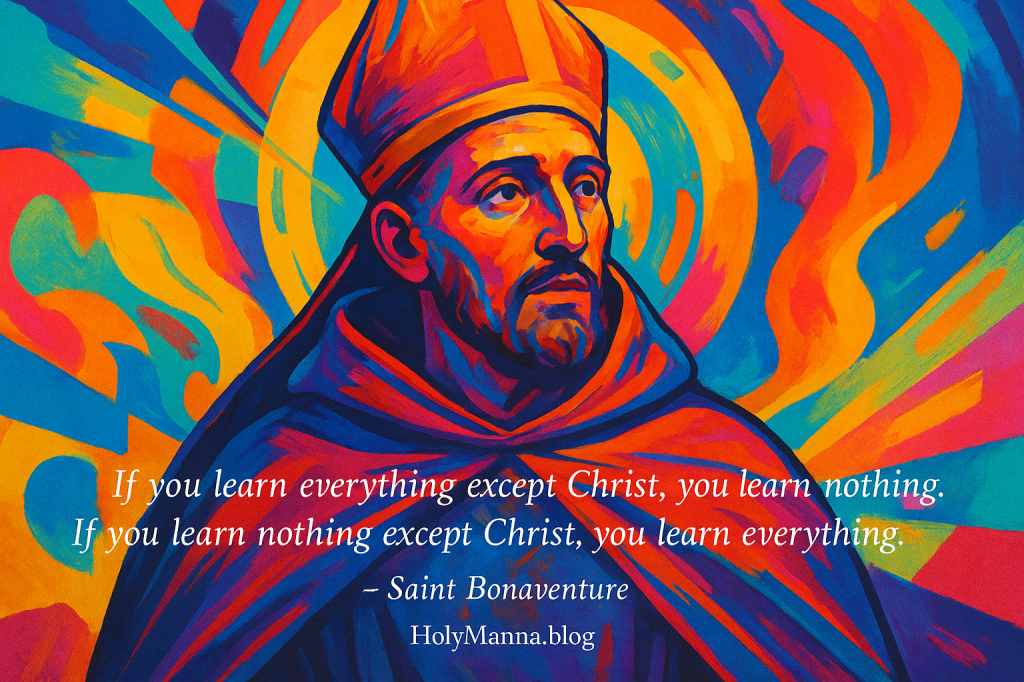
The Burning Intellect
Few saints so perfectly embody the harmony of head and heart, of study and sanctity, as Saint Bonaventure. Known as the “Seraphic Doctor,” he earned this title not merely for his theological insight but for the blazing love of God that animated his thought and his life. In an age where the Church was expanding its intellectual horizons through universities and rigorous philosophy, Bonaventure stood out as a figure who refused to separate learning from holiness. His deep friendship with Saint Thomas Aquinas, his leadership of the Franciscan Order, and his mystical writings have earned him a revered place in Church history. He reminds us that theology is not just a science—it is a path to union with God. The Catechism of the Catholic Church beautifully echoes this when it teaches that “the desire for God is written in the human heart” (CCC 27). Bonaventure’s life was one long, burning expression of that desire.
A Soul Saved by a Saint
Born around the year 1217 in the Italian village of Bagnoregio, Giovanni di Fidanza—who would later be known to the world as Saint Bonaventure—entered a world marked by feudal strife and spiritual hunger. His father was a respected physician, and his mother, Maria Ritella, was a devout woman whose prayers laid the foundation for her son’s future sanctity. At the tender age of four, Giovanni fell so seriously ill that his life hung by a thread. His mother, in desperation, turned to Saint Francis of Assisi, who was still alive at the time, and begged his intercession. Her plea was answered. Giovanni made a miraculous recovery, and years later he would testify, “I confess before God that I owe my life to blessed Francis.”
That healing was no mere physical restoration—it was the spark of a lifelong vocation. Giovanni joined the Order of Friars Minor in his early twenties and took the name Bonaventure. Legend holds that Saint Francis himself exclaimed “O buona ventura!”—“O good fortune!”—when he heard of the boy’s healing, a name that providentially stayed with him for life. Bonaventure’s genius quickly became evident, and he was sent to the University of Paris, where he studied under the great Alexander of Hales and soon became a leading figure in both philosophy and theology.
But Bonaventure was never content with academic achievement alone. In his soul burned a longing for God that went beyond books and debates. His most famous work, The Journey of the Mind into God (Itinerarium Mentis in Deum), written after a mystical experience on Mount La Verna—the same mountain where Saint Francis received the stigmata—is a masterpiece of spiritual theology. In it, Bonaventure guides the soul from the visible world to the invisible, from the intellect to the will, from analysis to adoration. He did not merely teach about God; he led souls to Him.
Flames of Wonder
While not known for working spectacular public miracles, Saint Bonaventure’s life was suffused with divine signs that testified to his sanctity. His fellow friars often observed that during prayer, he would enter into such deep ecstasy that he seemed unaware of the world around him. One story tells of him levitating while meditating on the Passion of Christ. Another time, while writing on the Eucharist, his face was said to have shone with a heavenly light, as though illuminated from within by the radiance of truth.
These miraculous moments, though quieter than raising the dead or healing the sick, reveal a man so united to God that the supernatural flowed gently through his natural life. Bonaventure’s gift of tears—frequent weeping during Mass or meditation—was considered by many a divine grace, a sign that his heart was overwhelmed by God’s mercy. He once wrote, “In all your contemplation, give place to the tears of love. Let your heart burn with love rather than merely shine with knowledge.”
This radiant holiness touched others deeply. Students who attended his lectures at the University of Paris claimed that they left not only informed, but transformed. His presence exuded peace. It was said that just being near him made people want to pray. Bonaventure’s miracles, then, were not so much dramatic interventions as they were ongoing invitations into the presence of the living God.
The Weight of the Mantle
Though he died peacefully, Saint Bonaventure endured profound trials during his lifetime, particularly in his leadership of the Franciscan Order. After the death of Saint Francis, the friars split into factions—some insisted on an extreme interpretation of Francis’s radical poverty, while others wished to adapt to the needs of a growing and more institutional Church. Caught between zeal and compromise, Bonaventure was elected Minister General in 1257 with the task of healing the Order. Through prayer, patience, and theological clarity, he reformed the Franciscans while preserving the original charism of their founder.
Even within the intellectual circles of Paris, Bonaventure faced opposition. He and Saint Thomas Aquinas were friends, but not all scholars welcomed their theological vision. The rise of certain heretical movements—such as Averroism, which denied the immortality of the soul—forced Bonaventure to defend the truth with clarity and boldness. His love of mysticism made some view him with suspicion. But Bonaventure’s writings silenced many critics, as they reflected a mind deeply steeped in Scripture, the Fathers of the Church, and the contemplative life.
Perhaps the greatest trial of all came near the end of his life. In 1274, Bonaventure was summoned by Pope Gregory X to help lead the Second Council of Lyon, a monumental gathering intended to reconcile the Eastern and Western Churches. He poured his energy into the work, balancing diplomacy with doctrine. Yet before the Council concluded, he died under mysterious circumstances. Some whispered of poisoning, but no firm evidence was found. What is certain is that his final days were offered in service to the unity of the Church, a fitting end to a life lived for the glory of God.
The Light That Did Not Go Out
The death of Saint Bonaventure did not end his impact on the world. On the contrary, his intercession became a source of healing and consolation for many. After his burial in Lyon, France, miracles began to occur at his tomb. People who were sick or troubled reported being healed or consoled after praying to the “Seraphic Doctor.” His writings, too, began to spread more widely, stirring hearts with their blend of theology and devotion. The Journey of the Mind into God, The Life of Saint Francis, and The Tree of Life became spiritual classics.
His relics were venerated with deep devotion, and pilgrimages to Lyon increased. Devotees described feeling an unusual peace when kneeling before his resting place, as if the saint’s gentle soul still watched over them. When Pope Sixtus IV canonized him in 1482, it was an affirmation of what the faithful already knew: Bonaventure was a saint not just in his mind, but in his life. In 1588, Pope Sixtus V went further, naming him a Doctor of the Church, recognizing that Bonaventure’s theological writings would feed generations of believers.
Even today, theologians and mystics alike turn to his works. His thought has shaped not only Franciscans but the entire Catholic tradition. His legacy is not buried in the past—it lives on in the hearts of those who seek both truth and love in their walk with Christ.
The Invitation of the Seraphic Doctor
In an age drowning in information but starved for wisdom, Saint Bonaventure calls out to us with a burning heart and open hands. He teaches us that theology must not stop at knowledge—it must lead to adoration. He shows us that leadership is not about power, but service. He invites us to marry our minds to our hearts, our reason to our love, our study to our prayer.
How can we live this today? By beginning each day with time in silence before the Lord. By studying the Catechism, yes—but also meditating on Psalm 42 and letting its cry echo in our souls: “My soul thirsts for God, the living God” (Ps 42:2). Bonaventure challenges us to ask not just what we believe, but why we believe—and how deeply we let it transform us.
He encourages us to let our trials purify our intentions. When misunderstandings or internal divisions arise—at work, in ministry, in our families—are we peacemakers like Bonaventure? Do we respond with humility, or pride?
Above all, Bonaventure teaches us to seek Christ with everything we are. As he once wrote, “In Christ are hidden all the treasures of the wisdom and knowledge of God… seek Him, find Him, love Him.” This is not merely academic advice. It is the cry of a man who burned with divine love. May it become our cry too.
Engage with Us!
We’d love to hear from you! Share your thoughts and reflections below.
Reflection Questions:
- How can I balance study and prayer in my own spiritual journey like Saint Bonaventure did?
- What attachments do I need to let go of in order to truly seek union with God?
- How can I cultivate a more loving and contemplative approach to the challenges in my life?
Let’s support one another in our walk with Christ, striving to be people who live not just with knowledge—but with hearts on fire. May we, like Saint Bonaventure, seek to do everything for the glory of God and the love of our Savior, Jesus Christ.
Saint Bonaventure, pray for us!
Follow us on Instagram and Facebook for more insights and reflections on living a faith-filled life.

 Holy Manna!
Leave a comment