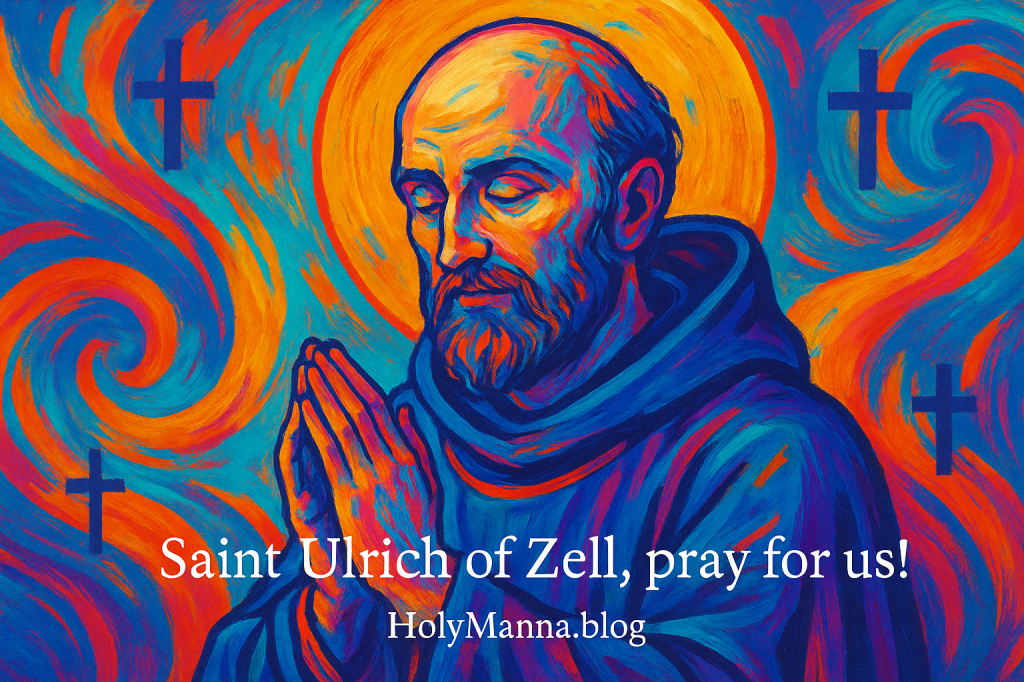
A Quiet Flame in the Forest of Renewal
In the grand story of salvation, there are saints who blaze like comets across the sky—bold, dramatic, unforgettable. But there are also saints who burn quietly, steadily, like oil lamps in a dark room. Saint Ulrich of Zell belongs to the latter. He did not draw attention through martyrdom or visions. Instead, he chose the path of humble service, deep prayer, and steady reform. As a monk and Cluniac reformer in the 11th century, Ulrich left behind nobility and status to embrace the rhythm of the Regula Benedicti—the Rule of Saint Benedict. His legacy is one of spiritual craftsmanship: building not only stone monasteries, but also communities of fervent, faithful monks who would rekindle the flame of holiness throughout the Church. In a time when monastic life had grown lax in some areas, Ulrich’s fidelity to order, prayer, and penance helped restore the Church from within. His feast is celebrated on July 14, and though he may not be as widely known today, his impact on European monasticism and Christian spiritual renewal remains profound.
The Conversion of a Courtier
Saint Ulrich was born around the year 1029 in the city of Regensburg, located in what is now southern Germany. He came from a noble family, likely with close ties to the imperial court of the Holy Roman Empire. As a young man, Ulrich enjoyed all the privileges of his social status: a refined education, opportunities for political advancement, and a future paved with worldly success. He served for a time in the royal court of Emperor Henry III, where he likely witnessed both the splendor and the spiritual emptiness that can accompany power.
But even as he stood among princes and nobles, something in Ulrich’s heart yearned for more. His soul was stirred by the Gospel call to radical discipleship—the kind of life that seeks not earthly crowns but heavenly ones. This interior longing led him to renounce his title and inheritance and seek the monastic life. He entered the famous Abbey of Cluny in France, which at the time was the heart of a powerful reform movement aiming to renew the Church by restoring the purity of monastic life. Under the direction of Saint Hugh of Cluny, Ulrich found the structure and holiness he had long desired.
What Ulrich is best known for is his role as a founder and reformer. Around 1072, he was sent by the abbot of Cluny to the Black Forest region to establish a new monastery that would model the Benedictine ideals. There, in the remote town of Zell (modern-day St. Ulrich im Schwarzwald), he founded a community that would become a spiritual lighthouse in the wilderness. His monastic foundation became a center of liturgical prayer, agricultural labor, intellectual study, and missionary outreach—everything that the Benedictine rule envisioned. Ulrich lived not just as a monk, but as a father to his brothers, a teacher of the faith, and a tireless laborer for the Kingdom of God.
Hidden Miracles and the Gift of Discernment
Though Saint Ulrich of Zell was not known for public, spectacular miracles like some of his contemporaries, there were many quiet testimonies to the grace that flowed through his life. The holiness of a saint often reveals itself not through thunder but through a still, small voice—and Ulrich’s life radiated that kind of gentle, constant presence of the divine. One of his most frequently mentioned spiritual gifts was his gift of prophecy. He was known to predict future events concerning his community and the Church with remarkable accuracy. These insights were not born of worldly calculation but of deep prayer and union with God.
Several stories recount how sick monks and laypeople were healed after receiving his blessing or praying with him. One tale speaks of a peasant suffering from a mysterious illness who was cured after spending a night in vigil near the monastery and receiving Ulrich’s prayerful intercession. Ulrich also reportedly had the ability to read hearts, offering spiritual guidance with pinpoint accuracy to monks who were struggling with sin, despair, or confusion. This spiritual discernment brought many people—both inside and outside the cloister—closer to God.
Yet perhaps the most miraculous element of Ulrich’s life was the transformation he brought to the places he touched. Through him, lifeless monastic communities were revived, young men were drawn to a life of holiness, and laypeople witnessed the beauty of a life fully consecrated to Christ. He was a living example of Psalm 34:5: “Look to him and be radiant, and your faces shall never be ashamed.”
Storms in the Forest
Ulrich’s path was not without thorns. Reformers are rarely welcome by those comfortable in their ways. When Ulrich sought to establish the new monastery at Zell, he encountered resistance from both secular authorities and even local clergy. Some saw his monastic reforms as a threat to their power, and others resented the spiritual rigor he brought to their region. His building efforts were frequently blocked, delayed, or sabotaged by those who opposed his mission. He was slandered, maligned, and endured deep loneliness in his early days at Zell.
Despite this, Ulrich never retaliated. He practiced the Benedictine virtues of humility, silence, and prayerful endurance. As The Catechism of the Catholic Church reminds us, “Charity bears all things, believes all things, hopes all things, endures all things” (CCC 1825). Ulrich lived this love even when it was costly. He continued to work the land with his hands, rise in the night for prayer, and guide his brothers in obedience and grace.
He also practiced physical mortification—fasting often and wearing simple garments. His penances weakened his body, but not his resolve. In time, his detractors were silenced by the fruit of his holiness, and the monastery at Zell began to flourish. He died on July 10, 1093, surrounded by his spiritual sons, worn out not by age alone but by decades of sacrificial love.
A Pilgrim’s Light
Following his death, Ulrich’s tomb became a destination for pilgrims. People came from surrounding regions to pray at his grave, many of them bringing petitions for healing, peace, or vocational discernment. Not long after his passing, reports began to spread of healings attributed to his intercession. Mothers brought sick children, farmers came with their injuries, monks with spiritual dryness—and many left with renewed strength and faith.
The Church recognized his sanctity quickly. By 1095, he was venerated as a saint, and his name began to spread across Germany and Switzerland. His monastery became not only a religious center, but also a place of cultural development and charity. The relics of Saint Ulrich were venerated with great devotion, and his rule of life continued to inspire monastic communities throughout the Holy Roman Empire.
In a world thirsting for spiritual fathers and quiet heroes, the memory of Saint Ulrich endured. His monastery at Zell—though eventually impacted by later political and religious upheavals—left an indelible mark on the monastic landscape. Today, his name is still honored, especially in areas of southern Germany and Alsace, where devotion to him remains strong.
Building the Church One Brick at a Time
Saint Ulrich’s life challenges our modern assumptions about greatness. He was not a bishop, a martyr, or a charismatic miracle-worker. He was a man who loved God quietly, deeply, and with every ounce of his strength. He shows us that true reform begins in the hidden places—within the heart, the home, and the humble monastery. In an age that values visibility, his life whispers a different message: “Seek first the kingdom of God and His righteousness” (Matthew 6:33).
His faithfulness to daily prayer, his willingness to suffer in silence, and his love for his brothers make him a powerful intercessor for anyone longing to rebuild their life on the solid foundation of Christ. What might God be asking you to build? Where are the broken places in your life, family, or community that need the patient love Ulrich showed? Do you trust that even hidden holiness has eternal weight in Heaven?
His story also reminds us of the beauty of religious life and the ongoing relevance of monastic spirituality. In a world of distraction, the Rule of Saint Benedict remains a treasure of balance, order, and peace. If we apply its principles to our homes, workplaces, and prayer lives, we too can become builders for God—brick by brick, day by day, heart by heart.
Engage with Us!
We’d love to hear how Saint Ulrich’s story speaks to you. Have you ever felt called to hidden holiness? What part of his journey resonated most with your own?
Reflection Questions:
- In what areas of your life are you being called to quiet but faithful reform?
- What comforts might God be asking you to release in order to draw closer to Him?
- How can the Rule of Saint Benedict help you bring order, peace, and purpose to your daily routine?
Let us support each other in our journey toward holiness. And as Saint Paul reminds us, “Let all that you do be done in love” (1 Corinthians 16:14). May we, like Saint Ulrich of Zell, choose faithfulness over fame and build up the Church one act of love at a time.
Saint Ulrich of Zell, pray for us! 🌲
Follow us on Instagram and Facebook for more insights and reflections on living a faith-filled life.

 Holy Manna!
Leave a comment