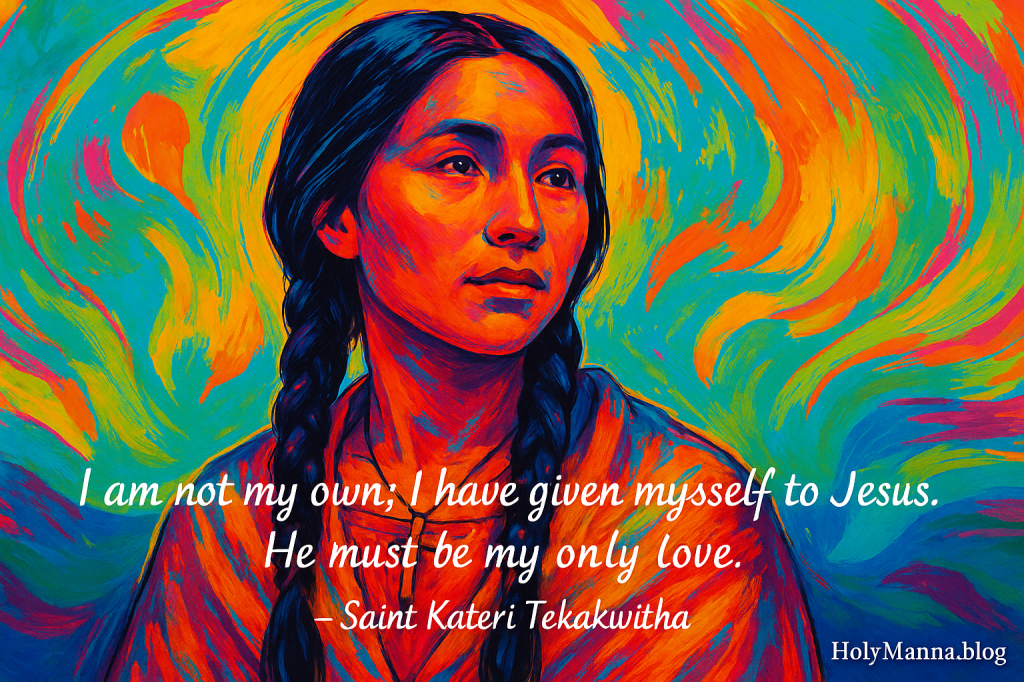
The Lily of the Mohawks
In the vast tapestry of Catholic saints, Saint Kateri Tekakwitha shines like a gentle but radiant light, especially for those who have experienced rejection, suffering, or longing for purity in a world full of distractions. Canonized by Pope Benedict XVI in 2012, Kateri is celebrated as the first Native American woman to be declared a saint. Her life, though brief, was marked by an extraordinary love for Jesus Christ and a deep devotion to the Eucharist, the Cross, and the virtue of chastity. Known lovingly as the “Lily of the Mohawks,” she is a bridge between the Gospel and Indigenous culture, a flower that blossomed in the soil of persecution, and a powerful intercessor for young people, converts, and those striving to live a life of purity and peace. Her feast day, celebrated on July 14 in the United States and April 17 in Canada, reminds the faithful that holiness is not confined to cathedrals and convents—it can grow in forests, villages, and quiet hearts devoted to God.
Roots Among Rivers and Fire
Kateri Tekakwitha was born in 1656 in the Mohawk village of Ossernenon, now Auriesville, New York, near the confluence of the Mohawk and Hudson Rivers. Her mother, Tagaskouita, was a baptized Catholic and an Algonquin woman who had been captured and adopted by the Mohawk people. Her father was a Mohawk chief, a man of influence but not of Christian faith. Kateri’s mixed heritage placed her at a spiritual and cultural crossroads, and her life from the start seemed destined to carry both the legacy of her people and the light of Christ.
At the age of four, tragedy struck when a smallpox epidemic ravaged her village. Both of her parents and her younger brother died, and Kateri herself was left disfigured by the disease. Her face bore deep scars, and her eyesight was permanently weakened. This suffering would become a formative element of her spirituality. She was taken in by her aunts and uncle, who sought to protect her according to traditional Mohawk customs—but they were vehemently opposed to Christianity.
Despite the pressures of her environment, Kateri’s heart longed for something more. When Jesuit missionaries—whom the Mohawks called Black Robes—arrived in her village, she was drawn to their teachings. At great personal risk, she began receiving religious instruction. At age 19, she was baptized on Easter Sunday in 1676, taking the name Catherine, after Saint Catherine of Siena, a mystic and Doctor of the Church. In her native tongue, this became Kateri.
After her baptism, Kateri’s faith grew quickly. She refused to work on Sundays, practiced frequent penance, and spent long hours in prayer and contemplation. She soon made a private vow of perpetual virginity, declaring herself a bride of Christ—an unheard-of commitment in her culture, where women were expected to marry early. Facing increasing hostility from her tribe, including threats to her life, she fled by foot over 200 miles north to the Christian mission village of Kahnawake, near Montreal, where she could live and worship freely. There, she became known for her deep piety, humble service, and ardent devotion to the Blessed Sacrament.
Heaven in the Heart of the Forest
Although Saint Kateri is not known for widely publicized or dramatic miracles during her earthly life, those who lived with her recognized the divine presence that seemed to radiate from her very being. Her spiritual director, Father Pierre Cholenec, wrote extensively about her holiness and the remarkable fruits of her prayer.
Kateri spent much of her time in the woods, fashioning small crosses out of sticks and pressing them into the ground as places of prayer. She would often retreat to these hidden sanctuaries to meditate on the Passion of Christ. Her spirit of sacrifice was profound—she practiced harsh penances, including fasting, sleeping on thorns, and scourging herself in secret, not out of self-hate but as an offering of love united to Jesus on the Cross.
Her charity extended beyond prayer. She cared tenderly for the sick and elderly in her mission village, served with joy, and bore no resentment toward those who had persecuted her. Many believed that God had given her a prophetic spirit—her advice was sought by both Natives and missionaries alike for its wisdom and clarity.
Perhaps the most visible miracle occurred at the hour of her death. On April 17, 1680, as she drew her final breath, those around her witnessed something astonishing: the deep scars that had marked her face since childhood vanished. Her skin became smooth, glowing with a supernatural radiance. Those who were present testified that they had never seen such peace and beauty on a person’s face. It was a sign from heaven, affirming the purity and sanctity that had burned within her hidden heart.
A Thorned Path to the Crown of Glory
Saint Kateri’s journey to holiness was paved with rejection, hardship, and persecution. From her earliest years, her disfigurement made her a subject of ridicule. After her baptism, her relatives turned on her, accusing her of abandoning her people and their traditions. They often insulted her, sabotaged her work, and isolated her within the community. She endured hunger on Sundays when she refused to labor, and she was once struck with stones by village children as she returned from prayer.
Yet Kateri never retaliated. Instead, she bore all these sufferings in silence, uniting them with the sufferings of Christ. She once confided to a missionary that she was happy to suffer because she loved Jesus and wanted to be like Him. Her vow of virginity was met with confusion and anger by her community, yet she held firm, refusing all marriage offers and declaring “I have given myself entirely to Jesus.”
Though not a martyr in the traditional sense, Kateri’s life was one of white martyrdom—an ongoing offering of suffering for the sake of Christ. Her endurance, her joyful acceptance of trials, and her unwavering commitment to her faith were themselves a form of witness more powerful than any sword or fire. Her death, at just 24 years old, was the quiet end of a life poured out in love.
Flowers After the Frost
After Saint Kateri’s death, her fame spread quickly throughout New France and beyond. Those who had known her shared stories of her purity, her fervent prayer, and the miracle of her healed face. Pilgrims began to visit her burial site at the Saint Francis Xavier Mission in Kahnawake, seeking healing and consolation through her intercession.
Over the centuries, many miracles have been attributed to her prayers. One of the most well-documented occurred in 2006, when Jake Finkbonner, a young Native American boy from Washington, contracted necrotizing fasciitis—a flesh-eating disease. Doctors gave him little chance of survival. His family, school, and parish began praying to Kateri Tekakwitha for a miracle. Remarkably, Jake recovered fully. The medical team could not explain the sudden turnaround, and the Vatican later confirmed it as the miracle needed for Kateri’s canonization.
Her canonization Mass on October 21, 2012, was attended by thousands of Native American Catholics from across North America. Pope Benedict XVI praised her courageous example, calling her “faithful to her people and to the traditions of her ancestors” while showing “a new path for future generations.”
Today, Saint Kateri is honored with shrines in Auriesville, New York, and Kahnawake, Quebec. Her legacy continues to inspire Indigenous Catholics, young women, and anyone seeking to live a life of courageous love in a world that often resists the Gospel. Her story is not just about the past—it is a call to each of us to bloom where we are planted, to be faithful even when we are misunderstood, and to trust in the transforming love of Christ.
The Sacred Trail We Walk Today
Saint Kateri Tekakwitha’s life is a luminous roadmap for modern disciples. In her, we find the grace to endure ridicule, the strength to live for Christ without compromise, and the beauty of surrender to God’s will. Her love for the Eucharist calls us to center our lives on the Real Presence of Jesus. Her passion for prayer in nature reminds us to see God’s fingerprints in creation. Her vow of virginity, made with such conviction and joy, challenges us to live with undivided hearts—no matter our state in life.
What is God asking you to surrender today? Where is He calling you to be bold in your faith, even when it costs you something? How can you, like Kateri, become a quiet but powerful sign of God’s love in your home, your workplace, your culture?
Kateri’s trail leads not just to a shrine, but to the heart of Christ. Follow her example, and you will find yourself walking in the footprints of the saints—through trials, through forests, through joy—toward eternal glory.
Engage with Us!
Saint Kateri’s story is a radiant witness of hope, courage, and faith. She reminds us that no matter our background or trials, we can choose Jesus above all else.
We’d love to hear from you!
- How does Saint Kateri’s life inspire you to live your faith more boldly?
- What areas of your life is God inviting you to purify and consecrate more fully to Him?
- Have you ever experienced healing—physical or spiritual—through the intercession of a saint?
Let’s lift one another up in prayer, share stories of faith, and encourage each other to walk the narrow path with love, just as our sister Saint Kateri Tekakwitha did.
Let us strive to do all things with love—“I am not my own; I have given myself to Jesus. He must be my only love.” – St. Kateri Tekakwitha
Saint Kateri Tekakwitha, pray for us! 🌿
Follow us on Instagram and Facebook for more insights and reflections on living a faith-filled life.

 Holy Manna!
Leave a comment