Memorial of Saint Kateri Tekakwitha, Virgin – Lectionary: 389
The Cost of Fidelity
Have you ever stood your ground for what’s right, only to feel more alone, misunderstood, or even punished for it? Today’s readings invite us to consider the uncomfortable—but deeply biblical—truth that fidelity to God often brings conflict before it brings peace. The journey of the faithful is not marked by worldly comfort but by courageous obedience, even when the world—or even our families—push against us. Yet in this tension, we discover a deeper communion with the God who saves.
In Exodus 1:8–14, 22, we witness the rise of a new Pharaoh who oppresses the Israelites out of fear and insecurity. The people of God are crushed beneath the weight of slavery, yet paradoxically, they flourish. This sets the stage for the Exodus—the defining act of divine liberation in Israel’s history. The Psalm 124 response reminds us of this very moment: “Had not the Lord been with us… then the waters would have engulfed us.” This is not just poetry; it is collective memory. God’s people are shaped through adversity, but they are never abandoned. Their suffering becomes the soil in which trust, deliverance, and identity are formed.
Then Jesus, in the Gospel of Matthew 10:34–11:1, delivers a jarring message: “I have come to bring not peace but the sword.” He speaks directly to His disciples—those He has just finished commissioning. Following Him will rupture the most intimate human ties and demand total allegiance. This is not a call to aggression, but a sober acknowledgment that the Gospel divides before it heals. The cross is not merely a symbol of sacrifice, but a threshold into divine life. Are we willing to lose the life we’ve known in order to find the life Christ promises? As we enter into today’s readings, we’re asked to reflect on this: fidelity to God may cost us everything, but it also secures us in the hands of the One who made heaven and earth.
First Reading – Exodus 1:8–14, 22
Oppression, Multiplication, and the Mystery of God’s Hidden Hand
The Book of Exodus marks a pivotal shift in salvation history: the transition from prosperity to persecution for the people of Israel. Having once found favor through Joseph in Egypt, the Israelites now face systemic oppression under a new Pharaoh who has no memory of Joseph’s contributions. This reading sets the scene for the entire Exodus narrative—the great liberation that prefigures our own deliverance through Christ. Culturally and historically, this passage reflects the volatile nature of political power and how fear often leads to scapegoating, particularly of minority groups. Religiously, it shows us a God who works in the shadows—silent in this chapter, yet actively allowing His people to grow even in hardship. Today’s theme of faithfulness in the face of persecution is sown here, as we witness how suffering becomes the context in which divine promises take root.
Exodus 1:8-14, 22
New American Bible (Revised Edition)
The Oppression. 8 Then a new king, who knew nothing of Joseph, rose to power in Egypt. 9 He said to his people, “See! The Israelite people have multiplied and become more numerous than we are! 10 Come, let us deal shrewdly with them to stop their increase; otherwise, in time of war they too may join our enemies to fight against us, and so leave the land.”
11 Accordingly, they set supervisors over the Israelites to oppress them with forced labor. Thus they had to build for Pharaoh the garrison cities of Pithom and Raamses. 12 Yet the more they were oppressed, the more they multiplied and spread, so that the Egyptians began to loathe the Israelites. 13 So the Egyptians reduced the Israelites to cruel slavery, 14 making life bitter for them with hard labor, at mortar and brick and all kinds of field work—cruelly oppressed in all their labor.
22 Pharaoh then commanded all his people, “Throw into the Nile every boy that is born, but you may let all the girls live.”
Detailed Exegesis
Verse 8 – “Then a new king, who knew nothing of Joseph, rose to power in Egypt.”
This verse marks the break in relationship between Egypt and Israel. The forgetting of Joseph is more than political; it’s a spiritual forgetting, a loss of gratitude and memory of God’s providential care through Joseph’s wisdom. In Scripture, forgetfulness often precedes sin (see Deuteronomy 8:11–14), and here it becomes the seed of oppression.
Verse 9 – “He said to his people, ‘See! The Israelite people have multiplied and become more numerous than we are!’”
Fear begins to fester. Pharaoh sees the blessing of Israel’s fruitfulness not as a gift, but as a threat. This inversion of perspective—viewing God’s abundance with suspicion—is a tactic the enemy uses repeatedly in salvation history. Like Herod in Matthew 2, Pharaoh is afraid of losing control.
Verse 10 – “Come, let us deal shrewdly with them to stop their increase; otherwise, in time of war they too may join our enemies to fight against us, and so leave the land.”
This verse reveals a political justification for oppression. The phrase “deal shrewdly” hints at cunning, even deceit. Pharaoh doesn’t see the Israelites as neighbors or fellow human beings, but as a threat to be neutralized—a deeply utilitarian worldview that echoes into our own age, especially in discussions about immigration, race, and population control.
Verse 11 – “Accordingly, they set supervisors over the Israelites to oppress them with forced labor. Thus they had to build for Pharaoh the garrison cities of Pithom and Raamses.”
Systematic oppression begins. The Hebrews are enslaved and used to build the economic and military power of Egypt. The mention of “garrison cities” underscores that Israel’s labor is contributing to the very system that is suppressing them. There is a bitter irony here: those who build the empire are crushed by it.
Verse 12 – “Yet the more they were oppressed, the more they multiplied and spread, so that the Egyptians began to loathe the Israelites.”
This is a pivotal verse in today’s theme. God’s people are mysteriously resilient. Affliction leads to abundance. The Egyptians’ fear escalates, revealing how irrational hatred grows even when its supposed cause—threat of population—becomes unfounded. This mirrors the early Church, where martyrdom led to more conversions: “The blood of the martyrs is the seed of the Church.” (Tertullian)
Verse 13 – “So the Egyptians reduced the Israelites to cruel slavery,”
This brief verse intensifies the tone. What began as suspicion becomes active brutality. The word “cruel” underlines the dehumanizing nature of sin when power is unchecked by justice or mercy.
Verse 14 – “making life bitter for them with hard labor, at mortar and brick and all kinds of field work—cruelly oppressed in all their labor.”
The repetition of labor imagery shows the totality of their bondage. Israel is not simply suffering physically, but spiritually. This suffering echoes forward into Christian theology as a symbol of life before redemption—enslaved to sin, desperate for a Savior.
Verse 22 – “Pharaoh then commanded all his people, ‘Throw into the Nile every boy that is born, but you may let all the girls live.’”
This final verse is horrifying. It represents a demonic attack on life itself, specifically male children—the future of the people. This infanticide mirrors what Herod would later do in Matthew 2:16, revealing the cyclical nature of evil when power feels threatened by God’s plan. Yet, through this horror, Moses will arise—the very deliverer whom Pharaoh fears.
Teachings of the Church
The Catechism of the Catholic Church teaches that “the economy of the Old Covenant was deliberately oriented to prepare for and declare in prophecy the coming of Christ” (CCC 122). The oppression of Israel foreshadows not only Christ’s suffering, but the trials His Body—the Church—must endure throughout history. In this way, the Exodus is not just history; it is a spiritual blueprint. Saint Gregory of Nyssa reflects on the Exodus as the soul’s journey from the slavery of sin to the promised land of union with God, and this first chapter is the beginning of that path. Moreover, CCC 2570 affirms: “Abraham’s faith and the beginnings of salvation history through Moses show that God always initiates the covenant, even when humanity is weak or enslaved.”
Saint John Chrysostom, commenting on the endurance of the faithful under persecution, once preached, “The more the enemy presses upon us, the more we thrive; the fire of oppression only purifies and strengthens the Church.” This mystery is lived out in the early Church, as in the days of Exodus. Historically, the Jewish people under Egyptian bondage remained spiritually resilient—preserving their identity, passing on the promises of Abraham, and preparing the way for the deliverer, Moses. God’s silence in this passage is not absence, but preparation. The silence before the Exodus is the stillness before a divine eruption.
The Church also teaches that the dignity of the human person must be upheld regardless of status or race. CCC 1935 says: “Every form of social or cultural discrimination in fundamental personal rights… must be curbed and eradicated as incompatible with God’s design.” Pharaoh’s fear-driven oppression stands in stark opposition to this teaching. In recognizing how the Israelites were dehumanized, we are reminded of our Christian obligation to oppose injustice and protect the vulnerable, even when doing so is costly.
Reflection
In our daily lives, we may not be building garrison cities or facing royal decrees of death, but many of us labor under the weight of invisible chains: chronic stress, unjust systems, spiritual dryness, or even persecution for living our faith. This reading challenges us to look differently at those sufferings. Where in your life does it feel like you’re being crushed, yet somehow growing? Do you trust that God is at work even when He seems silent? This passage teaches us that faithfulness in affliction is not futile—it’s fruitful. Like the Israelites, we are called to persevere, to hold fast to our identity as God’s people, and to trust that deliverance is already being prepared, even when it’s hidden from our eyes.
Responsorial Psalm – Psalm 124
If the Lord Had Not Been on Our Side…
Psalm 124 is one of the Songs of Ascents—pilgrimage hymns sung by the people of Israel as they journeyed to Jerusalem for major feasts. Traditionally attributed to King David, this psalm is a communal expression of thanksgiving for divine rescue from overwhelming peril. Historically and culturally, this song would have reminded the Israelites of God’s intervention throughout their history: from the Exodus to victories over enemies in the Promised Land. Liturgically, it serves as a triumphant proclamation that God, not human strength or strategy, is the true deliverer. Positioned between the oppression of Exodus and Christ’s radical call in The Gospel of Matthew, this psalm is a heartbeat of gratitude and survival—it reminds us that endurance through suffering is only possible because of God’s saving help.
Psalm 124
New American Bible (Revised Edition)
God, the Rescuer of the People
1 A song of ascents. Of David.
Had not the Lord been with us,
let Israel say,
2 Had not the Lord been with us,
when people rose against us,
3 Then they would have swallowed us alive,
for their fury blazed against us.
4 Then the waters would have engulfed us,
the torrent overwhelmed us;
5 then seething water would have drowned us.
6 Blessed is the Lord, who did not leave us
to be torn by their teeth.
7 We escaped with our lives like a bird
from the fowler’s snare;
the snare was broken,
and we escaped.
8 Our help is in the name of the Lord,
the maker of heaven and earth.
Detailed Exegesis
Verse 1 – “Had not the Lord been with us, let Israel say,”
This is a liturgical call to remembrance and repetition. The psalmist invites the entire people to participate in proclaiming the truth of God’s intervention. It reflects Israel’s communal memory—a history marked by divine rescue. The repetition underscores the certainty and urgency of this truth.
Verse 2 – “Had not the Lord been with us, when people rose against us,”
The psalm echoes back to specific moments of national crisis—wars, persecutions, and betrayals. The phrase “when people rose against us” ties directly to Exodus 1, where Pharaoh and the Egyptians turned against Israel. Theologically, it reminds us that opposition against God’s people is not new—it is part of a fallen world’s response to divine blessing.
Verse 3 – “Then they would have swallowed us alive, for their fury blazed against us.”
This verse uses vivid imagery to describe the extent of danger. The image of being “swallowed alive” evokes a primal fear, echoing Jonah 2 and also prefiguring martyrdom. The “blazing fury” of enemies mirrors the rage of Pharaoh, or even the division Christ speaks of in Matthew 10. The faithful are often targets of irrational, consuming hatred.
Verse 4 – “Then the waters would have engulfed us, the torrent overwhelmed us;”
Water in Scripture often symbolizes chaos, destruction, and death (see Genesis 7, Psalm 69, and Isaiah 43). This verse describes how close Israel came to destruction. But in not being consumed, they bear witness to the power of God who holds back the flood.
Verse 5 – “then seething water would have drowned us.”
The “seething” nature of the water intensifies the image. This is not still water—it is violent, boiling, turbulent. Yet the people of God live. The survival itself is the miracle, and it echoes Christ calming the storm (Mark 4:39)—reminding us that God’s peace is stronger than any chaos.
Verse 6 – “Blessed is the Lord, who did not leave us to be torn by their teeth.”
Here, the metaphor shifts from flood to predator. Enemies are like wild beasts, and yet God intervenes. This divine restraint is both justice and mercy. It is God actively standing between His people and their destruction.
Verse 7 – “We escaped with our lives like a bird from the fowler’s snare; the snare was broken, and we escaped.”
This is an image of unexpected deliverance. A bird caught in a trap is helpless—there is no way out unless the trap breaks. Theologically, this prefigures God’s grace: our salvation is not something we achieve but something we receive through divine intervention.
Verse 8 – “Our help is in the name of the Lord, the maker of heaven and earth.”
This final verse grounds the entire psalm in the power of God’s name. The phrase “maker of heaven and earth” recalls Genesis 1, reminding us that the One who rescues is also the One who created all. Our help is not just local or temporal—it is cosmic and eternal.
Teachings of the Church
The Catechism of the Catholic Church teaches that “in every need, we can find refuge in the name of the Lord who saves” (CCC 2666). Psalm 124 lives out this truth. The psalm is not a vague hope or wishful thinking—it is a testimony. God has acted. He has saved. And His name remains a source of strength for all generations. This is why the Church continues to pray the Psalms daily in the Liturgy of the Hours: they are songs of divine fidelity that shape our identity and memory as God’s people.
Saint Augustine, in his commentary on the Psalms, wrote: “Let us love our deliverer; he did not permit us to be torn by their teeth. What are these teeth? The fury of this world, the traps of the devil, the violence of sin.” He sees this psalm not only as a historical song but as a spiritual reality we live each day. The teeth and torrents may look different—abuse, addiction, betrayal, ridicule—but the Deliverer remains the same.
In the history of the Church, especially during times of persecution, Psalm 124 became a favorite among the early Christians. It was often sung in the catacombs, whispered in prison cells, and quoted by martyrs. They saw in it a declaration of God’s ultimate victory over every force that tries to swallow, snare, or destroy the faithful. It is a song of survival—and not just physical, but eternal.
Reflection
How many times have we been rescued from situations we thought would crush us? Do we pause to give thanks for the help we never saw coming but deeply needed? This psalm encourages us to cultivate spiritual memory—to remember that if we are still here, still standing, still breathing, it is because “our help is in the name of the Lord.” Begin today with gratitude. Look back at moments when the “waters” or the “teeth” nearly had you, and recognize that God was there. Let this Psalm shape your prayer: not as a plea, but as a proclamation. When was the last time you truly praised God for delivering you? Let that become your song today.
Holy Gospel – Matthew 10:34–11:1
The Sword of Love and the Cross of Allegiance
This portion of The Gospel of Matthew comes near the end of Jesus’ missionary discourse, where He sends out the Twelve with instructions on how to proclaim the Kingdom of Heaven. It is a sober warning and spiritual litmus test: discipleship will not bring comfort and consensus, but division and cost. Historically, Matthew’s Gospel was written for a Jewish-Christian audience experiencing tension both within their families and communities. Many converts were being ostracized or persecuted by their loved ones, and this passage gave voice to their pain while affirming the legitimacy of their sacrifice. Culturally, family was the core unit of Jewish identity and religious tradition; to lose it was a tremendous suffering. Religiously, Jesus is drawing a line in the sand: love for Him must surpass every earthly tie. In today’s theme of faithfulness in the face of persecution, this Gospel reveals the interior battle every disciple must confront—the willingness to lose everything to find everything in Christ.
Matthew 10:34-11:1
New American Bible (Revised Edition)
Jesus: A Cause of Division. 10:34 “Do not think that I have come to bring peace upon the earth. I have come to bring not peace but the sword. 35 For I have come to set
a man ‘against his father,
a daughter against her mother,
and a daughter-in-law against her mother-in-law;
36 and one’s enemies will be those of his household.’
The Conditions of Discipleship. 37 “Whoever loves father or mother more than me is not worthy of me, and whoever loves son or daughter more than me is not worthy of me; 38 and whoever does not take up his cross and follow after me is not worthy of me. 39 Whoever finds his life will lose it, and whoever loses his life for my sake will find it.
Rewards. 40 “Whoever receives you receives me, and whoever receives me receives the one who sent me. 41 Whoever receives a prophet because he is a prophet will receive a prophet’s reward, and whoever receives a righteous man because he is righteous will receive a righteous man’s reward. 42 And whoever gives only a cup of cold water to one of these little ones to drink because he is a disciple—amen, I say to you, he will surely not lose his reward.”
11:1 When Jesus finished giving these commands to his twelve disciples, he went away from that place to teach and to preach in their towns.
Detailed Exegesis
Verse 34 – “Do not think that I have come to bring peace upon the earth. I have come to bring not peace but the sword.”
This startling statement appears to contradict Jesus’ title as the Prince of Peace (Isaiah 9:6). But the peace Christ offers is not a superficial harmony—it is a radical reconciliation with God that often disturbs worldly alliances. The “sword” refers to division, not violence. It pierces through false attachments, loyalties, and comforts, demanding truth and fidelity.
Verse 35 – “For I have come to set a man against his father, a daughter against her mother, and a daughter-in-law against her mother-in-law;”
Jesus quotes Micah 7:6, a prophetic lament of family breakdown during times of moral decay. He applies it to the reality of the Gospel: even the most sacred human relationships can become battlegrounds when the truth is preached. This is not a command to reject family, but a warning that discipleship may provoke opposition from those closest to us.
Verse 36 – “and one’s enemies will be those of his household.”
This verse speaks directly to the pain of conversion. Households that were once united may become divided when Christ enters. The Gospel reveals and challenges the idols we hold—security, approval, tradition—and sometimes those idols are enshrined within our homes. How do we respond when choosing Christ leads to relational loss?
Verse 37 – “Whoever loves father or mother more than me is not worthy of me, and whoever loves son or daughter more than me is not worthy of me;”
Here, Jesus is not diminishing the importance of family love but establishing divine priority. To be “not worthy of me” is to refuse the radical reordering of love that the Kingdom demands. True love of others flows from love of God first. Anything less turns family into an idol.
Verse 38 – “and whoever does not take up his cross and follow after me is not worthy of me.”
This is the first time in Matthew’s Gospel that the cross is mentioned. For Jesus’ audience, crucifixion was a brutal Roman punishment. The call to “take up the cross” would have sounded scandalous. Yet this is the essence of discipleship: a willingness to embrace suffering, rejection, and death for the sake of following Christ.
Verse 39 – “Whoever finds his life will lose it, and whoever loses his life for my sake will find it.”
This paradox lies at the heart of Christian spirituality. To “find your life” by clinging to comfort, safety, or status is to lose the deeper life God offers. But to “lose your life”—to surrender it in love and sacrifice—is to gain eternal life. This echoes John 12:24: “Unless a grain of wheat falls to the ground and dies, it remains just a grain…”
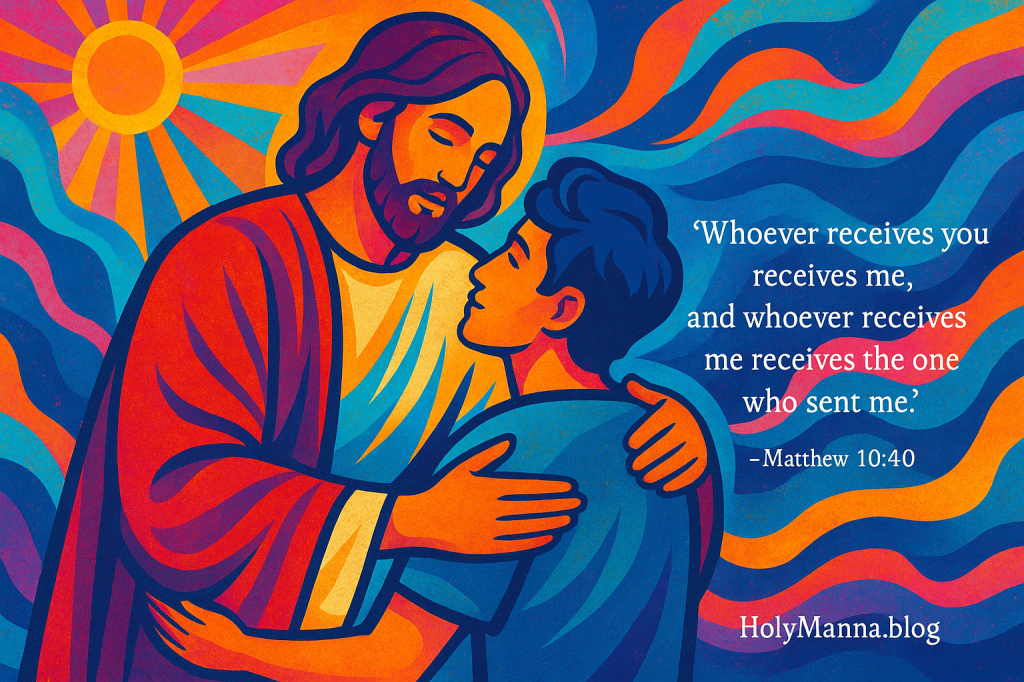
Verse 40 – “Whoever receives you receives me, and whoever receives me receives the one who sent me.”
This verse affirms the authority and dignity of the missionary disciple. To receive a disciple is to receive Christ; to receive Christ is to receive the Father. This intimate chain of communion shows that the messenger is not merely a representative but a vessel of divine presence.
Verse 41 – “Whoever receives a prophet because he is a prophet will receive a prophet’s reward, and whoever receives a righteous man because he is righteous will receive a righteous man’s reward.”
Hospitality and honor toward those who carry God’s Word is deeply rewarded. The “prophet’s reward” is not earthly success but divine favor and intimacy with God. This encourages the early Church to support one another in mission and suffering.
Verse 42 – “And whoever gives only a cup of cold water to one of these little ones to drink because he is a disciple—amen, I say to you, he will surely not lose his reward.”
Even the smallest act of love, done for the sake of a disciple, carries eternal weight. Jesus uplifts what the world deems insignificant. This affirms the Church’s teaching that charity—even when hidden—is never forgotten by God.
Chapter 11, Verse 1 – “When Jesus finished giving these commands to his twelve disciples, he went away from that place to teach and to preach in their towns.”
With this verse, the discourse ends and action begins. Jesus not only sends His disciples—He also continues the mission Himself. This final sentence bridges the teaching with its application: the work of the Kingdom is never theoretical; it always leads to witness.
Teachings of the Church
The Catechism of the Catholic Church teaches that “the way of perfection passes by way of the Cross. There is no holiness without renunciation and spiritual battle” (CCC 2015). This Gospel text does not soften the cost of following Jesus—it magnifies it. To take up our cross is to accept trials, misunderstandings, and loss, knowing that these are not signs of abandonment but marks of true discipleship. Christ sanctifies our suffering by walking it first.
Saint Thomas More, who was martyred for refusing to deny the authority of the Pope under Henry VIII, lived this Gospel vividly. He said shortly before his death, “I die the king’s good servant, but God’s first.” His martyrdom illustrates what it means to love Christ above even family or nation. This radical love is not fanaticism—it is sanctity. As CCC 2473 says, “Martyrdom is the supreme witness given to the truth of the faith: it means bearing witness even unto death.”
Even beyond martyrdom, the Gospel calls us to daily self-denial. Saint John Paul II writes in Veritatis Splendor, “Following Christ is not an imitation in outward behavior but becoming conformed to him who became a servant unto death.” (VS 21) Every act of obedience, every moment of sacrifice, is a participation in Christ’s cross. We are not called to comfort, but to communion.
Reflection
Today’s Gospel is not comfortable, but it is honest. Jesus never tricks us into discipleship. He tells us upfront: it will divide us from those we love, it will require suffering, and it may cost us everything. But it will also give us everything. What is Christ asking you to lay down today? Are there relationships, comforts, or ambitions you’ve placed above Him? Are you willing to be misunderstood for the sake of fidelity? If the answer feels like no, start by asking for the grace to want Him more. He never leaves us to carry the cross alone. As we take each step, He walks ahead, showing us that death is not the end—resurrection is. Let this Gospel stir you to examine your loyalties, embrace your cross, and trust in the reward that cannot be lost.
Faith That Stands When the World Shakes
Today’s readings draw us into a sobering but life-giving truth: following God will often lead us into conflict, suffering, and even rejection—but it will also lead us into divine intimacy, liberation, and eternal reward. From the oppression of Israel in Exodus, to the triumphant cry of deliverance in Psalm 124, to Jesus’ call to radical discipleship in The Gospel of Matthew, we are reminded that our faith is not meant to make us comfortable—it is meant to make us holy.
The Israelites endured cruel slavery and unjust suffering, yet “the more they were oppressed, the more they multiplied”. The psalmist echoes this truth: “Our help is in the name of the Lord”, who breaks every snare and stills every storm. Then Christ, in His own voice, tells us that to follow Him will mean carrying our cross, losing our life, and sometimes standing alone in our families and communities. Yet He promises: “Whoever loses his life for my sake will find it.” This is the divine paradox—true life is found not in self-preservation, but in self-gift.
What cross are you carrying right now? Where are you being called to stand firm in faith, even when it costs you? Today is an invitation to walk with courage, rooted in the love of a God who rescues, strengthens, and never abandons His people. The world may rage, families may resist, and trials may come—but our help is in the Lord, and our reward is Christ Himself. Hold fast. Keep going. You are not alone.
Engage with Us!
We’d love to hear how today’s readings spoke to your heart. Share your thoughts, prayers, or personal reflections in the comments below—your words may be the encouragement someone else needs today. Let’s grow together in faith, courage, and love.
Reflection Questions:
First Reading – Exodus 1:8–14, 22
In what areas of your life do you feel pressed down or “enslaved,” yet see God bringing growth? How do you respond when fear or injustice rise in your workplace, community, or nation? Do you trust that God is preparing deliverance even in seasons of silence?
Responsorial Psalm – Psalm 124
When has God rescued you from a “torrent” or trial that felt like it would swallow you whole? How can you build a habit of remembering and proclaiming the Lord’s faithfulness in your life? What does it mean for you today that your help is in the name of the Lord, the Maker of heaven and earth?
Holy Gospel – Matthew 10:34–11:1
What relationships or comforts might you be placing above your love for Christ? Are you willing to take up your cross and follow Jesus, even if it means rejection or loss? How can you support someone else who is carrying their cross today?
Keep pressing forward in faith. God sees your struggles, hears your prayers, and honors your sacrifices. Let everything you do be rooted in the love and mercy Jesus taught us—and never forget, the cross you carry is leading you to resurrection.
Follow us on Instagram and Facebook for more insights and reflections on living a faith-filled life.

 Holy Manna!
Leave a comment