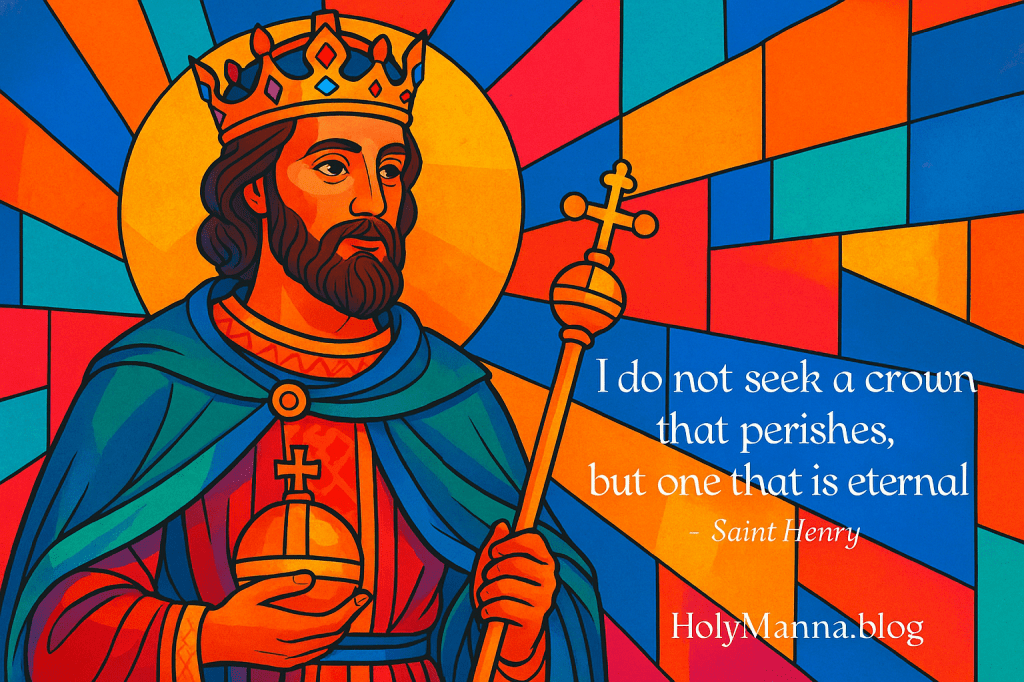
A King After God’s Own Heart
In an age where kings waged wars for glory and emperors demanded earthly homage, one man turned his crown into a vessel for divine service. Saint Henry II, also known as Henry the Holy, stands as a rare and radiant example of sanctity in sovereignty. Far from being intoxicated by power, Henry allowed grace to guide his imperial rule. His life demonstrates that even amidst the responsibilities of politics, the demands of empire, and the allure of worldly influence, holiness is not only possible—it is essential.
Revered as the last Saxon to wear the imperial crown, Henry is remembered not only for his successful reign but for his humility, chastity, devotion to prayer, and love of the Church. Canonized by Pope Blessed Eugene III in 1146, he is honored as the patron saint of the childless, the physically disabled, and those who have been turned away from religious life. His legacy whispers a powerful truth into the noise of ambition: that greatness in God’s eyes comes not from domination, but from obedience and faithful service.
Formed by Faith, Crowned by Grace
Born into nobility on May 6, 972, in Bavaria, Henry was the son of Duke Henry II of Bavaria and Gisela of Burgundy, placing him squarely in the elite of the Holy Roman Empire. But what set young Henry apart was not merely his noble blood, but the holy influences that shaped him from an early age. Entrusted to the care of Saint Wolfgang of Regensburg, a saintly bishop and Benedictine monk, Henry was immersed in both intellectual training and deep spiritual formation. His education combined political wisdom with monastic discipline, preparing him not just for rulership, but for righteousness.
It’s significant that even from a young age, Henry demonstrated a contemplative spirit. He was deeply influenced by the Rule of Saint Benedict and the teachings of The Rule of Saint Augustine, and he longed to join a monastic order himself—an aspiration that would accompany him to his final years. Though his path would take him to the throne instead of the cloister, Henry never lost the heart of a monk.
After the death of Emperor Otto III in 1002, Henry was elected King of Germany. Twelve years later, on February 14, 1014, Pope Benedict VIII crowned him Holy Roman Emperor in Rome. Unlike many rulers who sought papal approval for personal gain, Henry sought the blessing of the Church so he could serve more faithfully. He used his authority to build monasteries, reform clergy, protect the rights of bishops, and expand Christian education across the empire.
Henry’s marriage to Saint Cunegunda of Luxembourg was one of deep mutual respect and spiritual unity. The couple reportedly lived in perfect chastity, dedicating their marriage to God in a rare but holy commitment of virginal love. Despite facing political pressure and family expectations, they embraced a vocation that pointed beyond themselves toward eternal life. Together, they exemplified what The Catechism calls “a foretaste of the wedding feast of the Lamb” (CCC 1617).
Visions and the Hand of Providence
While Saint Henry may not be known for a multitude of dramatic, public miracles during his life, there were extraordinary moments that reflected the hand of divine providence at work in his journey. Most famously, before his coronation as emperor, Henry had a vivid vision of Saint Benedict, in which the founder of Western monasticism assured him that he would be crowned Holy Roman Emperor. This vision deeply moved Henry and convinced him of his divine mission to protect and promote the Church. It also led to his lifelong patronage of Benedictine monasteries, which he believed were spiritual fortresses for the soul of the empire.
His ability to govern with clarity and foresight was often regarded by his contemporaries as a supernatural gift. Henry showed a remarkable ability to discern the right path in difficult political circumstances, even when surrounded by conflicting interests. This gift of discernment recalls the wisdom praised in Psalm 119:125: “I am your servant; give me discernment that I may understand your statutes.” Henry governed with the heart of a servant, not merely a sovereign.
Moreover, his decisions often led to peaceful resolutions in situations that seemed destined for violence. For instance, he was known for reconciling rebellious nobles through dialogue and justice rather than force, echoing the beatitude: “Blessed are the peacemakers, for they shall be called children of God” (Matthew 5:9). Many saw his peaceful victories as signs of divine favor.
The Emperor Who Yearned for the Monastery
Despite his imperial power, Saint Henry suffered many personal and spiritual trials. One of the most painful moments in his life was when he expressed a strong desire to renounce his crown and join a Benedictine monastery. He traveled to the Abbey of Saint-Vanne near Verdun, where he humbly begged the abbot for admission as a simple monk. But the abbot, after prayerful consideration, refused him—believing that Henry’s vocation was to serve Christ in the world as emperor.
It must have been a crushing disappointment, but Henry accepted the decision as the will of God. This act of obedience is perhaps one of the greatest proofs of his sanctity. He exemplified CCC 2826: “By prayer we can discern ‘what is the will of God’ and obtain the endurance to do it.” Henry did not cling to his own preferences, even when they were holy. He embraced his role in the world with even greater zeal, serving as a lay consecrated soul in the heart of the empire.
Henry also faced political uprisings and betrayals, especially from nobles who opposed his close relationship with the Church. These tensions required immense patience and perseverance. He bore physical sufferings as well—especially from chronic leg ailments that often left him in pain. And yet, throughout these trials, Henry remained a man of prayer, fasting, and unwavering trust in Christ.
Rather than resenting his burdens, Henry offered them up. In this way, he lived out “Whoever wishes to come after me must deny himself, take up his cross, and follow me” (Mark 8:34). His suffering did not weaken his leadership—it sanctified it.
A Legacy of Healing from the Imperial Tomb
Saint Henry died on July 13, 1024, in Grona, Germany, and was buried in the Bamberg Cathedral, which he and Saint Cunegunda had founded. Almost immediately after his death, miracles began to be reported at his tomb. Pilgrims came seeking healing, and many returned with testimonies of being cured from chronic illnesses, blindness, and paralysis. His intercession became a source of great comfort for those who felt excluded—especially the sick, the infertile, and those longing for spiritual purpose.
One of the most moving miracles occurred when a blind man, after praying at Henry’s tomb and washing his eyes with water taken from near the grave, received his sight. These miraculous signs confirmed what many already knew: that Henry had lived as a saint among kings.
The shrine in Bamberg became a major site of pilgrimage in medieval Germany, and even today, thousands visit to pray at his tomb. The Church formally recognized these signs by canonizing him in 1146. His relics continue to be venerated, and his feast day, July 13, is a call for all Christians—especially those in leadership—to sanctify their vocations.
Henry’s posthumous miracles also bear witness to Psalm 34:19: “Many are the afflictions of the righteous, but the Lord delivers him out of them all.” In both life and death, Henry was a channel of God’s mercy.
Sanctifying the Ordinary Through Extraordinary Faith
In a time when many view political power or public life with skepticism and disillusionment, Saint Henry reminds us that faith can—and must—penetrate every corner of human society. His life is a shining testimony to the truth that holiness is not reserved for monks, hermits, or missionaries. It is also for rulers, workers, spouses, and citizens. Henry teaches us that every vocation, when lived in submission to God’s will, becomes a path to heaven.
We are each called to serve as little emperors in our own realms—whether that’s in our homes, our offices, our friendships, or our communities. Like Henry, we must ask: Am I building my own kingdom, or am I building God’s?
His example challenges us to bring Christ into every decision, every relationship, every project. He urges us to be faithful, even when our dreams are redirected or our bodies suffer. He shows us that we do not need to escape the world to be holy—we need to consecrate the world through our presence in it.
Are we willing to accept God’s will over our own? Are we living out our calling with joy and humility? How can we make our daily tasks acts of worship and love? These are questions Saint Henry leaves for us to ponder.
Let us take heart from his words and actions, and, like him, become faithful stewards of whatever thrones God has entrusted to us.
Engage with Us!
We’d love to hear how Saint Henry’s life touched your heart today. Whether you’re navigating leadership, struggling with unfulfilled desires, or seeking to grow in holiness, his story has something to offer you.
Reflection Questions:
- In what ways can I use my influence—big or small—for the service of God and others?
- Have I ever felt called to something that God seemed to redirect? How did I respond?
- What worldly attachments do I need to surrender to live more fully for Christ?
Let us encourage one another in the journey toward holiness, supporting each other in faith, and striving always to do everything with love—just as our Lord Jesus did.
Saint Henry, pray for us! 👑
Follow us on Instagram and Facebook for more insights and reflections on living a faith-filled life.

 Holy Manna!
Leave a comment