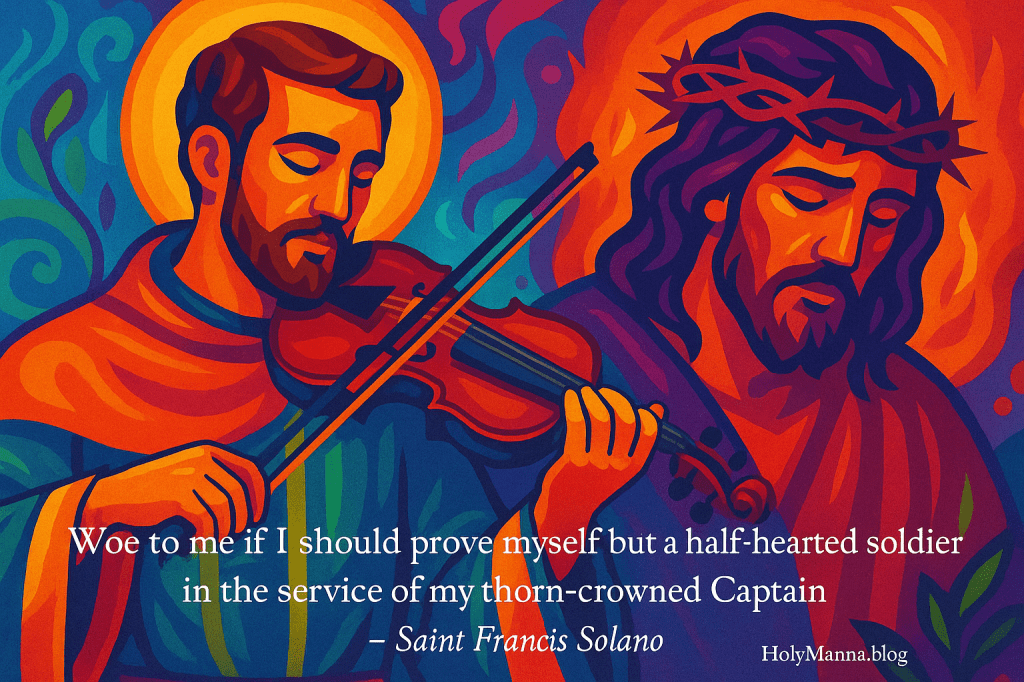
Heaven’s Musician in the New World
When the Church remembers Saint Francis Solano, it remembers a man on fire with love for God and for souls. This 16th-century Franciscan friar from Spain earned the title “Wonderworker of the New World” because of his powerful preaching, his miracles, and his deep compassion for the people of South America. He was a missionary who didn’t simply bring the Gospel—he embodied it. His voice was often raised in song, and his violin or lute would draw entire villages to hear the Good News. He walked barefoot across deserts and mountains, braving plagues and wild animals, hunger and resistance, because his heart belonged completely to Christ. Canonized in 1726, Saint Francis remains a symbol of what it means to preach the Gospel with one’s whole being—mind, heart, soul, and body. Through his example, we see that holiness is not a distant ideal, but a living, breathing love that transforms the world around it.
From Noble Blood to Franciscan Humility
Francis Solano was born on March 10, 1549, in Montilla, near Córdoba, Spain. His parents, Mateo Sánchez Solano and Ana Ximenes, were devout Catholics of noble blood, and they raised Francis in a household steeped in prayer, fasting, and works of charity. Even as a child, Francis showed signs of sanctity. He loved silence and solitude, sought out the sick and poor, and had an instinctive love for Scripture. The early seeds of faith planted in him would later bloom into the full radiance of evangelical charity.
He was educated by the Jesuits, who formed his intellect and shaped his devotion. At age 20, he answered the call to religious life and entered the Order of Friars Minor, the Franciscans, embracing the ideals of poverty, obedience, and humility. From the beginning, Francis was drawn to intense penance and constant prayer. He fasted often, mortified his body, and lived with a singular purpose: to imitate Christ Crucified.
Ordained a priest, Francis quickly became renowned as a preacher. His sermons were not only eloquent, but inspired by a deep interior fire. Crowds would gather just to hear him speak the name of Jesus. Yet despite his popularity, he longed to go where the Gospel had not yet been preached. In 1589, his desire was fulfilled when he was sent to the Americas. It was there, in the vast regions of Peru, Argentina, Paraguay, and Bolivia, that Francis Solano would spend the next two decades sowing the seeds of salvation, often walking hundreds of miles on foot to reach remote tribes. He learned many native dialects, but even when he didn’t know the language, his words were miraculously understood. One native witness described his preaching as “a fire that entered the heart”—the kind of fire only the Holy Spirit can light.
The Melodies of Heaven on Earth
Among the most remarkable aspects of Saint Francis Solano’s ministry were the miracles that accompanied his preaching. These were not tricks or spectacles, but genuine signs of divine love breaking into the world. His most famous miracles often involved music. Francis would carry his violin or lute on missionary journeys and play hymns to gather people before preaching. Entire villages—both Spanish settlers and indigenous peoples—were drawn by the beauty of his melodies, which seemed to speak to the soul in ways that words could not. Once the crowds had gathered, he would begin to preach, often leading hundreds to baptism.
One of the most dramatic miracles took place while Francis was sailing to the New World. The ship encountered a violent storm and was on the brink of sinking. Passengers panicked, but Francis remained calm. He knelt and prayed with deep trust in God, and suddenly, the storm ceased. Even hardened sailors attributed their survival to his intercession. Another time, during a plague outbreak in a native village, he entered fearlessly, made the Sign of the Cross over the afflicted, and many were healed on the spot. He would often touch the sick or make a simple prayer invoking the Name of Jesus, and people would rise from their beds, completely restored.
He also had gifts that defied natural explanation: bilocation, prophecy, and an uncanny ability to understand people whose language he had never learned. When he entered a village, wild animals would retreat, and hearts would open. Yet he never took credit for these wonders. He pointed everything back to God, always saying: “It is Jesus who heals, not I.”
The Road of Thorns and Glory
Though he was not martyred by blood, Saint Francis Solano lived a martyrdom of the heart every day. The missionary path was rugged and dangerous. He endured brutal conditions—scorching sun, dense jungles, infectious diseases, hostile terrain, and grueling travel on foot across mountains and rivers. He often slept on the ground, fasted frequently, and wore only the plain habit of the friars. There were times when he faced physical attacks from those resistant to the Gospel, including violent tribes and rebellious settlers who accused him of defending the indigenous too fiercely. Yet he never fought back. Instead, he would smile and say: “Blessed be God in all things.”
What pained him more than bodily discomfort was the indifference or coldness toward Christ that he sometimes encountered among fellow Christians. He wept when he saw baptized Catholics living in sin or ignoring the sacraments, and he would fast for their conversion. Despite rejection, illness, and constant fatigue, Francis never abandoned his mission. He saw every suffering as a participation in the Passion of Christ, drawing strength from The Gospel of Matthew where Jesus says, “Whoever does not take up his cross and follow Me is not worthy of Me” (Matthew 10:38).
His final years were spent in Lima, Peru, where his holiness had become so well-known that people crowded around his dwelling day and night. As his strength declined, he continued hearing confessions, preaching, and visiting the sick. On July 14, 1610, he died peacefully, surrounded by friars and laypeople who considered him a living saint. His last words echoed Psalm 122: “I rejoiced when I heard them say, ‘Let us go to the house of the Lord.’”
A Saint Who Still Speaks
Death did not silence the voice of Saint Francis Solano. In fact, it seemed to amplify it. Almost immediately after his passing, stories of miracles multiplied. People who prayed at his tomb were cured of fevers, blindness, and paralysis. Mothers who struggled with infertility conceived. Those in despair found peace. Many testified that just calling on his name in prayer brought comfort and healing. Pilgrimages began to his burial site in Lima, and later, churches, towns, and missions across Latin America were dedicated to his memory.
His relics became objects of deep veneration. In places where his heart had burned for the conversion of souls—Peru, Argentina, Bolivia—his name became synonymous with holiness. Even those who were not Catholic marveled at the stories of his life and the joy that surrounded his memory. Canonized by Pope Benedict XIII in 1726, he was officially declared a saint, but in the hearts of the people, he had already been one for decades.
To this day, Saint Francis Solano remains the patron of Latin American missions, travelers, and musicians. His legacy is one of holy boldness, tireless charity, and a love that did not flinch before hardship.
Your Song for the Kingdom
Saint Francis Solano offers a profound lesson for us in our modern, often distracted world: that holiness is not about grand gestures or fame, but about loving God and others with one’s entire being. He teaches us that evangelization is not a task for a few chosen individuals, but the mission of every baptized soul. Whether we preach with our voices or simply with our presence, we are called to be missionaries of mercy.
His example invites us to reflect: How do I use my gifts for the Kingdom? Francis used music, language, and his very body to bring Christ to others. We, too, have instruments—gifts—that God wants to use: our compassion, our creativity, our perseverance. Perhaps we will not travel across the ocean, but we can cross the street to visit a lonely neighbor, send a kind message to someone struggling, or be brave in speaking the truth when it’s unpopular.
Saint Francis shows us that sanctity is not limited by geography, education, or status. It is fueled by love and guided by the Spirit. His life echoes the call of The Catechism of the Catholic Church: “The desire for God is written in the human heart, because man is created by God and for God” (CCC 27). Let us respond to that desire, and let our lives become instruments of peace, joy, and Gospel truth—just as his was.
Engage with Us!
What about Saint Francis Solano’s life inspires you most? Have you ever experienced a moment when God used your talents to bring someone closer to Him?
Reflection Questions:
- How can I use my gifts—especially those that seem small or ordinary—to share the love of Christ with others today?
- What holds me back from proclaiming the Gospel boldly like Saint Francis Solano?
- Am I open to going “where the Spirit leads,” even if it takes me outside my comfort zone?
Share your thoughts in the comments below! Let’s support one another in our journeys of faith and strive to live with the same passion and mercy that Saint Francis Solano exemplified. May we, too, become instruments of God’s peace and love—in tune with the divine melody of Heaven.
Saint Francis Solano, pray for us! 🎻
Follow us on Instagram and Facebook for more insights and reflections on living a faith-filled life.

 Holy Manna!
Leave a comment