The Nearness of Love
Have you ever felt like holiness was just out of reach—something for monks, mystics, or people with more time and fewer wounds? Today’s readings remind us that God’s commandments are not distant ideals but a living invitation, written on our hearts and revealed in the Person of Christ. Love of God and love of neighbor are not separate paths—they are one. What’s most astonishing is that God doesn’t just tell us to love abstractly. He shows us how—by drawing near, by taking flesh, and by pouring out mercy.
In Deuteronomy 30, Moses pleads with the Israelites to return to the Lord with their whole heart and whole being. He insists that the command to love and obey God is not in the sky or across the sea, but “very near to you, in your mouth and in your heart, to do it” (Deuteronomy 30:14). This was revolutionary in a world where many religions believed divine wisdom was locked away for the elite or hidden in mystery. For Israel, the God who delivered them from Egypt also gave them a law of love that shaped not only personal piety but social justice. This nearness is fulfilled in Colossians 1, where Paul proclaims Christ as the very image of the invisible God—“through him and for him all things were created” (Colossians 1:16). He is not just the Lawgiver, but the Living Law—the one who reconciles all things and holds everything together in mercy.
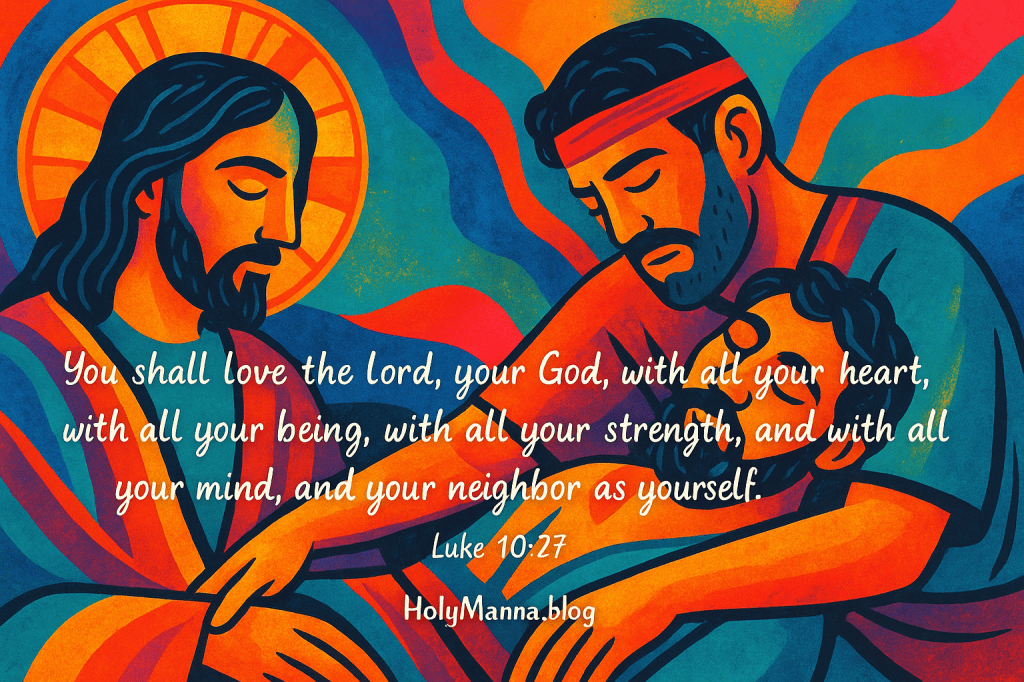
This nearness of God finds its most intimate expression in Luke 10 through the parable of the Good Samaritan. When the scholar of the law asks Jesus, “Who is my neighbor?”, he likely expected a tight legal definition. Instead, he received a disruptive story of radical mercy—a despised Samaritan who becomes the model of divine love. The Psalmist’s cry—“Answer me, Lord, in your generous love” (Psalm 69:17)—is answered in Jesus, who binds wounds, lifts the fallen, and calls us to do the same. Are we willing to let love draw near—not only to ourselves, but through us to those left wounded along the road?
First Reading – Deuteronomy 30:10–14
Love That’s Already Within Reach
The Book of Deuteronomy is Moses’ final discourse to the people of Israel as they prepare to enter the Promised Land. After 40 years of wandering, Israel stands on the edge of new life, but Moses knows they will be tempted to forget the God who brought them there. This reading comes from the heart of his plea: a passionate call for covenant fidelity rooted not in fear, but in love. Historically, Deuteronomy was composed during or shortly after the Babylonian exile, when Jewish scribes sought to recall the Law and renew Israel’s identity through memory and obedience. Culturally, this book reminds the Israelites—and us—that God’s law is not a burden imposed from afar but a divine intimacy implanted in human hearts. Religiously, it anticipates the full revelation of God’s nearness in Christ, echoing today’s Gospel where love is not merely defined but shown. In the context of today’s readings, Deuteronomy 30 prepares the way for the Good Samaritan’s mercy: only when God’s word lives in our hearts can we recognize and respond to the suffering of others.
Deuteronomy 30:10-14
New American Bible (Revised Edition)
10 because you will obey the voice of the Lord, your God, keeping the commandments and statutes that are written in this book of the law, when you return to the Lord, your God, with your whole heart and your whole being.
11 For this command which I am giving you today is not too wondrous or remote for you. 12 It is not in the heavens, that you should say, “Who will go up to the heavens to get it for us and tell us of it, that we may do it?” 13 Nor is it across the sea, that you should say, “Who will cross the sea to get it for us and tell us of it, that we may do it?” 14 No, it is something very near to you, in your mouth and in your heart, to do it.
Detailed Exegesis
Verse 10 – “because you will obey the voice of the Lord, your God, keeping the commandments and statutes that are written in this book of the law, when you return to the Lord, your God, with your whole heart and your whole being.”
This verse reflects the covenantal heartbeat of Deuteronomy: love must be total. To “obey the voice of the Lord” is not merely about compliance but deep communion—a response of love that encompasses the whole heart and entire being. It echoes the Shema (Deuteronomy 6:5), the central Jewish prayer commanding love of God with all one’s heart, soul, and strength. This call to return is not about legalism but relationship: returning to God with sincerity, integrity, and a desire for restored intimacy.
Verse 11 – “For this command which I am giving you today is not too wondrous or remote for you.”
God’s commandments are not abstract ideals or mystical secrets. They are accessible, rooted in human experience and capable of being lived out. In contrast to pagan religions of the time, which often presented divine will as unknowable, Israel’s God speaks plainly, offering a law that aligns with human dignity and freedom. The word “wondrous” here implies something beyond reach—but Moses insists the law is not out of reach for the faithful heart.
Verse 12 – “It is not in the heavens, that you should say, ‘Who will go up to the heavens to get it for us and tell us of it, that we may do it?’”
This verse critiques the idea that divine truth is hidden in the heights, accessible only to spiritual elites. Instead, God comes down to us. This foreshadows the Incarnation—Jesus, the Word made flesh, who brings heaven to earth. As Romans 10:6–8 later echoes, this verse is fulfilled in Christ, who dwells among us and writes His law upon our hearts.
Verse 13 – “Nor is it across the sea, that you should say, ‘Who will cross the sea to get it for us and tell us of it, that we may do it?’”
Again, Moses dismantles the notion of divine truth as distant or hidden. No pilgrimage across oceans is needed to uncover God’s will. His word is intimate, not exotic. In the ancient Near Eastern context, seas often symbolized chaos or danger—here, God assures His people that access to Him does not require overcoming treacherous trials.
Verse 14 – “No, it is something very near to you, in your mouth and in your heart, to do it.”
This is the climax of the passage. God’s law is internalized—ready to be spoken and lived. The dual mention of “mouth” and “heart” highlights the unity of confession and belief, speech and intention. In the Christian life, this anticipates the sacraments and the liturgy: faith is not only professed but embodied. The nearness of God’s word implies both responsibility and grace—we can do what God commands because He empowers us to do so.
Teachings
The Catechism of the Catholic Church affirms this nearness of God’s law in the human conscience: “Deep within his conscience man discovers a law which he has not laid upon himself but which he must obey. Its voice, ever calling him to love and to do what is good and to avoid evil, sounds in his heart at the right moment… For man has in his heart a law inscribed by God” (CCC 1776). This interior law, affirmed by Moses, is fully illuminated by Christ who not only gives us commandments but also gives Himself. The commandments are not merely obligations but invitations to communion with God, who empowers us with His grace.
Saint Bernard of Clairvaux, commenting on this passage, taught that true obedience is not forced compliance but the fruit of love: “Love seeks not to escape the burden of the law but embraces it, because the law of the Lord is sweeter than honey to the one who truly loves.” The saints understood that when God’s Word dwells in us, it transforms from command to delight. Saint Thomas Aquinas writes in the Summa Theologiae that the New Law, unlike the Old, is primarily the grace of the Holy Spirit written on the heart: “The New Law is chiefly the grace itself of the Holy Ghost, which is given to those who believe in Christ” (ST I–II, Q. 106, A. 1). God does not leave us alone to follow His will—He gives us the Spirit so that we may live in freedom and joy.
Historically, the Deuteronomic renewal provided a critical foundation for Israel’s resilience during exile. When the Temple was destroyed and sacrifices ceased, the Word remained. It was this Word—“near, in the mouth and in the heart”—that sustained Jewish identity through dispersion and shaped early Christian theology. Saint Paul’s frequent citations of Deuteronomy in his epistles testify to its enduring influence. This passage helps Christians today recover the truth that God’s commands are not arbitrary rules but a love letter carved into our very being. Obedience, then, becomes a response to divine intimacy, not divine distance.
Reflection
This reading confronts one of the great lies of modern life: that holiness is out of reach. What if the path to God isn’t found in striving upward or outward, but in turning inward with humility and letting His Word live in us? We don’t need to climb mountains or cross seas to know what God wants. He has already told us: love Him with all our heart and love our neighbor as ourselves. Are we willing to listen to the Word already written within us? Today is a call to stop waiting and start living—to speak truth with our mouths, believe with our hearts, and act with our hands. When love lives within, mercy can flow outward.
Responsorial Psalm – Psalm 69:14, 17, 30–31, 33–34, 36–37
The Cry of the Poor, the Answer of Mercy
Psalm 69 is one of the most poignant cries of lament in the Psalter. Traditionally attributed to King David, this psalm is both personal and prophetic—it expresses the anguish of one who suffers unjustly yet clings to the hope of divine deliverance. Historically, it reflects the deep pain of the righteous amid persecution, but it also anticipates the Passion of Christ, who Himself fulfills the cry of the suffering servant. Culturally, lament psalms like this gave voice to a community that believed in God’s justice yet struggled under the weight of oppression. Religiously, this psalm reveals that God does not remain distant from our pain. He hears, He draws near, and He saves. In the context of today’s readings, Psalm 69 echoes the theme of God’s nearness and responsiveness—“For the Lord hears the poor, and does not spurn those in bondage” (Psalm 69:34). It prepares us to understand the heart of the Good Samaritan, whose mercy is a reflection of God’s own.
Psalm 69:14, 17, 30-31, 33-34, 36-37
New American Bible (Revised Edition)
14 But I will pray to you, Lord,
at a favorable time.
God, in your abundant kindness, answer me
with your sure deliverance.
17 Answer me, Lord, in your generous love;
in your great mercy turn to me.
30 But here I am miserable and in pain;
let your saving help protect me, God,
31 That I may praise God’s name in song
and glorify it with thanksgiving.
33 “See, you lowly ones, and be glad;
you who seek God, take heart!
34 For the Lord hears the poor,
and does not spurn those in bondage.
36 For God will rescue Zion,
and rebuild the cities of Judah.
They will dwell there and possess it;
37 the descendants of God’s servants will inherit it;
those who love God’s name will dwell in it.
Detailed Exegesis
Verse 14 – “But I will pray to you, Lord, at a favorable time. God, in your abundant kindness, answer me with your sure deliverance.”
This verse captures the tension between suffering and hope. The psalmist does not despair; he prays with expectation. The phrase “at a favorable time” indicates a trust that God acts with perfect timing, not always when we desire, but always when it is right. His deliverance is not partial or hesitant—it is “sure”, rooted in covenant fidelity.
Verse 17 – “Answer me, Lord, in your generous love; in your great mercy turn to me.”
This is a direct plea for divine attention. The word “generous love” translates chesed, a Hebrew term denoting steadfast, covenantal mercy. The psalmist is not appealing to merit but to the unchanging character of God, whose mercy is not earned but given. CCC 271 affirms: “God’s almighty power is in no way arbitrary: ‘In God, power, essence, will, intellect, wisdom, and justice are all identical… God is love.’” His power is mercy, and His answer is always a movement of love.
Verse 30 – “But here I am miserable and in pain; let your saving help protect me, God.”
This honest confession reflects the vulnerability of the faithful. Rather than hide his misery, the psalmist exposes it before God, trusting that his pain will not be ignored. The phrase “saving help” anticipates Jesus, whose very name—Yeshua—means “God saves.” The psalmist seeks not escape, but protection in the midst of suffering.
Verse 31 – “That I may praise God’s name in song and glorify it with thanksgiving.”
Deliverance is not an end in itself—it leads to praise. The psalmist understands that salvation evokes worship. Gratitude and glorification flow naturally from the heart that has been rescued. This echoes the Mass, where the Eucharist—literally “thanksgiving”—is the ultimate response to God’s mercy.
Verse 33 – “See, you lowly ones, and be glad; you who seek God, take heart!”
This verse shifts from individual lament to communal encouragement. Those who are lowly—materially or spiritually poor—are called to joy. Seeking God is not futile; it leads to gladness. CCC 544 teaches: “The kingdom belongs to the poor and lowly, which means those who have accepted it with humble hearts.” Their joy comes from a God who sees them.
Verse 34 – “For the Lord hears the poor, and does not spurn those in bondage.”
This verse is the theological center of the psalm. God’s attentiveness is not abstract—it is concrete and reliable. The poor are not forgotten. The bound are not forsaken. This verse prefigures Jesus’ own proclamation in Luke 4:18, where He declares liberty to captives and good news to the poor.
Verse 36 – “For God will rescue Zion, and rebuild the cities of Judah. They will dwell there and possess it;”
Here we see a shift to eschatological hope—God not only saves individuals, but restores communities. The rebuilding of Judah signifies renewal after exile and hints at the Church as the new Zion, built upon the cornerstone of Christ. Salvation always has a communal dimension.
Verse 37 – “The descendants of God’s servants will inherit it; those who love God’s name will dwell in it.”
The inheritance of the faithful is not merely land, but the presence of God. To “love God’s name” is to revere His identity, to worship Him with fidelity. CCC 2143 reminds us: “Among all the words of Revelation, there is one which is unique: the revealed name of God. To honor the name of God is to manifest the respect owed to Him in our words and in our behavior.”
Teachings
Psalm 69 has been traditionally understood as a messianic psalm—one that prophetically points to Christ’s suffering and triumph. Jesus Himself refers to this psalm during His Passion, specifically in John 2:17, which quotes: “Zeal for your house will consume me”, and in Matthew 27:34, where He is given vinegar to drink in fulfillment of verse 22. In this way, the psalm becomes the voice of the suffering Christ—uniting His agony with the cries of all the poor and oppressed throughout history.
The Church has always taught that the Psalms are the school of prayer, and Psalm 69 is a striking example of how lament can become worship. As the Catechism teaches: “The Psalms both nourished and expressed the prayer of the People of God gathered during the great feasts at Jerusalem and each Sabbath in the synagogues” (CCC 2587). They continue to nourish the Church’s liturgy, allowing the faithful to pray in and with the heart of Christ, especially in times of sorrow.
Saint Augustine saw in this psalm the Church herself—crying out in the voice of Christ who lives in her. He writes: “Let us recognize the voice of Christ in this psalm. For if He did not speak in it, it would not be quoted of Him in the Gospel.” The psalmist’s suffering becomes redemptive when united with Jesus, and so does ours. When we pray these words in times of affliction, we are not alone—we are joined to the eternal intercession of Christ, who understands every cry.
Reflection
How do you pray when you’re in pain? Do you believe God actually hears the cries of your heart? This psalm invites us to honest lament—not to suppress our suffering, but to offer it to God in trust. It also challenges us to become answers to prayer. Could your act of kindness be the response to someone else’s cry for help today? Like the Good Samaritan, we are called to imitate the Lord who “does not spurn those in bondage” but draws near with healing and hope. In the classroom of suffering, may we learn to sing—so that our wounds may become worship, and our hearts may be formed in mercy.
Second Reading – Colossians 1:15–20
Christ at the Center of Everything
The Letter to the Colossians was written by Saint Paul, likely during his imprisonment in Rome, to address false teachings that were threatening the Christian community in Colossae, a small city in Asia Minor (modern-day Turkey). Some early Christians were being drawn toward mystical philosophies and syncretistic beliefs that emphasized secret knowledge or angel worship, suggesting that Christ was just one among many spiritual beings. In response, Paul offers this breathtaking hymn to the supremacy of Christ—affirming that Jesus is not only the image of God but also the source, sustainer, and purpose of all creation. Culturally, this letter would have stunned those influenced by Greco-Roman polytheism, which divided divinity among multiple lesser gods. Religiously, it proclaims one Lord, fully divine and fully human, who reconciles all things through His cross. Within today’s theme, this passage reveals that the Word written on our hearts (Deuteronomy) and the mercy shown to the wounded (Luke 10) flows from and returns to the One in whom “all things hold together”.
Colossians 1:15-20
New American Bible (Revised Edition)
His Person and Work
15 He is the image of the invisible God,
the firstborn of all creation.
16 For in him were created all things in heaven and on earth,
the visible and the invisible,
whether thrones or dominions or principalities or powers;
all things were created through him and for him.
17 He is before all things,
and in him all things hold together.
18 He is the head of the body, the church.
He is the beginning, the firstborn from the dead,
that in all things he himself might be preeminent.
19 For in him all the fullness was pleased to dwell,
20 and through him to reconcile all things for him,
making peace by the blood of his cross
[through him], whether those on earth or those in heaven.
Detailed Exegesis
Verse 15 – “He is the image of the invisible God, the firstborn of all creation.”
This profound statement affirms that Jesus makes the unseen God visible. The Greek word for “image,” eikon, does not mean a mere likeness, but the very expression and manifestation of God. Jesus is not a reflection; He is God revealed. The phrase “firstborn of all creation” refers not to Jesus being created, but to His preeminence and authority over creation. As the eternal Son, He precedes all things and inherits all things.
Verse 16 – “For in him were created all things in heaven and on earth, the visible and the invisible, whether thrones or dominions or principalities or powers; all things were created through him and for him.”
Here, Paul dismantles any belief in spiritual beings apart from Christ. Every power—seen and unseen—owes its existence to Him. This verse affirms Jesus’ role in creation, echoing John 1:3: “All things came to be through him, and without him nothing came to be.” Everything exists not only through Christ, but for Him. He is the source and goal of the universe.
Verse 17 – “He is before all things, and in him all things hold together.”
Christ is not only prior to creation; He is its glue. The cosmos is not a machine running on its own—it is sustained by the constant presence and love of Christ. Without Him, everything would fall apart. This verse evokes Wisdom 1:7, where God’s spirit fills and sustains all things. Paul is emphasizing Christ’s divine nature and ongoing activity in the world.
Verse 18 – “He is the head of the body, the church. He is the beginning, the firstborn from the dead, that in all things he himself might be preeminent.”
The same Christ who is Lord of creation is also Lord of the Church. The Church is not an institution separate from Christ—it is His body. The term “firstborn from the dead” refers to the Resurrection, making Jesus the first to rise to eternal life. His resurrection is the beginning of the new creation, making Him preeminent not just in origin but in destiny.
Verse 19 – “For in him all the fullness was pleased to dwell,”
“All the fullness” (pleroma) is a key word. It means the totality of divine attributes. This was a direct refutation of any claim that Jesus lacked divinity or that divine power was scattered among lesser beings. Paul insists: everything that makes God God dwells in Christ—fully, permanently, and personally.
Verse 20 – “and through him to reconcile all things for him, making peace by the blood of his cross, through him, whether those on earth or those in heaven.”
Christ’s lordship is not distant; it is redemptive. He restores unity to creation—broken by sin—through His sacrifice. His blood does not only forgive individual sins but reorders the cosmos, bringing peace where there was separation. This reconciliation is universal in scope, embracing heaven and earth. It anticipates Ephesians 1:10: “to bring all things in the heavens and on earth into one under Christ”.
Teachings
The Catechism of the Catholic Church reflects deeply on this passage in its treatment of Christ’s preeminence and divinity. It declares: “Jesus Christ is true God and true man, in the unity of his divine person; for this reason he is the one and only mediator between God and men” (CCC 480). Jesus is not just a moral teacher or prophet—He is the fullness of God. This truth is central to our faith. As CCC 668 boldly proclaims: “Christ is Lord of the cosmos and of history. In him human history and indeed all creation are ‘set forth’ and transcendently fulfilled.”
Saint Athanasius, defending the divinity of Christ against early heresies, wrote in On the Incarnation: “He became what we are so that He might make us what He is.” This is the mystery Paul is celebrating: God, in His fullness, comes to us—not as a distant judge but as a reconciling Savior. Through Christ’s blood, peace is made—not merely the end of conflict, but the restoration of harmony between God and creation.
This passage also reminds us that our unity as a Church is not man-made. Christ is “the head of the body”. As CCC 795 beautifully states: “Christ and his Church thus together make up the ‘whole Christ’ (Christus totus). The Church is one with Christ. The saints are acutely aware of this unity.” When we live as members of Christ’s body—listening to His Word, receiving His sacraments, loving our neighbor—we participate in the very life of the One who holds the universe together. This unity is not an idea—it is incarnate in the Eucharist and in the Church.
Reflection
This reading is a breathtaking reminder that Christ is at the center of everything—creation, the Church, salvation, and our own lives. Do you live as if Christ is holding your life together? Or do you live as if everything depends on you? When we root our identity in Christ, we are set free from striving to be our own saviors. We remember that peace—true peace—is not the absence of trouble, but the presence of Jesus. Are you allowing His peace to reconcile your brokenness? Are you seeing others as part of the same body, deserving of the same mercy poured out on the cross?
This passage invites us to pause and worship—to see in Jesus not just a teacher, but the One “in whom all things hold together”. Let that truth reorder your week. Let it humble you and embolden you. When we pray, serve, and love, we join in the cosmic work of reconciliation begun on the cross. And we remember that we are never alone—because Christ is before all things, and in Him, all things, including our hearts, are made whole.
Holy Gospel – Luke 10:25–37
Mercy That Crosses the Road
The parable of the Good Samaritan is one of the most well-known and beloved stories in The Gospel of Luke, yet it remains one of the most challenging. Luke’s Gospel is often called the Gospel of the Poor and the Outcast, and this passage captures that focus powerfully. Jesus is traveling toward Jerusalem, teaching His disciples what it truly means to follow Him. In the ancient Jewish world, the road from Jerusalem to Jericho was dangerous, full of twists, cliffs, and lurking thieves. Religious identity, purity laws, and tribal boundaries were strictly observed, and Samaritans were regarded by Jews as heretical and impure. Yet it is precisely a Samaritan who becomes the model of neighborly love. This passage directly responds to the theme found in Deuteronomy 30—that the law is near, written in the heart—and vividly illustrates how love of God becomes real when it takes the form of mercy for one’s neighbor. Today, we are invited not merely to understand mercy, but to live it with courage.
Luke 10:25-37
New American Bible (Revised Edition)
25 There was a scholar of the law who stood up to test him and said, “Teacher, what must I do to inherit eternal life?” 26 Jesus said to him, “What is written in the law? How do you read it?” 27 He said in reply, “You shall love the Lord, your God, with all your heart, with all your being, with all your strength, and with all your mind, and your neighbor as yourself.” 28 He replied to him, “You have answered correctly; do this and you will live.”
The Parable of the Good Samaritan. 29 But because he wished to justify himself, he said to Jesus, “And who is my neighbor?” 30 Jesus replied, “A man fell victim to robbers as he went down from Jerusalem to Jericho. They stripped and beat him and went off leaving him half-dead. 31 A priest happened to be going down that road, but when he saw him, he passed by on the opposite side. 32 Likewise a Levite came to the place, and when he saw him, he passed by on the opposite side. 33 But a Samaritan traveler who came upon him was moved with compassion at the sight. 34 He approached the victim, poured oil and wine over his wounds and bandaged them. Then he lifted him up on his own animal, took him to an inn and cared for him. 35 The next day he took out two silver coins and gave them to the innkeeper with the instruction, ‘Take care of him. If you spend more than what I have given you, I shall repay you on my way back.’ 36 Which of these three, in your opinion, was neighbor to the robbers’ victim?” 37 He answered, “The one who treated him with mercy.” Jesus said to him, “Go and do likewise.”
Detailed Exegesis
Verse 25 – “There was a scholar of the law who stood up to test him and said, ‘Teacher, what must I do to inherit eternal life?’”
The scholar is not simply asking a question—he is testing Jesus. In Jewish tradition, eternal life is tied to fidelity to the law. His question is legal in tone, but Jesus will shift it into a deeply personal and spiritual challenge. The phrase “inherit eternal life” reveals that the man sees salvation as something one must earn or acquire—Jesus will instead show it is something lived through love.
Verse 26 – “Jesus said to him, ‘What is written in the law? How do you read it?’”
Rather than answering directly, Jesus invites the scholar to reflect on what he already knows. This was a common rabbinic method. Jesus wants to reveal not just the content of the law, but the man’s understanding of it—his interpretation, his heart.
Verse 27 – “He said in reply, ‘You shall love the Lord, your God, with all your heart, with all your being, with all your strength, and with all your mind, and your neighbor as yourself.’”
The scholar answers correctly, quoting Deuteronomy 6:5 and Leviticus 19:18. These two commandments—love of God and love of neighbor—are at the heart of the law. This answer mirrors Jesus’ own summary of the law in other Gospels. The inclusion of “with all your heart, being, strength, and mind” emphasizes total commitment. But the real test is not whether we know this truth—but whether we live it.
Verse 28 – “He replied to him, ‘You have answered correctly; do this and you will live.’”
Jesus affirms the answer but adds a vital command: “do this and you will live.” Love is not merely theoretical; it must be enacted. Eternal life is not about legal perfection but relational fidelity—how we love God and others. Jesus gently points the scholar toward action, not debate.
Verse 29 – “But because he wished to justify himself, he said to Jesus, ‘And who is my neighbor?’”
Here, the scholar reveals his heart. He wants to limit the scope of his obligation. The question seeks to define boundaries: Who deserves my love? The impulse to justify oneself before God is ancient—and dangerous. Jesus responds not with a definition but with a story that redefines the question entirely.
Verse 30 – “Jesus replied, ‘A man fell victim to robbers as he went down from Jerusalem to Jericho. They stripped and beat him and went off leaving him half-dead.’”
The journey from Jerusalem to Jericho was notoriously perilous. The victim is anonymous—he could be anyone. His vulnerability sets the stage for mercy. Being “half-dead” symbolically suggests that he is on the brink of death, unable to save himself. This image foreshadows humanity’s spiritual condition apart from grace.
Verse 31 – “A priest happened to be going down that road, but when he saw him, he passed by on the opposite side.”
The priest represents religious authority. Some commentators suggest he avoided the man to maintain ritual purity, as contact with the dead rendered one unclean. Regardless, he chooses safety, convenience, or purity over compassion. His failure is not in what he does—but in what he refuses to do.
Verse 32 – “Likewise a Levite came to the place, and when he saw him, he passed by on the opposite side.”
The Levite, another religious figure, also avoids involvement. The repetition reinforces the failure of institutional religion to respond with mercy. Seeing is not enough—what matters is action.
Verse 33 – “But a Samaritan traveler who came upon him was moved with compassion at the sight.”
This would have shocked Jesus’ listeners. Samaritans were despised as heretics, yet here the outsider becomes the hero. The phrase “moved with compassion” (Greek: splagchnizomai) is used elsewhere in the Gospels to describe Jesus’ own mercy. This Samaritan acts with Christ-like love—crossing boundaries to save a stranger.
Verse 34 – “He approached the victim, poured oil and wine over his wounds and bandaged them. Then he lifted him up on his own animal, took him to an inn and cared for him.”
Every action here is deliberate and sacrificial. The Samaritan gets close, treats the wounds, gives up his transport, and cares personally for the man. Oil and wine were traditional first-aid tools, but also sacramental symbols. His care anticipates the healing ministry of the Church.
Verse 35 – “The next day he took out two silver coins and gave them to the innkeeper with the instruction, ‘Take care of him. If you spend more than what I have given you, I shall repay you on my way back.’”
The Samaritan’s mercy is not just emotional—it is enduring. He takes financial responsibility and promises to return. His love does not stop when the moment ends. It is generous, consistent, and deeply personal. This is the love Jesus calls us to imitate.
Verse 36 – _“Which of these three, in your opinion, was neighbor to the robbers’ victim?”
Jesus reframes the original question. It’s no longer “Who is my neighbor?” but “To whom am I being a neighbor?” The focus shifts from legal boundaries to merciful action. Jesus reorients the scholar—and us—toward a love that moves outward.
Verse 37 – “He answered, ‘The one who treated him with mercy.’ Jesus said to him, ‘Go and do likewise.’”
The scholar cannot even say “the Samaritan”—perhaps still struggling with his prejudice—but he identifies the core action: mercy. Jesus’ final command is simple and unambiguous: “Go and do likewise.” It is a call to conversion, to imitate divine mercy in concrete, costly ways.
Teachings
The Church teaches that the commandment of love of neighbor is inseparable from love of God. CCC 1825 states: “Christ died out of love for us, while we were still ‘enemies.’ The Lord asks us to love as he does… even our enemies, to make ourselves the neighbor of those farthest away.” The Good Samaritan is not just a moral example—he is a figure of Christ Himself, who finds us wounded and binds our wounds with sacramental grace. To love like Him is to participate in divine life.
Saint John Paul II saw in this parable a foundational ethic for the Church’s social teaching. In Sollicitudo Rei Socialis, he wrote: “We are all really responsible for all.” The call to be a neighbor transcends borders, race, and religion. This Gospel challenges the individualism of our age and reminds us that salvation is lived through solidarity. It is not enough to “pass by” with pious thoughts—we must cross the road.
The Samaritan’s compassion also reveals the Eucharistic heart of the Church. Pope Benedict XVI wrote: “To love someone is to say: ‘It is good that you exist; I am glad that you are in the world.’” When we love our neighbor with mercy, we affirm their dignity as someone made in God’s image. In the Eucharist, we receive Christ so that we may become Christ to others—especially the broken, the forgotten, and the difficult.
Reflection
Who are the people you are tempted to walk past? What boundaries keep you from showing mercy? This Gospel does not let us remain neutral. The road to Jericho runs through our own neighborhoods, workplaces, parishes, and homes. Every day, God places before us people in need of compassion—not always physically wounded, but emotionally or spiritually so. Will we cross the road, or pass by on the other side?
To follow Jesus is to imitate the Samaritan: to see, to feel compassion, and to act. Mercy is not convenient, but it is holy. The command is clear: “Go and do likewise.” What would your life look like if you took that command seriously this week? May we love not with words alone, but with actions that bring the love of Christ to a wounded world.
The Law of Love, Written in Flesh
Today’s readings speak with one voice, proclaiming that God’s will is not far off or hidden—it is as close as our own heartbeats. From Deuteronomy, we hear that the commandment of love is “very near to you, in your mouth and in your heart, to do it” (Deuteronomy 30:14). In the Psalm, we witness the cry of the poor and afflicted who trust in God’s saving mercy, knowing that “the Lord hears the poor, and does not spurn those in bondage” (Psalm 69:34). Colossians lifts our eyes to the cosmic Christ, “in whom all things hold together” (Colossians 1:17), the One who brings peace through the blood of His Cross. And in The Gospel of Luke, we see love made flesh in the most unexpected person—the Good Samaritan—who crosses the road to show us what neighborly mercy really looks like.
At the heart of all these readings is a single truth: love of God and love of neighbor are inseparable. The law is not merely written in stone—it is written in Christ, who writes it again on our hearts through grace. To love God is to respond with our whole heart, whole soul, and whole strength. To love our neighbor is to cross boundaries, break comforts, and pour out mercy for those the world passes by. When we do this, we not only fulfill the law—we embody it.
So what is the Lord asking of you today? He is not calling you to climb mountains or sail oceans to find Him. He is calling you to open your heart, see the suffering around you, and act with compassion. He is inviting you to remember that He is near—near to you in prayer, in the Eucharist, in the poor, and in every neighbor. Will you let His love take root in you, so that it may flow through you? Go, then—go and do likewise.
Engage with Us!
We’d love to hear how today’s readings spoke to your heart. Share your thoughts, prayers, or moments of insight in the comments below—your reflection could be just what someone else needs to read today. Here are some questions to help you dive deeper:
First Reading – Deuteronomy 30:10–14:
What does it mean to you that God’s Word is “very near” to your heart and mouth? Are there any areas in your life where God is inviting you to return to Him with your whole being?
Responsorial Psalm – Psalm 69:
When have you felt like the psalmist—miserable, in pain, and crying out to God? Do you truly believe the Lord hears the cry of the poor, including your own?
Second Reading – Colossians 1:15–20:
What would change if you truly believed that Christ holds all things in your life together? Where do you need the reconciling peace of Christ to reign in your heart right now?
Holy Gospel – Luke 10:25–37:
Who is God inviting you to see as your neighbor today? What’s one concrete way you can “go and do likewise” in your community this week?
Let’s encourage one another to live a life of faith that moves beyond words and into merciful action. May everything we do be rooted in the love and mercy Jesus has shown us, as we strive to love God with our whole hearts and love our neighbor as ourselves.
Follow us on Instagram and Facebook for more insights and reflections on living a faith-filled life.

 Holy Manna!
Leave a comment