An Unexpected Heroine on the Road to Calvary
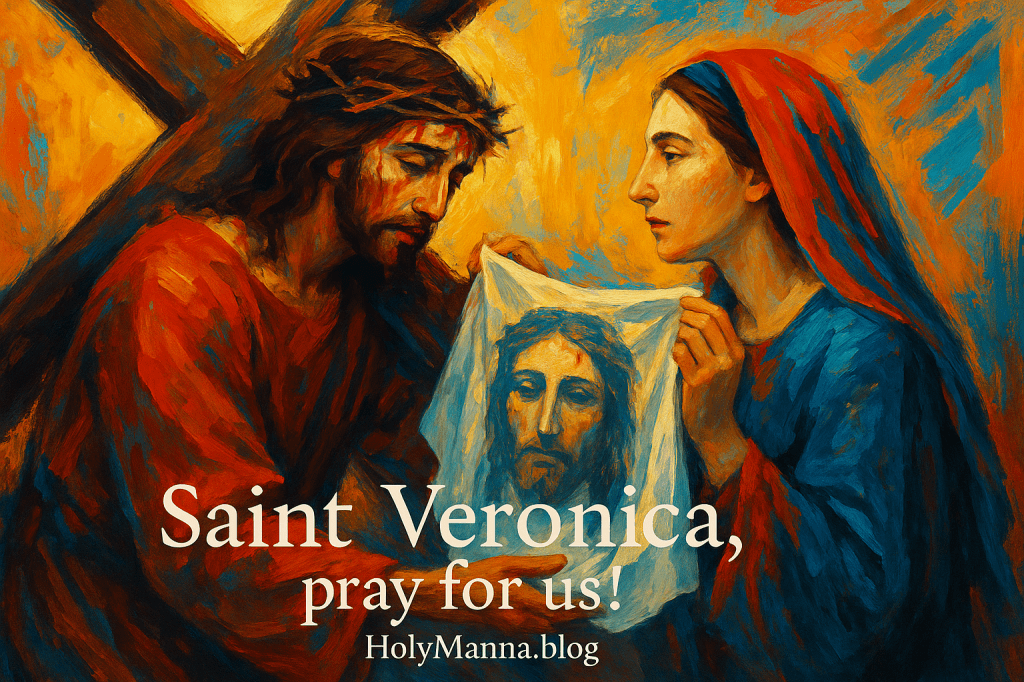
In the chaos of Good Friday, amidst jeering crowds, Roman soldiers, and the battered body of our Savior stumbling toward Golgotha, one woman steps forward. She doesn’t preach. She doesn’t fight. She simply acts. Saint Veronica is remembered in Catholic tradition for a single, breathtaking moment of courage and tenderness: she pushed through the crowd to wipe the face of Jesus with her veil as He carried His Cross. That simple act—motivated by love and mercy—has echoed through the ages, not because of grandeur, but because of its humanity.
Though her name is not found in the canonical Gospels, Saint Veronica is forever etched into the devotional life of the Church. Her encounter with Jesus is commemorated in the Sixth Station of the Cross, a meditation that invites us to step into the moment when love triumphed over fear. She is honored as the patroness of photographers and laundry workers—fitting titles for the woman who captured the Holy Face on a humble cloth and who wiped the sweat and blood of the Suffering Servant. In a world increasingly numb to compassion, Saint Veronica’s story is a radiant witness that even the smallest acts of love leave an eternal imprint.
The Heart Behind the Veil
The early life of Saint Veronica is wrapped in the folds of tradition and pious imagination, rather than strict historical detail. Most accounts place her in Jerusalem during the time of Christ’s Passion. Though the Bible doesn’t record her name, one powerful tradition identifies her with the woman who had suffered from a hemorrhage for twelve years and was healed when she touched the cloak of Jesus. In Luke 8:43–48, we read the tender exchange between this woman and Christ. Jesus turns and says, “Daughter, your faith has saved you. Go in peace.”
Many early Christians believed that this same woman later became Veronica. Whether or not that identity is historically accurate, both figures share one defining trait: bold, faith-filled love that led them to reach for Jesus when all others held back.
The name Veronica itself is steeped in theological beauty. It is often thought to derive from the Latin-Greek phrase vera icon, meaning “true image.” This is no coincidence. Her life, whether shrouded in anonymity or not, reflects what it means to bear the image of Christ—not only outwardly on a veil, but inwardly, on the soul. Veronica did not let fear or custom restrain her. When others watched in silence, she acted. When Jesus was disfigured and bloodied, she saw Him not as a criminal, but as her Lord. That moment was her conversion—not necessarily from unbelief, but from passive discipleship to radical love.
In Veronica, we see the transformation that happens when a heart fully yields to the suffering Christ. She did not wipe His face to change His fate; she did it simply to love Him better in His hour of need.
The Miracle of the Holy Face
The most famous miracle associated with Saint Veronica is the Veil of Veronica—a piece of cloth upon which the face of Christ was miraculously imprinted. This was no ordinary act of comfort. It was a divine moment that became a sign to the world: Jesus desires to leave His image on those who approach Him with compassion.
Tradition holds that when Veronica pressed the veil to Jesus’ face, His holy features remained on the cloth, full of dignity, pain, and divine serenity. The impression was not made with ink or pigment, but by the power of God. In doing this, Jesus gave the Church not only a physical relic, but a spiritual truth: when we draw near to Him in love, He leaves His likeness on us.
This veil became one of the most venerated relics in Christian history. Pilgrims traveled to see it. Stories of miraculous healings and conversions abound—people reported being healed of illnesses simply by gazing upon the Holy Face. Though the original veil’s whereabouts are uncertain today, a relic believed to be the Veil of Veronica is preserved in St. Peter’s Basilica in Rome, displayed for public veneration on special occasions.
The miracle of the veil is not just about a supernatural image. It reminds us that Christ’s face is found in the poor, the suffering, the outcast. As Matthew 25:40 teaches us, “Whatever you did for one of these least brothers of mine, you did for me.” Veronica’s act of love was rewarded not with public praise, but with an eternal image of the Face of God—a miracle that continues to move hearts toward compassion and adoration.
Love that Bears the Cross
Saint Veronica did not suffer martyrdom in the conventional sense. There are no ancient accounts of her being stoned, crucified, or executed. Yet, her witness was not without cost. Publicly aiding a condemned man—especially one as controversial as Jesus—was risky. In Roman-occupied Judea, aligning yourself with a figure labeled a rebel or heretic was an invitation to be scorned, persecuted, or even imprisoned.
But Veronica did not count the cost. She did not retreat into the shadows when Jesus was being led to His death. She stepped forward, knowing full well that she could become a target. That kind of courage does not come from human strength alone. It is the fruit of grace—of a soul so in love with Christ that nothing else matters.
Tradition holds that after the Resurrection, Saint Veronica lived a quiet life of prayer and service. Some accounts suggest she followed Saint John the Evangelist, continuing to serve the early Christian community. Others place her in southern France or Rome, spreading the story of the veil and Christ’s mercy. Wherever she went, she carried not just a relic, but a living memory—a testimony etched into her soul by her encounter with Christ.
Hers was a white martyrdom, a daily dying to self in a world that mocked the crucified Lord. Saint Veronica shows us that the cost of discipleship isn’t always paid in blood, but sometimes in quiet perseverance, hidden love, and the refusal to turn away from Christ when it is most uncomfortable.
The Echo of Her Love
Even after her death, Saint Veronica’s legacy did not fade. The veil she once used as an act of compassion continued to draw people to Jesus. Pilgrims reported healings of blindness, paralysis, and spiritual torment by coming into contact with the veil or praying before it.
As devotion to the Holy Face of Jesus grew, especially in medieval Europe, so did reverence for Saint Veronica. Churches were named after her. Artists, mystics, and theologians reflected deeply on her example. Saint Gertrude the Great and Saint Bridget of Sweden, among others, had profound devotions to the Holy Face, often linking their love for Christ’s Passion with the memory of Veronica’s veil.
In the 19th century, devotion to the Holy Face was renewed through the visions of Sister Marie of St. Peter in France. This led to the formation of the Archconfraternity of the Holy Face, approved by Pope Leo XIII. Saint Thérèse of Lisieux would later take “of the Holy Face” as part of her religious name, showing how central this devotion had become to many saints.
Today, relics associated with Veronica’s veil can be found in Rome, Manoppello, and other sites. Though debated among scholars, the power of these relics lies not just in their authenticity, but in the message they bear: the face of Christ is revealed in acts of love, in those who suffer, and in those who serve Him without counting the cost.
Living the Veil
Saint Veronica’s life reminds us that holiness is often found in the interruptions—those small moments where we choose love over fear, tenderness over indifference. Her act was not planned or dramatic. She simply saw a suffering man and chose to comfort Him. That man happened to be the Son of God.
You and I may not have the chance to wipe the physical face of Christ, but we are given the opportunity to comfort Him in others—every single day. When we show kindness to the homeless, mercy to the broken, or forgiveness to those who wound us, we repeat Veronica’s gesture.
In a world obsessed with recognition, Veronica chose anonymity. In a culture of self-preservation, she risked public shame. In a crowd moving away from the Cross, she stepped toward it. That is the heart of Christian discipleship.
How can we live the veil today? By being attentive to the suffering around us. By not hesitating when compassion calls. By letting our faith propel us into action—not grand or showy acts, but real, human love.
“Blessed are the merciful, for they will be shown mercy.” (Matthew 5:7)
Let us ask Saint Veronica to teach us to see the face of Jesus in everyone we meet—and to become, by grace, a living veil that carries His image into the world.
Engage with Us!
Have you ever felt called to serve someone in a moment of suffering, even when it was uncomfortable or risky? Saint Veronica’s story challenges us to love boldly and without hesitation.
🕊 Reflection Questions:
- How can I be more attentive to Christ present in the suffering people around me?
- What is one small act of compassion I can do today, even if no one sees it but God?
- Am I willing to stand with Jesus even when the world mocks or rejects Him?
We’d love to hear how Saint Veronica’s story moves you. Share your thoughts in the comments, and let’s build a community of compassionate faith. Let us strive, like her, to do everything with love—as our Lord Jesus did.
Saint Veronica, pray for us!
Follow us on Instagram and Facebook for more insights and reflections on living a faith-filled life.

 Holy Manna!
Leave a comment