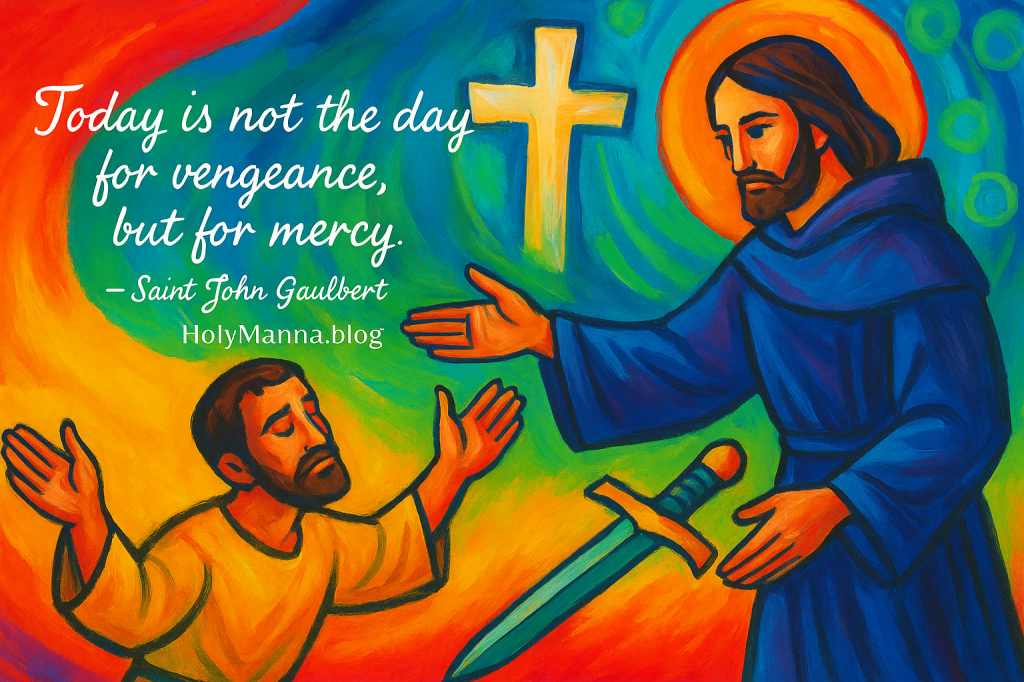
The Sword That Bowed Before the Cross
In a world where vengeance often masquerades as justice, the story of Saint John Gaulbert cuts through with a brilliant flash of divine mercy. Born into nobility and raised amid the clang of swords and the roar of pride, John’s life was destined for bloodshed. And for a time, that destiny seemed sure—until one unforgettable encounter before the crucified Christ transformed him into a servant of peace, humility, and holiness. His life is a profound testament to the radical power of forgiveness and the freedom that flows from choosing mercy over wrath. As the founder of the Vallombrosan Order—a reform branch of the Benedictines—John helped renew monastic life in 11th-century Italy and stood fearlessly against the corruption of simony within the Church. He is revered today as a model of interior transformation, spiritual leadership, and holy courage. Canonized in 1193, Saint John Gaulbert remains an enduring inspiration, especially for those struggling to forgive or searching for purpose beyond the noise of the world.
From Noble Blood to Sacred Silence
Saint John Gaulbert was born around the year 995 into the powerful Visdomini family of Florence, a lineage steeped in military valor and aristocratic privilege. As a young man, he was trained in the art of war and was deeply devoted to his family’s honor. When his only brother Hugh was murdered, John was overcome with rage. The pain of loss festered into a vow of revenge, and he swore that he would not rest until justice—his version of it—was served.
That opportunity came on Good Friday. As John rode through the streets of Florence, sword at his side and wrath in his heart, he came upon the man who had killed his brother. The killer fell to his knees and opened his arms in the shape of a cross, silently invoking the mercy of Christ. In that sacred moment, time seemed to freeze. John raised his sword—but something stronger than blood vengeance held him back. Looking into the man’s eyes, he was pierced not with hatred but with grace. He dropped his sword and embraced the man, whispering words of forgiveness.
Shaken by what had just transpired, John rode to the church of San Miniato al Monte. There, he knelt before a crucifix—and to his astonishment, the figure of Christ bowed His head, as if in approval of the mercy John had shown. That supernatural gesture sealed his conversion. No longer a man of war, John pledged his life to Christ.
He soon entered the Benedictine monastery at San Miniato, exchanging armor for the robe of a monk. Yet he quickly found the monastic life there to be compromised by laxity and worldliness. Yearning for a more authentic spiritual path, John left the monastery with papal approval and withdrew into the forests of Vallombrosa, where he would eventually found the Vallombrosan Order. This community would become known for its deep commitment to poverty, manual labor, contemplation, and fierce adherence to the Gospel. In an age of corruption, John lit a torch of reform that would shine for generations.
Fires Quenched and Demons Fled
While Saint John Gaulbert never sought recognition or applause, the Lord saw fit to magnify his holiness through striking miracles during his lifetime. These were not merely spectacles—they were living signs of divine favor and of the spiritual authority he carried. One of the most famous miracles occurred when a raging fire broke out in the Vallombrosan monastery. The flames threatened to engulf the entire monastic complex. As panic spread among the monks, John remained serene. He walked to the edge of the blaze, made the sign of the cross, and offered a prayer of trust. Immediately, the wind shifted direction, sparing the monastery and halting the fire. The monks rejoiced, not just for their safety, but for the visible confirmation that God’s hand was upon their abbot.
In another incident, a young monk was suffering from violent demonic possession. His screams echoed through the cloisters, and none could bring him peace. John was called to the scene. He approached the boy, knelt beside him, and made the sign of the cross over his forehead while invoking the name of Jesus. At once, the demon fled, and the boy collapsed into peaceful sleep. No words were needed. The cross had spoken.
Many others would come to John for healing, counsel, or deliverance. Though he preferred the hidden life, God allowed his holiness to shine forth in these tangible expressions of grace. Each miracle served to strengthen the faith of his brothers and of the people of Florence, reminding them that God’s power is made perfect in those who live in humility and trust.
Battles Without Blood
While John had once fought with the sword, his battles as a monk and abbot were no less fierce. The spiritual war he waged against corruption—especially the buying and selling of ecclesiastical offices (simony)—put him directly in conflict with powerful figures in the Church and society. His most famous confrontation came against Bishop Pietro Mezzabarba, who had purchased his episcopal position. Outraged by this desecration of holy orders, John and his monks refused to acknowledge the bishop’s authority and boldly declared him excommunicated. This act caused a scandal—but it also ignited a movement. John’s example inspired countless monks and laypeople to stand against corruption and to fight for holiness within the Church.
These actions came at a great cost. John was slandered, threatened, and ostracized by those in power. He and his monks endured isolation and persecution. Yet they never wavered. They clung to the truth, even when it made them enemies. In many ways, John’s life mirrors the teachings of Psalm 34: “Many are the afflictions of the righteous, but the Lord delivers him out of them all” (Psalm 34:19).
Though not a martyr in the literal sense, Saint John Gaulbert lived what the Church calls white martyrdom—a daily dying to comfort, pride, and worldly acceptance. He died to himself so that Christ might live more fully in him. His suffering purified him, and his perseverance transformed a corrupted corner of the Church into a wellspring of grace.
Grace Beyond the Grave
Even after his death in 1073, the graces flowing from Saint John Gaulbert’s life did not cease. His tomb in Vallombrosa quickly became a place of pilgrimage, especially for those seeking healing and peace. From the moment of his burial, reports began to emerge of miraculous healings and conversions. The blind received their sight. The paralyzed walked. The mentally afflicted found peace. Pilgrims from across Italy journeyed to the forest abbey to pray at his tomb, many leaving behind tokens of thanksgiving for favors received.
His relics, carefully preserved by the Vallombrosan monks, became instruments of divine power. Even when touched to the sick or carried in processions through towns plagued by illness, healings would occur. The Acta Sanctorum, the Church’s ancient collection of saintly lives and miracles, records multiple verified healings connected to John’s intercession.
Vallombrosa itself has remained a sacred place—a haven of contemplation and spiritual renewal. To this day, the order he founded continues to draw men to a life of hidden holiness, shaped by silence, charity, and devotion to Christ. His memory is not confined to history. It lives on in every act of forgiveness, every courageous stand for truth, and every monastery that dares to place God above all.
The Sword That Bows to the Cross
What makes Saint John Gaulbert so relatable—and so radical—is the simplicity of his conversion. He saw the cross. He remembered Christ. And he let go. He teaches us that the moment we surrender vengeance and pride, a new world opens to us. His life invites each of us to ask: What sword am I still holding? Whom have I refused to forgive?
We live in a world where grudges are normalized, and mercy is seen as weakness. But in the eyes of Heaven, forgiveness is the greatest strength. John’s entire life flowed from that one act of letting go. From that moment of mercy came miracles, monastic renewal, and eternal glory.
The Catechism of the Catholic Church tells us, “It is not in our power not to feel or to forget an offense, but the heart that offers itself to the Holy Spirit turns injury into compassion and purifies the memory in transforming the hurt into intercession” (CCC 2843). This is the transformation John experienced. This is the grace offered to each of us.
In the silence of the forest, in the fire of reform, and in the bowing of a crucifix, Saint John Gaulbert found the living Christ. And so can we—if we choose the path of mercy, even when it costs everything.
Engage with Us!
What did Saint John Gaulbert’s story stir in your heart today? We’d love to hear your thoughts and reflections. Let’s grow together as we follow Christ more faithfully.
Reflection Questions:
- What grudge or pain might God be inviting you to release today, like John Gaulbert did?
- How can you cultivate more silence and prayer in your daily life to hear God’s voice clearly?
- In what ways can you courageously stand up for justice and truth, even when it’s unpopular?
Let’s support each other in our journey of faith—and strive to do everything with love, as our Lord Jesus did.
Saint John Gaulbert, pray for us! ⚔️
Follow us on Instagram and Facebook for more insights and reflections on living a faith-filled life.

 Holy Manna!
Leave a comment