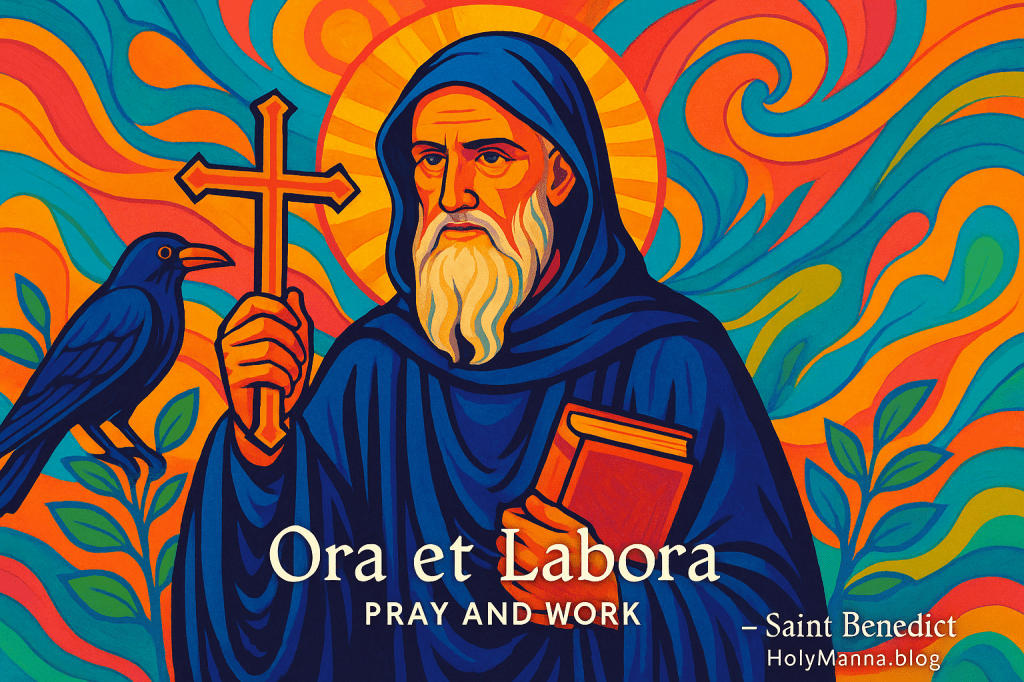
The Quiet Giant Who Shaped Christian Civilization
Saint Benedict of Nursia is one of the most influential figures in the history of Christianity, not merely because of the holiness of his life, but because of the monumental spiritual foundation he laid for the Church and the Western world. Born in the chaos following the fall of the Roman Empire, Benedict became a beacon of peace and structure through the founding of monastic communities rooted in a rule of life that emphasized balance, humility, obedience, and unceasing prayer. His Rule of Saint Benedict became the cornerstone of Western monasticism and a spiritual guide not only for monks but for anyone desiring to live a Christ-centered life. Revered as the Father of Western Monasticism, he was named patron of Europe by Pope Paul VI, recognizing that the seeds he planted in the monasteries of Italy would blossom into centers of faith, culture, learning, and charity throughout the continent. Saint Benedict teaches us that holiness does not require fame or power, but fidelity in the small, daily duties embraced with love and offered to God.
A Youth Transformed
Born around 480 AD in Nursia, a small town in central Italy, Benedict came from a noble Roman family and received a classical education in Rome. However, the city’s moral decay and political instability repulsed him. What he witnessed—the disintegration of virtue and the noise of worldly ambitions—awakened in him a deep desire for something greater, something eternal. This longing drove him to abandon the path of secular success and to seek solitude, silence, and holiness in the mountains outside of Rome.
He retreated to a cave in Subiaco, where he lived as a hermit for three years, embracing poverty, chastity, and obedience to God. His days were filled with prayer, fasting, and spiritual battle. Though alone, he was not forgotten. Word of his sanctity spread, and others began to seek him out. Eventually, a group of monks asked him to become their abbot, but they soon rebelled against his strict discipline and even tried to poison him. “He who would be great among you must be your servant” (cf. The Gospel of Matthew 20:26), and Benedict lived this out, choosing to quietly withdraw rather than retaliate.
Benedict then founded twelve small monasteries in Subiaco before eventually establishing the great monastery at Monte Cassino, where he would compose his famous Rule. His life was a continuous conversion—a turning from self to God, from comfort to the Cross, from noise to contemplation. He is most known today for his Rule, which provides a balanced framework of prayer, work, and study, grounded in the Gospel and in deep trust in divine providence.
Holy Signs in a Chaotic Age
Saint Benedict’s holiness was not only interior—it radiated in visible, miraculous ways. These miracles, lovingly recorded by Pope Saint Gregory the Great in The Dialogues, testify to the power of God working through a man who had given himself entirely to the divine will.
One of the most well-known miracles occurred when monks attempted to kill him by poisoning his wine. When Benedict made the Sign of the Cross over the cup, “it broke as if struck by a stone,” shattering on the table and exposing their treachery. On another occasion, when a jealous priest sent him poisoned bread, Benedict called upon his trusted raven, commanding it to carry the deadly food far away so no harm would come to others.
His ability to read hearts revealed a mystical insight into human souls. He would frequently rebuke monks for secret sins they had never confessed aloud, urging them to repentance and healing. In one particularly tender moment, he consoled a grieving monk by miraculously raising a boy from the dead, offering not only physical life but spiritual reassurance.
Perhaps most beautifully, Benedict brought about peace in troubled hearts. He calmed demons that tormented others, he prophesied events with stunning accuracy, and he brought harmony where discord reigned. These miracles were never sought for their own sake—they were signs of a greater reality: the nearness of God and the transforming power of sanctity.
Trials in the Desert
While Benedict did not die a martyr’s death, his life was one long martyrdom of the will. His hardships were many and relentless, particularly in the realm of spiritual warfare. The devil, enraged by Benedict’s holiness and the souls he led to God, assaulted him with temptations, ridicule, and physical danger.
One of the most vivid moments of his inner battle came when he was overwhelmed by a sudden temptation of lust. Rather than entertain it or flee in fear, Benedict ran into a patch of thorn bushes and hurled himself into them. The sharp pain of the thorns became a physical offering, purifying his desire and turning it heavenward. “Blessed are the pure in heart, for they shall see God” (The Gospel of Matthew 5:8)—Benedict understood this Beatitude not merely as a promise, but as a command.
He also endured persecution from envious clerics and rebellious monks. Some tried to poison him. Others spread lies about him. But he bore all this with calm resignation and unwavering faith. The cross that Benedict carried was interior and exterior—a crucible through which his soul was refined and strengthened in love.
The enduring symbol of this battle is the Saint Benedict Medal, inscribed with exorcistic prayers and the phrase “Vade retro Satana!”—“Begone, Satan!” It remains one of the Church’s most powerful sacramentals for protection against evil. In Benedict’s life, we see that the road to sanctity passes through suffering, but suffering embraced with Christ leads to glory.
His Final Offering
Saint Benedict died as he lived: in prayer and praise. Near the end of his life, he knew his time was short. He asked to be taken to the chapel where he received the Body and Blood of Christ. There, standing with arms raised in prayer, supported by his monks, he breathed his last. It was not a death marked by fear, but by fulfillment—the completion of a life totally given to God.
After his death, miracles flowed abundantly. His relics, enshrined next to those of Saint Scholastica, his beloved twin sister, became sources of healing and conversion. The monastery at Monte Cassino—though destroyed multiple times by war and disaster—rose again and again, a living sign of the spiritual vitality that Benedict unleashed.
Throughout the centuries, his intercession has been sought by those battling temptation, illness, poison, or demonic oppression. Pilgrimages to Monte Cassino and countless Benedictine monasteries have brought renewal to countless souls. His Rule continues to guide not only monks and nuns, but lay Christians seeking stability and peace in a chaotic world. “Let them prefer nothing whatever to Christ”—this phrase from his Rule echoes like a trumpet across the ages, calling each of us to deeper conversion.
The Rule Still Speaks
In a time when our lives are often consumed by noise, speed, and endless distractions, Saint Benedict offers a roadmap to interior peace. His Rule was written for monastic life, yes—but its wisdom is profoundly relevant for anyone who desires to follow Christ with intention and joy.
How can you begin to live the Rule today? Start by praying with consistency, even if only for five minutes in the morning. Offer your work—whether it’s in an office, a classroom, or at home—as a gift to God. Order your day with structure and simplicity, resisting the lure of busyness for its own sake. Make time for silence. Listen to God. Read Scripture. Cultivate humility, obedience, and love in your daily interactions.
The Catechism affirms this vision when it teaches, “The religious state is thus one way of experiencing a ‘more intimate’ consecration, rooted in Baptism and dedicated totally to God” (CCC 931). Saint Benedict’s life reminds us that every Christian, no matter their vocation, is called to this deep intimacy.
The world may never fully appreciate the quiet revolution Benedict began, but Heaven rejoices in it still. He has shown us that when we give our lives completely to God, hidden in humility and steadied by prayer, we become instruments of transformation in ways we may never see.
Engage with Us!
We’d love to hear how the life of Saint Benedict has inspired or challenged you. Please share your thoughts below and journey with us as we grow in faith together!
Reflection Questions:
- How can you bring more balance between prayer and work in your daily life?
- What “spiritual poisons” in your life need to be surrendered to God’s healing?
- How can Saint Benedict’s example help you battle temptation and seek holiness more intentionally?
Let’s support one another in becoming more faithful disciples, trusting in God’s mercy, and striving to do all things with love, as our Lord Jesus Christ did.
Saint Benedict, pray for us! 📜
Follow us on Instagram and Facebook for more insights and reflections on living a faith-filled life.

 Holy Manna!
Leave a comment