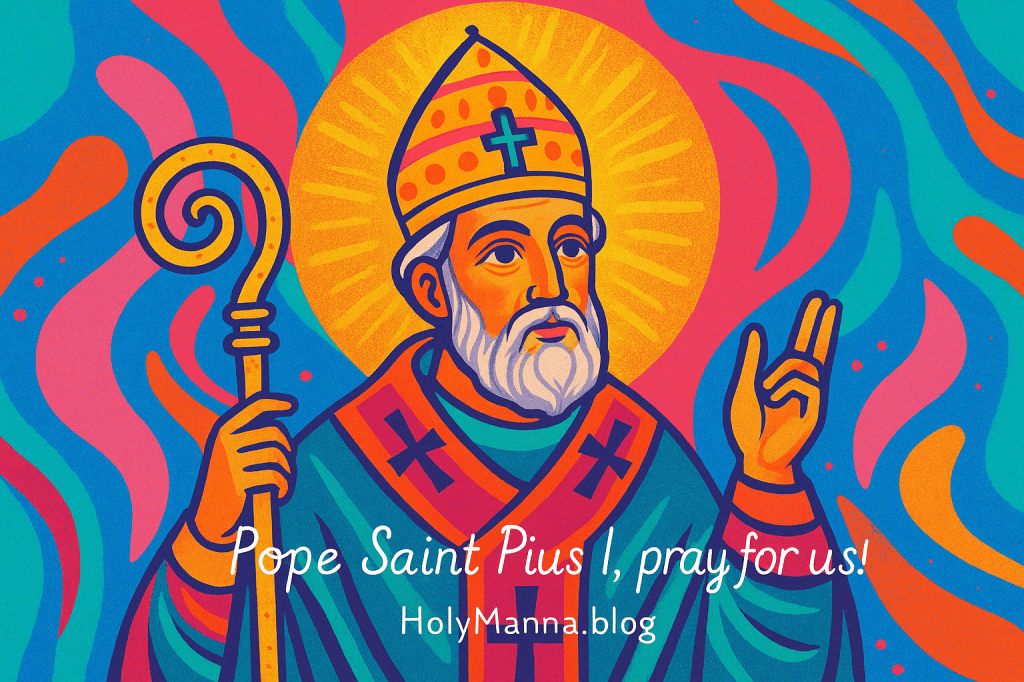
A Rock in Rome’s Storm
In an era when Christianity was still a persecuted faith and doctrinal confusion threatened to splinter the unity of believers, the Church needed strong, faithful leaders to protect and guide the flock. Pope Saint Pius I emerged as one of the most formative figures of the 2nd century, courageously leading the Church through dangerous and uncertain times. He is remembered not for spectacular miracles or dramatic martyrdom, but for his unwavering dedication to the truth, his defense of apostolic tradition, and his gentle yet firm pastoral care of the Roman Church. As the ninth pope after Saint Peter, he held the office of Bishop of Rome at a time when Christianity was still defining itself against both pagan hostility and internal heresy. His pontificate, marked by prudence, theological clarity, and fidelity to the teachings of Christ, earned him a place among the great early saints of the Church. The legacy of Pope Saint Pius I is that of a humble shepherd who refused to abandon the truth, even as the wolves gathered at the gate.
From Servant’s Son to Servant of Christ
The early life of Pope Saint Pius I reflects the Church’s mission to lift up the lowly and transform lives regardless of social status. Born likely around the end of the first century, Pius hailed from Aquila in northern Italy. According to the Liber Pontificalis, he was the son of a man named Rufinus, a freed slave. This detail alone speaks volumes. In the ancient world, lineage mattered deeply. Yet here was a man, the child of a former slave, rising to the highest position in the Church—a sign that in Christ there is no slave or free, but all are one (cf. Galatians 3:28).
Little is known about his youth, but what is clear is that Pius grew up during a time when Christianity was spreading rapidly yet perilously. The Christian faith was illegal in the Roman Empire and punishable by death. For someone to embrace this path was to risk everything. It is likely that Pius, inspired by the witness of early martyrs and perhaps catechized by early priests in Rome, was baptized and chose to devote his entire life to the service of the Church. By the time he was elected pope around 140 A.D., he had already proven himself as a man of deep prayer, spiritual discernment, and apostolic zeal.
During his papacy, which lasted approximately fifteen years, Pope Pius I became best known for opposing heresies that threatened the unity and doctrinal purity of the Church. He boldly challenged the teachings of Marcion, a former bishop who rejected the Old Testament and tried to establish a Christianity divorced from its Jewish roots. Pius excommunicated him and reinforced the belief that the Old and New Testaments are inseparably united in salvation history. He also opposed Valentinus, a charismatic teacher of Gnostic doctrines, which claimed secret knowledge and promoted dualism. Pope Pius I defended the unity of creation and redemption, asserting that God’s love encompasses both the visible and invisible, the material and the spiritual. It is largely thanks to his leadership that the Church began to clearly distinguish apostolic tradition from false teachings. His commitment to truth shaped the development of the Christian canon, the liturgy, and the unity of the Church.
A Miracle of Doctrine and Discernment
Unlike some saints known for dramatic wonders or visible healings, Pope Saint Pius I performed miracles of a different kind—miracles of faith, courage, and spiritual clarity. His miracles were not lightning bolts from heaven or sudden cures of leprosy. Rather, they were the slow, steady, and divinely inspired acts of discernment and protection that preserved the Church in an age of confusion. When heretical movements threatened to distort the Gospel and mislead the faithful, Pius stood like a lighthouse in a storm.
His most profound spiritual miracle was perhaps his unwavering commitment to defending orthodoxy without succumbing to bitterness or fear. To refute Marcion, for example, required not only theological expertise but also pastoral wisdom. Marcion was powerful, influential, and well-funded. Yet Pope Pius I, rooted in prayer and the Holy Spirit, calmly reaffirmed that the God of the Old Testament is the same loving and merciful Father revealed in Jesus Christ. His actions preserved the integrity of Scripture and laid the groundwork for the eventual canonization of the biblical texts.
It is also traditionally believed that his brother was Saint Hermas, author of the influential early Christian text The Shepherd, which emphasized repentance, angelic guidance, and Christian perseverance. Whether biological or spiritual kin, this connection speaks to the holy atmosphere that surrounded Pius’ ministry. His guidance nurtured not just correct doctrine but also deep devotion and trust in the voice of the Holy Spirit.
Persecution’s Shadow and the Martyr’s Honor
While historical accounts of Pope Saint Pius I’s martyrdom are not conclusive, early Church records and martyrologies suggest that he died either in prison or as a result of persecution under the Roman Emperor Marcus Aurelius. His name appears in the Roman Martyrology, and tradition venerates him as a martyr for the faith. Whether or not he died by the sword or quietly succumbed in captivity, his life was poured out like a libation, as Saint Paul wrote: “I have fought the good fight, I have finished the race, I have kept the faith” (2 Timothy 4:7).
Throughout his papacy, Pius faced constant political and spiritual threats. Christians were still considered enemies of the state. The Roman authorities saw the Eucharist as cannibalism, the gatherings of believers as subversive, and the proclamation of a crucified Lord as an insult to Caesar. As pope, Pius bore the weight of the Church’s suffering, encouraging believers not to despair, reminding them that “Blessed are those who are persecuted for righteousness’ sake, for theirs is the kingdom of heaven” (Matthew 5:10).
Even if his death was not at the hands of an executioner, his entire life was a slow martyrdom of self-sacrifice, leadership under pressure, and unshakable fidelity. He shepherded the Church not from a place of comfort, but from the cross.
The Silent Power of a Saint’s Legacy
The miracles attributed to Pope Saint Pius I after his death are not spectacular tales of apparitions or healings that we find in the stories of other saints, yet his posthumous influence on the Church is monumental. Venerated since the early centuries, he is remembered in the liturgical calendar on July 11, and his name was cherished by generations of Christians who saw in him a model of fidelity and wisdom.
It is believed that he was buried in the vicinity of Saint Peter’s Basilica, possibly near other early martyrs and pontiffs, a sign of his spiritual stature. Pilgrims who visit Rome, even unknowingly, walk in the footsteps of this quiet giant of faith. His memory was especially cherished by the early Church Fathers and theologians who continued his work in defending truth and teaching sound doctrine.
Through the preservation of apostolic tradition, the guidance of the early liturgy, and the shaping of Christian identity, Pope Pius I continues to perform a kind of miracle: he reminds us that the truth of Christ is not a relic of the past, but a living power, handed down through the successors of the Apostles and safeguarded by the Spirit of God.
Truth That Transforms
The life of Pope Saint Pius I offers a profound lesson for us today. In a world saturated with misinformation, shallow spirituality, and moral compromise, the example of a man who lived and died for the unchanging truth of the Gospel is both sobering and inspiring. He teaches us that holiness is not always loud or dramatic. Sometimes, it is the quiet refusal to compromise, the steady hand that holds to the barque of Peter, and the daily decision to lead with truth and love.
The Catechism of the Catholic Church teaches us that: “The task of interpreting the Word of God authentically has been entrusted solely to the Magisterium of the Church” (CCC 100). Pope Pius I embodied this principle, reminding us that fidelity to apostolic teaching is not optional—it is foundational to our communion with Christ.
How are we responding when truth is challenged in our families, workplaces, or online spaces? Are we willing to be lovingly bold like Pope Pius, to refute lies with gentleness and clarity, and to offer a witness of hope amid confusion?
To follow in his footsteps means to cling to Scripture, the teachings of the Church, and the Eucharist, even when it costs us popularity, comfort, or ease. It means trusting that God continues to guide His Church through storms, just as He did in the days of the early martyrs.
Let us pray through the intercession of Pope Saint Pius I, that we may be shepherds in our own lives—guiding others not by worldly wisdom, but by the enduring truth of the Gospel.
Engage with Us!
Let Pope Saint Pius I inspire you to courageously live out your faith in love and truth. Share your thoughts in the comments and reflect on the questions below:
- In what ways am I being called to defend the truth of the Gospel in my life today?
- How can I respond with love and clarity when faced with false teachings or confusion?
- What does it mean to be a “shepherd” in my own community, family, or circle of friends?
Let us support one another in our walk with Christ, always seeking to do everything with love—as our Lord Jesus did. May the intercession of Pope Saint Pius I strengthen us in truth and perseverance.
Pope Saint Pius I, pray for us! 🕊️
Follow us on Instagram and Facebook for more insights and reflections on living a faith-filled life.

 Holy Manna!
Leave a comment