Memorial of Saint Benedict, Abbot – Lectionary: 387
Led Through the Unknown
There are moments in life when we are called to step into the unfamiliar, not knowing what lies ahead—moments when the ground beneath us shifts, relationships are tested, or the future feels uncertain. Today’s readings meet us in these moments of transition, exile, and persecution, offering not only consolation but also a bold invitation: to place our trust entirely in the God who sees, guides, and redeems. Whether it’s the trembling journey of an elderly Jacob to Egypt, the psalmist’s assurance in divine justice, or Jesus commissioning His disciples for trials ahead, the Word of God today reminds us that even when we walk into hardship, we do not walk alone.
In Genesis 46, we encounter a pivotal turning point in salvation history. Jacob (Israel), the patriarch of God’s chosen people, leaves the promised land for Egypt—a place often symbolic of both refuge and future oppression. This isn’t a decision taken lightly. Yet God speaks to Jacob in a night vision, saying, “Do not be afraid to go down to Egypt, for there I will make you a great nation” (Gen 46:3). This reassurance of divine accompaniment—“I will go down to Egypt with you”—foreshadows the long arc of redemptive history that continues into the New Testament, where God not only journeys with His people but dwells among them in the person of Jesus Christ.
The Gospel passage from Matthew 10 may feel jarring in contrast, filled with warnings of betrayal, persecution, and hostility. Yet it echoes the same message of divine presence: “Do not worry about how you are to speak… the Spirit of your Father will be speaking through you” (Mt 10:19-20). The Psalm anchors it all with its beautiful realism—yes, evil exists, and suffering is real, but “The salvation of the righteous is from the Lord… because they take refuge in him” (Ps 37:39-40). Taken together, these readings assure us that when God sends us into uncertain places—whether literal journeys like Jacob’s or spiritual trials like the apostles’—He does not abandon us. He prepares the way, speaks through us, and shapes our crosses into channels of grace. What Egypt are you being asked to walk into today? Are you trusting that He goes with you?
First Reading – Genesis 46:1–7, 28–30
Trusting the God Who Goes Before
The Book of Genesis is the foundational narrative of the people of Israel. By the time we reach chapter 46, we are deep into the family saga of the patriarchs—Abraham, Isaac, and now Jacob (also called Israel). The reading captures a crucial moment: Jacob is being asked by God to uproot everything he knows and go down to Egypt. This journey will ensure the survival of his family during famine, but it also marks the beginning of centuries of dwelling in a foreign land. Egypt, a place of both refuge and eventual oppression, becomes a symbol of God’s mysterious providence. Jacob’s reunion with his son Joseph is deeply moving, but the larger theological arc is just as powerful: God is orchestrating salvation history through the faithful yes of His servant, even when that yes leads through the unknown. This passage sets the stage for Israel’s transformation from a tribe to a nation, aligning beautifully with today’s theme of divine guidance through uncertainty.
Genesis 46:1-7, 28-30
New American Bible (Revised Edition)
Migration to Egypt. 1 Israel set out with all that was his. When he arrived at Beer-sheba, he offered sacrifices to the God of his father Isaac. 2 There God, speaking to Israel in a vision by night, called: Jacob! Jacob! He answered, “Here I am.” 3 Then he said: I am God, the God of your father. Do not be afraid to go down to Egypt, for there I will make you a great nation. 4 I will go down to Egypt with you and I will also bring you back here, after Joseph has closed your eyes.
5 So Jacob departed from Beer-sheba, and the sons of Israel put their father and their wives and children on the wagons that Pharaoh had sent to transport him. 6 They took with them their livestock and the possessions they had acquired in the land of Canaan. So Jacob and all his descendants came to Egypt. 7 His sons and his grandsons, his daughters and his granddaughters—all his descendants—he took with him to Egypt.
28 Israel had sent Judah ahead to Joseph, so that he might meet him in Goshen. On his arrival in the region of Goshen, 29 Joseph prepared his chariot and went up to meet his father Israel in Goshen. As soon as Israel made his appearance, Joseph threw his arms around him and wept a long time on his shoulder. 30 And Israel said to Joseph, “At last I can die, now that I have seen for myself that you are still alive.”
Detailed Exegesis
Verse 1 – “Israel set out with all that was his. When he arrived at Beer-sheba, he offered sacrifices to the God of his father Isaac.”
Jacob begins his journey in reverence. Beer-sheba was a sacred place where both Abraham and Isaac had encountered God. By offering sacrifice there, Jacob is not acting on impulse; he is grounding his steps in worship and obedience. It reveals a pattern for all believers—before any major decision or journey, seek the Lord in prayer and sacrifice.
Verse 2 – “There God, speaking to Israel in a vision by night, called: Jacob! Jacob! He answered, ‘Here I am.’”
The double calling of Jacob’s name is intimate and urgent, reminiscent of the way God called Abraham (Gen 22:11) and Samuel (1 Sam 3:10). His response, “Here I am,” echoes the disposition of trust and readiness that characterizes the faithful heart.
Verse 3 – “Then he said: I am God, the God of your father. Do not be afraid to go down to Egypt, for there I will make you a great nation.”
God identifies Himself in continuity with the patriarchs, reinforcing that His promises remain intact. Egypt is not to be feared because it is under divine supervision. The phrase “Do not be afraid” is a command rooted in covenantal assurance: God will bring about fruitfulness even in exile.
Verse 4 – “I will go down to Egypt with you and I will also bring you back here, after Joseph has closed your eyes.”
This is perhaps the most touching promise. God does not merely send Jacob—He goes with him. The mention of Joseph tenderly closing Jacob’s eyes emphasizes not only personal reunion but the comfort of dying in peace. It is both pastoral and prophetic.
Verse 5 – “So Jacob departed from Beer-sheba, and the sons of Israel put their father and their wives and children on the wagons that Pharaoh had sent to transport him.”
The image is familial and communal. Pharaoh’s provision of wagons shows how God can work even through secular rulers to fulfill His purposes. This verse is a concrete image of divine providence at work in material details.
Verse 6 – “They took with them their livestock and the possessions they had acquired in the land of Canaan. So Jacob and all his descendants came to Egypt.”
The move is total. Nothing is left behind. The covenant family enters Egypt not as individuals, but as a united people, carrying their livelihood, identity, and hopes into a land of both promise and testing.
Verse 7 – “His sons and his grandsons, his daughters and his granddaughters—all his descendants—he took with him to Egypt.”
This verse emphasizes generational continuity. The future of Israel is wrapped in this migration. It signals the beginning of something far bigger than one family’s survival—it’s the setup for the Exodus, the defining event of Jewish identity.
Verse 28 – “Israel had sent Judah ahead to Joseph, so that he might meet him in Goshen. On his arrival in the region of Goshen,”
Judah, the ancestor of David and Jesus, is sent ahead. He becomes a figure of mediation and leadership. Goshen is where the Israelites will settle and grow in number—God has already prepared a place.
Verse 29 – “Joseph prepared his chariot and went up to meet his father Israel in Goshen. As soon as Israel made his appearance, Joseph threw his arms around him and wept a long time on his shoulder.”
This deeply emotional reunion is the climax of years of separation, betrayal, suffering, and redemption. It is also an image of divine reunion—like the prodigal son, this meeting prefigures how God embraces His children with overflowing love and tears of joy.
Verse 30 – “And Israel said to Joseph, ‘At last I can die, now that I have seen for myself that you are still alive.’”
For Jacob, the sight of Joseph alive is enough. It fulfills the longings of his heart and brings peace. His words are not of despair, but of contentment and closure. Life’s purpose has been fulfilled through the faithfulness of God.
Teachings
The Catechism of the Catholic Church teaches that God’s providence leads His people through history, using even suffering and exile for the unfolding of His divine plan. “God is the sovereign master of his plan. But to carry it out he also makes use of his creatures’ cooperation… This use of human freedom is compatible with the absolute sovereignty of God” (CCC 306). Jacob’s journey to Egypt exemplifies this cooperation between divine sovereignty and human freedom—he moves in faith, and God moves through him.
St. John Chrysostom reflects that even in suffering or confusion, “the ways of God are hidden; but they are always wise.” Egypt, while a place of bondage in the future, is currently a place of survival and promise. This dual meaning reminds us that God often works through paradox—our places of discomfort may be the very soil of future deliverance.
In the early Church, the descent into Egypt became symbolic of Jesus Himself—who, as an infant, would be taken to Egypt to escape death, just as Jacob’s family did. As Matthew writes: “Out of Egypt I called my son” (Mt 2:15), quoting Hosea. This draws a direct line between today’s reading and the broader mystery of salvation: God always makes a way, even through exile.
Reflection
This reading invites us to ask: Where is God asking me to go, even if I feel afraid or uncertain? We are often tempted to cling to what we know, but faith calls us to trust in the God who journeys with us. Like Jacob, we must offer sacrifices of praise before every transition, listening for God’s voice in the night. We must also be ready to embrace the Egypts of our lives—those unexpected places where God’s provision waits. What is your Goshen today? Where is God preparing a reunion, a blessing, a home you didn’t expect? May we have the courage to say, like Jacob, “Here I am”—and take the next step forward.
Responsorial Psalm – Psalm 37:3–4, 18–19, 27–28, 39–40
Dwelling Securely in the Lord
The Book of Psalms is often called the prayer book of the Church, offering poetic reflections on God’s faithfulness, justice, and mercy. Psalm 37 is a wisdom psalm attributed to David, written not in moments of triumph, but in response to the troubling reality of evil and injustice in the world. Its counsel is profoundly countercultural: rather than envy the success of the wicked, we are called to “trust in the Lord and do good.” In today’s liturgy, this psalm is strategically placed between the First Reading—Jacob’s faithful migration into Egypt—and the Gospel, which speaks of impending persecution. Together, they form a theological bridge, reminding us that trust in God is not passive resignation, but a courageous and active stance in the face of uncertainty. Psalm 37 teaches us that righteousness is not only rewarded in eternity but sustained by the Lord even amid suffering in this life.
Psalm 37:3-4, 18-19, 27-28, 39-40
New American Bible (Revised Edition)
3 Trust in the Lord and do good
that you may dwell in the land and live secure.
4 Find your delight in the Lord
who will give you your heart’s desire.
18 The Lord knows the days of the blameless;
their heritage lasts forever.
19 They will not be ashamed when times are bad;
in days of famine they will be satisfied.
27 Turn from evil and do good,
that you may be settled forever.
28 For the Lord loves justice
and does not abandon the faithful.
When the unjust are destroyed,
and the offspring of the wicked cut off,
39 The salvation of the righteous is from the Lord,
their refuge in a time of distress.
40 The Lord helps and rescues them,
rescues and saves them from the wicked,
because they take refuge in him.
Detailed Exegesis
Verse 3 – “Trust in the Lord and do good that you may dwell in the land and live secure.”
This verse offers both a command and a promise. Trust is not merely internal; it is lived out through the active pursuit of good. The reference to dwelling in the land ties back to the covenantal promise given to Abraham and his descendants. For the Christian, this becomes a symbol of spiritual inheritance—peace and security that come from a life rooted in God’s will.
Verse 4 – “Find your delight in the Lord who will give you your heart’s desire.”
Delight here does not mean superficial pleasure, but deep joy rooted in communion with God. When our hearts are conformed to His, our desires are purified. The Church Fathers often taught that God grants our heart’s desires when our desires have become what God desires for us.
Verse 18 – “The Lord knows the days of the blameless; their heritage lasts forever.”
This verse affirms divine attentiveness. To be known by the Lord is to be remembered and sustained. The heritage points to both earthly blessing and eternal reward—a continuity of grace that evil cannot disrupt.
Verse 19 – “They will not be ashamed when times are bad; in days of famine they will be satisfied.”
Shame is a powerful emotion tied to failure or abandonment. But those who walk blamelessly need not fear disgrace, even in times of material scarcity. God’s providence includes spiritual and sometimes miraculous provision, especially for those who rely on Him completely.
Verse 27 – “Turn from evil and do good, that you may be settled forever.”
This echoes the call of the prophets: repentance is not just about turning away from sin but actively doing good. The reward of being settled forever suggests stability, permanence, and peace, even when external circumstances are volatile.
Verse 28 – “For the Lord loves justice and does not abandon the faithful. When the unjust are destroyed, and the offspring of the wicked cut off,”
Here the psalmist contrasts the destinies of the faithful and the wicked. God’s love for justice ensures He will never forsake those who persevere in righteousness. The fate of the wicked is not due to vengeance but the natural consequence of a life detached from God.
Verse 39 – “The salvation of the righteous is from the Lord, their refuge in a time of distress.”
This verse brings the theological heart of the psalm into sharp focus: salvation is not earned but gifted by God. When distress comes—as it surely does—the righteous find their protection not in power or possessions, but in the Lord Himself.
Verse 40 – “The Lord helps and rescues them, rescues and saves them from the wicked, because they take refuge in him.”
Repetition here underscores assurance. God doesn’t merely protect; He rescues, saves, and delivers. The act of taking refuge implies a relationship of trust and dependency, a recurring theme in both Old and New Testaments.
Teachings
The Catechism of the Catholic Church teaches that divine providence is not detached from our lived reality but intimately involved in our choices and their consequences. “Providence and secondary causes: God is the sovereign master of his plan. But to carry it out he also makes use of his creatures’ cooperation” (CCC 306). Psalm 37 reflects this beautifully, where divine protection is offered in tandem with the call to “do good” and “turn from evil.” Righteous living is not merely passive waiting—it is an active stance rooted in grace.
St. Augustine, in his commentary on the psalms, writes: “Do not be jealous of the prosperity of the wicked. Their success is short-lived. Let your heart be where your treasure is—in God, who is eternal.” This insight reinforces the psalmist’s call to trust in God over worldly success. The righteous may seem to suffer in the short term, but their future is assured in the hands of a just and loving God.
Historically, this psalm became especially meaningful during times of persecution—whether during the Babylonian exile or the trials of the early Church. In every age, the faithful have turned to Psalm 37 for comfort and resolve. The promises it contains are not poetic exaggeration but spiritual realities confirmed through centuries of God’s fidelity. When the Church was outlawed, martyred, or marginalized, these verses echoed in hearts as lifelines of hope: “The Lord helps and rescues them”—and He still does.
Reflection
The voice of Psalm 37 speaks clearly into our current age, when injustice, confusion, and instability often dominate headlines and hearts alike. What does it mean to truly “delight in the Lord” when evil seems to prosper around us? It means choosing to anchor ourselves in eternal truths rather than shifting circumstances. It means doing good even when no one sees, trusting in divine justice even when it feels delayed, and taking refuge in God rather than fear. Ask yourself today: Where am I tempted to envy or despair? Where might God be calling me to plant my trust more deeply in Him? As we journey through our own spiritual Egypts and face the wolves of this world, Psalm 37 reminds us that we are not left defenseless—our refuge is secure, because it is the Lord Himself.
Holy Gospel – Matthew 10:16–23
Evangelizing with Courage and Innocence
The Gospel of Matthew was written primarily for a Jewish-Christian audience, carefully linking Jesus’ life and mission to the Old Testament prophecies and expectations. In chapter 10, Jesus is preparing His disciples for their first missionary journey, instructing them on how to live, preach, and endure as they carry the Gospel into a hostile world. This passage falls under the larger discourse on mission and persecution. The tone is sobering—Jesus offers no illusions about the ease of discipleship. Rather, He paints a stark image: His followers will be “sheep in the midst of wolves.” Yet He pairs this warning with divine reassurance: they are not alone. The Father’s Spirit will speak through them. This Gospel ties perfectly into today’s theme of trusting God’s providence in the face of uncertainty and trial. Just as Jacob trusted God’s voice in the night and the psalmist found refuge in God during famine, the disciples are called to radical trust as they step into danger, proclaiming the Kingdom.
Matthew 10:16-23
New American Bible (Revised Edition)
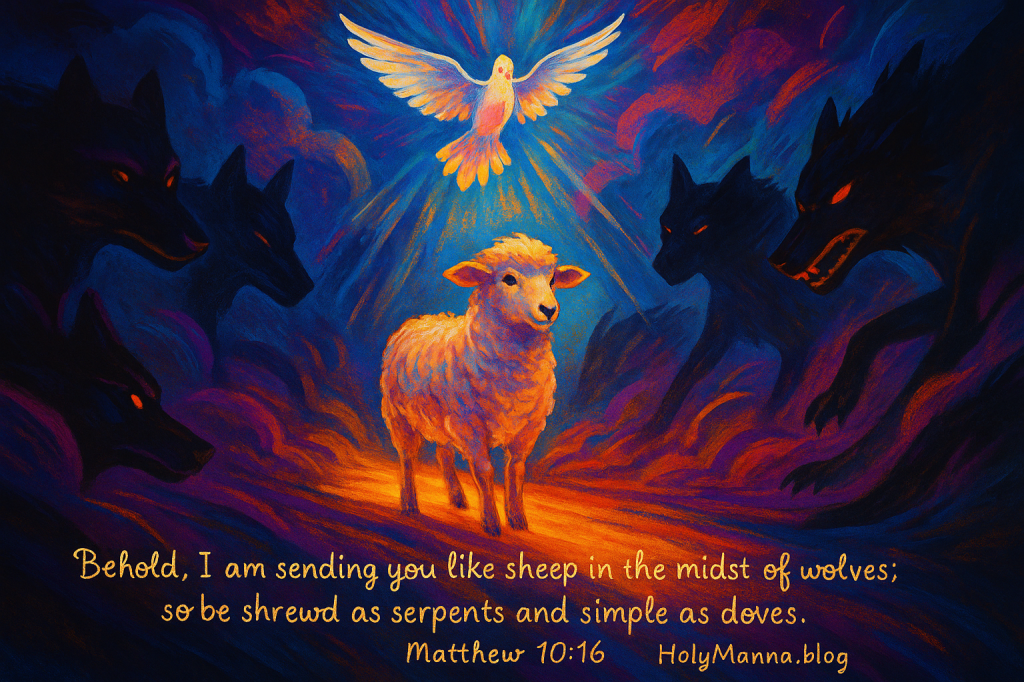
Coming Persecutions. 16 “Behold, I am sending you like sheep in the midst of wolves; so be shrewd as serpents and simple as doves. 17 But beware of people, for they will hand you over to courts and scourge you in their synagogues, 18 and you will be led before governors and kings for my sake as a witness before them and the pagans. 19 When they hand you over, do not worry about how you are to speak or what you are to say. You will be given at that moment what you are to say. 20 For it will not be you who speak but the Spirit of your Father speaking through you. 21 Brother will hand over brother to death, and the father his child; children will rise up against parents and have them put to death. 22 You will be hated by all because of my name, but whoever endures to the end will be saved. 23 When they persecute you in one town, flee to another. Amen, I say to you, you will not finish the towns of Israel before the Son of Man comes.
Detailed Exegesis
Verse 16 – “Behold, I am sending you like sheep in the midst of wolves; so be shrewd as serpents and simple as doves.”
This striking metaphor captures the vulnerability of the missionary disciple. Sheep are defenseless, while wolves symbolize those who seek to devour the truth. Jesus doesn’t promise protection from danger, but wisdom for navigating it. The balance of “shrewd as serpents” and “simple as doves” speaks to the need for both practical prudence and moral innocence—a call echoed in Romans 16:19, where Paul urges believers to be “wise as to what is good and innocent as to what is evil.”
Verse 17 – “But beware of people, for they will hand you over to courts and scourge you in their synagogues.”
Here, Jesus prepares His disciples for religious persecution. The synagogues were not only places of worship but also centers of local legal authority. Scourging was a brutal punishment. Christ is clear: this mission will cost them socially, religiously, and physically.
Verse 18 – “And you will be led before governors and kings for my sake as a witness before them and the pagans.”
This verse expands the scope to civil persecution. Apostolic witness will reach political leaders and Gentiles alike. What appears as disgrace will, in God’s hands, become a platform for testimony. This is fulfilled in the Acts of the Apostles—especially in Paul’s appearances before Roman officials.
Verse 19 – “When they hand you over, do not worry about how you are to speak or what you are to say. You will be given at that moment what you are to say.”
Jesus reassures them not with escape, but with divine assistance. The stress of persecution will be met with supernatural clarity. The faithful need not script their defense; the Spirit will provide words at the exact moment they are needed.
Verse 20 – “For it will not be you who speak but the Spirit of your Father speaking through you.”
This is one of the most powerful promises in the Gospel. The Holy Spirit, referred to here as “the Spirit of your Father,” not only accompanies but speaks through the believer. It affirms the Trinitarian reality of mission—those sent by the Son are empowered by the Spirit and protected by the Father.
Verse 21 – “Brother will hand over brother to death, and the father his child; children will rise up against parents and have them put to death.”
Jesus reveals the deep relational cost of discipleship. Loyalty to Christ will divide even the closest human bonds. This isn’t a call to abandon family, but a realistic preparation for the betrayal that can arise when truth confronts hardened hearts.
Verse 22 – “You will be hated by all because of my name, but whoever endures to the end will be saved.”
Hatred for the name of Jesus is not new. This verse reminds us that persecution is not failure—it is a mark of authenticity. Endurance is not optional; it is salvific. Salvation is promised not to the comfortable, but to the faithful.
Verse 23 – “When they persecute you in one town, flee to another. Amen, I say to you, you will not finish the towns of Israel before the Son of Man comes.”
Jesus counsels prudence in persecution—flight is not cowardice when it serves the mission. The final phrase, “before the Son of Man comes,” has been variously interpreted as a reference to the Resurrection, the destruction of Jerusalem, or the Second Coming. In all cases, it underscores urgency: time is short, and the mission is vast.
Teachings
The Catechism of the Catholic Church directly affirms the reality of persecution as a normal part of Christian life. “The Church… will enter the glory of the kingdom only through this final Passover, when she will follow her Lord in his death and Resurrection” (CCC 677). While this speaks of the Church as a whole, the same pattern applies to each believer. We are called to follow Christ not just in word, but in the cross, trusting that resurrection awaits on the other side.
Saint Cyprian of Carthage, writing during a time of Roman persecution, once proclaimed: “None of us is greater than our Master. If He was persecuted, we also must be ready to face persecution, for the name of Christ is a sword that divides.” These words mirror the truth of Matthew 10—that fidelity to Christ will necessarily invite conflict, but it also opens the door to deep union with God.
The early Church Fathers taught that martyrdom is the highest form of witness. But today’s Gospel also reminds us that not all persecution ends in martyrdom—some endure exile, slander, estrangement. The Spirit’s presence amid these trials fulfills what Jesus promised: that God is not absent in suffering. Rather, He is speaking through it. Every generation of Christians must reclaim this Gospel courage—not for self-defense, but for the sake of proclaiming Christ crucified and risen.
Reflection
In a world that often promotes comfort, self-preservation, and approval, Jesus’ words in Matthew 10 are radical and unsettling. Are we willing to be hated for His name? Are we prepared to speak when the Spirit prompts us, even if it costs us friendships, jobs, or peace of mind? This Gospel challenges us to reorient our expectations of the Christian life—not as a path of ease, but of witness. It does not glorify suffering for its own sake, but it does tell us to expect it. Today, ask the Holy Spirit to make you both shrewd and simple—to navigate opposition with the wisdom of serpents and the purity of doves. Where is He sending you as a sheep among wolves? Where are you being called to speak with courage, even if your voice shakes? Christ’s promise remains: “It will not be you who speak, but the Spirit of your Father speaking through you.” May we be bold enough to let Him speak.
Into Egypt, Into the Fire, But Never Alone
Today’s readings form a powerful mosaic of trust, perseverance, and divine presence. In Genesis, we see Jacob—a weary patriarch—leaving his homeland in obedience to God’s voice, stepping into Egypt not with fear, but with the assurance that “I will go down to Egypt with you.” In Psalm 37, the song of the righteous rises: those who trust in the Lord, who do good even when the world seems broken, will not be forsaken. And in Matthew’s Gospel, Jesus speaks with fierce honesty and unshakable tenderness, telling His disciples that persecution is coming, but so is the Spirit of the Father, who will speak through them and carry them through.
These are not disconnected themes—they are a unified invitation. To follow God is to journey into places we didn’t choose, to face opposition we didn’t expect, and to embrace courage we didn’t think we had. But through it all, the message is clear: You are not alone. Whether you are crossing into your own Egypt, navigating a famine of peace, or standing as a witness among wolves, God is with you. His providence does not fail. His Spirit does not remain silent. His promises do not return empty.
So today, ask yourself: Where am I being called to deeper trust? Where am I tempted to fear or compromise? Then remember: “Whoever endures to the end will be saved.” The same God who guided Jacob, satisfied the righteous, and spoke through the apostles now dwells within you. Step forward boldly. Be shrewd and gentle. Delight in the Lord. And walk into the unknown with confidence—for the God of your Father goes with you.
Engage with Us!
We’d love to hear how today’s readings are speaking to your heart. What stood out to you? How is God inviting you to trust Him more deeply in your current season of life? Share your reflections in the comments below and join us in building a prayerful, faithful community rooted in Scripture and the love of Christ.
Reflection Questions:
First Reading – Genesis 46:1–7, 28–30
What “Egypt” is God asking you to journey into right now? Are there areas where you need to trust His presence, even when the path feels uncertain?
Responsorial Psalm – Psalm 37:3–4, 18–19, 27–28, 39–40
Where do you need to choose trust over worry today? What does it mean for you personally to “delight in the Lord”?
Holy Gospel – Matthew 10:16–23
How are you being called to witness courageously for Christ? What helps you remain faithful when facing opposition or spiritual struggle?
May today’s Word stir courage within you, deepen your trust in God’s providence, and strengthen your love for Him. Let us go forth and live every moment with the faith, hope, and mercy that Jesus not only taught us—but embodied for us.
Follow us on Instagram and Facebook for more insights and reflections on living a faith-filled life.

 Holy Manna!
Leave a comment