The Bamboo of Vietnam’s Church
Saint Peter Tu is one of the hidden gems of the Catholic Church—one of the faithful whose lives might be little known but whose witness is unshakably strong. Canonized as one of the 117 Vietnamese Martyrs by Pope Saint John Paul II in 1988, Peter Tu’s life is a testimony to the quiet but powerful courage of ordinary laypeople. He was not a priest, bishop, or famous theologian. He was a catechist—a lay teacher of the faith—who lived in a time and place where proclaiming Christ meant certain persecution. But he chose Jesus anyway. He taught the faith in secret, knowing full well that it could cost him everything. And in the end, it did. Yet his martyrdom became a seed, planted deep in the soil of Vietnam, which would blossom into a harvest of faithful Christians. Like bamboo—flexible, enduring, and rooted—Peter Tu’s witness bends under pressure but never breaks.
The Humble Path to Heaven
Though much about Peter Tu’s early life is lost to history, what remains is sacred. Born in 19th-century Vietnam during a time of violent anti-Christian sentiment, he came of age in a culture that treated Catholicism as subversive and dangerous. The ruling Nguyen Dynasty, particularly under Emperor Tu Duc, viewed the faith as a foreign threat tied to French colonialism. Thousands of Christians were arrested, tortured, and killed simply for professing the name of Christ.
In this storm, Peter Tu quietly embraced his role as a catechist. His mission was not glamorous. He was responsible for preparing children and adults for baptism, teaching them about the Sacraments, and helping to sustain the faith of local Christian communities—especially in areas where priests had to operate in hiding. To be a catechist under persecution meant constant danger. One never knew when an informant might report you, when soldiers might show up at your door, or when your very presence at a Christian gathering could lead to arrest. But Peter Tu did not waiver. He kept teaching. He kept loving. He kept serving. He understood, deeply, what Saint Paul meant when he wrote, “For me, to live is Christ and to die is gain” (Philippians 1:21).
His courage wasn’t the kind that seeks applause. It was the kind that takes root in silence, in small acts of fidelity, in daily obedience to God. And it was precisely this kind of faith that God used to water His Church in Vietnam.
The Quiet Wonder
Unlike many canonized saints who are surrounded by legends of healing, bilocation, or prophecy, there are no widely recorded miracles attributed to Saint Peter Tu during his life. But that does not mean his life was without the miraculous. His very vocation was a miracle—a man continuing to evangelize under threat of death, driven not by fear but by love.
Every soul he taught, every catechumen he prepared, every hidden Mass he helped arrange was an act of divine grace. In times of persecution, the Church survives not only because of heroic bishops or dramatic interventions, but because of the everyday faithfulness of saints like Peter Tu. His miracles were acts of enduring love, forged in the furnace of suffering. His perseverance was not natural—it was supernatural. To live in such danger and still serve others requires a heart utterly surrendered to Christ.
The Church teaches that “the saints have always been the source and origin of renewal in the most difficult moments in the Church’s history” (CCC 828). Saint Peter Tu was precisely this—a quiet source of renewal in the midst of fear and bloodshed. His simple yes to God allowed others to know the Gospel. That is a miracle we should never underestimate.
The Final Trial
Peter Tu’s life ended the way many saints’ lives do: with a choice. When he was finally discovered and arrested by the imperial authorities, he was given the opportunity to save his life. All he had to do was renounce the faith. All he had to do was trample on the cross—literally. This was a common test devised by persecutors. A crucifix would be laid on the ground, and the accused would be ordered to step on it as a sign of apostasy. For many, this act—seemingly simple and small—was too much. It carried spiritual weight. It echoed Judas’s kiss. And Peter Tu would not do it.
He refused to betray the One who had laid down His life for him. “He who denies me before others, I will deny before my heavenly Father,” Jesus warned in Matthew 10:33. Peter Tu took this teaching to heart. In the face of physical torment and the promise of death, he remained faithful.
Tradition holds that he was executed by beheading or strangulation—brutal methods that were designed to instill fear. But instead of extinguishing the flame of the faith, his death became a torch. His martyrdom was not in vain. Like the grain of wheat that falls and dies to bear fruit (cf. John 12:24), his sacrifice became nourishment for a growing Church in Vietnam. He died not in despair, but in hope—hope in the resurrection, hope in Christ’s victory, hope that the faith he taught would endure long after his final breath.
Echoes Beyond the Grave
Though Saint Peter Tu does not have a list of canonized miracles attributed to him after death, his legacy is far from silent. Alongside his fellow Vietnamese martyrs, he has inspired a spiritual revival among Vietnamese Catholics both in their homeland and abroad. His memory is honored in churches, schools, and communities that bear the name of the 117 Martyrs of Vietnam, a testimony to the power of their sacrifice.
His relics, likely preserved in conjunction with other martyr saints, are venerated in shrines and churches where the faithful seek courage, healing, and strength. Many Vietnamese Catholics today credit the intercession of these martyrs with the survival and flourishing of their faith—especially during years of Communist suppression in the 20th century.
When Pope John Paul II canonized Peter Tu and his companions in 1988, he declared, “The blood of the martyrs is the seed of the Church.” Their witness continues to echo through history, offering encouragement to all who suffer for their faith. In Saint Peter Tu’s name, many continue to find the grace to persevere.
Lessons in Hidden Heroism
Saint Peter Tu challenges us to rethink what heroism looks like in the Christian life. He wasn’t a loud preacher. He wasn’t a miracle worker. He didn’t write theological treatises or command armies of followers. He was a catechist. A teacher. A servant. A man who, when faced with death, chose Christ.
We live in an age where our faith may not always cost us our lives—but it may cost us our reputation, our opportunities, or our comfort. How often do we hide our beliefs to avoid awkward conversations? How many times do we step around the truth so we won’t offend? Peter Tu calls us to more. He calls us to love the truth enough to suffer for it.
He also reminds us that laypeople are not second-tier disciples. The Church’s mission belongs to all the baptized. The Catechism teaches that “the laity… are made sharers in the priestly, prophetical, and kingly functions of Christ” (CCC 873). Peter Tu lived this truth. So can we.
Let us begin today. Let us teach our children, mentor our friends, and witness to our co-workers. Let us find the courage to say “I belong to Christ” in a world that offers many easier roads. And when we feel small, let us remember Saint Peter Tu. His quiet strength still moves mountains.
Engage with Us!
We’d love to hear from you. What part of Saint Peter Tu’s story moves you the most? How can we support one another as we strive to live holy, courageous lives in our modern world?
Reflection Questions:
- In what ways do I face pressure to compromise my faith in daily life? How can I respond like Saint Peter Tu?
- Do I see myself as a catechist to those around me—teaching through word and example?
- How can I grow in quiet, steadfast courage when my beliefs are challenged or mocked?
Let’s continue to encourage one another to be bold in love, unwavering in truth, and radiant with hope. Like Saint Peter Tu, may we live and die proclaiming: “Jesus Christ is Lord!”
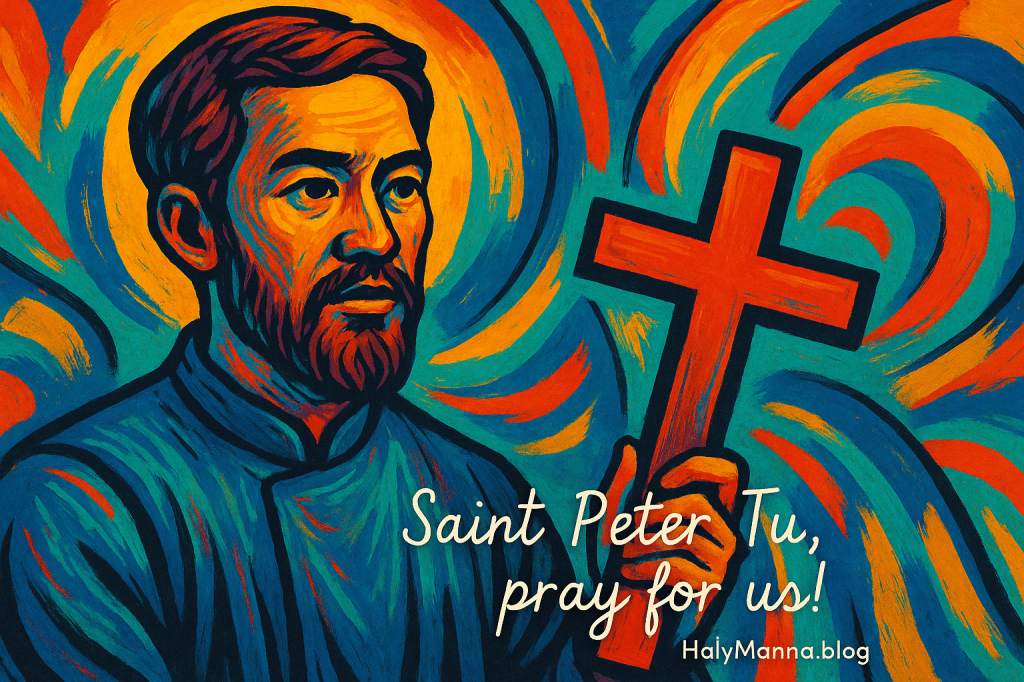
Saint Peter Tu, pray for us! ✝️
Follow us on Instagram and Facebook for more insights and reflections on living a faith-filled life.

 Holy Manna!
Leave a comment