Thursday of the Fourteenth Week in Ordinary Time – Lectionary: 386
Sent Ahead for a Greater Purpose
Have you ever looked back on a painful chapter in your life and suddenly seen God’s fingerprints all over it? Today’s readings invite us into the mystery of divine providence—a theme that is both humbling and empowering. Through betrayal, exile, poverty, or rejection, God’s hand continues to guide, heal, and commission. When we surrender our own understanding and let the Lord write our story, even our wounds can become instruments of salvation.
In Genesis 44–45, we witness one of the most moving moments in the Old Testament: Joseph revealing his identity to the very brothers who sold him into slavery. But instead of condemning them, he says with tears, “It was really for the sake of saving lives that God sent me here ahead of you” (Genesis 45:5). This is not just family drama—it’s a lesson in mercy and mission. Joseph’s story becomes a foreshadowing of Christ, who was also betrayed, abandoned, and sent ahead of us—not to condemn, but to redeem. This thread continues in Psalm 105, where Joseph’s suffering is not erased but reinterpreted as part of God’s plan to save nations: “He had sent a man ahead of them, Joseph, sold as a slave” (Psalm 105:17). Suffering, in God’s hands, is never wasted.
Then, in The Gospel of Matthew, Jesus sends out His disciples with a similar mission: to bring healing, peace, and proclamation to a broken world. Like Joseph, they are to go ahead, bearing nothing but trust in God. They are warned they will be rejected, but also reminded of their authority and purpose: “Without cost you have received; without cost you are to give” (Matthew 10:8). Just as Joseph was placed in Egypt to feed the hungry during famine, so too are the apostles sent to feed souls with the Good News. Taken together, these readings remind us that God often places us in unexpected, uncomfortable places—not to punish us, but to prepare us to become vessels of mercy for others. Where in your life might God be sending you ahead for a greater purpose?
First Reading – Genesis 44:18–21, 23–29; 45:1–5
Mercy in the Midst of Betrayal
The Book of Genesis, the first book of the Bible, is not only a foundational narrative of creation and covenant—it is also a profoundly human story of family, sin, suffering, and redemption. Today’s passage is drawn from the final arc of Genesis, which tells the dramatic and emotional story of Joseph, the son of Jacob, who was sold into slavery by his jealous brothers but eventually rose to become the second most powerful man in Egypt. This section of Genesis was likely compiled during or after the Babylonian exile, a time when themes of displacement, restoration, and forgiveness would have deeply resonated with the people of Israel. Today’s reading focuses on the moment Joseph, now in a position of great authority, chooses reconciliation over revenge. In light of the broader theme of God’s providence, this moment reveals a truth at the heart of salvation history: God can use even betrayal to bring about healing. Joseph becomes a type of Christ—sent ahead to save his people, rejected by his own, yet forgiving them with merciful love.
Genesis 44:18-21, 23-29; 45:1-5
New American Bible (Revised Edition)
44:18 Judah then stepped up to him and said: “I beg you, my lord, let your servant appeal to my lord, and do not become angry with your servant, for you are the equal of Pharaoh. 19 My lord asked his servants, ‘Have you a father, or another brother?’ 20 So we said to my lord, ‘We have an aged father, and a younger brother, the child of his old age. This one’s full brother is dead, and since he is the only one by his mother who is left, his father is devoted to him.’ 21 Then you told your servants, ‘Bring him down to me that I might see him.’
23 But you told your servants, ‘Unless your youngest brother comes down with you, you shall not see me again.’ 24 When we returned to your servant my father, we reported to him the words of my lord.
25 “Later, our father said, ‘Go back and buy some food for us.’ 26 So we reminded him, ‘We cannot go down there; only if our youngest brother is with us can we go, for we may not see the man if our youngest brother is not with us.’ 27 Then your servant my father said to us, ‘As you know, my wife bore me two sons. 28 One of them, however, has gone away from me, and I said, “He must have been torn to pieces by wild beasts!” I have not seen him since. 29 If you take this one away from me too, and a disaster befalls him, you will send my white head down to Sheol in grief.’
The Truth Revealed. 45:1 Joseph could no longer restrain himself in the presence of all his attendants, so he cried out, “Have everyone withdraw from me!” So no one attended him when he made himself known to his brothers. 2 But his sobs were so loud that the Egyptians heard him, and so the news reached Pharaoh’s house. 3 “I am Joseph,” he said to his brothers. “Is my father still alive?” But his brothers could give him no answer, so dumbfounded were they at him.
4 “Come closer to me,” Joseph told his brothers. When they had done so, he said: “I am your brother Joseph, whom you sold into Egypt. 5 But now do not be distressed, and do not be angry with yourselves for having sold me here. It was really for the sake of saving lives that God sent me here ahead of you.
Detailed Exegesis
Verse 18 – “Judah then stepped up to him and said: ‘I beg you, my lord, let your servant appeal to my lord, and do not become angry with your servant, for you are the equal of Pharaoh.’”
Judah, once a willing participant in Joseph’s betrayal, now emerges as a transformed man, interceding for his family. His respectful tone toward Joseph—unaware of his true identity—reflects both humility and desperation. This foreshadows Judah’s eventual role as the ancestor of King David and, ultimately, of Christ, the true King.
Verse 19 – “My lord asked his servants, ‘Have you a father, or another brother?’”
This recalls Joseph’s earlier testing of his brothers, probing their hearts to see whether they had changed. His questions are more than informational—they are spiritual tests designed to awaken conscience and bring repentance.
Verse 20 – “So we said to my lord, ‘We have an aged father, and a younger brother, the child of his old age. This one’s full brother is dead, and since he is the only one by his mother who is left, his father is devoted to him.’”
The “younger brother” is Benjamin, Joseph’s only full sibling. The mention of Jacob’s devotion to Benjamin stirs both sorrow and empathy in Joseph’s heart. The pain of his father’s loss is echoed in the family’s language, showing their awareness of the consequences of their past.
Verse 21 – “Then you told your servants, ‘Bring him down to me that I might see him.’”
Joseph’s command was a critical moment that put his brothers to the test. Would they protect Benjamin or sacrifice him as they once did Joseph? This verse sets up the climax of their moral development.
Verse 23 – “But you told your servants, ‘Unless your youngest brother comes down with you, you shall not see me again.’”
Joseph enforces a non-negotiable condition. Like God who waits for true contrition, Joseph awaits the full circle of repentance and transformation in his brothers.
Verse 24 – “When we returned to your servant my father, we reported to him the words of my lord.”
The brothers’ obedience marks a shift from their earlier deceit when they covered up Joseph’s disappearance. Honesty now begins to take root.
Verse 25 – “Later, our father said, ‘Go back and buy some food for us.’”
Famine, a constant biblical symbol of both physical and spiritual hunger, drives the narrative. God often uses need to draw people back into communion.
Verse 26 – “So we reminded him, ‘We cannot go down there; only if our youngest brother is with us can we go, for we may not see the man if our youngest brother is not with us.’”
Their insistence on bringing Benjamin shows growing unity and fidelity to their father’s wishes—another sign of their maturing conscience.
Verse 27 – “Then your servant my father said to us, ‘As you know, my wife bore me two sons.’”
Jacob’s reference to Rachel and her two sons—Joseph and Benjamin—reinforces the deep grief that has shaped this family’s story.
Verse 28 – “One of them, however, has gone away from me, and I said, ‘He must have been torn to pieces by wild beasts!’ I have not seen him since.”
Jacob’s grief is raw and unresolved. The irony is profound: the very man he mourns is standing in front of them, about to reveal himself.
Verse 29 – “If you take this one away from me too, and a disaster befalls him, you will send my white head down to Sheol in grief.”
Jacob’s words express a father’s fragile hope and unbearable sorrow. “Sheol” here denotes the realm of the dead, showing how trauma has nearly crushed his spirit.
Verse 1 – “Joseph could no longer restrain himself in the presence of all his attendants, so he cried out, ‘Have everyone withdraw from me!’ So no one attended him when he made himself known to his brothers.”
Joseph’s emotional control breaks. This moment is deeply personal—reconciliation must happen in intimacy, not spectacle. It echoes God’s own desire to meet us in the quiet of our hearts.
Verse 2 – “But his sobs were so loud that the Egyptians heard him, and so the news reached Pharaoh’s house.”
Joseph’s vulnerability, though private in intention, becomes publicly known. Redemption has ripple effects; what God heals in secret transforms communities.
Verse 3 – “I am Joseph,” he said to his brothers. “Is my father still alive?” But his brothers could give him no answer, so dumbfounded were they at him.”
The shock of this moment would have been seismic. Their sin is standing before them—not in wrath, but in weeping love.
Verse 4 – “Come closer to me,” Joseph told his brothers. When they had done so, he said: “I am your brother Joseph, whom you sold into Egypt.”
He names the wound directly—“whom you sold”—but not to condemn. True reconciliation requires truth-telling. Mercy is not denial; it is grace in full knowledge of sin.
Verse 5 – “But now do not be distressed, and do not be angry with yourselves for having sold me here. It was really for the sake of saving lives that God sent me here ahead of you.”
This verse is the heart of today’s reading. Joseph offers a divine perspective: God’s providence has the last word. What man meant for evil, God used for good.
Teachings from the Church and the Saints
The Catechism of the Catholic Church teaches us to see God’s hand in every circumstance: “God is the sovereign master of his plan. But to carry it out he also makes use of his creatures’ cooperation… God grants his creatures the dignity of acting on their own and of being causes and principles for each other” (CCC 306). Joseph’s story perfectly illustrates this dynamic cooperation—human freedom misused, yet ultimately redeemed by divine providence.
St. John Chrysostom, reflecting on Joseph, wrote, “Though you see wicked men prospering, do not be amazed. God permits it for his own purposes… Consider Joseph. He was sold, yet became king; he was accused, yet proved innocent; he was punished, yet was exalted. God turns all things to his glory.” Joseph’s journey is not only a lesson in patience but in holy detachment—trusting that God’s justice and timing are perfect.
The Church has long seen Joseph as a figure of Christ. St. Ambrose wrote: “Joseph prefigured Christ: beloved by his father, sold by his brothers, unjustly accused, and finally exalted so that he might feed the nations.” In this reading, we encounter not only a model of forgiveness but a glimpse into the divine logic of redemptive suffering—where wounds become channels of grace when united to God’s will.
Reflection: Living Mercy in the Real World
Joseph’s forgiveness wasn’t passive—it was active mercy rooted in faith. He saw beyond the betrayal to God’s larger story. In our daily lives, we often face those who hurt us, sometimes even in our own families. What would it look like to interpret our suffering not as random pain, but as part of a greater plan to bring life to others? We are called not only to forgive, but to be ministers of reconciliation—both within our homes and in the world.
Perhaps you’ve been wronged by someone and have buried the pain for years. Like Joseph, are you willing to name the wound and also speak a word of healing? Or maybe, like Judah, you’ve done wrong and now feel the weight of repentance—are you ready to step forward and intercede for others, even if it costs your pride? Today’s reading reminds us that our God is a God who redeems every broken story when we let Him.
Take some time today to reflect: Where in my life have I been “sent ahead” by God—not for my own sake, but for the sake of saving lives? Where do I need to extend or receive forgiveness? Like Joseph, may we see God’s hand not only in our triumphs but also in our trials, and trust that He truly works all things for good.
Responsorial Psalm – Psalm 105:16–21
Chains and Crowns: From Slavery to Stewardship
Psalm 105 is a historical psalm, recounting God’s covenantal faithfulness throughout Israel’s story. It was likely used in communal worship to help the people remember God’s mighty deeds and mercy across generations. This portion of the psalm recalls the life of Joseph and situates his personal trials within the larger story of salvation. While Genesis tells the emotional and familial side of Joseph’s journey, Psalm 105 proclaims its theological significance: God was always at work, orchestrating deliverance long before Israel knew it needed saving. This psalm fits seamlessly into today’s overarching theme of divine providence and redemptive suffering. Joseph’s chains were not the end—they were the means by which God would raise him up to preserve life. In every generation, the Church continues to proclaim that God is faithful, even when His purposes remain hidden in mystery.
Psalm 105:16-21
New American Bible (Revised Edition)
16 Then he called down a famine on the land,
destroyed the grain that sustained them.
17 He had sent a man ahead of them,
Joseph, sold as a slave.
18 They shackled his feet with chains;
collared his neck in iron,
19 Till his prediction came to pass,
and the word of the Lord proved him true.
20 The king sent and released him;
the ruler of peoples set him free.
21 He made him lord over his household,
ruler over all his possessions,
Detailed Exegesis
Verse 16 – “Then he called down a famine on the land, destroyed the grain that sustained them.”
This verse reminds us that even calamities are not beyond God’s control. The famine that led Jacob’s sons to Egypt was not random; it was allowed by God to set in motion a plan of reunion and redemption. In the biblical mindset, nothing escapes divine providence—not even suffering.
Verse 17 – “He had sent a man ahead of them, Joseph, sold as a slave.”
This is the interpretive key to Joseph’s entire story. What his brothers meant for evil, God used for good. Joseph’s slavery was not divine neglect but divine design. He was “sent ahead” like a prophet or a forerunner—prefiguring Christ, who would also be betrayed and suffer for the sake of saving His people.
Verse 18 – “They shackled his feet with chains; collared his neck in iron.”
This powerful imagery underscores the humiliation Joseph endured. His physical bondage represents the weight of injustice and the silence of God’s hidden plan. Like many of the saints, Joseph experienced the crucible of trial before the crown of glory.
Verse 19 – “Till his prediction came to pass, and the word of the Lord proved him true.”
Joseph’s dreams, once mocked and misunderstood, are vindicated. God’s word is always faithful, even if it takes time to unfold. This verse speaks to the importance of perseverance in hope. God’s promises are not always immediate—but they are always sure.
Verse 20 – “The king sent and released him; the ruler of peoples set him free.”
Here, divine providence and human authority intersect. Joseph is lifted from the pit to the palace—not by chance, but by God’s orchestration through Pharaoh’s decree. Liberation, when it comes, often arrives through unexpected agents.
Verse 21 – “He made him lord over his household, ruler over all his possessions.”
Joseph’s stewardship echoes the original vocation given to Adam—to rule in service. His exaltation mirrors Christ’s: from suffering servant to King. This verse completes the arc of reversal—God raises the lowly and exalts the faithful.
Teachings from the Church and the Saints
The Catechism of the Catholic Church reminds us that suffering and God’s providence are not opposed: “God is in no way—directly or indirectly—the cause of moral evil. He permits it, however, because he respects the freedom of his creatures and, mysteriously, knows how to derive good from it” (CCC 311). Joseph’s story is a living witness to this mystery. He was wronged, enslaved, and forgotten—but never abandoned by God. His life teaches us how God can turn injustice into grace without ever willing the sin that caused it.
St. Teresa of Ávila once wrote, “God writes straight with crooked lines.” Her words mirror today’s psalm, where the painful detours of Joseph’s life lead straight to God’s purposes. Just as Psalm 105 recounts God’s fidelity to Israel through Joseph’s suffering, Teresa invites us to trust that even our detours are not outside of God’s loving design.
Finally, the Church has always held the Psalms as the heartbeat of prayer. Psalm 105 is a call to remember. St. Augustine teaches that memory is the foundation of hope: “Let us remember what He has done for us, so that we do not doubt what He will do for us.” By meditating on Joseph’s story, we fortify our trust in God’s ability to redeem our own. The Psalms are not just songs—they are testimonies that echo in our own suffering and salvation.
Reflection: Remembering the Faithfulness of God
Psalm 105 challenges us to interpret our lives in light of God’s history, not just our feelings. Like Joseph, we may be walking through seasons of confinement—situations that feel like chains around our feet. Do we believe that God can bring glory out of our limitations? Do we trust that He has sent us ahead, even if we don’t yet know the purpose? This psalm reminds us that when everything seems lost, God may be writing the most meaningful part of our story.
As modern disciples, we are often tempted to see only the broken fragments of our lives. Psalm 105 invites us to zoom out and remember: God has always been faithful. In times of discouragement or delay, are we willing to be like Joseph—silent, faithful, hopeful—until the word of the Lord proves us true? Take time today to remember what God has already done for you, and let that memory anchor you in trust for what He has yet to do. Like Joseph, may we endure the chains with grace and rejoice when He lifts us up to serve.
Holy Gospel – Matthew 10:7–15
Sent to Serve, Not to Be Served
The Gospel of Matthew was written primarily for a Jewish-Christian audience, bridging the Old Covenant with the New and presenting Jesus as the fulfillment of the Law and the Prophets. Chapter 10 contains the “Mission Discourse,” where Jesus sends out the Twelve Apostles for the first time to minister publicly in His name. This commission is deeply rooted in the prophetic tradition, recalling the way prophets were often sent by God to preach repentance and prepare His people. Jesus’ instructions to His apostles in this passage are strikingly austere—they are to travel light, depend on the generosity of strangers, and accept the reality of rejection. This Gospel reading fits beautifully into today’s theme of providence and mission: just as Joseph was sent ahead to prepare for his family’s salvation, the apostles are sent out ahead of Christ’s own Passion to prepare the way for the Kingdom. They are not self-appointed, but divinely commissioned to bring life, healing, and truth.
Matthew 10:7-15
New American Bible (Revised Edition)
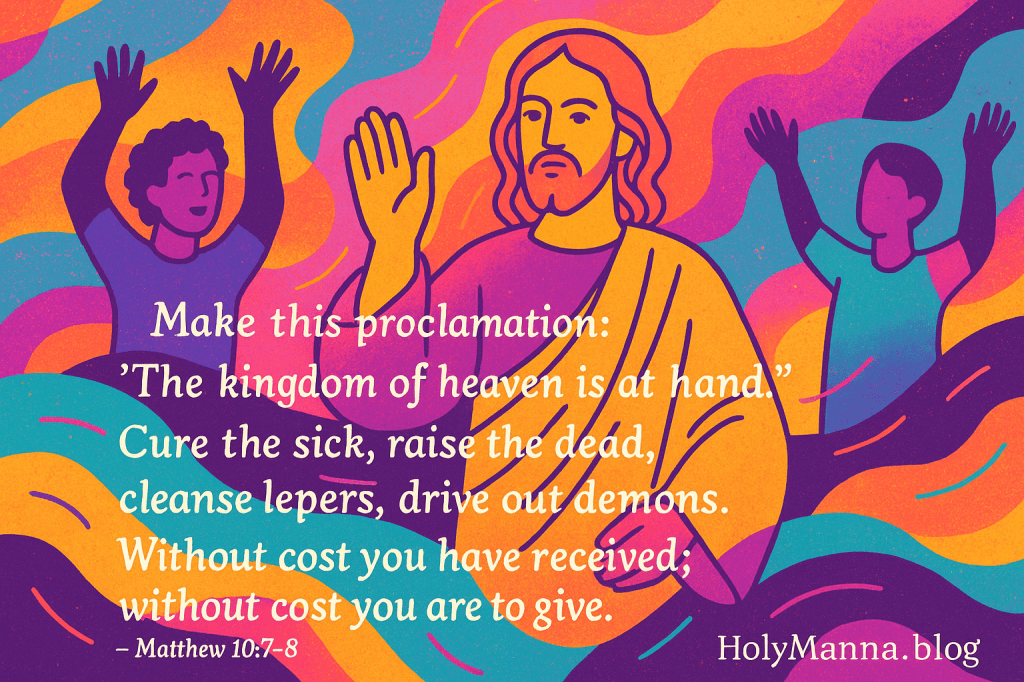
7 As you go, make this proclamation: ‘The kingdom of heaven is at hand.’ 8 Cure the sick, raise the dead, cleanse lepers, drive out demons. Without cost you have received; without cost you are to give. 9 Do not take gold or silver or copper for your belts; 10 no sack for the journey, or a second tunic, or sandals, or walking stick. The laborer deserves his keep. 11 Whatever town or village you enter, look for a worthy person in it, and stay there until you leave. 12 As you enter a house, wish it peace. 13 If the house is worthy, let your peace come upon it; if not, let your peace return to you. 14 Whoever will not receive you or listen to your words—go outside that house or town and shake the dust from your feet. 15 Amen, I say to you, it will be more tolerable for the land of Sodom and Gomorrah on the day of judgment than for that town.
Detailed Exegesis
Verse 7 – “As you go, make this proclamation: ‘The kingdom of heaven is at hand.’”
This message is not optional—it is central. The Kingdom of heaven refers to God’s reign breaking into the world through Jesus Christ. The apostles are to declare this boldly, echoing the message of John the Baptist and of Jesus Himself. They are announcing a new reality that demands a response.
Verse 8 – “Cure the sick, raise the dead, cleanse lepers, drive out demons. Without cost you have received; without cost you are to give.”
Jesus gives them real spiritual authority, linking proclamation with action. The signs of the Kingdom are not abstract—they are concrete works of mercy and power. The final command emphasizes that their authority is a gift. They must give freely, just as they have freely received, avoiding any temptation to profit from the Gospel.
Verse 9 – “Do not take gold or silver or copper for your belts.”
This instruction reflects total dependence on divine providence. By leaving behind money, they rely fully on God and on the hospitality of those who will receive the message. Their poverty is not punishment but prophetic: it reveals that their treasure is in heaven.
Verse 10 – “No sack for the journey, or a second tunic, or sandals, or walking stick. The laborer deserves his keep.”
Even the most basic provisions are to be left behind. This radical simplicity ensures that nothing distracts from the mission. At the same time, Jesus affirms that those who work for the Gospel have the right to receive care from the community—foreshadowing the Church’s later teaching on just wages for ministers of the Word.
Verse 11 – “Whatever town or village you enter, look for a worthy person in it, and stay there until you leave.”
The apostles are to be selective about where they stay—not seeking comfort, but a worthy host. This strategy helps prevent the temptation to shop around for better accommodations and encourages constancy and humility in mission.
Verse 12 – “As you enter a house, wish it peace.”
This greeting of peace is not merely polite—it is sacramental. The apostles carry the peace of Christ Himself, and their blessing can bring grace to a household. The Greek word for peace here, eirēnē, connotes wholeness and reconciliation.
Verse 13 – “If the house is worthy, let your peace come upon it; if not, let your peace return to you.”
This verse reinforces the spiritual weight of their blessing. The apostles are not responsible for whether people receive it, but they are responsible for offering it. The peace of Christ is never wasted—it either takes root or returns to the giver.
Verse 14 – “Whoever will not receive you or listen to your words—go outside that house or town and shake the dust from your feet.”
Shaking the dust is a symbolic act of judgment and separation, common in Jewish tradition. It signals that the hearers are rejecting not just the messenger but the message. The apostles must move on without bitterness, entrusting those who reject them to God’s justice.
Verse 15 – “Amen, I say to you, it will be more tolerable for the land of Sodom and Gomorrah on the day of judgment than for that town.”
This is a sobering warning. To reject the apostles is to reject Christ, and the consequences are grave. Sodom and Gomorrah were infamous for their sin and destruction, yet Jesus says those who reject the Gospel face even greater accountability because they have encountered the fullness of truth.
Teachings from the Church and the Saints
The Catechism of the Catholic Church speaks directly to the missionary nature of the Church: “The duty of Christians to take part in the life of the Church impels them to apostolic action… The laity fulfill their prophetic mission by evangelization, that is, the proclamation of Christ by word and the testimony of life” (CCC 905). The Gospel reading is not just for clergy—it is a call for every baptized person to live out their vocation as a witness to the Kingdom.
St. Gregory the Great wrote beautifully on apostolic poverty and mission: “Let the preacher’s life harmonize with his speech, so that when he enjoins his hearers to do right, he himself also shows them by his own example how they may do what he urges” (Homilies on the Gospels). The apostles’ lack of material provisions is not recklessness—it is their sermon. Their lives embody the urgency, generosity, and radical dependence the Kingdom demands.
The Church has always taught that rejection is part of authentic mission. St. Francis of Assisi sent his friars with these same Gospel instructions, urging them to bring peace wherever they went and to rejoice when they were misunderstood. The Apostolic mission is marked not only by fruitfulness but also by suffering. As Pope Francis said, “The Church grows not through proselytism, but through attraction—through witness” (Evangelii Gaudium, 14). The witness Jesus sends us to give may not always be accepted, but it will never be wasted.
Reflection: Trusting the Mission, Trusting the Sender
This Gospel is a challenge to every disciple: What have I received freely from the Lord, and how am I giving it away without cost? We are often tempted to hold onto our gifts, to wait for the right moment, or to worry about how we’ll be received. But Jesus tells us to go—now, with little, trusting in His providence and peace. Where is God asking you to step forward in faith, even if you feel under-equipped?
You don’t have to be a theologian to proclaim the Kingdom. You just have to be willing. The call is simple: bring healing, offer peace, and proclaim that the Kingdom of heaven is near. Are you living like someone who believes the Kingdom is at hand? Or have you grown comfortable, forgetting that we are all sent? Let this Gospel renew your courage to go out, to love boldly, and to leave the rest in God’s hands. Like Joseph before us, and the apostles after him, we are sent ahead—not for ourselves, but for the sake of saving lives.
Trusting the God Who Sends
Today’s readings carry us through the winding roads of human pain, providence, and mission. We began in Genesis with Joseph, a man betrayed by his own brothers, who could look back on his suffering and declare, “It was really for the sake of saving lives that God sent me here ahead of you” (Genesis 45:5). His story reveals that no wound is wasted in God’s hands. Even the most broken chapters of our lives can become the birthplace of mercy and salvation when we entrust them to Him.
In Psalm 105, we sang of God’s fidelity in the face of trial, proclaiming how He “sent a man ahead of them, Joseph, sold as a slave” (Psalm 105:17), only to raise him up to rule and save. This sacred memory strengthens us to believe that God remains at work even when we feel forgotten or bound in chains. His Word is faithful, and His timing is perfect.
And in The Gospel of Matthew, Jesus sends His disciples out not with riches or strategies, but with a message and a mission: “The kingdom of heaven is at hand… Without cost you have received; without cost you are to give” (Matthew 10:7–8). Like Joseph, we too are sent—often empty-handed, often unsure—but never alone. God goes before us, prepares the way, and invites us to be co-workers in His plan to heal and restore the world.
Where has God sent you ahead—into your family, your workplace, your community? How might He be using your story, even the painful parts, to bless others? Let today’s readings stir your heart to deeper trust, generous forgiveness, and fearless witness. You were not created for comfort but for mission. Step forward with courage, knowing that the same God who sent Joseph to Egypt and the apostles into the world now sends you—right where you are—to bring the light of Christ.
Engage with Us!
We’d love to hear how today’s Scriptures spoke to your heart. Share your reflections, questions, or prayers in the comments below—your insights could inspire someone else on their journey of faith. Take a moment to sit with the Word and let it speak personally to you.
Reflection Questions:
First Reading – Genesis 44:18–21, 23–29; 45:1–5
Have I ever seen how God used a painful moment in my life to bring about something good? Am I holding onto any past wounds that need to be brought into the light of God’s mercy like Joseph did?
Responsorial Psalm – Psalm 105:16–21
How can I grow in remembering God’s faithfulness in my life? Do I trust that God’s timing, though mysterious, is always perfect and full of purpose?
Holy Gospel – Matthew 10:7–15
What gifts have I received freely that I can share more generously? Where is Jesus sending me to proclaim the Kingdom—not with words only, but through love, peace, and healing?
May your heart be strengthened by God’s Word today. Walk in trust, offer forgiveness generously, and go forth with confidence in the mission He’s given you. Live boldly, love deeply, and remember that everything we do is to be done with the mercy and compassion that Jesus taught us. You were sent ahead for a reason—now go and be a light.
Follow us on Instagram and Facebook for more insights and reflections on living a faith-filled life.

 Holy Manna!
Leave a comment