Wednesday of the Fourteenth Week in Ordinary Time – Lectionary: 385
Bread for the Hungry, Hope for the Lost
There are moments in life when we are brought to our knees—by famine, fear, failure, or regret—and we’re left wondering: Where is God in all of this? Today’s readings speak directly to that ache, reminding us that God’s providence not only meets our physical needs but reaches even deeper—to restore our hearts, redeem our past, and renew our mission. Whether it’s through the wisdom of a betrayed brother in Egypt, the sacred trust placed in twelve ordinary men, or the psalmist’s declaration of divine mercy, we see a Father who always feeds His people—both body and soul.
In the first reading from Genesis, we return to the story of Joseph, once sold by his brothers into slavery, now elevated by Pharaoh to oversee Egypt’s grain during a time of global famine. The irony is heavy: the same brothers who discarded him now bow before him, desperate for food. What they intended for evil, God has woven into salvation—not just for Egypt, but for Israel. Joseph’s silent tears reveal a heart not hardened by revenge but softened by divine purpose. Psalm 33 affirms this theme of providence, proclaiming that “the eye of the Lord is upon those who fear him… to keep them alive through famine” (Ps 33:18–19). The psalmist reminds us that God’s plans are not thwarted by worldly designs—they stand forever.
Then, in The Gospel of Matthew, Jesus sends out the Twelve—not to Gentiles or Samaritans, but “to the lost sheep of the house of Israel” (Mt 10:6), those starving for truth and hope. Much like Joseph, they are entrusted with a mission to bring life during a different kind of famine—a spiritual one. And just as Pharaoh told the people, “Go to Joseph and do whatever he tells you” (Gn 41:55), we are now being told to go to Jesus and His Church, where healing and truth are freely given. These readings converge into a single call: Will you trust God to feed your soul, even when the land around you seems barren?
First Reading – Genesis 41:55–57; 42:5–7, 17–24
Providence in the Pit
The Book of Genesis is not just the beginning of creation; it is the story of how God establishes His covenant family through flawed yet faithful individuals. Today’s reading brings us to the latter part of Genesis, where Joseph, once a slave and prisoner in Egypt, has been raised by God to a position of power. Culturally and historically, Egypt was the breadbasket of the ancient world, and during this time of famine, it becomes the unlikely stage for God’s providence to unfold—not only for the Egyptians, but for the children of Israel as well. This episode falls within the great drama of salvation history, as God uses the betrayal of one brother to provide salvation for many. Joseph’s story is a type of Christ—betrayed, humbled, and then glorified to be the means of redemption. As we meditate on this passage, we are invited to recognize the mysterious yet intentional hand of God at work—even through suffering and injustice—to feed not only bodies, but hearts in need of reconciliation.
Genesis 41:55-57; 42:5-7, 17-24
New American Bible (Revised Edition)
41:55 When all the land of Egypt became hungry and the people cried to Pharaoh for food, Pharaoh said to all the Egyptians: “Go to Joseph and do whatever he tells you.” 56 When the famine had spread throughout the land, Joseph opened all the cities that had grain and rationed it to the Egyptians, since the famine had gripped the land of Egypt. 57 Indeed, the whole world came to Egypt to Joseph to buy grain, for famine had gripped the whole world.
42:5 And so the sons of Israel were among those who came to buy grain, since there was famine in the land of Canaan.
6 Joseph, as governor of the country, was the one who sold grain to all the people of the land. When Joseph’s brothers came, they bowed down to him with their faces to the ground. 7 He recognized them as soon as he saw them. But he concealed his own identity from them and spoke harshly to them. “Where do you come from?” he asked them. They answered, “From the land of Canaan, to buy food.”
17 With that, he locked them up in the guardhouse for three days.
18 On the third day Joseph said to them: “Do this, and you shall live; for I am a God-fearing man. 19 If you are honest men, let one of your brothers be confined in this prison, while the rest of you go and take home grain for your starving families. 20 But you must bring me your youngest brother. Your words will thus be verified, and you will not die.” To this they agreed. 21 To one another, however, they said: “Truly we are being punished because of our brother. We saw the anguish of his heart when he pleaded with us, yet we would not listen. That is why this anguish has now come upon us.” 22 Then Reuben responded, “Did I not tell you, ‘Do no wrong to the boy’? But you would not listen! Now comes the reckoning for his blood.” 23 They did not know, of course, that Joseph understood what they said, since he spoke with them through an interpreter. 24 But turning away from them, he wept. When he was able to speak to them again, he took Simeon from among them and bound him before their eyes.
Detailed Exegesis
Verse 55 – “When all the land of Egypt became hungry and the people cried to Pharaoh for food, Pharaoh said to all the Egyptians: ‘Go to Joseph and do whatever he tells you.’”
This verse mirrors the authority Joseph has been given as second-in-command in Egypt, pointing forward to Christ, to whom the Father says in essence: “Go to Him and do whatever He tells you.” Joseph becomes the channel of God’s providence. The hunger of the people reflects the deeper hunger of humanity—a hunger for salvation and mercy.
Verse 56 – “When the famine had spread throughout the land, Joseph opened all the cities that had grain and rationed it to the Egyptians, since the famine had gripped the land of Egypt.”
Joseph doesn’t just hoard resources—he distributes them wisely, generously, and intentionally. This verse highlights his stewardship and foresight, but more profoundly, it shows God providing through human means. It echoes the Church’s role in distributing the Bread of Life, the Eucharist, in times of spiritual famine.
Verse 57 – “Indeed, the whole world came to Egypt to Joseph to buy grain, for famine had gripped the whole world.”
This universal hunger causes all nations to turn toward Joseph, foreshadowing how all nations would one day turn toward Christ for salvation. In a world starved of truth and grace, the faithful steward becomes the lifeline.
Verse 5 – “And so the sons of Israel were among those who came to buy grain, since there was famine in the land of Canaan.”
Even the chosen people are not spared from the famine. This verse humbles any spiritual pride we may carry—being “chosen” does not mean we won’t suffer. Rather, it invites us to trust more deeply in God’s provision.
Verse 6 – “Joseph, as governor of the country, was the one who sold grain to all the people of the land. When Joseph’s brothers came, they bowed down to him with their faces to the ground.”
The fulfillment of Joseph’s earlier dream (from Genesis 37:7) comes to pass as his brothers bow before him, unaware of his identity. This is not a moment of vengeance, but of divine irony and justice. God’s dreams for us are not fantasies—they are truths that unfold in time.
Verse 7 – “He recognized them as soon as he saw them. But he concealed his own identity from them and spoke harshly to them. ‘Where do you come from?’ he asked them. They answered, ‘From the land of Canaan, to buy food.’”
Joseph’s concealment and harshness are not from resentment but serve a greater purpose. He is testing their hearts, drawing them into repentance and self-awareness. Just as God sometimes withholds immediate consolation to lead us to deeper conversion, Joseph withholds recognition.
Verse 17 – “With that, he locked them up in the guardhouse for three days.”
This confinement is symbolic. Three days echo the motif of death and resurrection found throughout Scripture—from Jonah in the belly of the whale to Christ in the tomb. It is a pause before mercy is revealed.
Verse 18 – “On the third day Joseph said to them: ‘Do this, and you shall live; for I am a God-fearing man.’”
Joseph’s declaration that he fears God reveals the guiding principle of his mercy. The fear of the Lord, far from terror, is the awe-filled respect for God’s justice and mercy. This sets the tone for the restoration that will follow.
Verse 19 – “If you are honest men, let one of your brothers be confined in this prison, while the rest of you go and take home grain for your starving families.”
Joseph’s conditions again reflect divine justice—he balances accountability with compassion. He ensures provision for the families while initiating a deeper process of healing and honesty among the brothers.
Verse 20 – “But you must bring me your youngest brother. Your words will thus be verified, and you will not die.” To this they agreed.
Joseph is drawing them to confront the past—to face the loss of their youngest brother Benjamin, whom they had likely kept guarded since Joseph’s own disappearance. This is not a demand for proof, but an invitation into truth.
Verse 21 – “To one another, however, they said: ‘Truly we are being punished because of our brother. We saw the anguish of his heart when he pleaded with us, yet we would not listen. That is why this anguish has now come upon us.’”
Their consciences are awakened. For the first time, they voice guilt over what they did to Joseph. This moment of contrition is the beginning of healing. Recognition of sin is the first step toward reconciliation with God and others.
Verse 22 – “Then Reuben responded, ‘Did I not tell you, “Do no wrong to the boy”? But you would not listen! Now comes the reckoning for his blood.’”
Reuben’s voice reveals the sorrow of one who tried to prevent the wrongdoing but was ultimately complicit. His words reflect the human tension between guilt and blame. This reckoning is not just justice—it’s the mercy of God calling them home.
Verse 23 – “They did not know, of course, that Joseph understood what they said, since he spoke with them through an interpreter.”
Joseph’s hidden understanding symbolizes how God always hears the cries of the penitent—even when we think He is distant or silent. Nothing escapes the heart of the one who loves us.
Verse 24 – “But turning away from them, he wept. When he was able to speak to them again, he took Simeon from among them and bound him before their eyes.”
Joseph’s weeping reveals his inner battle. Love and justice are never in opposition in God—they are one. His tears are the tears of a savior figure who bears the weight of both truth and mercy.
Teachings of the Church
The Catechism of the Catholic Church teaches that God’s providence “guides all His creatures with wisdom and love to their ultimate end” (CCC 321). Joseph’s story is a powerful embodiment of this teaching. Despite the evil intended by his brothers, God used it to fulfill a greater purpose—preserving life and forming a reconciled people. In this way, Joseph prefigures Christ, who was also betrayed, unjustly treated, and raised up to bring salvation to all.
Saint John Chrysostom, reflecting on God’s hidden hand in the trials of the righteous, writes: “The things that are done to us unjustly, if borne nobly, become causes of crowns and prizes.” (Homily on Matthew). Joseph’s patient suffering becomes his glory—and ours too, if we surrender our pain to God’s plan. He is not only a historical figure, but a mirror for all who suffer unjustly yet remain faithful.
Historically, this passage has been cherished by the early Church Fathers as an example of divine economy—the way God administers salvation through apparent contradictions. The Church herself acts as a spiritual Joseph in the world, distributing the Bread of Life to those who hunger for righteousness. This connection is not accidental, but deeply rooted in salvation history.
Reflection
When we reflect on Joseph’s story, we are drawn to ask ourselves: Where is God calling me to trust His providence, even when I cannot see the outcome? Like Joseph, we may be in a place of suffering, confusion, or even authority. Each place holds an invitation: to forgive, to feed, to listen. In our families, are there wounds that need reconciliation? Have we allowed guilt to keep us from God’s healing mercy? Are we willing to face the famine within and receive the Bread that does not perish?
God does not forget us in the famine. He places Josephs in our lives—those who lead us to healing, forgiveness, and truth. And sometimes, He calls us to be that Joseph for someone else. Will you allow your wounds to become a source of bread for others? Will you trust that God is doing something greater in your suffering than you can yet see?
Responsorial Psalm – Psalm 33:2–3, 10–11, 18–19
Trusting God’s Eternal Design
The Book of Psalms is the prayer book of Israel and of the Church. These sacred hymns capture the full spectrum of human experience—joy, despair, gratitude, fear, and hope—offered in communion with God. Psalm 33 is a hymn of trust and praise that celebrates God’s power over creation and history. Written in a context of uncertainty, possibly during a time of military threat or famine, this psalm affirms that while human plans may fail, God’s will endures. Today, it stands as a melodic anchor that ties together the readings: the famine in Genesis, the emotional reckoning of Joseph’s brothers, and the spiritual hunger Christ addresses in The Gospel of Matthew. This psalm reminds us that God’s eye is always on those who reverence Him—especially when the world seems unstable.
Psalm 33:2-3, 10-11, 18-19
New American Bible (Revised Edition)
2 Give thanks to the Lord on the harp;
on the ten-stringed lyre offer praise.
3 Sing to him a new song;
skillfully play with joyful chant.
10 The Lord foils the plan of nations,
frustrates the designs of peoples.
11 But the plan of the Lord stands forever,
the designs of his heart through all generations.
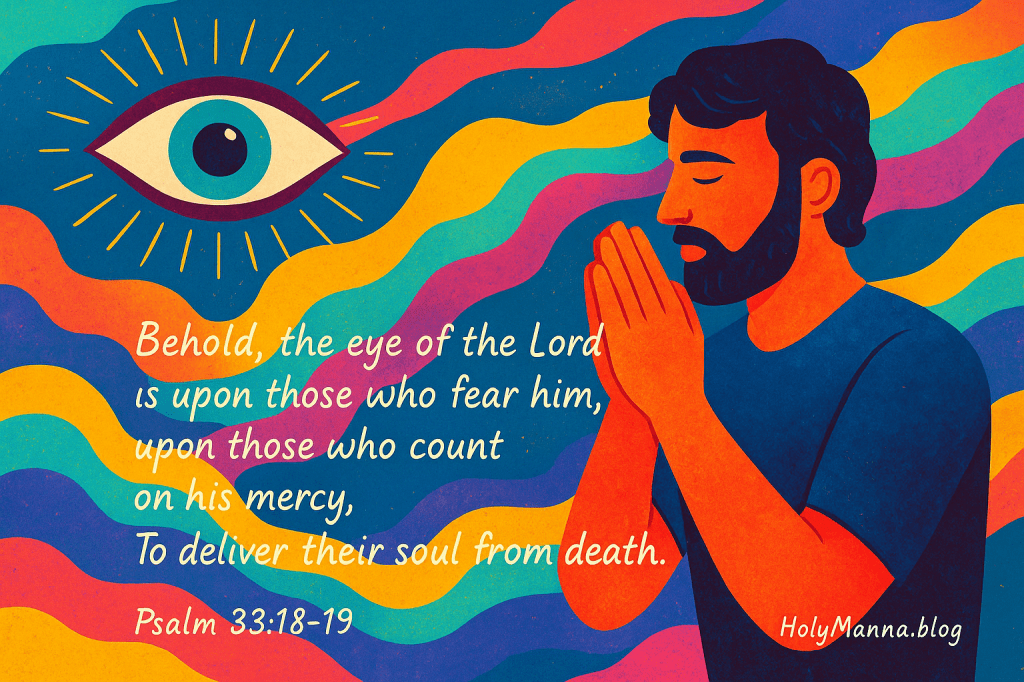
18 Behold, the eye of the Lord is upon those who fear him,
upon those who count on his mercy,
19 To deliver their soul from death,
and to keep them alive through famine.
Detailed Exegesis
Verse 2 – “Give thanks to the Lord on the harp; on the ten-stringed lyre offer praise.”
This verse situates praise within the beauty of music, underscoring that gratitude is not just spoken but sung. In ancient Israel, music was a central part of temple worship. Offering thanks with instruments was an act of total devotion—engaging the body, soul, and senses. Even in times of scarcity or fear, God’s people are called to give thanks.
Verse 3 – “Sing to him a new song; skillfully play with joyful chant.”
The “new song” symbolizes renewal—a fresh response to God’s ongoing work in our lives. The joy is not shallow; it is skillful, thoughtful, deliberate. In the face of famine or struggle, this verse challenges us to find joy in the Lord’s faithfulness, crafting our lives into songs of hope.
Verse 10 – “The Lord foils the plan of nations, frustrates the designs of peoples.”
This verse reasserts God’s sovereignty over worldly powers. Empires may rise and fall, but God alone is in control. Joseph’s rise in Egypt and the unexpected reconciliation with his brothers illustrates this truth. Human scheming cannot undo God’s providential care.
Verse 11 – “But the plan of the Lord stands forever, the designs of his heart through all generations.”
In contrast to the failed plans of men, God’s plan is eternal. His “designs” are not cold strategies—they come from His heart. This verse beautifully complements today’s Gospel, where Jesus commissions the Twelve. God’s plan for salvation continues to unfold through every generation, including ours.
Verse 18 – “Behold, the eye of the Lord is upon those who fear him, upon those who count on his mercy.”
This verse reveals the intimacy of God’s gaze. To “fear” the Lord is to live in awe-filled reverence, not dread. God watches over those who humbly trust Him—not because of their strength, but because they rely on His mercy. This echoes Joseph’s words: “I am a God-fearing man” (Gn 42:18).
Verse 19 – “To deliver their soul from death, and to keep them alive through famine.”
Here, the psalmist names God’s most tender and powerful work: to preserve life in the face of death, and to feed His people during famine. This mirrors the theme of today’s readings perfectly—whether physical or spiritual, God is our sustainer, our deliverer.
Teachings of the Church
The Catechism of the Catholic Church reminds us that “praise is the form of prayer which recognizes most immediately that God is God” (CCC 2639). This form of prayer springs from an awareness of who God is and what He has done. When we praise Him amid trials, we align ourselves with eternal truth rather than transient emotions. Psalm 33 calls us to this elevated stance of faith—to sing not because we see the end, but because we trust in the One who does.
Saint Augustine teaches that “singing is for one who loves” (Sermo 336). He often interpreted the “new song” as the life of grace and charity that believers live in Christ. In this light, each verse of the psalm becomes not only a call to vocal praise, but a summons to live lives of mercy, justice, and holy trust. This transforms the psalm from ancient poetry into a living exhortation.
Historically, Psalm 33 was sung during times of national crisis and liturgical thanksgiving. It shaped Israel’s identity as a people dependent on God’s provision. In the same way, the Church has taken up this psalm in her Liturgy of the Hours and Eucharistic liturgies, making its refrain a perpetual prayer. In a world often overwhelmed by fear and famine—whether material or spiritual—we are reminded that God’s designs are not only greater but good. He sees. He provides. He delivers.
Reflection
How do you respond to uncertainty in your life? When your plans fall apart, do you turn to praise or to panic? Psalm 33 teaches us to sing into the silence of famine, to praise even when we are waiting. It invites us to become people who “skillfully” live lives of worship—finding new ways to declare God’s faithfulness, even when we don’t understand His timing. In practical terms, this might look like beginning the day with a prayer of thanksgiving, keeping a gratitude journal, or simply choosing to trust when anxiety tempts us to despair.
When we align our hearts with the Lord’s eternal design, we find ourselves held—even in famine. Do you believe God is watching over you with mercy today? Are you living as if His plan still stands, even when yours falls apart? Let this psalm become your anthem. Sing it with your life. Let your praise be your resistance against fear. Let your trust be your new song.
Holy Gospel – Matthew 10:1–7
The Call to Proclaim and Heal
The Gospel according to Matthew was written primarily for a Jewish-Christian audience, emphasizing Jesus as the fulfillment of the Old Testament promises. Chapter 10 marks a pivotal moment in Jesus’ ministry—the formal commissioning of the Twelve Apostles. Historically and religiously, this event mirrors the tribal structure of Israel, recalling the twelve sons of Jacob, which deepens the symbolic significance of Jesus’ selection. Culturally, the apostles were not elite scholars or religious leaders but ordinary men—fishermen, tax collectors, zealots—whom Christ empowers to carry out an extraordinary mission. Within the context of today’s readings, this Gospel passage shifts our focus from receiving God’s providence (as seen in Joseph and the psalmist) to participating in it. Christ, the true Bread of Life, now sends out His chosen ones to feed the spiritually famished with healing, truth, and the good news that “the kingdom of heaven is at hand” (Mt 10:7).
Matthew 10:1-7
New American Bible (Revised Edition)
The Mission of the Twelve. 1 Then he summoned his twelve disciples and gave them authority over unclean spirits to drive them out and to cure every disease and every illness. 2 The names of the twelve apostles are these: first, Simon called Peter, and his brother Andrew; James, the son of Zebedee, and his brother John; 3 Philip and Bartholomew, Thomas and Matthew the tax collector; James, the son of Alphaeus, and Thaddeus; 4 Simon the Cananean, and Judas Iscariot who betrayed him.
The Commissioning of the Twelve. 5 Jesus sent out these twelve after instructing them thus, “Do not go into pagan territory or enter a Samaritan town. 6 Go rather to the lost sheep of the house of Israel. 7 As you go, make this proclamation: ‘The kingdom of heaven is at hand.’
Detailed Exegesis
Verse 1 – “Then he summoned his twelve disciples and gave them authority over unclean spirits to drive them out and to cure every disease and every illness.”
Jesus does not merely instruct—He imparts authority. This authority comes directly from Him, not from human qualifications. The power to drive out demons and heal is a sign of the in-breaking of God’s Kingdom, a reversal of sin and suffering. This verse parallels Joseph’s empowerment in Genesis, but with far greater stakes: spiritual freedom and eternal life.
Verse 2 – “The names of the twelve apostles are these: first, Simon called Peter, and his brother Andrew; James, the son of Zebedee, and his brother John;”
The naming of the apostles underscores the personal nature of the mission. These are not anonymous agents but individuals known and called by name. Simon Peter is listed first, marking his primacy among the Twelve. Just as Joseph’s story centered around a family, so too does Christ’s mission begin with a new spiritual family.
Verse 3 – “Philip and Bartholomew, Thomas and Matthew the tax collector; James, the son of Alphaeus, and Thaddeus;”
The list continues with a diverse group. Matthew’s identity as a tax collector is especially notable—once despised, now sent. This is a powerful witness to Christ’s redemptive call: no past disqualifies us from His mission. God uses both the betrayed (Joseph) and the betrayers (Joseph’s brothers) for His purposes, just as He now uses the once-unclean for holy work.
Verse 4 – “Simon the Cananean, and Judas Iscariot who betrayed him.”
Even Judas, the betrayer, is included. His presence reminds us that Jesus gives each of us the freedom to respond to His call with fidelity or rejection. The inclusion of Judas is sobering and teaches us that external vocation must be accompanied by internal conversion.
Verse 5 – “Jesus sent out these twelve after instructing them thus, ‘Do not go into pagan territory or enter a Samaritan town.’”
This instruction is not a rejection of Gentiles but a prioritization: the mission begins with Israel, God’s first covenant people. It is a moment of spiritual triage—Christ focuses on the “lost sheep” of Israel, just as Joseph focused first on feeding his family. Salvation will eventually reach all nations, but it starts with the household of God.
Verse 6 – “Go rather to the lost sheep of the house of Israel.”
Jesus echoes the language of the prophets, especially Ezekiel and Jeremiah, who lamented Israel’s condition as sheep without a shepherd. This verse is filled with compassion. Christ seeks out the weary, the wandering, the wounded. His commissioning of the apostles is a direct response to this spiritual famine.
Verse 7 – “As you go, make this proclamation: ‘The kingdom of heaven is at hand.’”
This is the heart of their mission. The Kingdom is not a distant ideal but a present reality in Christ. Their message is not merely information—it is an invitation. In a world starved for hope, this proclamation is nourishment. Just as the people in Genesis came to Joseph for grain, the people of Israel are now invited to feast on the presence of God among them.
Teachings of the Church
The Catechism of the Catholic Church teaches that the Church’s mission is a continuation of Christ’s own: “The Lord made Simon alone, whom he named Peter, the ‘rock’ of his Church. He gave him the keys of his Church and instituted him shepherd of the whole flock” (CCC 881). This apostolic foundation means that today’s Gospel is not merely a moment in history—it is the blueprint for the Church’s ongoing mission. Every baptized believer participates in this apostolic call to proclaim and to heal in Christ’s name.
Saint Gregory the Great wrote, “The proof of love is in the works. Where love exists, it works great things. But when it ceases to act, it ceases to exist.” The apostles were not only called—they were sent. Love compels mission. To receive God’s mercy like Joseph’s brothers is one grace; to become a vessel of that mercy, like the apostles, is the full flowering of faith. This Gospel challenges us to move from gratitude to action.
In Church history, the commissioning of the apostles was seen as the beginning of the apostolic succession, a line that continues today through bishops and the magisterium. But it also points to the universal call to evangelize. Lumen Gentium affirms that “the laity, by their very vocation, seek the kingdom of God by engaging in temporal affairs and directing them according to God’s will” (LG 31). This means every Catholic is, in a real sense, sent. The question is: Will we go where Christ sends us?
Reflection
Have you accepted the authority Jesus gives you as His disciple? Often, we doubt our ability to speak truth, to pray for healing, to act with mercy. But today’s Gospel reminds us that Jesus chooses ordinary people to carry out His extraordinary mission. You don’t need a perfect past or a polished plan. You need a willing heart and a listening ear.
In your workplace, your home, your friend group—there are “lost sheep” hungering for good news. Are you willing to be sent to them, to proclaim not your own opinions, but the nearness of the Kingdom? Begin today by asking the Holy Spirit: Who in my life is starving for hope? Lord, where are You sending me today? Like the apostles, let us go out—boldly, humbly, joyfully—knowing that the Bread we carry is not our own, but His, and it never runs out.
Trusting the God Who Sends and Saves
Today’s readings offer us a sweeping view of God’s providence—from the famine-stricken fields of Egypt, to the sacred songs of Israel, to the dusty roads where Jesus sends out His Twelve. At every turn, we see a God who does not remain distant in our hunger but moves with compassion to feed, to forgive, and to commission. In Genesis, Joseph’s suffering becomes the very means by which his family is saved—a foreshadowing of Christ, whose wounds open the storehouses of grace. In Psalm 33, we are reminded that “the eye of the Lord is upon those who fear him” (Ps 33:18), especially in times of famine and uncertainty. And in The Gospel of Matthew, Jesus empowers His disciples to be carriers of the Kingdom, proclaiming that “the kingdom of heaven is at hand” (Mt 10:7).
This divine pattern is not confined to Scripture—it is alive in your life right now. God is still feeding the hungry. He is still drawing near to the brokenhearted. And He is still calling ordinary people to go forth and proclaim His mercy. Have you brought your hunger to Him today? Are you willing to be the answer to someone else’s prayer for bread, truth, or healing? You are not too wounded, too weak, or too late. Like Joseph, like the apostles, you are part of God’s plan to bring His people from famine to fullness.
So let Him send you. Let Him sustain you. And let your life become the “new song” that the psalmist sings of—a melody of trust, healing, and hope in a world that is starving for all three. Will you let Him use your life as bread for others today? Will you trust that His plan, even when hidden, is always good? The Kingdom is near. The harvest is ready. Go.
Engage with Us!
We’d love to hear how today’s Scriptures are speaking to your heart. Share your thoughts, prayers, and experiences in the comments below. Your reflection could inspire someone else to draw closer to God today!
Reflection Questions:
First Reading – Genesis 41:55–57; 42:5–7, 17–24
Have you ever experienced a moment when a painful chapter in your life later became a source of healing or provision for others? Like Joseph’s brothers, are there past sins or wounds you feel called to confront with honesty and trust in God’s mercy?
Responsorial Psalm – Psalm 33:2–3, 10–11, 18–19
What “new song” is God inviting you to sing in your life right now, even in the midst of difficulty? Do you truly believe that God’s eye is upon you, especially when you feel unseen or overwhelmed? How does that affect the way you pray and live?
Holy Gospel – Matthew 10:1–7
Where is God sending you today—to your family, your workplace, your parish—to proclaim His Kingdom by your words and actions? Are you living as if the Kingdom of Heaven is truly “at hand”? What needs to change for you to live with greater faith and urgency?
Let’s continue walking this journey of faith together, trusting in the God who feeds us, heals us, and sends us. May every word, decision, and action today be done with the love and mercy that Jesus teaches us. You are not alone—and your witness matters. Go in peace, and live boldly for the Kingdom.
Follow us on Instagram and Facebook for more insights and reflections on living a faith-filled life.

 Holy Manna!
Leave a comment