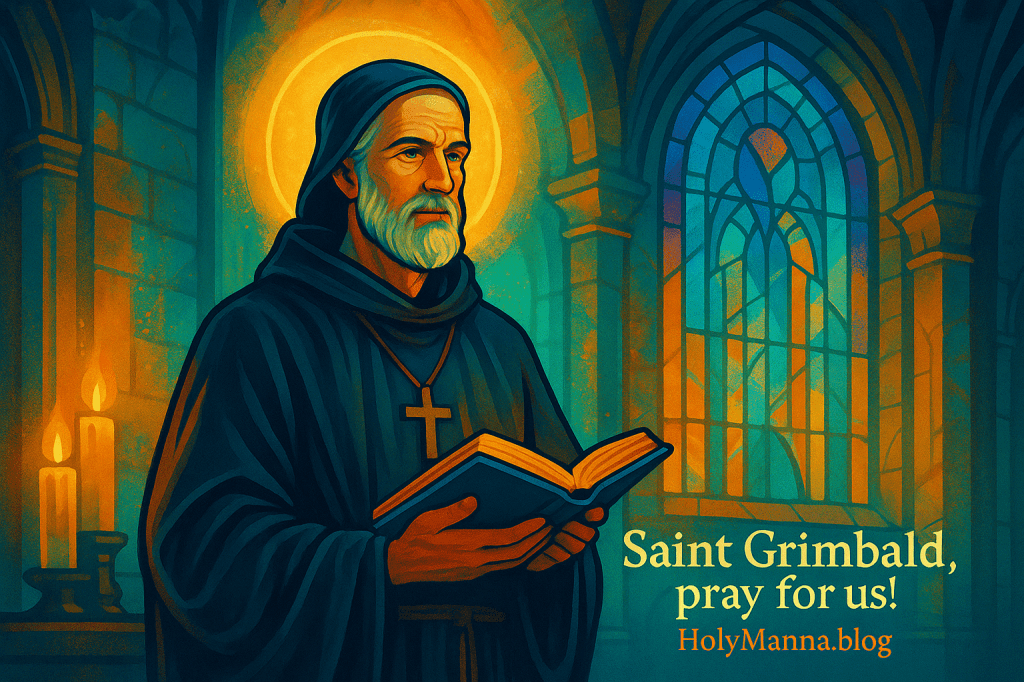
The Hidden Flame in a Time of Darkness
In an age when much of England lay in ruins from the ravages of Viking invasions, one man helped kindle a quiet flame that would reignite the light of faith and learning. Saint Grimbald, a humble Benedictine monk from France, was not a warrior or a martyr in the dramatic sense, but he fought a different kind of battle—a spiritual one—armed with wisdom, humility, and unshakable faith. Known for his deep learning, unwavering devotion, and the gentle yet powerful influence he had over one of England’s greatest kings, Saint Grimbald reminds us that holiness often flourishes not on the grand stage, but in the humble tasks of obedience and daily fidelity. He is remembered not just as a saint, but as a scholar, spiritual director, and quiet revolutionary who helped restore the soul of a nation through prayer and knowledge. His legacy speaks volumes: “Blessed are the meek, for they shall inherit the earth” (The Gospel of Matthew 5:5).
From Monastery to Monarchy
Saint Grimbald was born in the early 9th century in the region of northern France, likely near Saint-Omer. Raised in a devout environment, he entered the Benedictine monastery of Saint Bertin, one of the most important centers of learning and prayer in Carolingian Europe. From his earliest years, Grimbald showed a thirst for the sacred sciences and the things of God. He was a monk of discipline, balance, and profound humility—living out the Rule of Saint Benedict with faithfulness. Over time, he became a priest and a renowned scholar, deeply respected for his command of theology, Latin, and sacred Scripture. But his sanctity went deeper than books—he radiated peace and kindness, drawing others to God through his example.
His path took a remarkable turn when King Alfred the Great of Wessex, striving to restore Christian learning and culture in his war-torn realm, invited Grimbald to England around the year 886. Alfred saw in him not only a scholar, but a man of God whose wisdom could guide both clergy and king alike. Grimbald initially hesitated—his heart was in the quiet of monastic life—but he discerned that obedience to God’s call meant leaving behind comfort and embracing a new mission. His “yes” became a blessing to all of England. Upon his arrival, Grimbald became Alfred’s spiritual advisor and helped establish schools and promote the translation of important works into Old English. He was instrumental in reestablishing the Church’s influence and restoring ecclesial order in England, all while continuing to live as a humble monk.
Whispers of Grace
Though Saint Grimbald’s holiness expressed itself most visibly through education and counsel, his life was also marked by the miraculous—those subtle yet unmistakable signs of God’s grace at work. The miracles attributed to him during his lifetime were quiet ones, often hidden from public acclaim, yet no less powerful for their simplicity. He was known for his healing prayers, particularly for the sick and those troubled in spirit. A popular story tells of how Grimbald once interceded during a fierce storm that threatened travelers near the River Itchen; after invoking the name of Jesus and making the sign of the Cross, the winds calmed, and all were delivered safely.
There are also accounts of his profound spiritual insight. Grimbald was said to have a discerning heart, able to see into the souls of those who came to him for counsel. He often gently brought sinners to repentance, helping many to return to the sacraments after long years away. These moments—though lacking the spectacle of great signs—were miraculous in the truest sense: lives were changed, hearts converted, and faith revived.
Obedient to the End
Saint Grimbald did not suffer martyrdom by sword or fire, but he bore a martyrdom of obedience and detachment, the slow dying to self that Christ demands of all His disciples. His journey to England, though an honor, was also a sorrow—leaving behind his beloved monastery and homeland to serve a king and a nation in spiritual need. Later, when offered the prestigious position of Archbishop of Canterbury, Grimbald declined. He discerned that his place was not in the high offices of power but among the people, continuing his work in the quieter city of Winchester.
He lived through a turbulent period in Church and political history, and he endured the weariness that comes with long years of laboring for the Gospel in a land marked by instability and war. Yet he never wavered in charity or courage. He remained steadfast in prayer and in service, embracing the sufferings that came with his mission with the serenity of one who trusted wholly in God. His life echoed the words of Psalm 34: “Many are the afflictions of the righteous, but the Lord delivers him out of them all” (Psalm 34:19).
A Saint in the Silence
Saint Grimbald passed from this life around the year 901 AD, likely in Winchester, where he had spent the last years of his ministry. But in death, as in life, God continued to work through him. His body was buried at New Minster in Winchester, and his tomb quickly became a site of pilgrimage. Numerous healings were reported at his grave, particularly of fevers and throat ailments. Pilgrims came seeking intercession and found peace, consolation, and even physical healing through his relics. His sanctity was such that his name appeared in several early English martyrologies, and he was venerated for centuries after his death.
Though the shrine was later destroyed during the Reformation, his memory lives on in the Church’s spiritual treasury. Winchester and its people long remembered the gentle monk whose prayers had once lifted a king and whose wisdom had revived a land. His feast day gives us an annual invitation to recall his legacy—and to strive for the kind of holiness that begins in humility and ends in glory.
Seeds of Wisdom for Today’s Pilgrims
What can we, in the modern world, possibly learn from a quiet monk who lived over a thousand years ago? Everything. Saint Grimbald’s life is a luminous reminder that greatness in the Kingdom of God is not measured by applause, but by obedience. In a time when success is often measured by how loudly one speaks or how widely one is seen, Grimbald offers us a counter-gospel: the call to serve, to listen, to be faithful in the hidden spaces of our lives. His deep union with God gave him the strength to leave his comfort zone, to build up others in faith, and to remain humble in the face of power.
We too are called to be saints, not necessarily by achieving fame or performing visible miracles, but by offering each day to God with faith and love. As The Catechism beautifully teaches: “By his revelation, ‘the invisible God, from the fullness of his love, addresses men as his friends… and moves among them, in order to invite and receive them into his own company’” (CCC 142). Grimbald responded to this divine invitation with quiet joy. So must we.
Let us be faithful in prayer. Let us use our gifts to uplift others. Let us seek wisdom over pride, service over self, and Christ above all.
Engage with Us!
We’d love to hear how Saint Grimbald’s life speaks to your own spiritual journey.
Reflection Questions:
- In what ways are you being called to use your gifts in humble service rather than personal glory?
- How can you grow in wisdom and holiness in your daily routine, like Grimbald did in the quiet of his monastery and court life?
- Have you ever experienced a hidden or quiet miracle—something only you and God recognized as grace?
Let us encourage one another to seek the Lord in the ordinary, to remain faithful in the small things, and to do everything with love, as our Lord Jesus did.
Saint Grimbald, pray for us! 🔥
Follow us on Instagram and Facebook for more insights and reflections on living a faith-filled life.

 Holy Manna!
Leave a comment