Tuesday of the Fourteenth Week in Ordinary Time – Lectionary: 384
Wrestling with God, Walking with Mercy
Have you ever felt like you were in a spiritual wrestling match—struggling in prayer, limping through suffering, or crying out for God to just show up? Today’s readings speak to that raw, intimate tension between trial and transformation. In Genesis 32, Psalm 17, and The Gospel of Matthew, we encounter a God who meets us not only in comfort, but in the struggle—who allows our wrestlings, heals our wounds, and calls us into mission. These are not disconnected moments, but a spiritual thread tying together the story of Jacob, the cries of the psalmist, and the compassionate gaze of Christ.
The backdrop of Genesis 32 is ancient, but its message is timeless. Jacob’s mysterious encounter at the Jabbok River marks a pivotal moment—not just for him, but for the people of Israel who would forever be shaped by this identity. To be “Israel” is to be one who wrestles with God and prevails. This theme of divine struggle echoes in Psalm 17, where David prays for vindication, knowing he has been tested “by fire” and found faithful. The plea to “see your face” (cf. Ps 17:15) directly mirrors Jacob’s own words: “I have seen God face to face” (Gen 32:31). And in The Gospel of Matthew, we move from personal encounter to public mission—where Jesus not only heals the mute and silences the demonic but also lifts His eyes to the crowd with a heart broken open in pity: “They were troubled and abandoned, like sheep without a shepherd” (Mt 9:36).
This encounter with God—whether through wrestling, crying out, or being healed—is never for our sake alone. It marks us, transforms us, and sends us. Like Jacob limping into the sunrise, or like the healed man speaking for the first time, we are called to walk into the day changed. We are called to become laborers in the harvest. How is God trying to encounter you in your present struggle? And how might He be preparing you—not only to be healed—but to be sent?
First Reading – Genesis 32:23–33
When Wrestling Becomes Blessing
The Book of Genesis is more than a collection of origin stories—it is the sacred account of God’s covenantal relationship with humanity, culminating in the formation of a chosen people. Today’s passage is a profound turning point in the life of Jacob, the patriarch whose descendants will bear the name Israel. At this moment in salvation history, Jacob stands on the threshold of reunion with his estranged brother Esau, burdened by guilt and fear. The crossing of the Jabbok River is not merely geographical—it is symbolic of Jacob’s transition from self-reliant deceiver to a man marked by divine encounter. This mysterious wrestling match is rich with spiritual and theological meaning. It speaks to the human condition of struggle, the desire for blessing, and the transformative power of God’s touch—even when it wounds. In the context of today’s readings, Jacob’s encounter parallels the healing and mission seen in The Gospel of Matthew, reminding us that true transformation often begins in the dark night of the soul.
Genesis 32:23-33
New American Bible (Revised Edition)
23 That night, however, Jacob arose, took his two wives, with the two maidservants and his eleven children, and crossed the ford of the Jabbok. 24 After he got them and brought them across the wadi and brought over what belonged to him, 25 Jacob was left there alone. Then a man wrestled with him until the break of dawn. 26 When the man saw that he could not prevail over him, he struck Jacob’s hip at its socket, so that Jacob’s socket was dislocated as he wrestled with him. 27 The man then said, “Let me go, for it is daybreak.” But Jacob said, “I will not let you go until you bless me.” 28 “What is your name?” the man asked. He answered, “Jacob.” 29 Then the man said, “You shall no longer be named Jacob, but Israel, because you have contended with divine and human beings and have prevailed.” 30 Jacob then asked him, “Please tell me your name.” He answered, “Why do you ask for my name?” With that, he blessed him. 31 Jacob named the place Peniel, “because I have seen God face to face,” he said, “yet my life has been spared.”
32 At sunrise, as he left Penuel, Jacob limped along because of his hip. 33 That is why, to this day, the Israelites do not eat the sciatic muscle that is on the hip socket, because he had struck Jacob’s hip socket at the sciatic muscle.
Detailed Exegesis
Verse 23 – “That night, however, Jacob arose, took his two wives, with the two maidservants and his eleven children, and crossed the ford of the Jabbok.”
This verse sets the stage for the climactic moment. Jacob, aware of the looming meeting with Esau, removes his family from danger. The crossing of the Jabbok at night signifies the spiritual darkness and internal turmoil Jacob is experiencing. It echoes the isolation we often feel when we are about to confront our past or face a painful truth.
Verse 24 – “After he got them and brought them across the wadi and brought over what belonged to him, Jacob was left there alone. Then a man wrestled with him until the break of dawn.”
Jacob’s solitude is essential. In Scripture, God often meets His people in isolation—think of Moses on Sinai or Jesus in the desert. The mysterious “man” is traditionally understood by the Church to be either an angelic being or a theophany—a manifestation of God. The Catechism notes that “Throughout the Old Testament, theophanies (manifestations of God) light up the path of the promise… God reveals himself gradually” (CCC 707). Jacob’s physical wrestling reflects a deeper spiritual and moral struggle.
Verse 25 – “When the man saw that he could not prevail over him, he struck Jacob’s hip at its socket, so that Jacob’s socket was dislocated as he wrestled with him.”
This verse is not about physical dominance but spiritual persistence. Jacob is not overcoming God—he is clinging to Him. The wound he receives is a mark of both humility and intimacy. It reminds us that God’s blessings often leave us changed, sometimes even scarred, yet those marks are signs of grace.
Verse 26 – “The man then said, ‘Let me go, for it is daybreak.’ But Jacob said, ‘I will not let you go until you bless me.’”
Jacob’s demand for a blessing is bold. He knows he is wrestling with more than a man. His insistence reveals the heart of one who longs not just for escape, but for reconciliation, for healing, and for a new identity. How often do we settle for less when God wants us to wrestle for more?
Verse 27 – “What is your name?” the man asked. He answered, ‘Jacob.’”
To name oneself is to confess one’s identity. The name “Jacob” means “heel-grabber” or “deceiver”—a fitting description of his earlier life. This moment is a confession. He is admitting who he is before receiving who he is meant to become.
Verse 28 – “Then the man said, ‘You shall no longer be named Jacob, but Israel, because you have contended with divine and human beings and have prevailed.’”
Here lies the crux of the encounter: identity transformation. The name “Israel” means “God contends” or “he who struggles with God.” Jacob’s struggle is no longer a flaw—it becomes a title of honor and mission. This name will define the people of God for generations.
Verse 29 – “Jacob then asked him, ‘Please tell me your name.’ He answered, ‘Why do you ask for my name?’ With that, he blessed him.”
Jacob seeks to know the identity of the mysterious being, but he is only met with mystery and blessing. This recalls Exodus 3, when God tells Moses “I am who I am” (Ex 3:14). God cannot be fully grasped, only encountered.
Verse 30 – “Jacob named the place Peniel, ‘because I have seen God face to face,’ he said, ‘yet my life has been spared.’”
This is one of the most awe-filled lines in the Old Testament. To see God and live is extraordinary. Jacob’s naming of the place Peniel—“face of God”—reveals that even in the struggle, God’s presence was real. The fact that he survived the encounter shows the mercy of God.
Verse 31 – “At sunrise, as he left Penuel, Jacob limped along because of his hip.”
The new day dawns, and Jacob leaves marked forever by his encounter. The limp is both a wound and a sign—a constant reminder that he met God and was transformed. Like the mute man in the Gospel who now speaks, Jacob walks forward into a new life, carrying the mark of mercy.
Verse 32 – “That is why, to this day, the Israelites do not eat the sciatic muscle that is on the hip socket, because he had struck Jacob’s hip socket at the sciatic muscle.”
This detail preserves the memory of the sacred encounter within the cultural and dietary laws of Israel. It is a sign that this moment became part of Israel’s religious identity, a reverence for the place where God touched their ancestor and formed their nation.
Teachings of the Church
The Catechism of the Catholic Church speaks to the mystery of divine encounter and transformation in this way: “By love, God has revealed himself and given himself to man. He has thus provided the definitive, superabundant answer to the questions that man asks himself about the meaning and purpose of his life” (CCC 68). Jacob’s wrestling was not just about physical safety—it was about identity, destiny, and divine love. Saint Ambrose reflects that “Jacob is a type of all those who struggle with faith; he wrestles not against men but against despair, against temptation, against doubt, and he prevails by grace”. This scene prefigures the inner battles faced by saints and sinners alike, and the ultimate healing and naming we receive in Christ.
In the life of the Church, this passage also resonates with Christ’s own agony in the garden. Just as Jacob wrestled with God in the dark and emerged wounded but transformed, so Christ wrestled with the will of the Father, sweating blood, and rose to fulfill His mission. It reminds us that our transformation is often painful—but holy. As Gaudium et Spes puts it, “Man achieves his proper dignity by clinging to what is true and good” (GS 41). Jacob clung, not to his old name, but to the truth of God.
The Church Fathers often saw Jacob’s limp as a sign of sanctification through suffering. Saint Gregory of Nyssa wrote that “the soul that has touched God is wounded with love… and this divine wound draws it forward ever more deeply into the mystery”. This is the call to every Christian: not to flee from the struggle, but to press in, cling tightly, and be changed by the presence of the living God.
Reflection
How many of us are limping from past battles—emotional wounds, regrets, fears we’d rather not name? Jacob teaches us that these are the very places where God wants to meet us. Our “Jabbok” moments—where we feel alone and afraid—can become the birthplace of a new identity if we refuse to let go of God. Like Jacob, we must insist: “I will not let you go until you bless me.” And when the sun rises, we too will walk forward, marked not by shame, but by grace. Where are you struggling today? Can you see that God may be trying to meet you there? Are you willing to wrestle—through prayer, through surrender, through perseverance—until He blesses you?
Responsorial Psalm – Psalm 17:1–3, 6–8, 15
The Prayer of the Tested Heart
The Psalms are the inspired prayers of Israel—raw, poetic expressions of human longing, pain, worship, and trust. Psalm 17 is a lament and a plea for vindication from David, spoken in the midst of persecution. Unlike other laments that focus on external enemies, this psalm invites us inward, into the heart of the psalmist who knows he has been tested and found faithful. In ancient Israelite culture, prayers were more than words—they were acts of covenantal fidelity. This psalm fits beautifully into today’s readings because, like Jacob wrestling in the night, David is struggling in the dark with God, crying out for justice, mercy, and ultimately, to see God’s face. The connection to Genesis 32 is unmistakable: just as Jacob sees God and lives, so David yearns for that same divine intimacy. It is a prayer that springs from trial but blossoms into trust.
Psalm 17:1-3, 6-8, 15
New American Bible (Revised Edition)
Prayer for Rescue from Persecutors
1 A prayer of David.
Hear, Lord, my plea for justice;
pay heed to my cry;
Listen to my prayer
from lips without guile.
2 From you let my vindication come;
your eyes see what is right.
3 You have tested my heart,
searched it in the night.
You have tried me by fire,
but find no malice in me.
My mouth has not transgressed
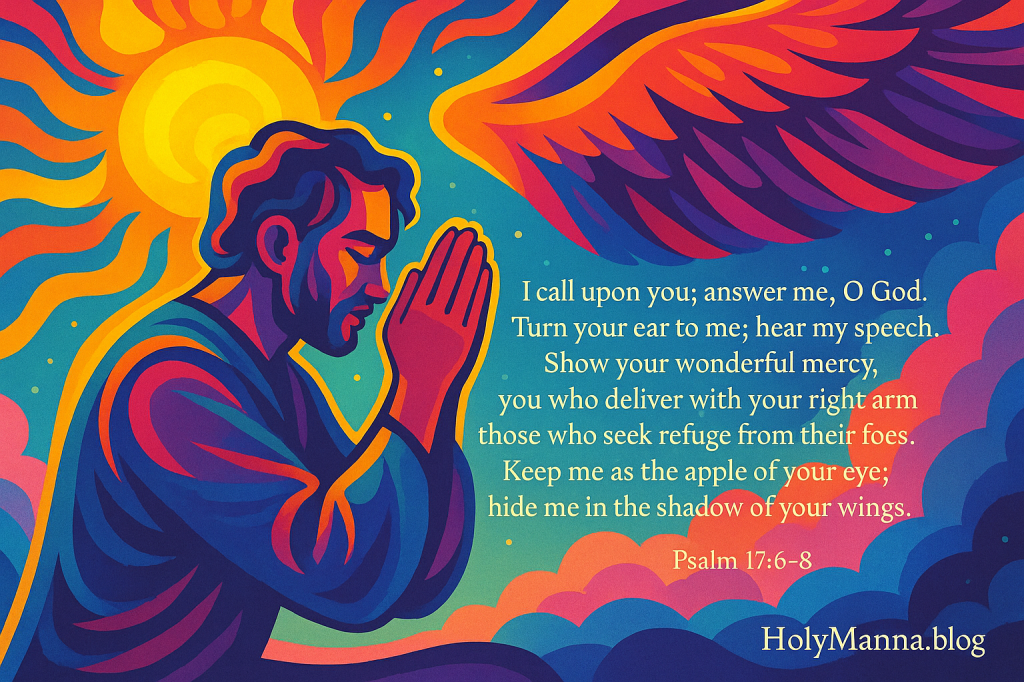
6 I call upon you; answer me, O God.
Turn your ear to me; hear my speech.
7 Show your wonderful mercy,
you who deliver with your right arm
those who seek refuge from their foes.
8 Keep me as the apple of your eye;
hide me in the shadow of your wings
15 I am just—let me see your face;
when I awake, let me be filled with your presence.
Detailed Exegesis
Verse 1 – “Hear, Lord, my plea for justice; pay heed to my cry; listen to my prayer from lips without guile.”
David begins with a triple petition—“hear… pay heed… listen”—emphasizing the urgency and sincerity of his cry. His claim to pray with “lips without guile” mirrors Jacob’s moment of honesty in naming himself. This is not a manipulative prayer but one rooted in integrity. In biblical tradition, righteousness is not perfection, but right relationship with God.
Verse 2 – “From you let my vindication come; your eyes see what is right.”
David entrusts judgment to God alone, not to man. He appeals not to his strength but to God’s justice. The line “your eyes see what is right” echoes the theme of divine vision—God sees us clearly, even when we cannot fully see Him. This prepares us for the Gospel’s focus on Jesus’ compassionate gaze.
Verse 3 – “You have tested my heart, searched it in the night. You have tried me by fire, but find no malice in me. My mouth has not transgressed.”
This verse is profoundly connected to the theme of wrestling with God. David has undergone testing, perhaps in solitude, temptation, or suffering—just like Jacob. The imagery of being “tried by fire” evokes the refining nature of trial. The Catechism teaches that “God is the only one who can probe the heart and test its purity” (CCC 2714).
Verse 6 – “I call upon you; answer me, O God. Turn your ear to me; hear my speech.”
David’s calling out reflects not doubt, but deep faith. His persistence in prayer parallels Jacob’s refusal to let go. Prayer, as shown here, is not just recitation—it is a holy insistence, a clinging to the promise that God listens and responds.
Verse 7 – “Show your wonderful mercy, you who deliver with your right arm those who seek refuge from their foes.”
God’s mercy is not abstract—it is active. The “right arm” is a biblical image of divine power and salvation. David recalls God’s saving deeds, rooting his plea in memory. Like the mute man healed in the Gospel, David trusts in a God who rescues the vulnerable.
Verse 8 – “Keep me as the apple of your eye; hide me in the shadow of your wings.”
This is one of the most tender verses in all of Scripture. The “apple of your eye” refers to the pupil—the most sensitive and guarded part. David asks to be cherished and protected as something precious. The image of being hidden under God’s wings evokes the care of a mother bird, used elsewhere in Deuteronomy and Matthew. It is a cry for intimacy and safety in God.
Verse 15 – “I am just—let me see your face; when I awake, let me be filled with your presence.”
This final verse beautifully completes the arc of the psalm and unites it with Jacob’s experience at Peniel. The longing to “see God’s face” is the ultimate goal of every spiritual struggle. It also foreshadows the beatific vision—the destiny of the saints. As 1 John 3:2 says, “When He is revealed, we shall be like Him, for we shall see Him as He is.”
Teachings of the Church
The Church affirms that prayer is not merely speech but a sacred encounter. The Catechism states: “Contemplative prayer is the simplest expression of the mystery of prayer. It is a gaze of faith fixed on Jesus, an attentiveness to the Word of God, a silent love” (CCC 2715). David’s cry in Psalm 17 is born from that kind of gaze—even when God feels hidden. His trust, even in suffering, reveals a mature and tested faith. This kind of prayer doesn’t ask why, but where is God—and how can I stay close to Him in this?
Saint Teresa of Avila, reflecting on this spiritual hunger, said: “Prayer is nothing else than being on terms of friendship with God, frequently conversing in secret with Him who, we know, loves us.” David’s prayer is just that: honest, vulnerable, persistent. His longing to see God’s face anticipates the full revelation of God in Jesus Christ, who makes the Father visible and accessible. In the face of Christ, the ancient hope of the psalmist is fulfilled.
Historically, Psalm 17 has been used in both Jewish and Christian traditions as a night prayer—a plea offered in darkness, awaiting the light. This fits beautifully with the first reading, where Jacob wrestles through the night and walks into dawn with a limp and a blessing. The spiritual tradition of the Church teaches that our night prayers—those spoken through tears, confusion, or weariness—are often the ones closest to God’s heart. Psalm 17 reminds us that even in the silence, God is listening—and preparing to act.
Reflection
What do you do when God seems silent, yet your heart is on fire with longing? David teaches us to pray honestly, humbly, and with persistence. He models how to cry out without guile, to cling to God through testing, and to dare to ask for the impossible: to see His face. Psalm 17 is an invitation to pray from the depths—especially when you feel misunderstood, unjustly treated, or spiritually dry. It teaches us to entrust our vindication to the Lord, to remember His past mercies, and to beg for intimacy with Him above all else. Are you seeking His hand, or His face? Are your prayers transactional—or transformational? Like Jacob and David, may we emerge from our wrestling with a deeper intimacy and a faith that is not shaken by the night.
Holy Gospel – Matthew 9:32–38
From Healing to Harvest
The Gospel of Matthew is the most overtly Jewish of the four Gospels, written to demonstrate that Jesus is the fulfillment of the Law and the Prophets. Chapter 9 is packed with miracles and encounters that show Jesus’ authority over sin, illness, and demonic powers. Today’s passage concludes this chapter and serves as both a summary of Jesus’ ministry and a pivotal moment of transition. We move from healing to commissioning—from encounter to mission. As in the stories of Jacob and David, we find here a moment of transformation: not only in the mute man who regains his voice, but in the hearts of the disciples, who are called to see the crowds with the compassionate eyes of Christ. This Gospel speaks into today’s theme by revealing the deep mercy of God who heals our wounds, responds to our cries, and then sends us out as laborers in His harvest. It is the spiritual movement from wrestling to walking—from being transformed to becoming instruments of transformation for others.
Matthew 9:32-38
New American Bible (Revised Edition)
The Healing of a Mute Person. 32 As they were going out, a demoniac who could not speak was brought to him, 33 and when the demon was driven out the mute person spoke. The crowds were amazed and said, “Nothing like this has ever been seen in Israel.” 34 But the Pharisees said, “He drives out demons by the prince of demons.”
The Compassion of Jesus. 35 Jesus went around to all the towns and villages, teaching in their synagogues, proclaiming the gospel of the kingdom, and curing every disease and illness. 36 At the sight of the crowds, his heart was moved with pity for them because they were troubled and abandoned, like sheep without a shepherd. 37 Then he said to his disciples, “The harvest is abundant but the laborers are few; 38 so ask the master of the harvest to send out laborers for his harvest.”
Detailed Exegesis
Verse 32 – “As they were going out, a demoniac who could not speak was brought to him.”
This verse introduces a man doubly afflicted—spiritually and physically. The inability to speak in biblical terms often represents more than a medical condition—it points to a deeper isolation, a life cut off from communion. The demoniac cannot call on God or speak with others. His muteness echoes the silent wrestling of Jacob and the inward groaning of David in Psalm 17. He cannot ask for healing himself—he must be brought to Jesus. How many in our world today are similarly voiceless, needing someone to intercede for them?
Verse 33 – “And when the demon was driven out the mute person spoke. The crowds were amazed and said, ‘Nothing like this has ever been seen in Israel.’”
The healing is immediate and complete. The exorcism not only frees the man from demonic possession but restores his voice—his ability to praise, to speak truth, to live fully. The crowd’s reaction shows their astonishment, recognizing that something truly new has occurred. Their declaration—“Nothing like this has ever been seen in Israel”—is a statement of messianic awe. Jesus is doing what only God can do.
Verse 34 – “But the Pharisees said, ‘He drives out demons by the prince of demons.’”
This verse reveals a stark contrast. While the crowds are open to wonder, the Pharisees—threatened by Jesus’ authority—attribute His works to evil. This foreshadows the later accusation of blasphemy and the hardness of heart that will lead to the Passion. The refusal to see God at work, even in undeniable good, is a warning to all of us who might be tempted to cling to control, power, or religious pride.
Verse 35 – “Jesus went around to all the towns and villages, teaching in their synagogues, proclaiming the gospel of the kingdom, and curing every disease and illness.”
This verse summarizes Jesus’ mission: teaching, proclaiming, and healing. It is a ministry that touches the mind, the heart, and the body. The phrase “gospel of the kingdom” emphasizes the arrival of God’s reign through Jesus—a reign that includes not just spiritual truths but physical restoration. Jesus is walking among the people, embodying the God who comes close, just as He did in the wrestling match with Jacob.
Verse 36 – “At the sight of the crowds, his heart was moved with pity for them because they were troubled and abandoned, like sheep without a shepherd.”
This verse gives us a window into the heart of Christ. The Greek word for “moved with pity” is splagchnizomai—a visceral, gut-wrenching compassion. Jesus is not emotionally detached; He is deeply affected by the suffering He sees. The description “troubled and abandoned” captures the spiritual condition of the people—wandering, wounded, leaderless. It recalls Ezekiel 34, where God promises to shepherd His scattered flock. Jesus is fulfilling that promise.
Verse 37 – “Then he said to his disciples, ‘The harvest is abundant but the laborers are few;’”
After healing and seeing the need, Jesus turns to His disciples and invites them to share in His mission. The image of a harvest suggests that the world is ripe for conversion, for spiritual fruitfulness—but there are not enough workers. This is not a crisis of opportunity, but of response. God is ready to move; He waits for us to step forward.
Verse 38 – “So ask the master of the harvest to send out laborers for his harvest.”
The response Jesus calls for is prayer—ask the Lord of the harvest. Before we act, we must pray. This verse links divine initiative with human cooperation. God is the Lord of the harvest, but He desires to send us. The disciples are not only to pray for workers—they will become those very laborers in the next chapter. The movement is always from encounter to mission, from healing to sending.
Teachings of the Church
The Catechism of the Catholic Church emphasizes that Christ’s miracles are signs of the Kingdom. “Jesus accompanies his words with many ‘mighty works and wonders and signs,’ which manifest that the kingdom is present in him and attest that he was the promised Messiah” (CCC 547). This Gospel scene perfectly embodies that teaching. The healing of the mute man, the deliverance from demonic oppression, and the compassion for the crowd all point to Jesus as the one in whom God’s kingdom has broken into the world.
But the miracles are not ends in themselves. The Catechism continues: “They invite belief in him… but they can also be occasions for ‘offense.’ They are not intended to satisfy people’s curiosity or desire for magic. Despite his evident miracles some people reject Jesus; he is even accused of acting by the power of demons” (CCC 548). This is precisely what happens in verse 34. The resistance of the Pharisees warns us against the danger of spiritual blindness—even in the face of God’s mercy.
Finally, the Church teaches that we are not passive spectators in this Gospel story. We are called to participate in Christ’s mission. “The desire to respond to the Lord’s call is nourished by prayer. The harvest is great, the laborers are few. We must ask the Lord to send laborers into His harvest” (CCC 2611). Jesus’ words are not abstract—they are a summons. Like the disciples, like Jacob, like David, we are called to encounter God and then go forth to serve, to heal, to speak.
Reflection
Have you encountered the healing touch of Jesus in your life? Has He opened your mouth, restored your voice, and given you back your identity? If so, then today’s Gospel reminds us: that encounter is not the end—it is the beginning. Jesus sees the crowds and His heart breaks. He sees their confusion, their pain, their longing for truth. Do you see them too? Do you allow your heart to be moved with compassion, or do you look away? This Gospel calls us not only to pray for laborers but to become one. That might mean evangelizing a friend, volunteering in your parish, mentoring someone who is spiritually lost, or simply being present to a person who is suffering. Will you wrestle in prayer until God sends workers—and are you willing to be the one He sends? Let the compassion of Christ be your fuel, and let His mission become your mission.
Marked by Mercy, Moved to Mission
Today’s readings form a sacred journey—from struggle to intimacy, from healing to harvest. In Genesis 32, Jacob wrestles through the night and refuses to let go of the divine until he receives a blessing. He emerges wounded, renamed, and forever changed. In Psalm 17, David cries out in the darkness, tested and refined by trial, yet boldly asking to see the face of God. In The Gospel of Matthew, Jesus responds with deep compassion to a voiceless man and to a wandering crowd, restoring one and calling others into His mission. Each passage reveals a God who does not remain distant but steps into our weakness, our silence, and our confusion—offering transformation and purpose.
Together, these Scriptures invite us to wrestle honestly with God, to pray from the heart, and to receive His healing touch. But they don’t stop there—they push us outward. Like Jacob, we are renamed and sent. Like David, we are tested and preserved. Like the disciples, we are told to look at the world with Christ’s own heart and respond—not with apathy, but with action. We are called to labor in the harvest, to speak for the voiceless, and to become living witnesses of God’s mercy in a hurting world.
Where are you wrestling right now? What wound do you carry that might become your blessing? Let today’s Word encourage you to meet God face to face—in prayer, in Scripture, in the needs of others—and let Him transform you. Then, step out in faith. Let your limp become your legacy, your prayer become your power, and your healing become your mission. God is still sending laborers—will you be one of them?
Engage with Us!
We’d love to hear how today’s readings spoke to your heart. Share your reflections, experiences, or prayers in the comments—your witness could be the encouragement someone else needs today. Let’s grow together in faith as a community marked by God’s mercy and sent out in His love.
Reflection Questions:
First Reading – Genesis 32:23–33
What area of your life feels like a wrestling match with God right now? Have you ever experienced a “limp” that reminded you of God’s presence or taught you something lasting?
Responsorial Psalm – Psalm 17:1–3, 6–8, 15
When have you cried out to God in the night and felt heard? What does it mean to you to be “the apple of His eye”?
Holy Gospel – Matthew 9:32–38
Who are the “voiceless” in your life or community that God may be calling you to bring to Him? How can you become a laborer in the Lord’s harvest right now—at home, in your parish, at work, or online?
May today’s Word stir your heart and deepen your trust in the God who meets you in your struggle, heals you with compassion, and sends you forth in love. Let everything you do today be done with the mercy, strength, and hope that Jesus teaches us—because the world is waiting, and the harvest is ready.
Follow us on Instagram and Facebook for more insights and reflections on living a faith-filled life.

 Holy Manna!
Leave a comment