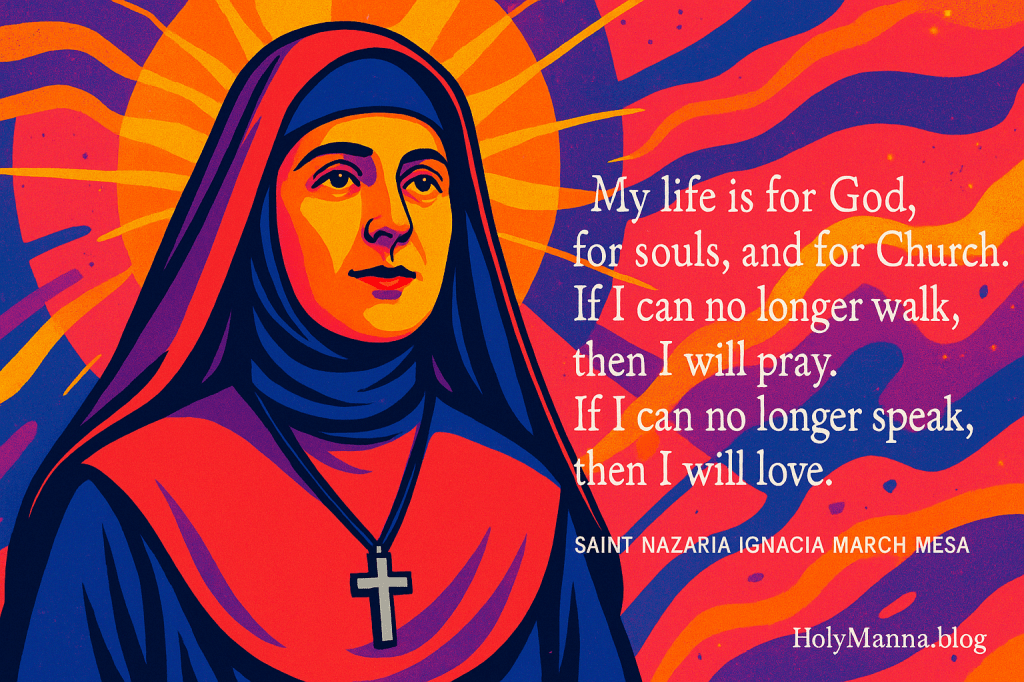
Fire in Her Veins
In turbulent times, the Holy Spirit raises up champions—not of the sword, but of the Cross. Saint Nazaria Ignacia March Mesa was one such champion. Born into a world already teetering toward conflict, she would grow into a fierce lover of the Church, an intrepid missionary, and a spiritual mother to the poor and abandoned. Canonized by Pope Francis in 2018, she founded the Congregation of the Missionary Crusaders of the Church, whose motto still resounds with divine fervor: “For the Church I live, for the Church I work, for the Church I die.” With remarkable bravery, she took the Gospel to the streets, the slums, and even war zones, defending the Church not with political power but with the shield of faith and the sword of love. She burned with desire to see souls return to Christ and the Church flourish, no matter the cost. In a time when many retreated in fear, Nazaria Ignacia ran into the fire with nothing but her habit and the Eucharist as her armor.
The Vocation of a Spiritual Warrior
Born on January 10, 1889, in Madrid, Spain, Nazaria Ignacia March Mesa was raised in a devout Catholic family who nurtured her early sense of faith and responsibility. Her family moved to Mexico during her youth, a transition that exposed her to deep societal inequality and the aching spiritual poverty of many. It was in Mexico that her vocation began to blossom. At just nine years old, she felt a mysterious, interior voice whisper, “You, Nazaria, follow Me.” Those words became a personal call to holiness and mission that would echo throughout her life.
At 19, she joined the Little Sisters of the Abandoned Elderly, a religious congregation focused on caring for the sick and elderly poor. She was eventually sent to Bolivia, a country whose people and challenges would come to define her legacy. There, she served the elderly with tenderness and strength for over a decade. Yet her spirit longed for a mission even greater: to bring spiritual renewal to the Church and ignite a fire of faith among the laity. After years of discernment and prayer, and with the blessing of her confessor, she stepped into the unknown. In 1925, she founded the Missionary Crusaders of the Church in Oruro, Bolivia—an order dedicated to evangelization, catechesis, and the spiritual defense of the Church. From that point on, she became not just a sister, but a crusader, leading an army of women consecrated to Christ and devoted to building up the Kingdom of God.
Grace in Action
Though Saint Nazaria Ignacia may not be remembered for overtly supernatural phenomena like levitating or bilocation, the Church has always recognized another kind of miracle: the quiet, steady miracle of total fidelity. Her life was a living Eucharist—broken and given for others. One example that reveals the supernatural depth of her faith occurred during a violent wave of anti-religious sentiment in Bolivia. Police raided her community, threatening to confiscate Church property and disband the sisters. While many would have fled in fear, Nazaria gathered her sisters and led them in prayer, placing everything in the hands of God. With calm conviction, she faced the armed officers and declared their mission to serve Christ and His Church. The police, moved—perhaps unnerved—by her boldness and serenity, departed without carrying out their orders. In a culture where fear silenced many, her faith spoke louder.
Nazaria also had the gift of spiritual insight and discernment. Many young women reported feeling deeply seen and spiritually awakened in her presence. She had a way of cutting through confusion with clarity and kindness, often pointing others directly back to Christ. Her ability to inspire vocations, to gather and lead others in difficult times, and to multiply hope where there was despair, was itself a miracle of God’s grace working through a willing soul.
Thorns Beneath the Halo
To follow Christ is to carry the Cross, and few knew this more intimately than Saint Nazaria Ignacia. Her life was steeped in suffering—not only physical and emotional, but deeply spiritual. From the very founding of her congregation, she encountered resistance from ecclesial authorities, governmental persecution, and even betrayal from those close to her. Bolivia at the time was rocked by anti-clerical policies and growing hostility toward the Church. Her missionary schools and houses were often under threat. Political forces tried to silence her message and erase her growing community. Still, she pressed forward.
In 1938, she was expelled from Bolivia under accusations of political agitation, a painful exile from the land she had come to love as home. Forced to leave her sisters and the people she had served for years, she moved to Argentina. There, though ill and weakened, she continued to write letters, organize missions, and offer spiritual direction. Her health declined rapidly. She bore her illness in union with the suffering Christ, writing, “My life is for God, for souls, and for the Church. If I can no longer walk, then I will pray. If I can no longer speak, then I will love.” Her death on July 6, 1943, was not a defeat but a quiet victory—her final yes to the God she had followed since childhood. She died not by sword or fire, but through a slow, cruciform surrender, becoming a white martyr whose offering would bear great fruit.
A Light That Would Not Go Out
After her death, the memory of Saint Nazaria Ignacia continued to inspire. Her congregation grew, expanding across Latin America and eventually reaching Europe and Africa. Sisters took her motto seriously: to be “Crusaders for the Church,” living witnesses of Christ’s love. Countless people who visited her tomb in Argentina or venerated her relics reported miraculous healings, spiritual conversions, and moments of divine consolation.
One such miracle—officially approved by the Vatican—was the healing of a woman in Argentina who had been diagnosed with an untreatable illness. After prayers invoking Nazaria’s intercession, the woman experienced a full and lasting recovery, medically inexplicable and spiritually profound. This miracle served as the basis for Nazaria’s canonization in 2018. Today, pilgrims continue to visit sites connected to her mission, particularly in Oruro, Bolivia and Buenos Aires, Argentina. Her spiritual daughters continue to serve in schools, hospitals, and missions, carrying her fire into places most in need of Christ.
Marching Orders for the Faithful
What does Saint Nazaria Ignacia have to teach us today? Everything. In a world that often tempts us to privatize our faith or retreat from spiritual battle, she reminds us that the Church is worth fighting for—and loving. Her life teaches us that holiness is not passive. It is a march, a crusade of the heart, waged with compassion, prayer, and unyielding fidelity to Christ and His Bride. She saw herself not merely as a nun, but as a daughter and defender of the Church.
Her example invites us to examine our own relationship with the Church. Do we love the Church as our Mother? Do we suffer with her? Do we strive to heal her wounds, not with criticism but with service and holiness? Her life also reminds us of the power of women in the Church—as warriors, as leaders, as evangelists. She lived The Catechism’s teaching that “the Church is apostolic: she is built on a lasting foundation: ‘the twelve apostles of the Lamb’ (Revelation 21:14). She is indestructible” (CCC 869). She knew this truth in her bones, and she gave her entire life to make it known.
So how can we imitate her today? Begin with prayer. Ask the Lord where He is calling you to serve the Church more radically. Perhaps it’s by returning to confession, teaching the faith to your children, or standing firm in Catholic truth when it’s unpopular. Like Nazaria, we too can become torches. As she once wrote, “We are torches that must burn and consume ourselves to give light to the world.”
Engage with Us!
How is God calling you to defend and build up the Church today? What parts of Saint Nazaria’s life stirred your heart?
Reflection Questions:
- How can I more actively love and serve the Church, even in times of confusion or difficulty?
- In what ways can I be a missionary in my current vocation and daily life?
- Where is the Holy Spirit inviting me to be bold in faith like Saint Nazaria Ignacia?
Drop your answers in the comments—we’d love to hear how the Holy Spirit is speaking to you.
Let’s support one another in our walk with Christ, and strive to do everything with love, as our Lord Jesus did.
Saint Nazaria Ignacia March Mesa, pray for us! 🔥
Follow us on Instagram and Facebook for more insights and reflections on living a faith-filled life.

 Holy Manna!
Leave a comment