Fourteenth Sunday in Ordinary Time – Lectionary: 102
Written in Heaven
Have you ever felt the deep joy of being part of something eternal—something bigger than yourself that brings light to a dark world? Today’s readings invite us to pause and rejoice in that very truth: we are part of God’s divine mission, wrapped in His mercy, marked by His Cross, and sent out with His authority. From the tender image of a mother comforting her child to the triumphant return of disciples who cast out demons, Scripture today is bursting with the radiant joy of belonging to the Kingdom of God.
In the first reading from Isaiah 66, the prophet speaks to a people longing for restoration. Jerusalem, once devastated and barren, is now envisioned as a nurturing mother whose children are consoled and nourished. This prophetic vision was deeply moving for the exiles returning from Babylon, but it also foreshadows the Church as our spiritual mother—where God’s comfort flows like a river, and where the faithful flourish in His presence. Paired with Psalm 66, a hymn celebrating the mighty works of God from the Exodus to personal deliverance, we are reminded that our joy is not rooted in fleeting pleasures but in a God who saves, restores, and reigns forever.
Saint Paul, writing in Galatians 6, shifts our focus to the transforming power of the Cross: “May I never boast except in the cross of our Lord Jesus Christ”. For Paul, this new creation transcends religious identity markers and binds all believers into one people of God—what he calls “the Israel of God.” This identity compels mission. In Luke 10, Jesus sends out seventy-two disciples to prepare the way, empowering them to bring peace, heal the sick, and proclaim that “the kingdom of God is at hand”. Their joyful return speaks volumes, yet Jesus reminds them of the truest joy: “Rejoice because your names are written in heaven”. As we reflect on these readings, we are asked to consider not just the power of our mission, but the wonder of our belonging. Are we rejoicing in the right things? Do we recognize the eternal joy of being sent by God and written into His story?
First Reading – Isaiah 66:10–14, 16, 20
God’s Motherly Mercy
The Book of Isaiah spans centuries of prophecy, offering both stern warnings and radiant hope. Chapter 66, its climactic conclusion, emerges from the period after the Babylonian exile, when the Israelites had returned to a desolate Jerusalem. Amid confusion and disillusionment, God speaks through Isaiah to reveal a stunning vision: the holy city, once broken, is now a nurturing mother. This promise wasn’t merely political restoration but a deeper spiritual rebirth—Jerusalem becomes the vessel of divine comfort and joy. For Christians, this prophecy points to the Church, the New Jerusalem, as the place where God gathers His people from all nations and pours out His mercy. Today’s reading aligns beautifully with our overarching theme: rejoicing in God’s mission and mercy. It reminds us that we are consoled in order to be sent, and that the comfort of God is not weak sentimentality, but a powerful, healing force that renews the world.
Isaiah 66:10-14
New American Bible (Revised Edition)
10 Rejoice with Jerusalem and be glad because of her,
all you who love her;
Rejoice with her in her joy,
all you who mourn over her—
11 So that you may nurse and be satisfied
from her consoling breast;
That you may drink with delight
at her abundant breasts!
12 For thus says the Lord:
I will spread prosperity over her like a river,
like an overflowing torrent,
the wealth of nations.
You shall nurse, carried in her arms,
cradled upon her knees;
13 As a mother comforts her child,
so I will comfort you;
in Jerusalem you shall find your comfort.
14 You will see and your heart shall exult,
and your bodies shall flourish like the grass;
The Lord’s power shall be revealed to his servants,
but to his enemies, his wrath.
Detailed Exegesis
Verse 10 – “Rejoice with Jerusalem and be glad because of her, all you who love her; Rejoice with her in her joy, all you who mourn over her—”
This verse invites communal joy. Those who once grieved Jerusalem’s downfall are now called to rejoice in her restoration. Mourning is not ignored—it is transformed. The joy here is redemptive, pointing forward to Christ’s promise in Matthew 5:4: “Blessed are those who mourn, for they will be comforted.”
Verse 11 – “So that you may nurse and be satisfied from her consoling breast; That you may drink with delight at her abundant breasts!”
This rich maternal imagery portrays Jerusalem as a mother offering nourishment. It evokes security, peace, and intimacy with God. For the early Church, this became an image of the Church herself, who offers spiritual sustenance through the sacraments, the Word, and her maternal care.
Verse 12 – “For thus says the Lord: I will spread prosperity over her like a river, like an overflowing torrent, the wealth of nations. You shall nurse, carried in her arms, cradled upon her knees;”
The imagery shifts from nourishment to abundance and embrace. God promises an outpouring of grace—His mercy will flow like a river. This also prophesies the inclusion of Gentiles (“the wealth of nations”), prefiguring the universal Church. We are not just given what we need—we are cherished and cradled.
Verse 13 – “As a mother comforts her child, so I will comfort you; in Jerusalem you shall find your comfort.”
Here, God likens His love to a mother’s comfort—tender, patient, close. This is one of Scripture’s most intimate portraits of divine mercy. The Church teaches in CCC 239: “God’s parental tenderness can also be expressed by the image of motherhood, which emphasizes God’s immanence, the intimacy between Creator and creature.”
Verse 14 – “You will see and your heart shall exult, and your bodies shall flourish like the grass; The Lord’s power shall be revealed to his servants, but to his enemies, his wrath.”
Joy becomes visible. The flourishing of the body reflects spiritual renewal. Yet a distinction is made: God’s mercy uplifts the faithful, while His justice confronts His enemies. The comfort is real, but so is the call to holiness.
Verse 16 – “For by fire the Lord shall enter into judgment, and, by his sword, with all flesh; those slain by the Lord shall be many.”
A striking shift in tone—fire and sword symbolize purification and divine justice. This is not a contradiction of God’s comfort but its complement: true love calls for truth. Those who resist grace will face judgment. This verse echoes Luke 12:49: “I have come to set the earth on fire, and how I wish it were already blazing!”
Verse 20 – “They shall bring all your brothers and sisters from all the nations as an offering to the Lord, on horses and in chariots, in carts, upon mules and dromedaries, to Jerusalem, my holy mountain, says the Lord, just as the Israelites bring their grain offering in a clean vessel to the house of the Lord.”
This vision of pilgrimage from all nations finds fulfillment in the Great Commission and Pentecost. All peoples are now “brothers and sisters.” The “clean vessel” signals the purity of this new covenant offering—lives transformed by grace and united in worship.
Teachings
The Catechism of the Catholic Church expands this theme beautifully, especially in CCC 2040, which teaches: “The Church, the ‘Jerusalem from above,’ is our mother, and she teaches us the way of life in Christ.” Just as Isaiah’s Jerusalem became a source of comfort, so too the Church nurtures, teaches, and strengthens her children through the Word and sacraments. This maternal role is not sentimental; it is essential. We are cradled in the arms of grace so that we may grow in holiness and mission.
Saint Cyprian reinforces this truth, proclaiming: “He can no longer have God for his Father who has not the Church for his mother.” (De unitate ecclesiae, 6). This early teaching affirms that our identity as sons and daughters of God is intimately tied to our belonging in the Church. Like the people returning from exile, we too are being gathered and purified, not by force, but by divine love poured out through Christ.
Saint Thérèse of Lisieux offers a deeply personal reflection of this passage. In her Story of a Soul, she writes: “It is confidence and nothing but confidence that must lead us to Love.” She understood that the soul, like a child, is safest in God’s arms. Isaiah 66 resonates with her “Little Way”—a path of spiritual childhood, surrender, and joy in God’s mercy. What Isaiah prophesied, Thérèse lived: comfort that leads to confident mission.
Reflection
So many of us long for peace, yet we often chase it in all the wrong places—noise, achievements, even distractions masquerading as joy. Have you allowed yourself to be comforted by God? Not just to be “told things will be okay,” but to be truly embraced by the Church, fed at the altar, and healed through prayer? Where do you run when your soul is tired? God is not a distant ruler but a mother who cradles you, a Father who provides, a Savior who carries you. Like Jerusalem reborn, you too are called to flourish in His arms. Let today be a return—rejoice, be glad, and drink deeply from the river of His mercy. Then go forth, bringing that same comfort to the world.
Responsorial Psalm – Psalm 66:1–7, 16, 20
Songs of Deliverance
The Psalms are the heart of Israel’s prayer life, and Psalm 66 is a triumphant hymn of thanksgiving that celebrates God’s mighty deeds. Likely composed after a significant act of deliverance—possibly the Exodus or a military victory—the psalm invites all the earth, not just Israel, to join in exalting the Lord. It is both communal and deeply personal, showing how the mighty works of God in history are also the foundation of individual worship. Within the liturgy, the responsorial psalm bridges the Old and New Testaments, helping us respond to God’s Word with praise. In today’s context, Psalm 66 connects powerfully to Isaiah’s vision of comfort and Galatians’ call to transformation. We are not spectators of salvation—we are participants in it. The psalm leads us to rejoice in what God has done, what He continues to do, and the eternal joy of being part of His mission.
Psalm 66:1-7, 16, 20
New American Bible (Revised Edition)
Praise of God, Israel’s Deliverer
1 For the leader. A song; a psalm.
2 Shout joyfully to God, all the earth;
sing of his glorious name;
give him glorious praise.
3 Say to God: “How awesome your deeds!
Before your great strength your enemies cringe.
4 All the earth falls in worship before you;
they sing of you, sing of your name!”
Selah
5 Come and see the works of God,
awesome in deeds before the children of Adam.
6 He changed the sea to dry land;
through the river they passed on foot.
There we rejoiced in him,
7 who rules by his might forever,
His eyes are fixed upon the nations.
Let no rebel rise to challenge!
Selah
16 Come and hear, all you who fear God,
while I recount what has been done for me.
20 Blessed be God, who did not reject my prayer
and refuse his mercy.
Detailed Exegesis
Verse 1 – “Shout joyfully to God, all the earth;”
The psalm begins with a universal invitation. This is not a private or tribal song—it is a call to the entire world to give glory to God. The earth itself is summoned to recognize the greatness of the Lord. It echoes the cosmic vision of salvation where all creation sings praise, as seen in Romans 8:22, where Paul describes creation groaning and awaiting redemption.
Verse 2 – “Sing of his glorious name; give him glorious praise.”
This verse calls us to honor God’s name—His very identity. In the biblical worldview, the name of God is more than a label; it is His revealed presence and power. Glorifying His name means acknowledging His deeds and character. The Hebrew word for “glory” (kabod) implies weight, importance, and brilliance.
Verse 3 – “Say to God: ‘How awesome your deeds! Before your great strength your enemies cringe.’”
Here, worship becomes proclamation. God’s actions are so awe-inspiring that even His enemies tremble. The use of the word “awesome” reminds us that God’s majesty is both beautiful and fearsome. His power is not arbitrary but redemptive—it saves the humble and humbles the proud.
Verse 4 – “All the earth falls in worship before you; they sing of you, sing of your name!”
This verse completes the global vision begun in verse 1. True worship includes submission (“falls in worship”) and joy (“they sing of you”). The double repetition of singing underscores the joy and unity that flows from recognizing God’s sovereignty. It echoes Isaiah’s vision of all nations being drawn to Jerusalem in peace.
Verse 5 – “Come and see the works of God, awesome in deeds before the children of Adam.”
This invitation shifts from universal praise to personal witness. The psalmist beckons us to look at God’s concrete actions in history. “Children of Adam” emphasizes that God’s works are not limited to one people—they concern all humanity. The phrase “Come and see” is also used by Jesus in John 1:39, when calling His first disciples.
Verse 6 – “He changed the sea to dry land; through the river they passed on foot. There we rejoiced in him,”
A clear reference to the Exodus and crossing of the Red Sea, this verse anchors God’s awesomeness in real, historical events. These moments of divine intervention were central to Israel’s identity and liturgy. CCC 1094 explains that “the New Testament lies hidden in the Old, and the Old is unveiled in the New”—the crossing of water prefigures baptism, our own passage from slavery to freedom.
Verse 7 – “Who rules by his might forever, His eyes are fixed upon the nations. Let no rebel rise to challenge!”
God’s reign is not temporary but eternal. His gaze over the nations is one of both justice and mercy. The final line is a sober warning: those who rebel against God’s will—who reject His authority—do so in vain. This is not a threat but a loving reminder that God’s order is good and meant for our flourishing.
Verse 16 – “Come and hear, all you who fear God, while I recount what has been done for me.”
The psalmist now offers personal testimony. Praise becomes intimate. The communal song turns into a witness of personal salvation. This verse is an invitation to listen, echoing Revelation 12:11: “They conquered him by the blood of the Lamb and by the word of their testimony.”
Verse 20 – “Blessed be God, who did not reject my prayer and refuse his mercy.”
The psalm ends with gratitude. God not only listens—He responds. This affirmation of answered prayer affirms God’s faithfulness and mercy. In times of struggle, this verse becomes a powerful reassurance that God hears and acts on behalf of His people.
Teachings
The Church has always emphasized that liturgical praise is not optional—it is central to our identity. CCC 2639 teaches: “Praise is the form of prayer which recognizes most immediately that God is God. It lauds God for his own sake and gives him glory, quite beyond what he does, but simply because HE IS.” Psalm 66 models this kind of praise. It rejoices in God’s deeds, yes, but ultimately in God’s very being. The repetition of God’s name and the call to worship reflect what we do at every Mass: glorify God because He is worthy.
Saint Augustine, who loved the Psalms dearly, once said: “He who sings prays twice.” (Sermon 336) The Psalms teach us to pray not just with our minds, but with our whole being. Augustine reminds us that praise isn’t a filler between readings or a warm-up—it is itself a powerful act of communion with God. In praising Him, we become more fully ourselves. We recognize our place in creation and enter more deeply into the joy of salvation.
Historically, Psalm 66 was often used during the Jewish festivals that commemorated the Exodus and harvest. These liturgies formed the imagination of the early Church. When the disciples rejoiced in Luke 10 over their spiritual victories, they were echoing the very joy this psalm describes. And yet Jesus tells them, “Do not rejoice because the spirits are subject to you, but rejoice because your names are written in heaven.” (Luke 10:20) In this light, Psalm 66 becomes not only a song of what God has done—but a glimpse into the eternal joy to come.
Reflection
We live in a world saturated with noise, distraction, and shallow praise. How often do we pause to recount what God has done for us? Do we make time to sing to Him—not just on Sundays, but in the quiet places of our lives? This psalm is a call to become witnesses of praise. Whether we are experiencing deliverance or waiting in hope, we are invited to “come and see,” to “come and hear,” and to proclaim God’s goodness. Today, take a moment to recall one concrete thing God has done in your life—and thank Him aloud. Let your heart become a psalm, and your life a testimony of His mercy.
Second Reading – Galatians 6:14–18
Living as a New Creation
Saint Paul’s Letter to the Galatians is a passionate defense of the Gospel’s radical grace. Written to a community grappling with Judaizing influences—those insisting on circumcision and full adherence to Mosaic Law for salvation—Paul responds with deep theological clarity and personal conviction. He reminds the Galatians that their identity is no longer rooted in external practices but in the transformative power of the Cross. His words today echo loudly in our own time, when the temptation to define ourselves by appearances, accomplishments, or status is as strong as ever. Paul invites us to live as “a new creation,” marked not by ritual or rule alone, but by the interior transformation brought by Jesus Christ. This reading ties directly to our Sunday theme: rejoicing not in our own strength or power, but in belonging to Christ, in bearing His marks, and in being part of God’s reconciling mission.
Galatians 6:14-18
New American Bible (Revised Edition)
14 But may I never boast except in the cross of our Lord Jesus Christ, through which the world has been crucified to me, and I to the world. 15 For neither does circumcision mean anything, nor does uncircumcision, but only a new creation. 16 Peace and mercy be to all who follow this rule and to the Israel of God.
17 From now on, let no one make troubles for me; for I bear the marks of Jesus on my body.
18 The grace of our Lord Jesus Christ be with your spirit, brothers. Amen.
Detailed Exegesis
Verse 14 – “But may I never boast except in the cross of our Lord Jesus Christ, through which the world has been crucified to me, and I to the world.”
Paul begins with a bold declaration: he will boast in nothing but the Cross. In Greco-Roman culture, crucifixion was shameful and humiliating. Yet Paul sees it as the ultimate victory. The Cross is not just an event—it is a new lens through which he sees everything. To be “crucified to the world” means to reject the values, ambitions, and attachments that once defined him. He now lives solely for Christ.
Verse 15 – “For neither does circumcision mean anything, nor does uncircumcision, but only a new creation.”
This verse strikes at the heart of the Galatian controversy. Paul isn’t rejecting the Jewish tradition out of disdain, but because in Christ, external signs no longer define one’s covenant identity. What matters is the inner renewal—the “new creation” that comes through faith and baptism. This reflects 2 Corinthians 5:17: “Whoever is in Christ is a new creation: the old things have passed away.”
Verse 16 – “Peace and mercy be to all who follow this rule and to the Israel of God.”
Here Paul blesses those who live by the truth he’s just proclaimed. “This rule” refers to the principle of the new creation. “The Israel of God” likely refers to the Church, the renewed people of God made up of Jews and Gentiles. Paul doesn’t erase Israel—he redefines it around the person of Christ, who fulfills and expands the covenant.
Verse 17 – “From now on, let no one make troubles for me; for I bear the marks of Jesus on my body.”
Paul ends his argument with a personal testimony. The “marks of Jesus” (stigmata Iēsou) likely refer to the scars and wounds he endured during his missionary work (see 2 Corinthians 11:24–25). These physical sufferings are badges of honor—not shame. He doesn’t need circumcision as a sign of faith; his bruised body is proof of his union with Christ. He is not just a preacher of the Cross—he is conformed to it.
Verse 18 – “The grace of our Lord Jesus Christ be with your spirit, brothers. Amen.”
This final verse is a gentle farewell. “Grace” is Paul’s signature blessing—God’s free and transforming love. By invoking grace upon their “spirit,” Paul touches the core of their identity. In calling them “brothers,” he reaffirms their relationship, despite the stern tone of much of the letter. His desire is always reconciliation in truth.
Teachings
The Catechism affirms the power and meaning of Paul’s message in CCC 1987: “The grace of the Holy Spirit has the power to justify us, that is, to cleanse us from our sins and to communicate to us the righteousness of God through faith in Jesus Christ and through Baptism.” This new creation is not symbolic—it is sacramental. Baptism unites us to Christ’s death and resurrection, making us spiritually reborn. Paul’s rejection of boasting in anything but the Cross reflects the humility and dependency all Christians are called to embrace.
Saint John Chrysostom, preaching on this very passage, once said: “Paul gloried in the cross because the Cross destroyed enmity and brought reconciliation. It opened paradise and brought down the tyrant. It reconciled us with God and made earth heaven.” The Cross, then, is not simply a source of suffering—it is the bridge between death and life, between slavery and freedom. To be marked by it is to participate in the mystery of divine love poured out for others.
In the early Church, Christians viewed martyrdom and suffering not with dread, but as a privilege. The “marks” Paul speaks of foreshadow the devotion of countless saints who bore physical or spiritual suffering for the Gospel. Saint Francis of Assisi would later receive the stigmata—the wounds of Christ—as a mystical participation in His Passion. But Paul reminds us that even in ordinary trials, we too can carry the marks of Christ if we live in fidelity and love. The Church today continues to honor such suffering as redemptive and salvific when united with Jesus.
Reflection
This passage cuts through so many modern illusions. We are surrounded by temptations to boast—in achievements, appearance, reputation, or even religious accomplishments. But Paul flips everything upside down. Where do you find your identity? What marks your life—comfort, comparison, or the Cross? To live as a new creation is to die to the world’s false promises and rise into God’s grace. We are not saved by effort or by keeping up appearances, but by clinging to the Cross that saves. Do you bear any marks of your faith? Have you suffered or sacrificed for Christ? If so, rejoice—your life is already proclaiming the Gospel. Today, let us boast in Christ alone, walking humbly and confidently as children of grace.
Holy Gospel – Luke 10:1–12, 17–20
Rejoicing in Heaven
The Gospel of Luke is often referred to as the Gospel of mercy and mission. Written by a Gentile physician and companion of Saint Paul, Luke’s account is especially attentive to the universal call of salvation, the power of the Holy Spirit, and the joy of discipleship. In this passage, Jesus sends out seventy-two disciples, a number that symbolically represents the nations of the world, indicating that the mission of God’s kingdom is expansive and inclusive. This episode, unique to Luke, emphasizes the urgency, vulnerability, and authority of the missionary task. The disciples go out in pairs, without earthly provisions, relying solely on divine providence. They return filled with joy, but Jesus redirects their focus from power to eternal belonging: “Rejoice because your names are written in heaven.” This Gospel harmonizes perfectly with today’s theme—rejoicing not in worldly success, but in the mercy, mission, and identity God has given us.
Luke 10:1-12, 17-20
New American Bible (Revised Edition)
The Mission of the Seventy-two. 1 After this the Lord appointed seventy[-two] others whom he sent ahead of him in pairs to every town and place he intended to visit. 2 He said to them, “The harvest is abundant but the laborers are few; so ask the master of the harvest to send out laborers for his harvest. 3 Go on your way; behold, I am sending you like lambs among wolves. 4 Carry no money bag, no sack, no sandals; and greet no one along the way. 5 Into whatever house you enter, first say, ‘Peace to this household.’ 6 If a peaceful person lives there, your peace will rest on him; but if not, it will return to you. 7 Stay in the same house and eat and drink what is offered to you, for the laborer deserves his payment. Do not move about from one house to another. 8 Whatever town you enter and they welcome you, eat what is set before you, 9 cure the sick in it and say to them, ‘The kingdom of God is at hand for you.’ 10 Whatever town you enter and they do not receive you, go out into the streets and say, 11 ‘The dust of your town that clings to our feet, even that we shake off against you.’ Yet know this: the kingdom of God is at hand. 12 I tell you, it will be more tolerable for Sodom on that day than for that town.
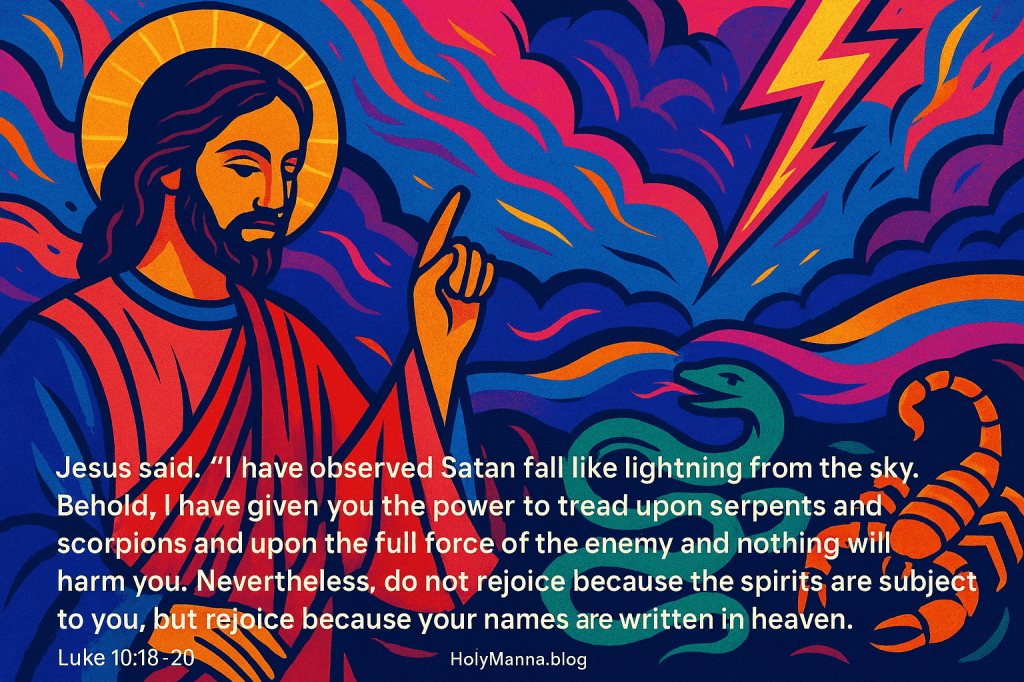
Return of the Seventy-two. 17 The seventy[-two] returned rejoicing, and said, “Lord, even the demons are subject to us because of your name.” 18 Jesus said, “I have observed Satan fall like lightning from the sky. 19 Behold, I have given you the power ‘to tread upon serpents’ and scorpions and upon the full force of the enemy and nothing will harm you. 20 Nevertheless, do not rejoice because the spirits are subject to you, but rejoice because your names are written in heaven.”
Detailed Exegesis
Verse 1 – “After this the Lord appointed seventy-two others whom he sent ahead of him in pairs to every town and place he intended to visit.”
Jesus expands the mission beyond the Twelve, signaling that His ministry is for all people and that many are needed to prepare the way. The sending “in pairs” reflects the communal nature of evangelization and fulfills the biblical principle that testimony is confirmed by two witnesses (Deuteronomy 19:15).
Verse 2 – “He said to them, ‘The harvest is abundant but the laborers are few; so ask the master of the harvest to send out laborers for his harvest.’”
This verse expresses both urgency and hope. The spiritual harvest—souls ready to receive the Kingdom—is vast, but the workers are few. Prayer for vocations begins here. Jesus frames the mission as God’s work; we are not the master of the harvest, but His willing laborers.
Verse 3 – “Go on your way; behold, I am sending you like lambs among wolves.”
This sobering image underscores the vulnerability of discipleship. Lambs among wolves are defenseless—our strength lies not in worldly power, but in divine protection. The image also echoes Jesus’ own Passion, as He is the Lamb of God sent to a hostile world.
Verse 4 – “Carry no money bag, no sack, no sandals; and greet no one along the way.”
Jesus calls for radical trust. By stripping away earthly securities, He teaches the disciples to rely entirely on God’s providence. The instruction to “greet no one” is not about rudeness but reflects the urgency of the mission—there is no time to delay.
Verse 5 – “Into whatever house you enter, first say, ‘Peace to this household.’”
Peace (shalom) is more than a greeting—it is a blessing of wholeness and divine presence. The disciple is not just visiting; he is bringing the peace of Christ into the home, fulfilling the role of an ambassador of the Kingdom.
Verse 6 – “If a peaceful person lives there, your peace will rest on him; but if not, it will return to you.”
The peace offered is not wasted. It either takes root or returns, undiminished. This verse reflects the mysterious reality of spiritual receptivity—some hearts are prepared to receive peace, others are not.
Verse 7 – “Stay in the same house and eat and drink what is offered to you, for the laborer deserves his payment. Do not move about from one house to another.”
Jesus affirms the dignity of the missionary. Their needs will be met, and they should accept hospitality gratefully without seeking better conditions. This teaches contentment and respect for those who offer support.
Verse 8 – “Whatever town you enter and they welcome you, eat what is set before you,”
Again, the emphasis is on simplicity and gratitude. Missionaries are not to be picky or entitled. This also hints at the future inclusion of Gentiles, as dietary restrictions are no longer emphasized in the mission.
Verse 9 – “Cure the sick in it and say to them, ‘The kingdom of God is at hand for you.’”
The proclamation of the Kingdom is accompanied by acts of healing and mercy. The disciples are to be visible signs of God’s nearness. Their message is not abstract—it is tangible in love, healing, and presence.
Verse 10 – “Whatever town you enter and they do not receive you, go out into the streets and say,”
Rejection is part of the mission. Jesus instructs them to make a public witness, not in anger, but as a symbolic act that the message was offered and refused. Even rejection is part of the evangelizing testimony.
Verse 11 – “‘The dust of your town that clings to our feet, even that we shake off against you.’ Yet know this: the kingdom of God is at hand.”
Shaking off the dust signifies detachment and absolves the missionary of responsibility for rejection. Yet, the warning still affirms the Kingdom’s nearness. Whether accepted or rejected, God’s reign is unfolding.
Verse 12 – “I tell you, it will be more tolerable for Sodom on that day than for that town.”
This stark warning highlights the gravity of rejecting the Gospel. Sodom’s sins were grievous, yet those who reject Christ’s messengers are judged more severely because they are refusing the fulfillment of God’s promise.
Verse 17 – “The seventy-two returned rejoicing, and said, ‘Lord, even the demons are subject to us because of your name.’”
The disciples return elated. Their joy reflects the real spiritual power that accompanies Christ’s mission. The phrase “because of your name” reveals that this power is not their own—it flows from Jesus.
Verse 18 – “Jesus said, ‘I have observed Satan fall like lightning from the sky.’”
Jesus confirms their spiritual authority and reveals a cosmic dimension to their work. The fall of Satan symbolizes the defeat of evil through their obedience and faith, marking a decisive turning point in salvation history.
Verse 19 – “Behold, I have given you the power ‘to tread upon serpents’ and scorpions and upon the full force of the enemy and nothing will harm you.”
This verse is rich in biblical imagery. Serpents and scorpions represent spiritual evil. The disciples are assured of divine protection—not immunity from suffering, but the indestructibility of their mission in Christ.
Verse 20 – “Nevertheless, do not rejoice because the spirits are subject to you, but rejoice because your names are written in heaven.”
Jesus reorients their joy. Spiritual victories are real, but they are not the source of deepest identity. The truest cause for celebration is belonging to God. Their names are written in the Book of Life—a permanent mark of divine love.
Teachings
The Catechism affirms the mission of the Church as a continuation of Christ’s own: “The Church is missionary by her very nature, for it is from the mission of the Son and the mission of the Holy Spirit that she draws her origin” (CCC 850). The sending of the seventy-two shows us that the call to mission is not reserved for an elite few. Every baptized person is sent to proclaim and embody the nearness of God’s Kingdom.
Saint Pope John Paul II frequently reminded the Church that evangelization is not optional. In Redemptoris Missio, he wrote: “Faith is strengthened when it is given to others!” The joy of the seventy-two reflects this truth. When we step out in obedience, we experience firsthand the power and presence of God. And yet, as Jesus reminds us, the deepest joy is not success in ministry, but security in our eternal identity.
The early Church Fathers also interpreted this passage mystically. Saint Ambrose taught that the seventy-two symbolize the fullness of the nations, and their return rejoicing prefigures the eschatological joy of the saints. The number seventy-two itself mirrors the table of nations in Genesis 10, signaling the Gospel’s universal reach. In every age, Christ sends His disciples to every “town and place,” and the joy of that mission remains unchanged.
Reflection
The Lord sends each of us into the world with a mission. Not all are called to travel or preach publicly, but all are called to bring peace, healing, and the Good News to the places we inhabit—our homes, workplaces, and communities. Do you see yourself as a missionary? Do you rejoice more in what you do for God—or in who you are to Him? Jesus reminds us today that our deepest identity is not in our success or even our spiritual gifts, but in being written into heaven’s story. Are you rejoicing in the right things? Ask the Holy Spirit to renew your sense of mission, to help you speak peace, to walk in humility, and to live with confidence that your name is known and loved by the Father.
Rejoice, You Are Written in Heaven
Today’s readings draw us into a profound spiritual truth: our deepest joy comes not from our achievements or even our spiritual authority, but from belonging to God. From Isaiah’s tender image of Jerusalem as a mother offering divine comfort, to the psalmist’s exuberant call to praise the God who saves, to Saint Paul’s bold declaration that the Cross alone is our glory, and finally to Jesus’ reminder that “your names are written in heaven”—we are invited to rejoice in the mercy and mission of the Lord.
We are not alone or abandoned. We are nourished by the Church, consoled by God’s love, sent out with His authority, and held eternally in His heart. The joy that flows through these readings is not fleeting emotion—it is the fruit of a life surrendered to Christ, lived in communion with the Body, and poured out in mission for others. Our boast is not in ourselves, but in the Cross. Our power is not in status, but in service. Our peace is not circumstantial, but rooted in knowing we are God’s children.
Will you live today as one whose name is written in heaven? Let your heart rejoice, your lips praise, your life witness. Whether you are mourning or flourishing, being sent or returning, the invitation remains the same: Rejoice with Jerusalem, walk in the Spirit, proclaim the Kingdom, and rest in the joy of belonging to the Father who comforts, calls, and keeps you—now and forever.
Engage with Us!
We’d love to hear how God is speaking to your heart through today’s readings. Share your thoughts, prayers, or personal experiences in the comments below—your witness may inspire someone else on their journey of faith. Take a moment to reflect on these questions and let the Word dwell richly within you.
First Reading – Isaiah 66:10–14, 16, 20
Where in your life do you most need the comfort of God right now? Do you allow yourself to be nourished by the Church like a child at its mother’s breast? How can you bring God’s comfort to others this week?
Responsorial Psalm – Psalm 66:1–7, 16, 20
What mighty deeds has God done in your life that you can praise Him for today? Do you take time in prayer to praise God simply for who He is? How can your life become a song of thanksgiving and testimony to others?
Second Reading – Galatians 6:14–18
What do you tend to boast in—your own accomplishments or the Cross of Christ? Are you living as a “new creation,” or are you clinging to old ways of identity? What “marks of Christ” are visible in your life through sacrifice, love, or witness?
Holy Gospel – Luke 10:1–12, 17–20
Do you see yourself as someone sent by Jesus to share His peace and Good News? What gives you more joy—your accomplishments, or knowing you belong to God? Where is the Lord calling you to bring healing, peace, or encouragement today?
May these words stir your heart into deeper faith, greater hope, and a more courageous love. Go forth into your week rejoicing—not in your strength, but in the mercy of the One who sends you, sustains you, and has written your name in heaven. Live every moment with faith, and let every word and deed reflect the love and mercy that Jesus Christ taught us.
Follow us on Instagram and Facebook for more insights and reflections on living a faith-filled life.

 Holy Manna!
Leave a comment