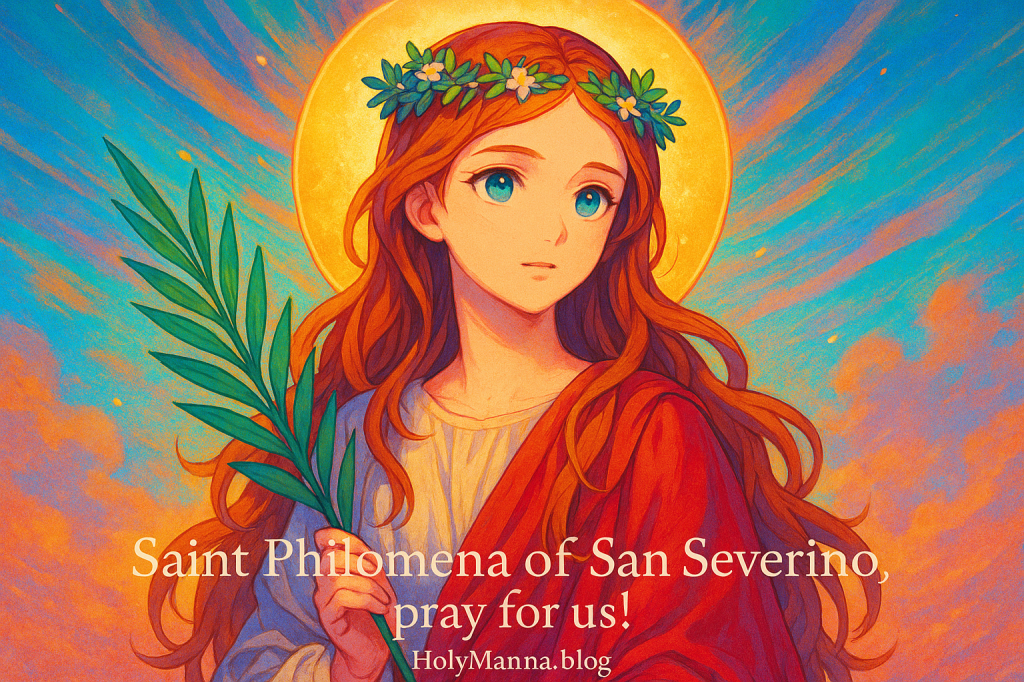
A Hidden Gem of Heaven’s Army
Saint Philomena of San Severino may not be a name echoed throughout the global Church, but in the quiet hills of Italy, she is venerated as a spiritual force cloaked in humility. She is a shining example of the “hidden saints”—those whose stories were not recorded in detail but whose lives radiated Christ’s light. Her memory lives on through regional devotion, oral tradition, and the miraculous fruits of her intercession. Unlike more famous saints whose deeds were written and celebrated widely, Philomena reminds us of how powerfully God works through those who live in obscurity, choosing silence over spectacle and sanctity over acclaim. Revered as a virgin martyr, Philomena embodies purity, spiritual fortitude, and unwavering love for Jesus, traits that echo through every corner of Catholic devotion. She invites us into the mystery of holiness that blooms in the shadows and proves that the Kingdom of God belongs to those who live simply, suffer faithfully, and love quietly.
A Lily in the Hills of San Severino
Born in the quaint town of San Severino in the region of Marche, Italy, Saint Philomena came from a Christian family during a time of persecution. While detailed records of her lineage and childhood are lost to history, the enduring veneration she receives speaks volumes. Her name—Philomena—translates as “daughter of light,” a fitting reflection of her character and legacy. The early Christians of San Severino preserved her story through oral tradition, never letting her flame extinguish.
From a young age, Philomena is believed to have consecrated herself entirely to Christ, embracing a life of virginity and prayer. This was not an easy choice in a culture that prized marriage, status, and conformity to the imperial order. Her decision set her apart and marked her as a threat to the Roman rulers. Yet it was precisely in this commitment that her holiness flourished. Like Saint Agnes and Saint Cecilia before her, Philomena lived out her devotion in quiet but fierce fidelity, offering every moment of her life to her divine Bridegroom. Her life wasn’t filled with dramatic conversions or political confrontations—it was marked by constancy, chastity, and an immovable love for Jesus. In a world increasingly defined by noise and notoriety, her silent witness becomes a louder proclamation than many sermons.
The Grace that Walked Among Them
Though no written miracle accounts from her earthly life remain, Saint Philomena’s sanctity left its mark on those who encountered her. Oral tradition speaks of her as a gentle soul with an otherworldly serenity, someone whose prayers carried weight and whose mere presence brought comfort to the afflicted. She was known to tend to the sick and the dying, to comfort the grieving, and to visit the forgotten. Her compassion was not loud or showy—it was the kind that whispered peace into troubled hearts and brought light to those in despair.
Many believe that healings occurred at her hands—not through mystical theatrics, but through the mysterious power of deep, unwavering intercession. She did not need signs and wonders to prove her holiness. Instead, her life bore the fragrance of Christ as described in 2 Corinthians 2:15, “We are the aroma of Christ to God among those who are being saved and among those who are perishing.” Her faith worked silently, like yeast in dough or light hidden under a bushel, growing and spreading far beyond what eyes could see.
A Silent Battle for the Bridegroom
Philomena’s commitment to Christ did not go unnoticed by the powers of her time. As with so many of the early virgin martyrs, her vow of chastity would have been seen as an act of rebellion against both her family’s expectations and the societal norms enforced by the Roman Empire. In a culture that viewed women as commodities for alliance and power, her spiritual espousal to Christ posed both a personal and political threat.
Though the details are obscured by the passage of time, tradition holds that Philomena was pursued for marriage—likely by a Roman official or noble. Her refusal was not simply a personal decision; it was a defiant declaration that she belonged to Jesus alone. For this, she was punished. The faithful believe she endured imprisonment and physical abuse, yet never wavered in her love. As with many martyrs of the early Church, she likely faced torture and perhaps death by beheading, fire, or another cruel method employed by persecutors who sought to break the body and silence the spirit. But Philomena’s spirit could not be silenced.
Her martyrdom was not merely the end of her life—it was her final and greatest act of love. As The Catechism of the Catholic Church (CCC 2473) teaches, “Martyrdom is the supreme witness given to the truth of the faith: it means bearing witness even unto death.” Philomena bore that witness not in rage or vengeance but in meekness, peace, and joyful surrender to the One who had captured her heart.
An Intercessor Who Still Speaks
After her death, the flame of devotion to Saint Philomena of San Severino did not die. In fact, it grew stronger. Though her name may not appear in universal martyrologies, her memory is enshrined in the hearts of the people of San Severino and surrounding areas. A chapel dedicated to her draws pilgrims who seek healing, clarity, and courage. Over the centuries, stories have emerged of people who prayed through her intercession and received miracles: barren women who conceived, the terminally ill who recovered, and the anxious who found peace.
Though these miracles were not published in papal decrees, they were written on the hearts of the faithful. Her relics, if preserved, are venerated with reverence, not because they hold magic, but because they connect the faithful to the one who so radically united her body and soul to Christ. Like Saint Thérèse of Lisieux, who promised to spend her heaven doing good on earth, Philomena appears to have embraced the same mission quietly, gently, and persistently.
In a world of skeptics and distractions, the miracles attributed to her serve not just as signs of divine power but as invitations to trust. “Jesus Christ is the same yesterday and today and forever” (Hebrews 13:8), and His saints, though hidden, still carry His love into the lives of those who ask for it.
The Power of a Hidden Yes
What can we learn from a saint whose biography we do not fully possess? In Saint Philomena of San Severino, we see the beauty of a hidden “yes.” She shows us that you don’t need to be famous, articulate, or even widely remembered to be holy. What matters is fidelity—remaining true to Christ in the small, unseen moments, when no one is clapping and no one is watching.
Her life challenges us to examine our own: Are we more concerned with being noticed or being faithful? Are we willing to say yes to God in obscurity, when our sacrifices are known only to Him? Her purity urges us to reclaim the sacredness of our bodies and our hearts in a world that seeks to exploit them. Her martyrdom calls us to courage in the face of pressure to conform. And her continued miracles beckon us to trust that even when God seems silent, He is still working through His saints.
As Saint Paul reminds us in Romans 5:3-4, “We rejoice in our sufferings, knowing that suffering produces endurance, and endurance produces character, and character produces hope.” Philomena lived this truth. Let us, inspired by her, live it too—quietly, faithfully, and with great love.
Engage with Us!
We would love to hear your thoughts about Saint Philomena of San Severino and how her life inspires you.
Reflection Questions:
- How can you practice hidden holiness in your everyday life?
- What area of your life needs a renewed commitment to purity or silence?
- How might Saint Philomena’s quiet strength help you endure a trial or temptation today?
Let’s support one another in this journey of faith. May we do all things with love, as our Lord Jesus did.
Saint Philomena of San Severino, pray for us! ✨
Follow us on Instagram and Facebook for more insights and reflections on living a faith-filled life.

 Holy Manna!
Leave a comment