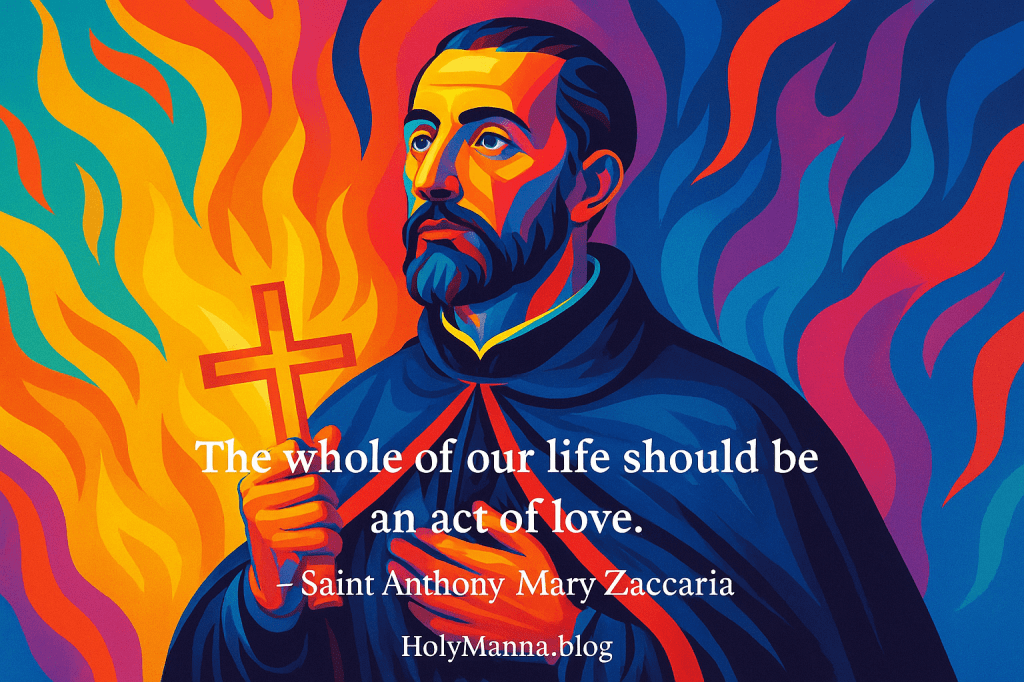
Lighting the Fire of Reform
Saint Anthony Mary Zaccaria shines in Church history as a man wholly consumed by love for the Crucified Christ and a passion to rekindle that love in the hearts of others. His mission was not born in grandeur but in the silence of prayer, the depth of Scripture, and the clarity of vision granted by the Holy Spirit. He entered a time of profound spiritual apathy in Northern Italy, where both clergy and laity had grown lax in devotion and moral living. Into that darkness, Saint Anthony brought the fire of reform—not with condemnation, but with compassionate exhortation, penance, and Eucharistic renewal. His founding of the Clerics Regular of St. Paul (later known as the Barnabites), the Angelic Sisters of St. Paul, and the Laity of Saint Paul was not simply administrative work—it was a prophetic move to breathe life into a stagnant Church. His love for the Eucharist and the Passion of Christ animated his mission. He revived the custom of ringing church bells at 3 p.m. on Fridays to recall the moment of the Lord’s death, encouraging believers to pause and contemplate the mystery of the Cross. He also reinvigorated Eucharistic Adoration, and was one of the earliest proponents of the Forty Hours Devotion. In everything, he sought to bring souls face-to-face with the living Jesus.
From Cremona’s Streets to Heaven’s Hospital
Anthony Mary Zaccaria was born in 1502 in Cremona, Lombardy, into a noble yet devout family. His mother, Antonia Pescaroli, was widowed when Anthony was only two years old. She raised him with a strong sense of piety and service, fostering in him both intellectual and spiritual gifts. From childhood, he showed a profound concern for the poor, often giving away his own possessions to those in need. He pursued medicine at the University of Padua, where he distinguished himself by both brilliance and humility. After graduating at age 22, he began practicing as a physician in Cremona, offering free medical care to the poor. Yet even amid a respected career, Anthony felt the tug of divine love calling him deeper. The physical illnesses he treated stirred in him a longing to heal the sickness of sin. His turning point came as he encountered the Letters of Saint Paul, which awakened a fire in his soul for missionary zeal and interior renewal. Feeling called to be a physician of souls, he entered the seminary and was ordained a priest in 1529. From that moment on, he ceased to live for himself. He used his gifts, not for personal gain, but for the glory of God and the salvation of others. As a preacher and confessor, he drew countless hearts back to Christ, emphasizing conversion of life, frequent reception of the sacraments, and deep contemplation of the Lord’s Passion. He sought not to create a new spirituality but to restore the timeless call to holiness rooted in Scripture, especially Romans 12:2: “Do not conform yourselves to this age but be transformed by the renewal of your mind.”
The Quiet Miracles of a Burning Heart
Though not associated with extravagant supernatural displays, Saint Anthony’s life was marked by quiet but unmistakable miracles—miracles of grace, healing, and spiritual transformation. His very presence seemed to dispel doubt and draw others toward repentance. There are recorded accounts of individuals who, after listening to one of his sermons, experienced such profound conviction that they changed their entire way of life. In one case, a child suffering from a grave illness was brought to Anthony for prayer. With simple faith, he blessed the child and offered prayers. The child recovered quickly, baffling local physicians. Yet Anthony never sought recognition for these signs, always directing attention to Christ as the true healer. He was particularly gifted in bringing peace to troubled consciences. Hardened sinners wept in his confessional. Families on the verge of collapse found reconciliation through his counsel. Widows, the poor, and the sick flocked to him, and he welcomed them all with tenderness and a father’s heart. But perhaps the most lasting miracle was the formation of the Barnabites, men on fire for the Gospel who would go on to lead missions, schools, and parishes throughout Europe and beyond. His vision of reform, anchored in the Epistles of Saint Paul, transformed not only individual hearts but entire communities. He reminded the world that the greatest miracle is not the healing of the body, but the conversion of the soul.
A Cross-Carrier in a Comfort-Loving World
Anthony’s pursuit of holiness and renewal did not go unchallenged. The comfortable and complacent were often threatened by his call to deeper conversion. Some accused him of being overly zealous or unorthodox, slandering his reputation and questioning his teachings. He was even summoned before Church authorities in Milan to defend his actions. But each time, he responded with obedience, charity, and unshakable resolve. He reminded his followers that suffering for the sake of Christ is a crown, not a curse. As 2 Corinthians 12:10 declares, “For when I am weak, then I am strong.” Anthony embraced that paradox, enduring the hostility of critics, the fatigue of constant travel, and the physical toll of fasting, prayer, and penance. He lived simply, slept little, and gave all his energy to preaching missions and forming communities of reform. Though not executed as a martyr, he died a martyrdom of love. In the summer of 1539, while on mission in Guastalla, his strength gave out. He was brought back to his mother’s home in Cremona, where he received the sacraments and prepared to meet the Lord. His final words, echoing the apostle Paul, were “We are fools for Christ’s sake” (1 Corinthians 4:10). He was only 36 years old. Yet in his short life, he had planted seeds that would bear fruit for centuries.
The Echo of a Saint Who Would Not Be Silenced
Though his earthly voice fell silent in 1539, the witness of Saint Anthony Mary Zaccaria continued to resound in the hearts of the faithful. After his death, stories of miraculous healings and divine favors attributed to his intercession began to circulate. Pilgrims came to pray at his tomb, and many testified to receiving physical and spiritual healing. A woman with a terminal illness was restored to health after invoking his prayers. Others reported receiving clarity in prayer, courage in trials, and unexpected conversions in their families. The religious communities he founded—especially the Barnabites—continued his mission of reform, preaching, and education, establishing missions as far as Brazil and the Philippines. His body, found incorrupt years after his death, became a site of veneration. In 1897, Pope Leo XIII canonized him, lifting him up as a model of priestly holiness and apostolic courage. Today, his remains are enshrined in the Church of Saint Barnabas in Milan, where countless faithful still come to seek his intercession. His feast day on July 5 reminds us each year of the call to be burning torches in a darkened world—to allow Christ to purify our hearts and to live as true disciples, no matter the cost.
Let the Doctor of the Soul Guide You
What can we learn from the life of Saint Anthony Mary Zaccaria in our modern age? In a culture that often prizes comfort, compromise, and superficial success, Anthony invites us to dig deeper—to become spiritual doctors in a world wounded by sin, confusion, and despair. His life reminds us that holiness is possible, even amid brokenness. His example challenges us to take our faith seriously, to love the Eucharist fervently, and to meditate often on the Passion of Christ. Are we willing to let Christ heal our hearts and use us to bring healing to others? Anthony’s life is a beautiful reflection of CCC 2013, which teaches: “All Christians in any state or walk of life are called to the fullness of Christian life and to the perfection of charity.” He did not wait for ideal circumstances. He acted with courage and prayer in the midst of cultural decay. His legacy challenges us to stop making excuses and to start making saints. Let us turn to him for guidance and strength. Let us ask for his intercession when we feel weary or afraid. And most of all, let us remember that sanctity is not for the few—it is the vocation of us all.
Engage with Us!
Have you ever heard of Saint Anthony Mary Zaccaria before today? What part of his life spoke to your heart?
Share your thoughts and experiences in the comments below. Let’s grow together in holiness!
- How can I contribute to the renewal of faith in my family, parish, or workplace?
- Do I turn to the Cross of Christ in my suffering, or do I try to carry my burdens alone?
- In what areas of my life do I need to be “healed” by Christ the Divine Physician?
Let us support one another in this faith journey—and strive to do everything with love, as our Lord Jesus did.
Saint Anthony Mary Zaccaria, pray for us! 🔥
Follow us on Instagram and Facebook for more insights and reflections on living a faith-filled life.

 Holy Manna!
Leave a comment