Saturday of the Thirteenth Week in Ordinary Time – Lectionary: 382
New Wine, Old Expectations
Have you ever noticed how God loves to surprise us—often choosing the least expected person or moment to reveal His plan? Today’s readings draw us into the mysterious and sometimes unsettling way God works: bypassing human conventions, upending expectations, and inviting us into something radically new. Whether it’s a blessing stolen, a psalm of praise, or a parable about wine and weddings, each passage reminds us that God’s will is not confined to our traditions, timelines, or understanding. In fact, to receive His grace, we often need to let go of the old and be made new.
In Genesis 27, we witness Jacob’s deception of his blind father Isaac, orchestrated by his mother Rebekah. It’s a morally troubling story on the surface, yet one that God mysteriously uses to fulfill His covenant promise. Jacob, though not the firstborn, becomes the heir of the blessing—a pattern we see throughout salvation history: God choosing Abel over Cain, David over his older brothers, Mary over every other maiden in Israel. As Psalm 135 joyfully proclaims, “The Lord has chosen Jacob for himself, Israel as his treasured possession”. This was not because of Jacob’s virtue, but because of God’s sovereign will. His plans are never random, but they do often confound the logic of human hierarchy and religious formalism.
That’s precisely what Jesus confronts in The Gospel of Matthew when questioned about fasting. His reply reframes religious practice as something rooted in relationship—not ritual for ritual’s sake. “Can the wedding guests mourn as long as the bridegroom is with them?” (Matthew 9:15). In other words, something new is happening, and clinging to the old ways will only cause the wineskins to burst. Today’s readings invite us to consider: Are we willing to be reshaped by God’s surprising grace, even when it comes in ways we don’t expect? God is pouring new wine—will our hearts be ready to receive it?
First Reading – Genesis 27:1–5, 15–29
A Blessing in Disguise
The story of Jacob and Esau’s stolen blessing is one of the most dramatic episodes in the Book of Genesis, capturing both the brokenness of human relationships and the sovereignty of God’s will. As the first book of the Bible, Genesis introduces us not just to creation but to the unfolding of God’s covenant with His chosen people. Abraham, Isaac, and Jacob are the patriarchs through whom God forms Israel. Yet, the way God chooses them defies expectation: Isaac, the son of laughter; Jacob, the younger twin; and later Joseph, the eleventh son. The blessing in today’s reading is far more than a nice gesture from a dying father—it is the passing on of divine favor, the covenantal promise originally given to Abraham. That this blessing comes through deception reminds us that God’s plan can unfold even through imperfect human choices. Today’s theme—God’s transformative plan often breaks human expectations—resonates deeply here, as we watch God work through flawed people to bring about His holy purpose.
Genesis 27:1-5, 15-29
New American Bible (Revised Edition)
Jacob’s Deception. 1 When Isaac was so old that his eyesight had failed him, he called his older son Esau and said to him, “My son!” “Here I am!” he replied. 2 Isaac then said, “Now I have grown old. I do not know when I might die. 3 So now take your hunting gear—your quiver and bow—and go out into the open country to hunt some game for me. 4 Then prepare for me a dish in the way I like, and bring it to me to eat, so that I may bless you before I die.”
5 Rebekah had been listening while Isaac was speaking to his son Esau. So when Esau went out into the open country to hunt some game for his father,
15 Rebekah then took the best clothes of her older son Esau that she had in the house, and gave them to her younger son Jacob to wear; 16 and with the goatskins she covered up his hands and the hairless part of his neck. 17 Then she gave her son Jacob the dish and the bread she had prepared.
18 Going to his father, Jacob said, “Father!” “Yes?” replied Isaac. “Which of my sons are you?” 19 Jacob answered his father: “I am Esau, your firstborn. I did as you told me. Please sit up and eat some of my game, so that you may bless me.” 20 But Isaac said to his son, “How did you get it so quickly, my son?” He answered, “The Lord, your God, directed me.” 21 Isaac then said to Jacob, “Come closer, my son, that I may feel you, to learn whether you really are my son Esau or not.” 22 So Jacob moved up closer to his father. When Isaac felt him, he said, “Although the voice is Jacob’s, the hands are Esau’s.” 23 (He failed to identify him because his hands were hairy, like those of his brother Esau; so he blessed him.) 24 Again Isaac said, “Are you really my son Esau?” And Jacob said, “I am.” 25 Then Isaac said, “Serve me, my son, and let me eat of the game so that I may bless you.” Jacob served it to him, and Isaac ate; he brought him wine, and he drank. 26 Finally his father Isaac said to him, “Come closer, my son, and kiss me.” 27 As Jacob went up to kiss him, Isaac smelled the fragrance of his clothes. With that, he blessed him, saying,
“Ah, the fragrance of my son
is like the fragrance of a field
that the Lord has blessed!
28 May God give to you
of the dew of the heavens
And of the fertility of the earth
abundance of grain and wine.
29 May peoples serve you,
and nations bow down to you;
Be master of your brothers,
and may your mother’s sons bow down to you.
Cursed be those who curse you,
and blessed be those who bless you.”
Detailed Exegesis
Verse 1 – “When Isaac was so old that his eyesight had failed him, he called his older son Esau and said to him, ‘My son!’ ‘Here I am!’ he replied.”
Isaac’s blindness is both physical and symbolic. He cannot see what is truly happening—not just Jacob’s disguise, but the deeper spiritual truth that God has chosen the younger son. In biblical literature, blindness often points to a deeper lack of discernment or insight (see John 9).
Verse 2 – “Isaac then said, ‘Now I have grown old. I do not know when I might die.’”
Isaac’s awareness of his mortality sets the stage for the patriarchal blessing, a practice in the ancient Near East that was deeply significant—conveying inheritance, status, and spiritual authority. This moment is meant to be sacred, yet it becomes a point of manipulation and human weakness.
Verse 3 – “So now take your hunting gear—your quiver and bow—and go out into the open country to hunt some game for me.”
Esau is fulfilling his father’s preference for him: he is a skilled hunter and Isaac’s favorite. This action reinforces the human favoritism at play in the family, a recurring issue in Genesis that often leads to strife.
Verse 4 – “Then prepare for me a dish in the way I like, and bring it to me to eat, so that I may bless you before I die.”
Isaac intends to bestow the blessing upon Esau, the firstborn, despite God’s earlier word to Rebekah that “the older shall serve the younger” (Genesis 25:23). This verse is the dramatic setup for the tension that follows.
Verse 5 – “Rebekah had been listening while Isaac was speaking to his son Esau. So when Esau went out into the open country to hunt some game for his father…”
Rebekah’s eavesdropping is pivotal. Unlike Isaac, she remembers—or trusts—God’s oracle about Jacob. Her actions are not merely maternal scheming; they are her attempt, however flawed, to fulfill God’s will.
Verse 15 – “Rebekah then took the best clothes of her older son Esau that she had in the house, and gave them to her younger son Jacob to wear.”
This marks the beginning of the disguise. Clothing often symbolizes identity in Scripture. Jacob is literally cloaking himself in someone else’s identity, foreshadowing how he will later struggle to find his own.
Verse 16 – “And with the goatskins she covered up his hands and the hairless part of his neck.”
This detail emphasizes the extent of the deception. Jacob is covering up who he is to receive a blessing—something we all do spiritually when we rely on masks instead of authenticity.
Verse 17 – “Then she gave her son Jacob the dish and the bread she had prepared.”
Rebekah’s control over the situation continues. She prepares the meal—not Jacob—mirroring how Jacob’s actions are being orchestrated by his mother.
Verse 18 – “Going to his father, Jacob said, ‘Father!’ ‘Yes?’ replied Isaac. ‘Which of my sons are you?’”
The tension peaks. Isaac senses something is amiss. This question sets the moral dilemma clearly: Will Jacob proceed with the lie?
Verse 19 – “Jacob answered his father: ‘I am Esau, your firstborn. I did as you told me. Please sit up and eat some of my game, so that you may bless me.’”
This is the explicit lie. Jacob names himself as Esau—showing that deceit is central to this encounter. And yet, despite the sinfulness, God allows this moment to stand.
Verse 20 – “But Isaac said to his son, ‘How did you get it so quickly, my son?’ He answered, ‘The Lord, your God, directed me.’”
Jacob even invokes God to support his lie, which is spiritually dangerous. This verse highlights the complexity of using God’s name in vain—“You shall not invoke the name of the Lord, your God, in vain” (Exodus 20:7).
Verse 21 – “Isaac then said to Jacob, ‘Come closer, my son, that I may feel you, to learn whether you really are my son Esau or not.’”
Isaac’s doubt surfaces again, showing how deeply he is trying to reconcile what he hears (Jacob’s voice) with what he touches (Esau’s skin).
Verse 22 – “So Jacob moved up closer to his father. When Isaac felt him, he said, ‘Although the voice is Jacob’s, the hands are Esau’s.’”
This moment is almost poetic: the dissonance between voice and touch symbolizes the disintegration of truth in this household.
Verse 23 – “(He failed to identify him because his hands were hairy, like those of his brother Esau; so he blessed him.)”
Isaac is deceived by surface appearances, and so are we when we judge others by externals rather than the heart (1 Samuel 16:7).
Verse 24 – “Again Isaac said, ‘Are you really my son Esau?’ And Jacob said, ‘I am.’”
This second confirmation of deceit reveals Jacob’s full commitment to the lie. His identity is now wrapped in a falsehood—but still, the blessing comes.
Verse 25 – “Then Isaac said, ‘Serve me, my son, and let me eat of the game so that I may bless you.’ Jacob served it to him, and Isaac ate; he brought him wine, and he drank.”
The scene continues to imitate Esau’s role. Food and wine—symbols of covenant throughout Scripture—are offered under false pretenses.
Verse 26 – “Finally his father Isaac said to him, ‘Come closer, my son, and kiss me.’”
The kiss—an intimate act—heightens the drama. This kiss, like Judas’s later in Luke 22:48, is a symbol of betrayal cloaked in affection.
Verse 27 – “As Jacob went up to kiss him, Isaac smelled the fragrance of his clothes. With that, he blessed him, saying, ‘Ah, the fragrance of my son is like the fragrance of a field that the Lord has blessed!’”
Isaac is convinced. The imagery of blessing—a fruitful field—connects Jacob’s identity with God’s favor, even in deception.
Verse 28 – “May God give to you of the dew of the heavens and of the fertility of the earth abundance of grain and wine.”
This is a material and agricultural blessing, pointing to prosperity, sustenance, and the abundance of God’s creation. Dew and grain were seen as signs of divine favor in ancient Israel.
Verse 29 – “May peoples serve you, and nations bow down to you; be master of your brothers, and may your mother’s sons bow down to you. Cursed be those who curse you, and blessed be those who bless you.”
Here, the blessing echoes Genesis 12:3, God’s promise to Abraham. This blessing is irrevocable—once spoken, it takes effect, even if obtained deceitfully. The prophetic nature of Isaac’s words transcend the moment, affirming God’s covenantal plan through Jacob.
Teachings of the Church and the Saints
The Catechism of the Catholic Church teaches that while God does not will evil, He permits it in order to bring about a greater good. “God is in no way, directly or indirectly, the cause of moral evil. He permits it, however, because he respects the freedom of his creatures and, mysteriously, knows how to derive good from it” (CCC 311). Jacob’s deception is a moral evil, but God permits it to fulfill His promise, just as He later uses the betrayal of Judas to accomplish our salvation.
Saint Augustine reflects on this story with theological depth: “Jacob was not approved for his deceiving, but the blessing of Isaac could not be undone, since it was a divine mystery prefiguring God’s free choice of grace” (On the Grace of Christ, Ch. 13). Jacob becomes a figure of the baptized Christian—undeserving yet chosen, not by merit but by grace. This reminds us of Saint Paul’s words: “I will have mercy on whom I have mercy” (Romans 9:15), quoting God’s freedom to bestow His blessings as He wills.
Historically, this passage also foreshadows the drama of Christ’s Passion, where betrayal, false appearances, and a kiss lead to God’s ultimate act of redemption. The theme of God’s surprising, even scandalous grace, flows from Jacob to Jesus, showing that human sin can never thwart God’s saving will.
Reflection
This reading challenges our tendency to judge based on appearances or assume God must work within the rules we’ve established. It reminds us that God’s grace is not earned—it is given. Like Jacob, we often hide behind disguises to feel worthy of love or approval. But God sees through our masks and still chooses to bless. Where in your life are you trying to earn God’s favor instead of receiving it with humility? Are you willing to believe that God can use even your mistakes to bring about good?
We are invited today to trust in God’s mysterious providence. Like Rebekah and Jacob, we may act imperfectly, but if our hearts are open to His will, God can redirect our brokenness toward His plan. Instead of manipulating outcomes, let’s surrender and allow ourselves to be reshaped. How would your choices change if you trusted that God’s blessing was already yours—not something to steal or perform for, but something to receive with awe?
Responsorial Psalm – Psalm 135:1–6
Chosen and Treasured
Psalm 135 is a joyful hymn of praise rooted in Israel’s identity as God’s chosen people. This psalm was likely composed during or after the Babylonian exile, a time when Israel was rediscovering its unique relationship with God amid national hardship and historical displacement. It draws heavily from the liturgical traditions of the Temple and recalls key moments in salvation history when God acted decisively on behalf of His people. Its placement in today’s liturgy complements the story of Jacob’s blessing in Genesis 27, reinforcing that it is God—not birth order, merit, or human effort—who chooses and blesses. The psalm’s mention of Jacob as God’s “treasured possession” confirms the central theme that God’s transformative plan often breaks human expectations and unfolds according to His divine will.
Psalm 135:1-6
New American Bible (Revised Edition)
Praise of God, the Ruler and Benefactor of Israel
1 Hallelujah!
Praise the name of the Lord!
Praise, you servants of the Lord,
2 Who stand in the house of the Lord,
in the courts of the house of our God!
3 Praise the Lord, for the Lord is good!
Sing to his name, for it brings joy!
4 For the Lord has chosen Jacob for himself,
Israel as his treasured possession.
5 For I know that the Lord is great,
that our Lord is greater than all gods.
6 Whatever the Lord desires
he does in heaven and on earth,
in the seas and all the depths.
Detailed Exegesis
Verse 1 – “Hallelujah! Praise the name of the Lord! Praise, you servants of the Lord,”
This opening call to worship invites all who serve in the Temple to praise God. “Hallelujah” means “Praise the Lord”, and in Hebrew liturgy, this exclamation marked the beginning of joyful communal worship. The emphasis on praising God’s name underscores His identity and authority over Israel.
Verse 2 – “Who stand in the house of the Lord, in the courts of the house of our God!”
This verse locates the worship within the Temple in Jerusalem. The imagery of “standing” recalls the posture of reverence before a king. Those in God’s house are not passive spectators but active participants in the covenant, affirming that worship is central to Israel’s vocation.
Verse 3 – “Praise the Lord, for the Lord is good! Sing to his name, for it brings joy!”
Here, the goodness of the Lord is offered as the reason for praise. God is not only powerful but good—a reminder that His choices, like selecting Jacob over Esau, are rooted in divine wisdom and love, not favoritism or human logic. His “name” itself brings joy, because it reveals His mercy and covenant faithfulness.
Verse 4 – “For the Lord has chosen Jacob for himself, Israel as his treasured possession.”
This is the heart of the psalm and the direct connection to the First Reading. God’s election of Jacob is not random; it is intentional and loving. To be God’s “treasured possession” is to be set apart for divine purposes. This verse affirms that God’s choice defines our worth, not our status, performance, or birthright.
Verse 5 – “For I know that the Lord is great, that our Lord is greater than all gods.”
The psalmist moves from historical memory to theological declaration. In a polytheistic world, where Israel was surrounded by pagan cultures, this bold proclamation asserts the uniqueness and supremacy of the Lord. His greatness is unmatched—not only in power but in authority over history and hearts.
Verse 6 – “Whatever the Lord desires he does in heaven and on earth, in the seas and all the depths.”
This final verse emphasizes God’s absolute sovereignty. His will is not bound by human institutions, social customs, or natural boundaries. When God chooses Jacob or reframes the law through Christ, He is acting from the same creative freedom that formed the cosmos. His will is both transcendent and personal.
Teachings of the Church and the Saints
The Catechism of the Catholic Church teaches that praise is the form of prayer that “lauds God for His own sake and gives Him glory quite beyond what He does, but simply because HE IS” (CCC 2639). Psalm 135 is a prime example of this kind of prayer. It does not plead, question, or lament—it exults in God’s character, God’s choices, and God’s goodness. We are reminded that worship is not just something we do—it is a response to who God is and how He has acted throughout history.
Saint John Chrysostom taught that praising God is a mark of the true believer. He wrote, “Nothing so fills the soul with joy as the service of God. The psalms, being songs of praise, raise the soul upward to the source of all good” (Homilies on the Psalms). Psalmody, for the early Church, was not merely poetic expression—it was a discipline of forming the soul. When we praise God for choosing Jacob, we are also praising Him for choosing us, unworthy as we may feel.
Historically, Psalm 135 was a staple of Jewish worship and was adopted by early Christians as a hymn of thanksgiving. Its themes resonate through the Church’s liturgical life, especially in the Liturgy of the Hours. Its reminder that God does “whatever He desires” invites us to surrender our need for control. Whether in the scandal of Jacob’s deception or the challenge of Jesus’ new covenant, God’s will reigns supreme—and always leads toward redemption.
Reflection
This psalm calls us back to praise—not just for what God has done, but for who He is. In a world that often measures worth by achievement or status, Psalm 135 declares that we are God’s “treasured possession” simply because He chose us. Do you believe that God has chosen you out of love, not obligation? Do you let that truth shape how you view yourself and others? Praising God reshapes our spiritual posture. Instead of striving to earn blessings, we learn to receive and rejoice. Let this psalm be your guide today: take a moment to praise God—aloud, in song, or in silence—for choosing you, for being good, and for being God. Let that praise be the fresh wineskin ready to receive His new wine.
Holy Gospel – Matthew 9:14–17
New Wine and New Hearts
This Gospel passage comes from The Gospel of Matthew, a text written primarily for a Jewish-Christian audience to reveal Jesus as the fulfillment of the Law and the Prophets. By chapter 9, Jesus has already healed the paralytic, called the tax collector Matthew, and is now responding to a question from the disciples of John the Baptist. The question concerns fasting, one of the three great pillars of Jewish religious observance, alongside almsgiving and prayer. Fasting was not only an act of penance but also a sign of mourning, humility, and preparation for the coming of the Messiah. Jesus’ answer flips this expectation on its head. He declares that the Messiah has already come—and with Him, a new reality has broken in. This brief dialogue reveals Jesus’ mission to renew the religious heart of Israel, not by discarding the law, but by fulfilling it in a way that requires transformation. It speaks directly to today’s theme: God’s transformative plan often breaks human expectations—and requires a new heart to receive it.
Matthew 9:14-17
New American Bible (Revised Edition)
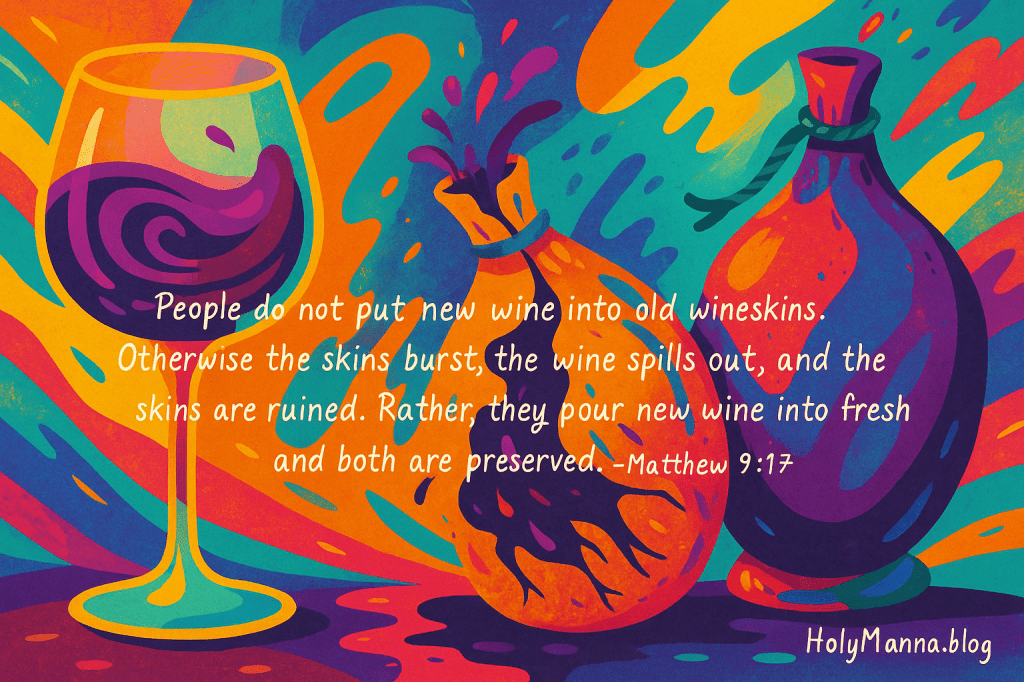
The Question About Fasting. 14 Then the disciples of John approached him and said, “Why do we and the Pharisees fast [much], but your disciples do not fast?” 15 Jesus answered them, “Can the wedding guests mourn as long as the bridegroom is with them? The days will come when the bridegroom is taken away from them, and then they will fast. 16 No one patches an old cloak with a piece of unshrunken cloth, for its fullness pulls away from the cloak and the tear gets worse. 17 People do not put new wine into old wineskins. Otherwise the skins burst, the wine spills out, and the skins are ruined. Rather, they pour new wine into fresh wineskins, and both are preserved.”
Detailed Exegesis
Verse 14 – “Then the disciples of John approached him and said, ‘Why do we and the Pharisees fast much, but your disciples do not fast?’”
The disciples of John approach Jesus with a sincere, though possibly critical, question. Fasting was widely practiced by both the Pharisees and John’s followers as a mark of holiness and repentance. Their question highlights a contrast: why doesn’t Jesus impose the same rigor on His disciples? Beneath this lies an assumption that spiritual discipline must look a certain way to be valid. It’s an early sign of resistance to the newness of Christ’s mission.
Verse 15 – “Jesus answered them, ‘Can the wedding guests mourn as long as the bridegroom is with them? The days will come when the bridegroom is taken away from them, and then they will fast.’”
Jesus responds with a powerful metaphor: He is the bridegroom, and His presence signals a time of joy, not mourning. In the Old Testament, God is often depicted as the bridegroom of Israel (Isaiah 62:5, Hosea 2:19), and here Jesus identifies Himself with that divine role. His reference to the bridegroom being taken away is a veiled prediction of His Passion. Fasting will return, but not out of obligation—instead, it will flow from longing and love. Jesus redefines fasting not as a religious rule, but as a response to relationship.
Verse 16 – “No one patches an old cloak with a piece of unshrunken cloth, for its fullness pulls away from the cloak and the tear gets worse.”
This is the first of two parables illustrating the incompatibility between the old forms of religious observance and the new life Jesus brings. Trying to graft the new reality of the Kingdom onto old systems will cause rupture. The image is simple but profound: renewal must be holistic. You can’t just tweak your religious habits—you need a new garment altogether.
Verse 17 – “People do not put new wine into old wineskins. Otherwise the skins burst, the wine spills out, and the skins are ruined. Rather, they pour new wine into fresh wineskins, and both are preserved.”
This second parable reinforces the first. In ancient times, wineskins were made of animal hides, which expanded during fermentation. Old skins were brittle and would burst if filled with new wine. Jesus is the new wine—alive, fermenting, expanding. The old wineskins represent rigid religious structures and mindsets unable to contain the vibrancy of divine grace. If we want to hold His Spirit, we must be renewed from the inside out.
Teachings of the Church and the Saints
The Catechism of the Catholic Church affirms that the New Covenant brought by Christ does not abolish the Law but brings it to fulfillment in Himself. “The Law finds its fullness and unity in Christ. Jesus is the eternal Law of God” (CCC 197). In this passage, Jesus does not condemn fasting; instead, He transforms its purpose. Fasting, prayer, and almsgiving are still vital Christian practices, especially during Lent, but they are no longer just signs of external discipline—they are expressions of interior conversion (CCC 1434).
Saint Irenaeus wrote, “God has always had the newness He brings to man… and man needs this newness which renews him” (Against Heresies, Book IV). The teaching that we must become new wineskins speaks to the entire process of sanctification—letting God renew our minds, hearts, and lives through grace. The Church Fathers understood that external religious observance, if not rooted in personal transformation, leads to legalism rather than life. This Gospel reminds us that the Christian journey is not about preserving old customs, but about allowing God to create something altogether new within us.
Historically, the Church has always wrestled with how to preserve tradition while embracing the new work of the Spirit. The early Church faced this challenge in discerning how Gentiles could enter the covenant without becoming Jewish first (Acts 15). Today, we face similar tensions—trying to balance reverence for tradition with openness to the Spirit’s renewal. Jesus’ teaching here gives us a timeless principle: new wine requires new hearts, not just new rituals.
Reflection
Jesus is always inviting us into something new. The question is: are we willing to let go of our old wineskins—our old ways of thinking, praying, and behaving—to receive it? Are there parts of your spiritual life that have become rigid, lifeless, or purely external? The presence of the Bridegroom is not about mere observance, but about joyful relationship. When we recognize Jesus with us, we feast. When we long for Him, we fast. Either way, we are moved by love, not law.
Today’s Gospel calls us to examine not just what we do for God, but why we do it. Fasting, prayer, and tradition are all beautiful when animated by the Spirit. But if they become boxes we check or burdens we bear, they crack under pressure. Where is the Spirit calling you to renewal today? Let Him stretch your heart. Let Him pour His new wine into your life. And trust that, with Him, you will be made new.
Let God Surprise You
Today’s readings unveil a God who doesn’t always follow our expectations—but who always fulfills His promises. In Genesis 27, we saw Jacob receive the blessing through an act of deception, yet this very twist became part of God’s larger plan to form the nation of Israel. Psalm 135 reminded us that it was not Jacob’s perfection, but God’s choice, that made him a “treasured possession.” And in Matthew 9, Jesus reoriented our understanding of religious practice—not as rigid ritual, but as a living response to His presence. In each reading, the message is clear: God’s transformative plan breaks human patterns and invites us to be made new.
The common thread is God’s sovereign initiative. He chooses, He blesses, He renews—and often through people and paths we least expect. That includes us. We may feel like impostors or unlikely candidates for grace, but God sees the heart. He knows the full story. What He desires is not performance, but surrender. Are you willing to let Him bless you, even when you feel unworthy? Are you open to receiving His new wine, even if it requires letting go of old expectations?
Let today’s Word shake loose your assumptions and soften your heart. Let God surprise you. Trust that His ways are higher than yours, and His mercy deeper than your weakness. And let that trust lead you into a deeper relationship with Him—not based on control or appearances, but on joyful praise, renewed fasting, and a heart ready to be transformed. The Bridegroom is here. Rejoice, and be made new.
Engage with Us!
We’d love to hear how today’s readings spoke to your heart. Share your thoughts, insights, or questions in the comments below—your reflection could be the encouragement someone else needs today. Let’s grow in faith together as we listen for God’s voice in Scripture and respond with trust and love.
Reflection Questions:
First Reading – Genesis 27:1–5, 15–29
Have you ever tried to “earn” God’s blessing instead of receiving it freely? How might God be using even your past mistakes to fulfill His purpose in your life?
Responsorial Psalm – Psalm 135:1–6
What does it mean to you to be God’s “treasured possession”? How can you incorporate more praise into your daily life, even when things are difficult?
Holy Gospel – Matthew 9:14–17
Are there “old wineskins” in your heart—rigid patterns, assumptions, or fears—that God is inviting you to release? How does the image of Jesus as the Bridegroom shift your understanding of prayer, fasting, or religious life?
Let’s commit to living each day with hearts wide open to the new wine of Christ’s presence. May we praise God boldly, trust His unexpected plans, and do everything with the love and mercy Jesus taught us.
Follow us on Instagram and Facebook for more insights and reflections on living a faith-filled life.

 Holy Manna!
Leave a comment