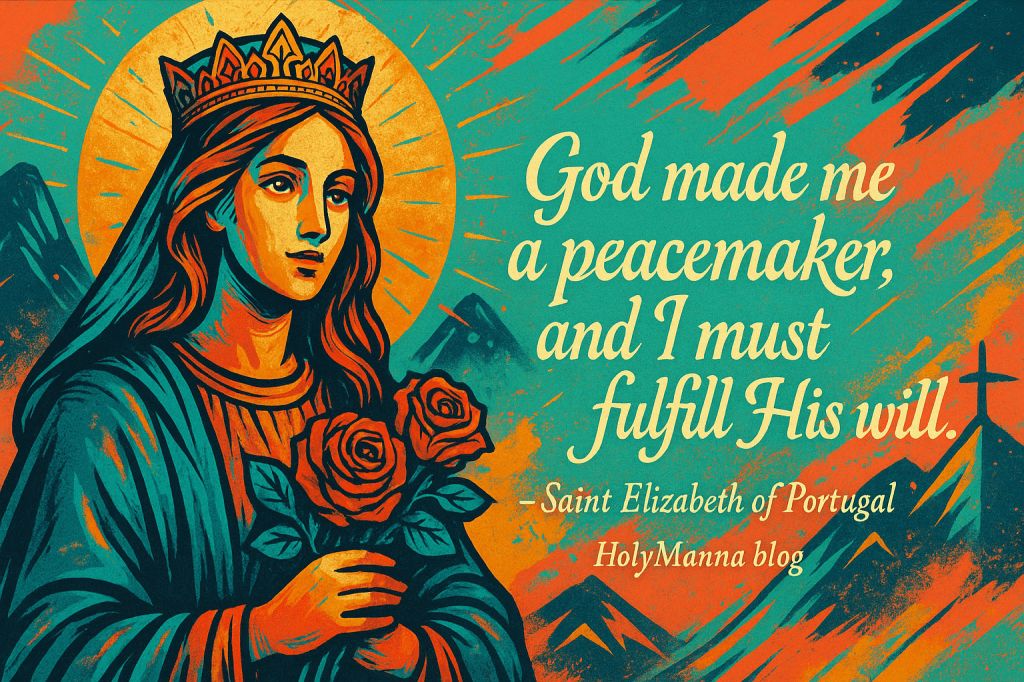
The Queen of Peace
From the outside, she was born for nobility, but God destined her for sanctity. Saint Elizabeth of Portugal, also known as Isabel, stands as a luminous example of how political power, personal suffering, and profound charity can come together in the making of a saint. She is remembered most vividly for her role as a peacemaker, for her boundless love for the poor, and for her calm, maternal authority that brought resolution to violent feuds. Her life testifies that holiness is not reserved for convent walls or monastic silence—rather, it flourishes even amidst royal courts and family conflict. Canonized in 1625 by Pope Urban VIII, she is rightly called the Peacemaker Queen, and her legacy continues to inspire Catholics across the globe to pursue mercy, justice, and harmony in their own spheres of life.
From the Palace to the Poor
Born in 1271 in Zaragoza, Spain, Elizabeth was the daughter of King Peter III of Aragon and Queen Constantia of Sicily. Her lineage was noble, but her soul bore the mark of an even greater inheritance: the grace of God. Named after her grand-aunt, Saint Elizabeth of Hungary, she was raised in an atmosphere of courtly elegance but also deep piety. From early childhood, Elizabeth was immersed in the rhythm of the Church. She attended daily Mass, recited the Divine Office, and practiced penance with the kind of fervor one might expect from a cloistered nun—not a princess destined for the throne.
At the age of 12, Elizabeth was married to King Denis of Portugal, a man both brilliant and pragmatic, though not particularly virtuous in his early years. Their union was politically strategic, but Elizabeth brought something more than diplomacy into the Portuguese court—she brought Christ’s tenderness. As queen, she lived a life of discreet piety, charity, and self-denial. She built churches, monasteries, hospitals, and hospices. She personally attended to the needs of the sick and poor, even washing their feet and feeding them herself. While surrounded by the opulence of royal life, she chose the simplicity of Gospel living.
What makes her conversion so striking is that it was not from unbelief to faith, but from faith to greater faith. Amidst scandal, betrayal, and loneliness, Elizabeth grew in union with God. Her piety was not mere ritual but vibrant love—offered for the conversion of her wayward husband, for peace in her kingdom, and for the protection of the vulnerable. She became the quiet center of spiritual gravity in the midst of worldly turbulence.
Miracles in Her Mantle
One of the most beloved stories of Saint Elizabeth’s life is the miracle of the roses. She was known to secretly bring bread to the hungry, often concealing it in the folds of her cloak. Her husband, suspicious of her repeated excursions and concerned she was giving away royal resources, stopped her one day and asked what she was carrying. She replied, “Roses, my lord.” When he demanded to see for himself, Elizabeth opened her cloak—and the loaves had miraculously transformed into roses, despite it being the dead of winter. This tender miracle did more than save her from rebuke; it revealed the divine favor resting upon her acts of charity. It was as though God Himself crowned her hidden mercy with beauty.
Her miracles were not limited to objects, however—they extended to hearts. The greatest of these was perhaps her intervention during a civil war between her husband, King Denis, and their son, Prince Afonso. When tensions escalated into military confrontation, Elizabeth mounted a horse and rode between both armies. She risked her safety to plead for peace and succeeded in preventing bloodshed between father and son. Who can doubt the miraculous nature of such reconciliation, brought about not by might, but by a mother’s tears and faith?
Again, near the end of her life, when war threatened between her son Afonso and her Castilian grandson, Elizabeth intervened, traveling long distances at great personal cost. Her words softened hearts hardened by pride and suspicion. Where swords would have clashed, peace reigned. Her very presence, steeped in prayer and humility, was itself a kind of sacrament of God’s peace.
A Queen’s Cross
Despite her crown, Elizabeth bore a cross. Her husband was not faithful to her in marriage, and his court was often filled with moral compromise and political intrigue. Yet, she never allowed bitterness to take root. Instead, she offered her suffering in union with Christ. Her spiritual practice of wearing a hairshirt under her royal robes is a powerful testament to how she balanced worldly status with heavenly humility.
She endured slander and suspicion from nobles who misunderstood or resented her devotion. Even her acts of charity were at times questioned by the king himself. And yet, in all things, she remained gentle and patient. She offered no public rebukes, only silent prayers. Her forgiveness was generous, and her endurance was fueled by the Holy Eucharist and a profound interior life.
After King Denis’s death in 1325, Elizabeth entered the Poor Clare Monastery she had founded in Coimbra. There, she lived out her final years in contemplative simplicity, though she did not take final vows. When political strife once again threatened her family, she responded—not with resignation, but with action. She undertook another journey of reconciliation between her son and the King of Castile. The exhaustion from this journey hastened her death, but she died as she lived: in the service of peace.
Echoes of Heaven
Saint Elizabeth passed away on July 4, 1336, in Estremoz, Portugal, after one last mission of love. Her body was interred at the monastery in Coimbra, and quickly became a place of pilgrimage. Pilgrims flocked to her tomb, and soon, reports of miraculous healings emerged—blind eyes restored, fevers cured, limbs strengthened. She who had ministered to the suffering in life, now did so in death.
Centuries later, her body was found to be incorrupt, a sign that the purity she preserved in life had been kept intact even in the grave. The Church recognized her holiness officially when Pope Urban VIII canonized her in 1625, affirming what the faithful had long known: that Elizabeth had walked among them as a living icon of Christ’s peace.
Today, the site of her tomb remains a sacred place for those seeking healing, forgiveness, and restoration. Many women—especially queens and noblewomen throughout Europe—took inspiration from her example, forming religious and charitable orders in her name.
Peace Begins with Us
What makes Saint Elizabeth of Portugal so compelling is not just her royal status, but how she used that status to reflect the mercy and justice of God. She did not hoard privilege, but poured it out in love. Her life challenges us to ask: Am I using the power I have—whether social, financial, or relational—to uplift the lowly and promote peace?
In her, we find a model of gentle courage. She was never loud, never forceful, and yet she moved empires and healed broken families. Her peacemaking was born of prayer, her miracles born of love. The miracle of the roses reminds us that when we serve in secret, God’s beauty blooms through our sacrifice.
Today, we are called to imitate her. Can we bring peace to a workplace divided by gossip? Can we reach out to estranged family members with forgiveness? Can we fast and pray for the world’s conflicts, trusting that God can turn bread into roses once again?
Let us follow Saint Elizabeth’s example, choosing the narrow path of mercy in a world often dominated by pride and violence. As she once did, may we bear Christ’s peace into every situation, every heart, every nation.
Engage with Us!
How does the story of Saint Elizabeth of Portugal move your heart? We’d love to hear your thoughts in the comments below!
Reflection Questions:
- In what areas of my life am I being called to be a peacemaker, even when it’s difficult?
- Do I use my resources—time, influence, or talents—to serve the poor and forgotten as Saint Elizabeth did?
- How can I deepen my trust in God’s power to bring reconciliation and healing in seemingly impossible situations?
Let’s support one another on this journey of faith and strive to do everything with love, as our Lord Jesus did.
Saint Elizabeth of Portugal, pray for us! 🌹
Follow us on Instagram and Facebook for more insights and reflections on living a faith-filled life.

 Holy Manna!
Leave a comment