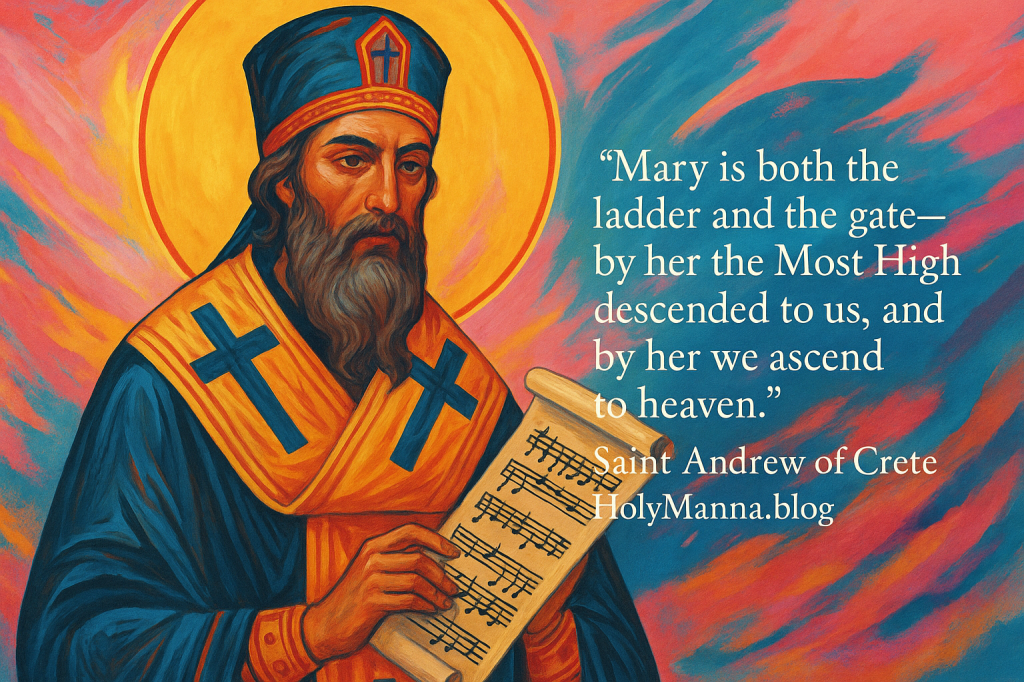
A Saint Who Sang with the Voice of Angels
Among the greatest hymnographers of the Church, Saint Andrew of Crete is remembered not only for his poetic genius but for his profound love for Christ and the beauty of the liturgy. Known as the Father of the Canon, Andrew left a legacy of sacred music and theological insight that continues to resonate through the Eastern Catholic and Orthodox liturgies to this day. He is especially famous for composing the Great Canon, a lengthy hymn of repentance still sung during the first week of Lent in many Eastern Christian traditions. Saint Andrew’s words are not mere ornament; they are arrows that pierce the heart, drawing the soul to contrition and union with God.
His feast day, celebrated in the Roman Catholic Church on July 4, reminds us that even in an age saturated with noise, the voice of one humble saint—tuned to the melody of divine truth—can still echo across the centuries. Saint Andrew is revered for his theological brilliance, his defense of the true faith, and his ability to express in song what many souls can barely express in prayer. He is a shining witness to the truth that God speaks most powerfully through those who first listen in silence.
When was the last time you allowed sacred words—not just music—to move your soul to tears?
From Silence to Song
Born around 650 A.D. in Damascus, Saint Andrew came into the world in relative obscurity. His early years were marked by a peculiar affliction: he was mute. For seven long years, the boy made no sound, not even the coo of a baby or the babble of a toddler. His parents must have prayed in confusion and sorrow, wondering what would become of their son. Then, in a moment both ordinary and miraculous, Andrew received the Holy Eucharist—and immediately began to speak.
This miracle not only gave him a voice but revealed his purpose. Entrusted at a young age to the Monastery of Saint Sabbas near Jerusalem, Andrew was formed in the furnace of monastic discipline, immersed in the Psalms, the writings of the Church Fathers, and the sacred liturgy. His intellect quickly blossomed, and by the time he reached adulthood, his eloquence and holiness were already being recognized.
Andrew was ordained a deacon in Jerusalem and later summoned to Constantinople, where he took part in the Sixth Ecumenical Council (680–681). There, he joined the defense of the orthodox belief that Christ has two wills—divine and human—as taught by the Church and confirmed in CCC 475. Andrew’s speech was so compelling, so rich in scriptural and theological depth, that he became a spiritual authority to many.
Eventually, he was appointed Archbishop of Gortyna on the island of Crete. From this relatively remote position, Andrew shepherded his flock with wisdom, fervor, and gentleness. But it was not only through preaching and governance that he reached souls—his greatest legacy remains his hymns, particularly the Great Canon, which weaves together stories from Genesis to the Gospels into one sweeping reflection on sin, grace, and redemption.
Have you ever wondered what it means to truly repent—not with fear, but with a heart full of longing for God’s mercy?
The Rainmaker of Crete
Although Saint Andrew’s life was not marked by an abundance of dramatic miracles, those that are recorded reveal a soul deeply united with God. During a terrible drought that threatened the people of Crete with famine, Andrew called the faithful together for prayer and penitence. He led them in solemn procession, chanting psalms and supplications with tears in his eyes. As the people lifted their voices with their shepherd, the heavens broke open and rain poured down upon the dry land.
To many, it was a sign that Andrew’s prayer was heard—because it was spoken from a heart purified by repentance and filled with trust. The same hands that had composed poetic lamentations now reached toward the sky in prophetic intercession. It was not showy. It was not loud. It was simple, powerful, and rooted in love.
Other stories tell of Andrew healing those suffering from illness or plague, often by anointing them with oil and praying in the name of Jesus. Yet he never claimed credit for these works. In the spirit of true Christian humility, he attributed all power and healing to God alone, echoing the words of Saint Paul: “It is no longer I who live, but Christ who lives in me” (Galatians 2:20).
Andrew teaches us that the most powerful miracles may come not from fire and thunder, but from prayerful trust and sacrificial love.
Do you believe that quiet, persistent prayer can move mountains—even the droughts of your own soul?
A Lion Among Wolves
The world Andrew inhabited was theologically and politically volatile. Heresies about the nature of Christ had deeply wounded the unity of the Church, and the seeds of iconoclasm—the rejection of sacred images—were beginning to grow. As bishop, Andrew found himself in a precarious position: to remain silent would be safer, but to speak the truth was to risk exile or worse.
He chose the truth. With the same clarity he had shown at the Ecumenical Council, Andrew defended the orthodox teachings of the Church with courage and pastoral gentleness.
There were political pressures, misunderstandings, and at times opposition from the very people he sought to serve. Yet he bore all with patience and charity. His was not a comfortable ministry, but a cruciform one. Like Christ the Good Shepherd, he laid down his life day after day for his flock—not with swords, but with psalms.
When the world tempts you to remain silent about your faith, will you speak with the voice God has given you?
The Music of Heaven
After Saint Andrew’s death—believed to be around 740 A.D.—his influence only grew. Pilgrims began visiting his tomb in Crete, many reporting healings and spiritual consolations. His relics became a source of grace, and churches throughout the region were dedicated in his honor.
But perhaps the most enduring miracle is the continued power of his Great Canon. To this day, it is chanted during Great Lent in the Byzantine tradition, often moving the faithful to deep tears of repentance. Its beauty lies in its weaving of Scripture into personal lament, drawing on examples from the lives of saints and sinners alike—from David to Peter, Rahab to the Prodigal Son.
One story from the 12th century tells of a monk who had abandoned his vocation and fell into grave sin. One evening, he stumbled into a church where Saint Andrew’s Great Canon was being sung. The sheer sorrow and beauty of the words overwhelmed him. He wept uncontrollably, confessed his sins, and returned to the monastic life. He later claimed that he felt as if Andrew himself had been there, singing the canon with him, leading him back to God.
The music Saint Andrew composed was never meant for entertainment—it was medicine for the soul. And its healing continues.
What might happen if you let the sacred words of the Church echo within your heart this week?
A Voice to Stir the Soul
Saint Andrew of Crete reminds us that every voice, no matter how small or silent at first, can be made into an instrument of divine beauty. Born mute, he became one of the Church’s greatest hymnographers. Humble in station, he shook the heavens with his prayers.
In our time, when liturgy is often hurried or overlooked, Andrew invites us to rediscover its power—not as routine, but as revelation. His life is a call to repentance, to reverence, and to reclaiming the beauty of our Catholic faith. The Great Canon is not only a poetic masterpiece; it is a mirror held up to the soul, calling us to conversion not with fear, but with longing.
Are you willing to let sacred words draw you closer to Christ? Will you allow the rhythm of the Church’s prayer to become the heartbeat of your life? Will you sing—not necessarily with your voice, but with your life—the mercy of God?
Saint Andrew shows us how: “I have made myself a vessel of defilement, a dwelling-place of the passions. But accept me in repentance, O God of all.”
What song is your life singing to the Lord today?
Engage with Us!
What do you think of Saint Andrew of Crete’s journey from silence to sacred song? How has sacred music or liturgy stirred your soul? Let’s talk about it in the comments below.
Here are some questions to guide your reflection:
- How can I allow the beauty of sacred music to deepen my relationship with Christ?
- Am I making space in my life for true repentance and interior conversion?
- What gifts or talents has God given me that I can use for His glory, as Saint Andrew did?
Let us continue to support one another in this walk of faith, sharing our joys and struggles, and striving to do everything with love—just as our Lord Jesus Christ did.
Saint Andrew of Crete, pray for us! 🎶
Follow us on Instagram and Facebook for more insights and reflections on living a faith-filled life.

 Holy Manna!
Leave a comment