Friday of the Thirteenth Week in Ordinary Time – Lectionary: 381
Mercy in the Midst of Transition
Have you ever stood at the crossroads of grief and hope, unsure how to take the next step? Today’s readings meet us right there—in the messiness of life’s transitions, where sorrow, uncertainty, and divine invitation intersect. Whether we are mourning a loss, stepping into a new vocation, or facing our own sinfulness, the Lord is always near, gently leading us forward. Through Abraham’s mourning, Isaac’s marriage, the psalmist’s yearning, and Matthew’s conversion, we witness a God who does not abandon us in times of change, but instead draws near with healing, promise, and mercy.
The central theme woven through today’s readings is this: God’s mercy prepares and provides for new beginnings. In Genesis, Abraham has just lost his beloved Sarah and begins a new chapter for his family by securing a burial place and preparing a future for Isaac through marriage—actions that preserve both memory and covenant. This wasn’t just cultural custom; it was an act of faith. Abraham believed in the promise God made—that his descendants would inherit the land—and he trusted that even in grief, God’s purposes would prevail. Similarly, in Psalm 106, we hear a communal cry for mercy—a recognition that while Israel has sinned, God’s steadfast love endures. The psalmist doesn’t dwell in guilt but pleads to be remembered, to rejoice in the joy of God’s chosen people.
Then we arrive at The Gospel of Matthew, where mercy takes on flesh. Jesus sees a tax collector—a man despised, excluded, and dismissed by religious leaders—and says simply, “Follow me”. In that moment, Matthew’s life changes forever. The religious elite scoff, but Jesus responds with one of the most stunning truths in Scripture: “I desire mercy, not sacrifice”. Just as Abraham trusted God in the twilight of his life, and the psalmist cried out for grace, Jesus extends a personal, healing call to a sinner—and by doing so, invites us all to trust that God’s mercy is the true beginning of every transformation. What new beginning might God be calling you into today?
First Reading – Genesis 23:1–4, 19; 24:1–8, 62–67
Love, Legacy, and the Lord’s Leading
This passage from Genesis offers a beautiful window into the heart of Abraham’s final years—a time marked by loss, hope, obedience, and divine promise. The Book of Genesis, as the first book of the Bible, lays the theological foundation for salvation history. In today’s reading, we see Abraham transitioning from mourning the death of his beloved wife Sarah to securing the covenantal future of his son Isaac. The cultural practice of burial, marriage arrangements, and lineage takes center stage here, but with a deeply spiritual dimension: Abraham acts not simply as a father, but as a man clinging to God’s promises even when life shifts beneath his feet. This narrative reminds us that grief does not cancel calling. In fact, through grief, Abraham becomes a vessel of hope for the next generation. This perfectly ties into today’s theme—God’s mercy prepares and provides for new beginnings.
Genesis 23:1-4, 19; 24:1-8, 62-67
New American Bible (Revised Edition)
Purchase of a Burial Plot. 23:1 The span of Sarah’s life was one hundred and twenty-seven years. 2 She died in Kiriath-arba—now Hebron—in the land of Canaan, and Abraham proceeded to mourn and weep for her. 3 Then he left the side of his deceased wife and addressed the Hittites: 4 “Although I am a resident alien among you, sell me from your holdings a burial place, that I may bury my deceased wife.”
19 After this, Abraham buried his wife Sarah in the cave of the field of Machpelah, facing Mamre—now Hebron—in the land of Canaan.
Isaac and Rebekah. 24:1 Abraham was old, having seen many days, and the Lord had blessed him in every way. 2 Abraham said to the senior servant of his household, who had charge of all his possessions: “Put your hand under my thigh, 3 and I will make you swear by the Lord, the God of heaven and the God of earth, that you will not take a wife for my son from the daughters of the Canaanites among whom I live, 4 but that you will go to my own land and to my relatives to get a wife for my son Isaac.” 5 The servant asked him: “What if the woman is unwilling to follow me to this land? Should I then take your son back to the land from which you came?” 6 Abraham told him, “Never take my son back there for any reason! 7 The Lord, the God of heaven, who took me from my father’s house and the land of my relatives, and who confirmed by oath the promise he made to me, ‘I will give this land to your descendants’—he will send his angel before you, and you will get a wife for my son there. 8 If the woman is unwilling to follow you, you will be released from this oath to me. But never take my son back there!”
62 Meanwhile Isaac had gone from Beer-lahai-roi and was living in the region of the Negeb. 63 One day toward evening he went out to walk in the field, and caught sight of camels approaching. 64 Rebekah, too, caught sight of Isaac, and got down from her camel. 65 She asked the servant, “Who is the man over there, walking through the fields toward us?” “That is my master,” replied the servant. Then she took her veil and covered herself.
66 The servant recounted to Isaac all the things he had done. 67 Then Isaac brought Rebekah into the tent of his mother Sarah. He took Rebekah as his wife. Isaac loved her and found solace after the death of his mother.
Detailed Exegesis
Verse 1 – “The span of Sarah’s life was one hundred and twenty-seven years.”
Sarah’s age is uniquely recorded in its entirety—an honor given to no other woman in Scripture. This detail reflects the biblical reverence for Sarah as the matriarch of Israel. Her full life and peaceful death affirm the fruitfulness of her faith and obedience.
Verse 2 – “She died in Kiriath-arba—now Hebron—in the land of Canaan, and Abraham proceeded to mourn and weep for her.”
This verse humanizes Abraham. He weeps. He grieves. Despite being a towering figure of faith, he mourns like any husband would. Hebron is significant—it becomes a sacred site, anchoring Israel’s physical and spiritual heritage in the Promised Land.
Verse 3 – “Then he left the side of his deceased wife and addressed the Hittites:”
Abraham’s sorrow does not immobilize him. He rises from his mourning to negotiate with the Hittites, signaling a turn from loss to action—a faith-filled step into legacy planning.
Verse 4 – “Although I am a resident alien among you, sell me from your holdings a burial place, that I may bury my deceased wife.”
Here we see Abraham’s humility and foreignness. Though promised this land by God, he still has to ask for a piece of it. This act of purchasing land legally establishes a foothold in the Promised Land—an early sign of God’s covenant unfolding.
Verse 19 – “After this, Abraham buried his wife Sarah in the cave of the field of Machpelah, facing Mamre—now Hebron—in the land of Canaan.”
The cave of Machpelah becomes Israel’s first family tomb. Generations will be buried here—Abraham, Isaac, Rebekah, Jacob, and Leah—transforming it into a tangible reminder of divine promise.
Verse 1 (Chapter 24) – “Abraham was old, having seen many days, and the Lord had blessed him in every way.”
The text sets the tone for the next act of obedience. Abraham’s age and accumulated blessings indicate God’s enduring faithfulness, despite the uncertainties he still faces.
Verse 2 – “Abraham said to the senior servant of his household, who had charge of all his possessions: ‘Put your hand under my thigh,’”
This ancient gesture symbolized a solemn oath, invoking the bearer’s responsibility in the continuation of Abraham’s line. Abraham entrusts this mission to his most faithful servant.
Verse 3 – “…and I will make you swear by the Lord, the God of heaven and the God of earth, that you will not take a wife for my son from the daughters of the Canaanites among whom I live,”
Abraham insists on preserving the sanctity of God’s covenant. Canaanite women worshipped foreign gods. To ensure Isaac’s faith remains rooted in Yahweh, his wife must come from Abraham’s own people.
Verse 4 – “…but that you will go to my own land and to my relatives to get a wife for my son Isaac.”
This directive is not just cultural—it’s covenantal. Marriage is seen not only as union but as the continuation of divine mission.
Verse 5 – “The servant asked him: ‘What if the woman is unwilling to follow me to this land? Should I then take your son back to the land from which you came?’”
The servant’s question is practical. What if the plan fails? But it also reveals Abraham’s concern: the Promised Land is not to be abandoned. His descendants must remain in the space God designated.
Verse 6 – “Abraham told him, ‘Never take my son back there for any reason!’”
This emphatic response highlights Abraham’s unwavering commitment. He trusts that God will provide. Returning to the old land would be regressive—faith must move forward.
Verse 7 – “The Lord, the God of heaven…He will send his angel before you, and you will get a wife for my son there.”
Abraham speaks with prophetic confidence. God has led him this far—surely He will not abandon him now. The angel represents divine orchestration, showing that even personal matters like marriage fall under God’s providence.
Verse 8 – “If the woman is unwilling to follow you, you will be released from this oath to me. But never take my son back there!”
Abraham gives the servant an out, but never compromises on the central truth: Isaac must remain in the land of promise. God’s word is the anchor, not convenience.
Verse 62 – “Meanwhile Isaac had gone from Beer-lahai-roi and was living in the region of the Negeb.”
Isaac’s location sets the stage. Beer-lahai-roi, meaning “well of the Living One who sees me,” reminds us of Hagar’s encounter with God. Isaac, like his father, is in a place touched by divine presence.
Verse 63 – “One day toward evening he went out to walk in the field, and caught sight of camels approaching.”
This evening walk signals contemplation. In biblical imagery, twilight is often a time of encounter. Isaac is about to receive a divine gift in the form of his wife.
Verse 64 – “Rebekah, too, caught sight of Isaac, and got down from her camel.”
Her gesture is one of respect and readiness. Both parties see each other before words are exchanged—an immediate, almost sacred recognition.
Verse 65 – “She asked the servant, ‘Who is the man over there, walking through the fields toward us?’ ‘That is my master,’ replied the servant. Then she took her veil and covered herself.”
The veil was a symbol of modesty and bridal preparation. Rebekah recognizes that her life is about to change. She humbles herself before her future husband.
Verse 66 – “The servant recounted to Isaac all the things he had done.”
This recounting validates the process. God’s hand is visible in every step, and the servant becomes a witness to divine fulfillment.
Verse 67 – “Then Isaac brought Rebekah into the tent of his mother Sarah. He took Rebekah as his wife. Isaac loved her and found solace after the death of his mother.”
Love blossoms. Rebekah becomes not just a wife, but a comforter. Her presence helps heal the wound left by Sarah’s passing. A new chapter begins—not in erasing the past, but by honoring it.
Teachings of the Church
The Catechism of the Catholic Church affirms the sanctity and covenantal nature of marriage. In CCC 1612, we read: “The nuptial covenant between God and his people Israel had prepared the way for the new and everlasting covenant in which the Son of God, by becoming incarnate and giving his life, has united to himself in a certain way all mankind saved by him…”. The story of Isaac and Rebekah prefigures this. Their union is not only romantic but salvific, serving as a step in the divine plan that would culminate in Christ.
Saint John Chrysostom, reflecting on Christian marriage, reminds us: “Marriage is a mystery of love. It is the image of the union of Christ and His Church… It is not a mere contract, but a spiritual reality pointing beyond itself.” Abraham’s insistence on choosing the right spouse for Isaac models for us the responsibility of family to protect the spiritual future of its children. Rebekah’s willing response to leave her homeland also mirrors Mary’s fiat—both women played critical roles in salvation history through trust and surrender.
Historically, the cave of Machpelah remains a symbol of faith for Jews, Christians, and Muslims alike. It is a place of memory, promise, and presence. Abraham’s purchase of the land shows how even acts of practical foresight—buying a burial plot or arranging a marriage—can be imbued with theological significance when done in obedience to God’s word.
Reflection
This reading invites us to reflect on how we respond to change and loss. Do we grieve with hope, like Abraham? Do we trust God enough to step into unfamiliar territory, like Rebekah? Do we make decisions grounded in divine truth, not just social norms? Our lives are often a mix of endings and beginnings, but as this passage shows, God is present in both. His mercy is not just for the spiritually dramatic—it’s for the daily, difficult steps of faith and obedience.
How might God be asking you to trust Him more deeply today? Are there areas where you are being called to obedience even in uncertainty? Like Abraham, we can choose to act in faith while still feeling the ache of sorrow. Like Isaac, we can be open to receiving love and healing when we least expect it. And like Rebekah, we can cover ourselves in humility and walk boldly into the future God has prepared.
Responsorial Psalm – Psalm 106:1–5
Mercy Remembered, Mercy Desired
The Book of Psalms is often called the prayer book of the Church—and for good reason. It captures the full range of human emotion in relationship with God: praise, lament, thanksgiving, and petition. Psalm 106 is a historical psalm, recounting the unfaithfulness of Israel and the enduring mercy of God. Today’s verses are taken from the opening of that psalm, and they offer a communal confession and plea for grace. In the context of today’s readings, these verses serve as the emotional and spiritual heartbeat of the theme: God’s mercy prepares and provides for new beginnings. Abraham’s trust in God’s promises, Isaac’s readiness to receive love, and Matthew’s call from sin all mirror the yearning captured in this psalm—the cry of a soul who knows it needs the Lord’s mercy to start again.
Psalm 106:1-5
New American Bible (Revised Edition)
Israel’s Confession of Sin
1 Hallelujah!
Give thanks to the Lord, who is good,
whose mercy endures forever.
2 Who can recount the mighty deeds of the Lord,
proclaim in full God’s praise?
3 Blessed those who do what is right,
whose deeds are always just.
4 Remember me, Lord, as you favor your people;
come to me with your saving help,
5 That I may see the prosperity of your chosen ones,
rejoice in the joy of your people,
and glory with your heritage.
Detailed Exegesis
Verse 1 – “Hallelujah! Give thanks to the Lord, who is good, whose mercy endures forever.”
This verse begins with the exclamation “Hallelujah!”, a Hebrew word meaning “Praise the Lord!” The psalmist invites the whole community to give thanks—not merely because of what God has done, but because of who He is: good and merciful. The phrase “whose mercy endures forever” echoes throughout Scripture, forming a refrain that defines God’s identity in covenant love (hesed in Hebrew).
Verse 2 – “Who can recount the mighty deeds of the Lord, proclaim in full God’s praise?”
This rhetorical question emphasizes the infinite majesty of God’s actions. His deeds are beyond human comprehension or recounting. This verse humbles the speaker while simultaneously magnifying God, setting the tone for honest confession and reverent awe.
Verse 3 – “Blessed those who do what is right, whose deeds are always just.”
Here, the psalmist shifts to moral exhortation. Holiness is not abstract; it is lived in just actions. The word “blessed” connects to Jesus’ beatitudes in The Gospel of Matthew—God’s favor rests on those who live in righteousness. In light of Israel’s past failures, this verse also reflects a longing to be that kind of faithful person.
Verse 4 – “Remember me, Lord, as you favor your people; come to me with your saving help,”
This is a deeply personal cry. The speaker knows that salvation is not earned but granted by divine favor. To be remembered by God is to be embraced by His mercy and brought back into right relationship. The psalmist places his hope not in his own merit but in God’s covenant love.
Verse 5 – “That I may see the prosperity of your chosen ones, rejoice in the joy of your people, and glory with your heritage.”
The final verse expresses the desire not just for personal salvation, but for inclusion in the community of the faithful. The speaker longs to rejoice with God’s people, to share in their blessings, and to take part in the inheritance of grace. This echoes our ultimate calling—to share in the communion of saints and the joy of heaven.
Teachings of the Church
The Catechism of the Catholic Church speaks often of God’s mercy as foundational to our relationship with Him. In CCC 210, it affirms: “After Israel’s sin, when the people had turned away from God to worship the golden calf, God hears Moses’ prayer of intercession and agrees to walk in the midst of an unfaithful people, thus demonstrating his love. When Moses asks to see his glory, God responds ‘I will make all my goodness pass before you, and will proclaim before you my name ‘the LORD’…’ The Lord passed before him and proclaimed, ‘The LORD, the LORD, a God merciful and gracious, slow to anger, and abounding in steadfast love and faithfulness.’” This mercy, described in Psalm 106, is not soft sentiment—it is God’s covenant fidelity even in the face of human failure.
Saint Augustine once wrote: “The confession of evil works is the first beginning of good works.” This psalm, beginning with praise and moving into petition, embodies this Augustinian truth. Before recounting Israel’s many failures, the psalmist anchors everything in God’s unchanging goodness. It reminds us that we are not defined by our sin, but by the God who redeems us.
Liturgically, the Church frequently uses psalms like this during penitential seasons such as Lent, not just to dwell on sin but to magnify mercy. The psalmist’s desire to be included in the joy of God’s people points us toward the Eucharist, where we are made one body in Christ through His sacrifice. As CCC 1391 teaches: “Holy Communion augments our union with Christ. The principal fruit of receiving the Eucharist in Holy Communion is an intimate union with Christ Jesus… He who eats my flesh and drinks my blood abides in me, and I in him.” This union is the ultimate fulfillment of the psalmist’s cry to “glory with your heritage.”
Reflection
This psalm invites us to become people who remember and rejoice. We remember God’s mercy not to wallow in guilt, but to rise with gratitude. We rejoice not because we have earned anything, but because we are invited into a love we cannot lose. When was the last time you truly asked God to “remember” you—not out of fear, but out of desire for closeness? Do you believe that God’s mercy is personal, lasting, and ready for you today?
Let today’s verses stir in you a hunger for justice, joy, and mercy. Be the one who gives thanks, who recalls His mighty deeds, who dares to ask for saving help—not as one abandoned, but as one already chosen. And when you find yourself stumbling, let this psalm be your prayer: “Give thanks to the Lord, who is good, whose mercy endures forever.”
Holy Gospel – Matthew 9:9–13
Called from the Margins, Healed by Mercy
The Gospel of Matthew was written with a Jewish audience in mind, emphasizing how Jesus fulfills the Law and the Prophets. It is rich with references to Old Testament Scripture and Jewish tradition, presenting Jesus as the long-awaited Messiah and divine teacher. In today’s Gospel, we encounter a personal moment of transformation: the calling of Matthew the tax collector. Tax collectors were among the most despised figures in Jewish society. Seen as collaborators with the Roman oppressors and often corrupt, they were socially and religiously ostracized. Yet it is precisely to such a man that Jesus says, “Follow me.” The call is startling not only for its direction but for what it reveals about the heart of Christ. This passage echoes the theme running through all of today’s readings: God’s mercy prepares and provides for new beginnings—not just for patriarchs and prophets, but for sinners and outcasts too.
Matthew 9:9-13
New American Bible (Revised Edition)
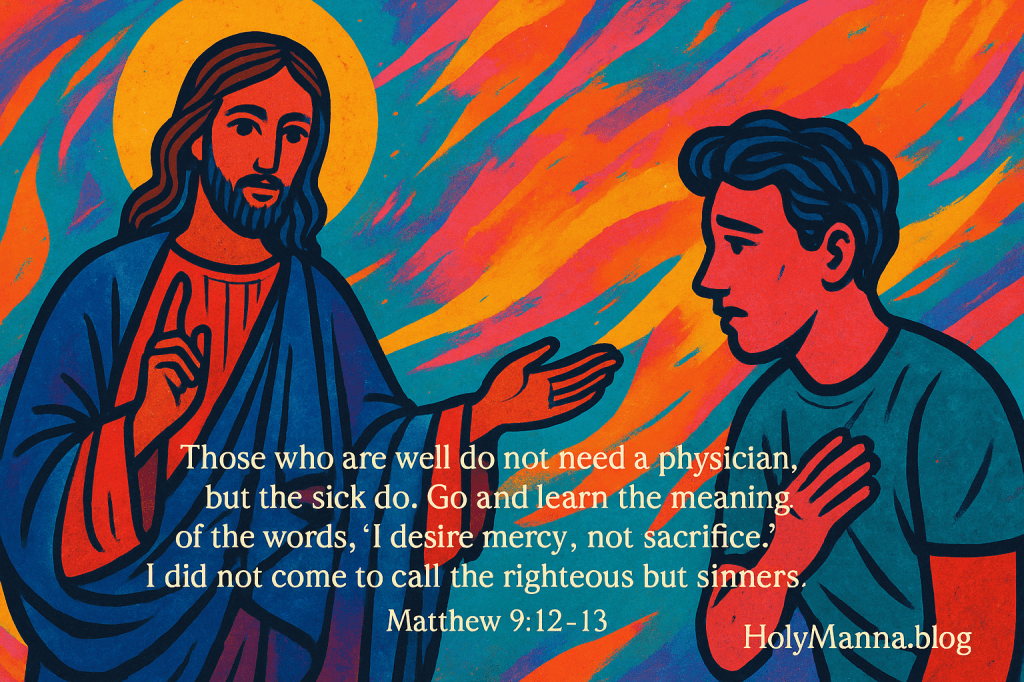
9 As Jesus passed on from there, he saw a man named Matthew sitting at the customs post. He said to him, “Follow me.” And he got up and followed him. 10 While he was at table in his house, many tax collectors and sinners came and sat with Jesus and his disciples. 11 The Pharisees saw this and said to his disciples, “Why does your teacher eat with tax collectors and sinners?” 12 He heard this and said, “Those who are well do not need a physician, but the sick do. 13 Go and learn the meaning of the words, ‘I desire mercy, not sacrifice.’ I did not come to call the righteous but sinners.”
Detailed Exegesis
Verse 9 – “As Jesus passed on from there, he saw a man named Matthew sitting at the customs post. He said to him, ‘Follow me.’ And he got up and followed him.”
This verse is as brief as it is profound. Jesus sees Matthew—not just physically, but spiritually. He sees beyond his occupation and public shame. With the words “Follow me”, Jesus offers Matthew a new identity and purpose. The immediacy of Matthew’s response—“he got up and followed him”—demonstrates radical obedience and openness to grace. In biblical Greek, the word for “got up” (ἀνίστημι) is often used in resurrection contexts, hinting that Matthew experiences a kind of spiritual rising.
Verse 10 – “While he was at table in his house, many tax collectors and sinners came and sat with Jesus and his disciples.”
This verse shows Jesus not just calling sinners but dwelling with them. Table fellowship in Jewish culture symbolized intimacy, acceptance, and belonging. Jesus breaks through social barriers by reclining at a meal with those considered impure, illustrating that His mercy is not just extended—it is embodied.
Verse 11 – “The Pharisees saw this and said to his disciples, ‘Why does your teacher eat with tax collectors and sinners?’”
The Pharisees, devoted to ritual purity and the Law, are scandalized. From their perspective, Jesus is violating religious boundaries. Their question reveals their hardened hearts and misunderstanding of holiness—they fail to see that mercy is not a compromise of righteousness but its fulfillment.
Verse 12 – “He heard this and said, ‘Those who are well do not need a physician, but the sick do.’”
Jesus responds with a parable-like proverb. He reveals His mission as healer, not enforcer. His presence among sinners is not approval of sin but a sign of divine remedy. This line echoes Isaiah 53, where the Suffering Servant bears the infirmities of the people.
Verse 13 – “Go and learn the meaning of the words, ‘I desire mercy, not sacrifice.’ I did not come to call the righteous but sinners.”
Jesus quotes Hosea 6:6, confronting the Pharisees with Scripture they profess to know. “I desire mercy, not sacrifice” calls out hollow religiosity. True worship is not about external ritual alone, but interior transformation. Jesus clarifies His mission: to call those in need of grace. The irony is that all are in need—but only the humble will admit it.
Teachings of the Church
The Catechism of the Catholic Church beautifully teaches that God’s mercy is the foundation of our hope. In CCC 1846, it states: “The Gospel is the revelation in Jesus Christ of God’s mercy to sinners. The angel announced to Joseph: ‘You shall call his name Jesus, for he will save his people from their sins.’ The same is true of the Eucharist, the sacrament of redemption: ‘This is my blood of the covenant, which is poured out for many for the forgiveness of sins.’” Matthew’s call is not an isolated event—it is a microcosm of the entire Gospel message.
Saint Bede the Venerable comments on this passage with awe: “Jesus saw the tax collector and because he saw him through the eyes of mercy and chose him, he said to him, ‘Follow me.’ This following meant imitating the pattern of his life—not just walking after him.” This insight emphasizes that our response to Jesus must go beyond admiration; it must lead to transformation.
Pope Francis has frequently referred to this Gospel in his teachings on mercy. In Misericordiae Vultus, he writes: “Jesus affirms that mercy is not only an action of the Father, it becomes a criterion for ascertaining who his true children are. In short, we are called to show mercy because mercy has first been shown to us.” This Gospel compels the Church to be a field hospital, a place where sinners are not shamed but healed.
Reflection
Jesus did not come to call the perfect. He came for people like Matthew—people like us—flawed, broken, misunderstood, and longing to be seen. Have you allowed yourself to be seen by Jesus? Not just in your best moments, but in your most shameful and hidden ones? His invitation, “Follow me,” still echoes today. It is a summons to rise from whatever keeps us chained and walk in the freedom of mercy.
What tables are you being called to sit at? Who are the “sinners” you are tempted to judge or avoid? Today’s Gospel invites us to imitate Jesus not just in word, but in action. Sit with the broken. Speak with kindness. Call people by name. And above all, never forget that holiness begins not with pride, but with the humility to be healed. In a world that celebrates image over interior renewal, Jesus still chooses mercy—and He still chooses you.
Grace at the Threshold
Today’s readings lead us through the quiet, sacred terrain of transition—the kind that reshapes our hearts and reorients our lives. From Abraham mourning Sarah and preparing Isaac for covenantal legacy, to the psalmist’s longing cry for mercy and inclusion, to Jesus’ radical call to Matthew in the midst of sin and rejection—each moment is charged with divine invitation. The Lord does not wait for us to have it all figured out. Instead, He steps into our grief, our hesitation, and our guilt, offering the same promise again and again: “I desire mercy, not sacrifice” (Matthew 9:13).
This is a mercy that anchors us when we feel lost, uplifts us when we are burdened, and sends us out when we’re unsure of the way. Abraham’s hope amid sorrow, Rebekah’s trust in leaving home, the psalmist’s yearning to rejoice with God’s people, and Matthew’s immediate response to Jesus—all point us toward a deeper truth: God’s mercy prepares and provides for new beginnings. Each of us stands at some threshold today. Whether it’s a small choice, a major life shift, or a need for healing, the Lord is present—patiently waiting for our “yes.”
What new beginning is the Lord placing before you today? Are you willing to rise, like Matthew, and follow Him? Don’t be afraid of the unknown. Instead, lean into the mercy that never ends and the love that never fails. God doesn’t just call the righteous—He calls the willing. Let today be the day you answer Him. Let today be the day you trust in His mercy and walk forward into grace.
Engage with Us!
We’d love to hear how today’s readings spoke to your heart. Share your thoughts, insights, or prayers in the comments below—we’re journeying together as a community of faith. Let these reflection questions guide your prayer and inspire deeper conversation with the Lord and one another.
First Reading – Genesis 23:1–4, 19; 24:1–8, 62–67
What part of Abraham’s trust in God challenges or inspires you most? How do you respond to change, especially when it comes through sorrow or uncertainty? In what ways can you, like Rebekah, courageously say “yes” to God’s call—even when the path is unfamiliar?
Responsorial Psalm – Psalm 106:1–5
How often do you stop to remember and give thanks for God’s mercy in your life? Do you believe that you are included among God’s “chosen ones” and “heritage”? Why or why not? What does it mean for you personally to ask God to “remember” you today?
Holy Gospel – Matthew 9:9–13
How do you relate to Matthew in this passage? Is there someone in your life you tend to judge rather than invite to the table of mercy? What is Jesus asking you to leave behind so that you can follow Him more fully?
Let’s walk in faith today, trusting that every sorrow, every step, and every “yes” becomes holy when it is offered with love. May we live boldly, love mercifully, and follow Jesus with hearts wide open.
Follow us on Instagram and Facebook for more insights and reflections on living a faith-filled life.

 Holy Manna!
Leave a comment