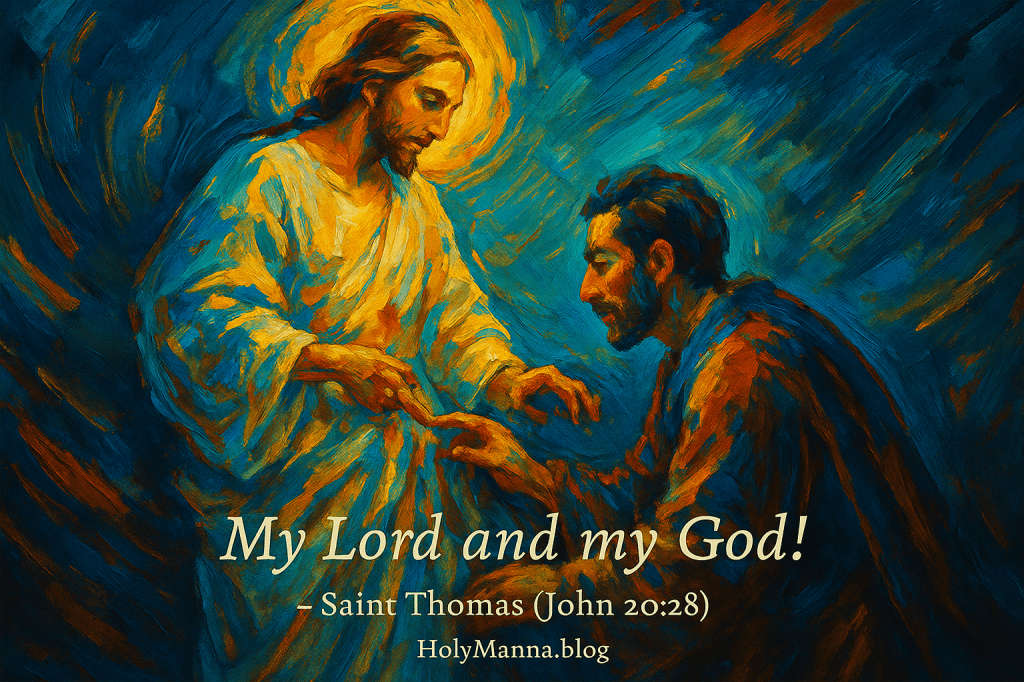
From Doubt to Devotion
The Bold Faith of Saint Thomas the Apostle
Saint Thomas the Apostle, one of the original Twelve chosen by Jesus Christ, stands as a towering figure in both the Gospels and Church tradition—not because he was perfect, but because he was human. He is best known for his bold skepticism when he heard of the Resurrection, and yet, his words—“My Lord and my God!” (John 20:28)—became one of the most profound declarations of faith in the entire New Testament. While the world remembers him as “Doubting Thomas,” the Church venerates him as a martyr, a missionary, and a man of deep conviction who proclaimed the Gospel to the very ends of the earth. His legacy is especially cherished in India, where Christian communities continue to thrive, tracing their roots back to his evangelization. Saint Thomas teaches us that faith is not the absence of doubt, but the courage to seek truth and surrender once it is found. In the tapestry of Apostolic witness, his thread may be woven with initial uncertainty, but it shines just as brightly with faith and fire.
The Twin Who Followed the Way of the Cross
Though the Scriptures do not give many personal details about Saint Thomas’ upbringing, we know he was a Jew from Galilee. His Aramaic name “Thomas” and its Greek equivalent “Didymus” both mean “twin,” though the identity of his sibling, if he had one, is never revealed. He was likely a fisherman or tradesman when Christ called him to be among the Twelve. From the start, Thomas displayed a character of loyalty mixed with inquisitiveness. In John 11:16, when Jesus decides to return to Judea to visit Lazarus despite death threats, Thomas speaks up: “Let us also go, that we may die with him.” These words, often overlooked, reveal a man willing to walk into danger for the sake of his Teacher.
His most iconic moment comes after the Resurrection in John 20:24–29. When the other Apostles tell him they have seen the risen Lord, Thomas refuses to believe unless he sees and touches Jesus’ wounds. Christ, in His mercy, grants Thomas this very grace, appearing eight days later and inviting him to do just that. But Thomas doesn’t even need to touch. At the sight of Jesus, he collapses into one of the clearest and most beautiful professions of Jesus’ divinity: “My Lord and my God!” In that moment, the Apostle who needed evidence becomes the Apostle who utters eternity’s greatest truth.
According to ancient tradition, after Pentecost, Saint Thomas traveled far east, eventually reaching the Malabar Coast of India. There he spread the Gospel with zeal, founding Christian communities that exist to this day. The Syro-Malabar and Syro-Malankara Catholic Churches honor him as their spiritual father. From the shores of Galilee to the coasts of India, Thomas the Apostle lived and died proclaiming the Name he once hesitated to believe.
The Apostle Who Built with Faith, Not Stone
Though the canonical Gospels do not record miracles performed by Saint Thomas, extra-biblical writings such as the Acts of Thomas—an early Christian text—recount numerous wonders attributed to him. These traditions, while not part of the Scriptural canon, were treasured by early Christian communities and continue to inspire the faithful, particularly in India and the Middle East.
One of the most beloved stories involves a king in India who commissioned Thomas to build him a palace. The Apostle accepted the king’s gold but gave it all to the poor. When the king later discovered there was no palace built, he summoned Thomas to answer for his deception. Thomas calmly explained that the palace he had built was not on earth, but in heaven. Initially enraged, the king later came to believe after a vision confirmed the Apostle’s words. This miracle not only displays Thomas’ boldness but illustrates how the true dwelling place of the faithful is not of this world.
In another account, Thomas healed the sick and cast out demons in the name of Jesus. He was known for baptizing large crowds and preaching the Gospel with such authority that entire villages were converted. These miracles were never performed for show or acclaim but always to bring glory to Christ and to draw hearts to salvation. They reflect the deep faith of an Apostle who no longer needed to touch the wounds of Jesus to believe in His power—because now, Thomas bore that power within him.
The Martyr Whose Blood Became Seed for the Church
Preaching the Gospel in a foreign land often comes with great risk, and Saint Thomas knew this well. His mission in India was met not only with curiosity and openness but also with resistance and hostility, particularly from local rulers who viewed his message as a threat to their power and religious authority.
Tradition holds that Saint Thomas was martyred near present-day Chennai, India. While there are variations in the details, the most consistent account says he was pierced through with spears while praying at a hilltop shrine. The very man who once placed his hand into Christ’s wounded side now bore the wounds of Christ in his own body. His martyrdom was not an act of defeat but the crowning of a life poured out for the Gospel. As Tertullian wrote, “The blood of the martyrs is the seed of the Church.” Thomas’ blood watered the soil of India, giving rise to generations of Christian faith.
Even in the face of death, Thomas remained unwavering. He had seen the Risen Lord. He had touched the marks of crucifixion. No earthly threat could silence the fire that now lived in his heart. His martyrdom, far from silencing his message, only amplified it—echoing through the centuries in every act of faith, every profession of belief, every time someone dares to say, “My Lord and my God.”
The Apostle Whose Tomb Still Draws Pilgrims
After his death, the faithful began to venerate Saint Thomas as a powerful intercessor and miracle-worker. His tomb in Mylapore, now part of Chennai, became a place of pilgrimage, healing, and wonder. From early Christian times to the present day, miracles have been reported by those who seek his intercession at this sacred site.
One of the most significant moments in the history of his posthumous veneration occurred in the 16th century. Portuguese explorers arrived on the Indian coast and rediscovered the tomb of Saint Thomas. They found inscriptions and relics that confirmed a long-standing Christian presence, predating their arrival by over a millennium. The explorers built the San Thome Basilica over the Apostle’s tomb—a beautiful structure that still stands today, welcoming thousands of pilgrims from all over the world.
Miraculous healings, conversions, and spiritual awakenings have been reported at the site. Testimonies tell of physical ailments cured, hearts converted, and prayers answered through the intercession of the Apostle. His relics are honored not only in India but in various parts of the world, including Italy and Iraq, where other relics were transferred in the early centuries.
Through these miracles, Saint Thomas continues to be a channel of God’s grace. His bones may rest in the earth, but his voice still proclaims the glory of the risen Lord.
The Saint Who Speaks to Every Honest Seeker
Saint Thomas is a saint for the honest doubter, for the wounded believer, and for the restless heart that longs to be sure. His life teaches us that God is not afraid of our questions. In fact, He invites them. When Thomas expressed his doubt, Jesus did not scold him. He came close. He offered His wounds. He let Thomas touch the truth.
This intimacy changed Thomas forever. His doubt did not disqualify him—it was the very soil in which faith took root. That is the grace of our God. As the Catechism of the Catholic Church reminds us, “Faith is a personal act—the free response of the human person to the initiative of God who reveals himself” (CCC 166). Saint Thomas gave that response with all his heart, and he challenges us to do the same.
Do you wrestle with questions about your faith?
Have you been tempted to walk away because you couldn’t see or feel God’s presence?
Bring those wounds to the Lord, as Thomas did. Let Him show you His.
In a world full of uncertainties, Saint Thomas invites us to anchor ourselves in the one unshakable truth: that Jesus Christ is Lord. Let us make his words our own: “My Lord and my God!” And let us live each day with the boldness to follow, to proclaim, and to believe—no matter the cost.
Engage with Us!
We’d love to hear your thoughts about Saint Thomas the Apostle. Let’s grow together in faith by supporting and encouraging one another in the comments.
Reflection Questions:
- In what areas of your life do you find it difficult to trust in God’s plan, like Thomas at first?
- Have you ever experienced a moment when God transformed your doubt into deeper faith?
- How can you courageously share your faith with others, even when it’s unpopular or difficult?
Let’s walk this journey of faith together, and strive—like Saint Thomas—to do everything with love, as our Lord Jesus did.

 Holy Manna!
Leave a comment