Feast of Saint Thomas, Apostle – Lectionary: 593
Built to Believe: From Doubt to Dwelling
Have you ever felt like a stranger in your own story—like you’re searching for a place to belong or a truth to hold onto, but you just can’t quite grasp it? Today’s readings speak powerfully to that ache. They invite us to recognize that in Christ, we are not only given something to believe in, but a place to belong to. Through the journey of faith—from hesitant questions to bold declarations—we are being formed into something much greater than ourselves: a holy temple, a spiritual home, a dwelling place for God.
In Ephesians 2:19-22, St. Paul writes to Gentile believers who once stood on the outside of the covenant. He assures them that through Christ, they are “no longer strangers and sojourners”, but fully integrated members of God’s household. This was radical news in the first century. The early Church was navigating the tension between Jewish roots and a rapidly growing Gentile mission. Yet Paul insists that the foundation of the Church is not ethnicity, geography, or status—it is “built upon the foundation of the apostles and prophets, with Christ Jesus himself as the capstone”. This same structure, Paul says, is growing into a temple—a place where God’s Spirit dwells. The invitation is not just to believe in Christ, but to be built together in Him.
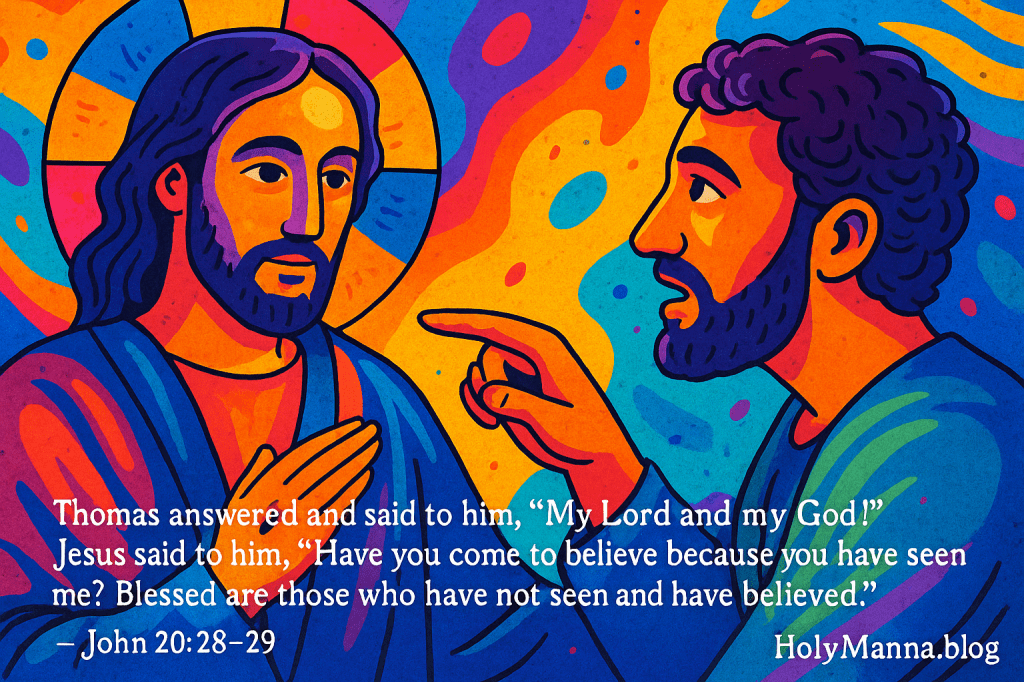
The Gospel reading from John 20:24-29 zooms in on St. Thomas, the apostle whose doubt became the doorway to one of the most profound confessions of faith: “My Lord and my God!” His story reminds us that faith isn’t a barrier-free ascent—it’s often born in the space between uncertainty and encounter. Jesus does not reject Thomas for his doubts. Instead, He meets him with wounds still visible, offering not just proof, but peace. And then comes the blessing that echoes across time to us today: “Blessed are those who have not seen and have believed.” As Psalm 117 cries out in joyful chorus, all nations are called to praise the Lord, because “His mercy for us is strong; the faithfulness of the Lord is forever.” Whether you are a questioning heart or a committed believer, these readings assure us that faith welcomes us home—and Christ Himself is the cornerstone of that home.
First Reading – Ephesians 2:19–22
From Outsiders to Living Stones
The Letter to the Ephesians is a powerful proclamation of the universal Church—a Church not limited by race, nationality, or background, but unified in Christ. Likely written while St. Paul was imprisoned (cf. Ephesians 3:1), this letter was addressed to a Gentile audience in Ephesus, a culturally diverse and religiously pluralistic city in Asia Minor. Many of these Gentile converts may have struggled with feelings of inferiority or exclusion, unsure of how they fit into the Jewish narrative of salvation history. Paul speaks directly into this tension, affirming their full inclusion into the household of God. This short passage reflects the culmination of Paul’s sweeping vision: that in Christ, all are made one, and this oneness is not theoretical—it’s architectural. The believers are quite literally being built into a spiritual temple where God dwells. This connects seamlessly to today’s Gospel, where faith—especially that which overcomes doubt—becomes the gateway into this sacred structure.
Ephesians 2:19-22
New American Bible (Revised Edition)
19 So then you are no longer strangers and sojourners, but you are fellow citizens with the holy ones and members of the household of God, 20 built upon the foundation of the apostles and prophets, with Christ Jesus himself as the capstone. 21 Through him the whole structure is held together and grows into a temple sacred in the Lord; 22 in him you also are being built together into a dwelling place of God in the Spirit.
Detailed Exegesis
Verse 19 – “So then you are no longer strangers and sojourners, but you are fellow citizens with the holy ones and members of the household of God,”
Paul uses strong, familial language here. The terms “strangers” (xenoi) and “sojourners” (paroikoi) were commonly used for those who had no legal or communal rights in a land. Now, through Christ, Gentiles are not just residents—they are citizens in God’s kingdom. Even more intimately, they are now part of God’s own household, a word that evokes both familial bonds and temple imagery.
Verse 20 – “Built upon the foundation of the apostles and prophets, with Christ Jesus himself as the capstone.”
Paul draws from the rich tradition of temple building, likening the Church to a structure founded upon the apostles and prophets. The apostles represent the New Covenant bearers of Christ’s message; the prophets point back to the Old Testament voices who prepared the way. At the center is Christ, the “capstone” (akrogōniaios), the vital stone that joins the entire structure. Without Him, the Church would collapse. This image ties beautifully with Psalm 118:22: “The stone the builders rejected has become the cornerstone.”
Verse 21 – “Through him the whole structure is held together and grows into a temple sacred in the Lord.”
This is not a static building; it’s a living, growing temple. The unity and sanctity of the Church are upheld not by human strength, but by Christ Himself. The imagery evokes the temple in Jerusalem—once the center of God’s presence among His people—but now transformed into a living temple made of believers, united and sanctified in Christ.
Verse 22 – “In him you also are being built together into a dwelling place of God in the Spirit.”
Here Paul makes it personal. “You also”—even Gentiles—are not just spectators but participants in this divine construction. The phrase “dwelling place of God” (katoikētērion tou Theou) underscores the indwelling of the Holy Spirit. This verse echoes 1 Corinthians 3:16: “Do you not know that you are God’s temple and that the Spirit of God dwells in you?”
Teachings
The Catechism of the Catholic Church confirms this deep theological truth, teaching: “In the unity of this Body, there is a diversity of members and functions. All the members are linked to one another, especially to those who are suffering, to the poor and persecuted.” (CCC 806). The Church is more than an institution; she is a living organism, held together by Christ and animated by the Holy Spirit. This aligns perfectly with Paul’s image of the Church as a growing temple—where every person, regardless of background, has a place and a purpose.
CCC 756 further explains: “The Church is the temple of the Holy Spirit. The Spirit is the soul, as it were, of the Mystical Body, the source of its life, of its unity in diversity, and of the riches of its gifts and charisms.” This divine architecture is not man-made—it is animated from within by the presence of the Spirit. Each baptized soul contributes to the strength and sanctity of the Church, much like individual stones in a temple wall.
St. Augustine reflected on this passage by calling the Church “the house of God built up of living stones.” He exhorted Christians to recognize that “you are the temple of God. Be holy, therefore, so that He may dwell in you.” His words challenge us not only to admire the architecture of God’s Church but to participate in its construction by living lives of holiness and unity. St. Cyril of Jerusalem also wrote that the baptized are like stones being shaped for the heavenly Jerusalem—each one placed carefully by the hand of the Master Builder. These insights root our identity not in private faith alone but in belonging to something sacred and communal.
Reflection
What does it mean for you to be part of God’s household? This reading reminds us that faith is not just about individual belief—it is about communion. Every moment of doubt, every act of trust, every confession of faith is like another stone being placed in the temple of God’s glory. Ask yourself: Do I live like I am part of something sacred and eternal? Do I welcome others into this household with the same mercy and unity Paul speaks of? In a world obsessed with individualism and exclusion, today’s reading is a clarion call to unity, inclusion, and sanctity. Today, let’s recommit to living as living stones, cemented in charity, aligned to Christ our capstone, and open to the Spirit who builds us together day by day.
Responsorial Psalm – Psalm 117
The Smallest Psalm with the Loudest Praise
At just two verses, Psalm 117 is the shortest chapter in the entire Bible, but its theological significance is vast. Often overlooked due to its brevity, this psalm stands as a profound and universal call to worship. Traditionally attributed to King David and situated among the Hallel Psalms (Psalms 113–118) recited during Jewish festivals such as Passover, Psalm 117 bridges the Old and New Testaments. It anticipates the day when all nations—not just Israel—would come to worship the one true God. This makes it a perfect fit for today’s readings, especially Ephesians 2, which emphasizes the full inclusion of Gentiles in the household of God. As the Church grows into a temple of the Spirit, Psalm 117 reminds us that worship is the fitting response to God’s covenantal love—open to all peoples, rooted in His eternal faithfulness.
Psalm 117
New American Bible (Revised Edition)
The Nations Called to Praise
1 Praise the Lord, all you nations!
Extol him, all you peoples!
2 His mercy for us is strong;
the faithfulness of the Lord is forever.
Hallelujah!
Detailed Exegesis
Verse 1 – “Praise the Lord, all you nations! Extol him, all you peoples!”
This opening line is astonishing in its scope. Unlike many psalms that focus on Israel’s experience of God, this one issues a summons to all nations and all peoples. The Hebrew word for “nations” (goyim) refers specifically to Gentiles. This universal invitation to praise anticipates the Catholicity of the Church—“catholic” meaning “universal.” This verse prophetically echoes the mission of the apostles to the ends of the earth and the unity described in Ephesians 2:19: “You are fellow citizens with the holy ones.”
Verse 2 – “His mercy for us is strong; the faithfulness of the Lord is forever. Hallelujah!”
Here the reason for this universal praise is declared: God’s mercy (hesed) is powerful, and His faithfulness (emet) is eternal. These two Hebrew words are deeply theological. Hesed implies covenantal love—a steadfast, loyal, and generous love that binds God to His people. Emet is God’s unchanging reliability and truth. Together, they assure both Israel and the Gentiles that God’s promises are firm and His love endures. The final “Hallelujah” is not merely a liturgical tag; it is the crescendo of praise that belongs to the God who has thrown open the gates of His household to the entire world.
Teachings
The universal call to praise in Psalm 117 is echoed and fulfilled in the life and mission of the Church. The Catechism of the Catholic Church teaches: “The Church is catholic because she has been sent out by Christ on a mission to the whole of the human race” (CCC 831). This echoes the psalm’s vision of all nations being gathered under one banner of worship. In this way, Psalm 117 prefigures Pentecost, when the apostles spoke in tongues and all nations heard the Gospel in their own language—an unmistakable sign that salvation was for all.
St. John Paul II, reflecting on this psalm, once wrote, “The brief Psalm 117 is like a spark that ignites the fire of universal praise. It teaches us that praise is not limited by borders, and the love of God is not confined to the past or to one people.” This tiny psalm stands as a spiritual lighthouse, calling in every soul from every shore to rejoice in the God who is faithful beyond time and merciful beyond measure.
Furthermore, Psalm 117 is quoted by St. Paul in Romans 15:11 as part of his argument for the inclusion of the Gentiles in salvation: “Praise the Lord, all you Gentiles, and let all the peoples praise him.” Paul recognized that the ancient Scriptures pointed forward to the day when Jew and Gentile alike would form one body in Christ. In this sense, Psalm 117 is both a prophecy and a promise. It is a scriptural glimpse of the heavenly liturgy described in Revelation 7:9, where a great multitude from every nation stands before the throne of God.
Reflection
Have you ever paused to praise God not just for what He has done in your life, but for His mercy and faithfulness to the entire world? This psalm calls us to broaden our view of God’s love and to recognize the global, eternal scope of His covenant. In your prayer today, try this: praise God not only for your personal blessings but for the quiet, unseen mercies He is showing others around the world. Praise Him for the strangers who are now family, for the doubters who are becoming believers, and for the nations who are slowly being built into His Church. Do you believe your voice matters in this chorus of praise? Because it does. Today, choose to be one of the voices that fulfills this ancient call: Praise the Lord, all you nations! Let every act of faith, no matter how small, become a hallelujah in the household of God.
Holy Gospel – John 20:24–29
Faith That Sees Beyond Sight
In the days following the Resurrection, the disciples found themselves caught between awe and uncertainty, joy and confusion. The Gospel of John, written with deep theological reflection near the end of the first century, captures this tension with vivid personal encounters between the risen Jesus and His followers. Today’s passage focuses on one such disciple: Thomas, often remembered as “Doubting Thomas.” But there is far more happening here than doubt. This Gospel scene is a window into the mercy of Christ, the nature of true belief, and the blessedness of faith that transcends physical evidence. In a cultural context where eyewitness testimony was crucial and skepticism was common in both Jewish and Greco-Roman worlds, this appearance of Jesus serves as both a consolation to Thomas and a commissioning of the Church. It teaches that even those who have not seen—namely, all generations after the apostles—are truly blessed when they believe. This Gospel brings today’s theme full circle: faith is not just about seeing with our eyes, but about being built into something holy by trusting the One who reveals Himself through love.
John 20:24-29
New American Bible (Revised Edition)
Thomas. 24 Thomas, called Didymus, one of the Twelve, was not with them when Jesus came. 25 So the other disciples said to him, “We have seen the Lord.” But he said to them, “Unless I see the mark of the nails in his hands and put my finger into the nailmarks and put my hand into his side, I will not believe.” 26 Now a week later his disciples were again inside and Thomas was with them. Jesus came, although the doors were locked, and stood in their midst and said, “Peace be with you.” 27 Then he said to Thomas, “Put your finger here and see my hands, and bring your hand and put it into my side, and do not be unbelieving, but believe.” 28 Thomas answered and said to him, “My Lord and my God!” 29 Jesus said to him, “Have you come to believe because you have seen me? Blessed are those who have not seen and have believed.”
Detailed Exegesis
Verse 24 – “Thomas, called Didymus, one of the Twelve, was not with them when Jesus came.”
Thomas is introduced here by both his name and his title. “Didymus” means “twin,” reminding us that this is a real man with a real personality. He was not present during Jesus’ first post-Resurrection appearance to the other disciples. His absence becomes spiritually significant—it reflects how easy it is to miss encounters with the risen Christ when we are isolated from the community.
Verse 25 – “So the other disciples said to him, ‘We have seen the Lord.’ But he said to them, ‘Unless I see the mark of the nails in his hands and put my finger into the nailmarks and put my hand into his side, I will not believe.’”
Thomas’s reaction is deeply human. He doesn’t reject the idea of resurrection outright, but he demands empirical evidence. His emphasis on touch reflects both his desire and his skepticism. He is not content with secondhand faith—he wants a personal encounter. His words also unintentionally highlight the bodily reality of the Resurrection. Jesus didn’t rise as a ghost or metaphor—His glorified body still bears the wounds of crucifixion.
Verse 26 – “Now a week later his disciples were again inside and Thomas was with them. Jesus came, although the doors were locked, and stood in their midst and said, ‘Peace be with you.’”
A full week passes. This detail mirrors the Christian rhythm of Sunday worship and anticipates the structure of the liturgical week. The disciples are still behind locked doors—still afraid, still unsure. Yet Jesus appears again, undeterred by physical barriers. His first words are not rebuke, but “Peace be with you.” Christ’s peace is not the absence of conflict—it is His risen presence entering our fear.
Verse 27 – “Then he said to Thomas, ‘Put your finger here and see my hands, and bring your hand and put it into my side, and do not be unbelieving, but believe.’”
Jesus directly addresses Thomas’s demand. He meets Thomas in his doubt, not to shame him but to invite him. Jesus shows that He was present even when Thomas spoke those words. His wounds become signs of victory and intimacy. The invitation is physical, but the command is spiritual: “Do not be unbelieving, but believe.” This Greek phrase can also be read as: “Do not become unfaithful, but faithful.” Jesus is not merely correcting Thomas—He is restoring him.
Verse 28 – “Thomas answered and said to him, ‘My Lord and my God!’”
This is the climax of the encounter. Thomas makes the highest confession of faith in all four Gospels. He doesn’t just call Jesus “Rabbi” or “Messiah”—he calls Him “My Lord and my God!” This declaration is profoundly theological and deeply personal. In Jewish tradition, calling someone “my God” was an act of worship. Thomas’s doubt gives way to the deepest faith—a testimony that still echoes in every Eucharistic adoration and every whispered prayer of surrender.
Verse 29 – “Jesus said to him, ‘Have you come to believe because you have seen me? Blessed are those who have not seen and have believed.’”
This final verse is not a dismissal of Thomas, but a beatitude for all future believers. Jesus blesses those who believe without visible proof. This includes every generation of Christians, including us. Faith is not blind—it is a grace-filled trust in the reliability of God’s word and the witness of His Church. This verse affirms that spiritual sight is often clearer than physical sight.
Teachings
The Catechism of the Catholic Church teaches that “Faith is the personal adherence of man to God and the free assent to the whole truth that God has revealed” (CCC 150). Thomas models this assent not in theory, but in encounter. His story shows that faith often begins in weakness but matures through grace. CCC 644 emphasizes the reality of Christ’s bodily resurrection, stating: “Even when faced with the reality of the risen Jesus the disciples are still doubtful, so impossible did the thing seem: they thought they were seeing a ghost.” Thomas, therefore, is not an outlier—he is a mirror of the early Church’s struggle to understand and believe the Resurrection.
St. Gregory the Great offers a powerful meditation on this Gospel: “It was not an accident that that particular disciple was not present. The Divine Mercy ordained that a doubting disciple should, by feeling in his Master the wounds of the flesh, heal in us the wounds of unbelief.” For Gregory, Thomas’s doubt serves a greater purpose—so that we who have not seen might be strengthened in our faith. His declaration, “My Lord and my God!”, has become a devotional prayer said silently by countless Catholics at the moment of consecration in the Mass, acknowledging the real presence of Christ in the Eucharist.
Moreover, this Gospel scene echoes the principle that faith is always a response to grace. As CCC 153 explains: “Faith is a gift of God, a supernatural virtue infused by him. Before this faith can be exercised, man must have the grace of God to move and assist him.” Thomas was not converted by his own reasoning, but by a grace-filled encounter with the risen Lord. His journey from unbelief to faith is a blueprint for every Christian: doubt is not the enemy of faith, but the soil in which authentic faith can take root—when surrendered to Christ.
Reflection
Have you ever placed conditions on your faith? Have you found yourself saying, “Unless God shows me, I won’t believe”? Thomas’s story reassures us that Jesus is not scandalized by our doubts. He enters through locked doors and speaks peace into fearful hearts. This Gospel invites us to move from doubt to declaration—from waiting to be convinced, to boldly proclaiming with Thomas: “My Lord and my God!” When we are unsure, we are called not to retreat but to stay close to the community, close to the sacraments, and close to the wounds of Christ—because it is in those wounds that healing and belief are born. What doors in your heart are locked today? What would happen if you invited Jesus into that space—just as Thomas did? Today, let your faith be the response to the One who comes to you still, offering not only proof, but peace.
Home Is Where the Faith Is
Today’s readings weave together a beautiful tapestry of belonging, worship, and belief. From Ephesians, we are reminded that we are “no longer strangers and sojourners”, but “members of the household of God”—a temple built not with bricks, but with the hearts of believers, joined together through Christ, our cornerstone. Psalm 117 gives voice to this joy, calling “all you nations” to praise the Lord for His enduring mercy and faithfulness. And in The Gospel of John, Thomas’s honest doubts become the door to a profound encounter, culminating in the words that every believer is invited to echo: “My Lord and my God!”
These readings speak to the core of our Christian identity. We are not meant to walk alone. We are not meant to be spiritual tourists. We are called into communion—a holy family being built into something sacred. Christ does not reject our questions or our wounds. He steps into the locked rooms of our hearts and offers peace. And even when we do not see, we are still blessed if we believe.
So today, take one step closer to that household. Whether through prayer, the sacraments, a deeper reading of Scripture, or an act of reconciliation, let your faith become a stone in the temple God is building. What would happen if you dared to believe—right where you are, without needing to see? Let your voice join the praise of every nation and generation, and let your life become a dwelling place of God in the Spirit.
Engage with Us!
We’d love to hear how today’s readings spoke to your heart. Share your reflections, questions, or experiences in the comments below—your voice could inspire someone else on their journey of faith. Let’s grow together as living stones in God’s holy temple!
Reflection Questions:
First Reading – Ephesians 2:19–22
Do you truly see yourself as a member of God’s household? How does being “built together” with others in faith challenge or encourage you in your spiritual life?
Responsorial Psalm – Psalm 117
Do you take time to praise God for His mercy, even when life feels uncertain? How can you live your life in a way that invites others—especially those who feel like outsiders—to glorify the Lord?
Holy Gospel – John 20:24–29
What areas of your life are you still asking God to “prove” Himself in? What would it look like for you to say, with full conviction, “My Lord and my God”?
May your heart be bold in belief, generous in love, and unshakable in the peace that only Jesus can give. Let everything you do today be grounded in faith and carried out with the mercy and love that Christ has poured into your life.
Follow us on Instagram and Facebook for more insights and reflections on living a faith-filled life.

 Holy Manna!
Leave a comment