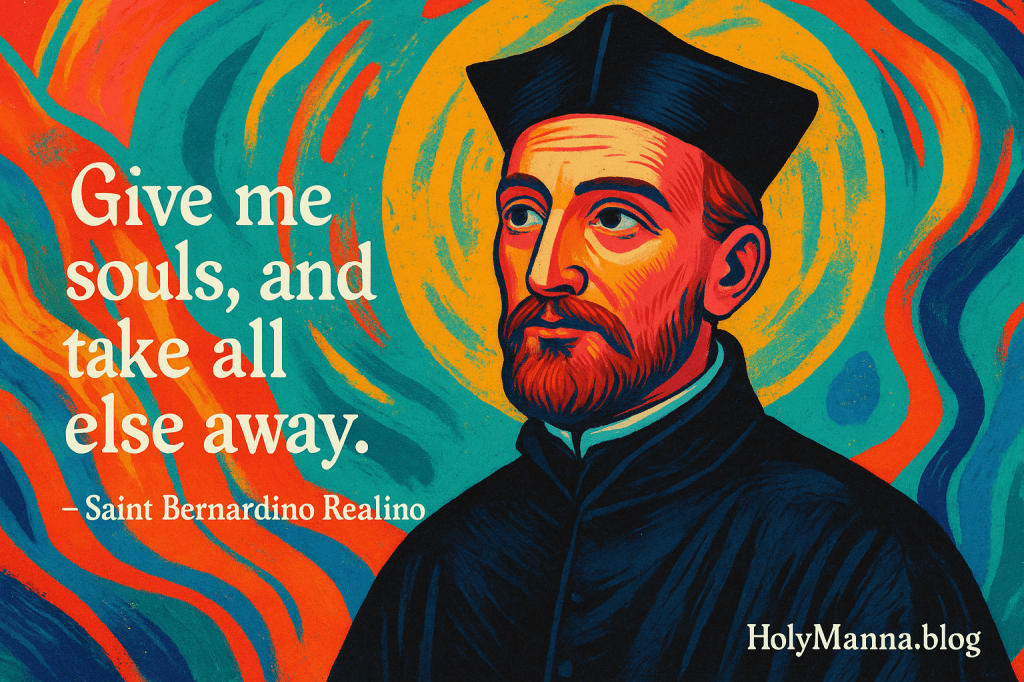
The Gentle Magistrate of Christ’s Mercy
A Life Written by the Finger of God
In every generation, the Holy Spirit raises up souls whose lives serve as bridges between the justice of heaven and the needs of earth. Saint Bernardino Realino is one of those rare figures whose very presence brought balance between law and love, between discipline and mercy. Known for his conversion from a promising legal career to a hidden life of obedience and sanctity as a Jesuit priest, Bernardino’s legacy is one of radical trust in God’s call, deep compassion for the poor, and devotion to Christ that outshone all worldly honors. Canonized by Pope Pius XII in 1947, he continues to inspire not only judges and lawyers, but all those wrestling with what it means to live justly and love tenderly in a world of competing ambitions. His memory lives on in Lecce, Italy, where the city still claims him as its beloved patron, and where pilgrims come seeking clarity, justice, and healing through his intercession.
When the Gavel Fell at the Feet of the Cross
Bernardino Realino was born on December 1, 1530, in the town of Carpi, nestled in northern Italy. Born into a noble family, he was raised with all the privileges of the Renaissance elite. His early education was shaped by tutors who recognized his brilliant intellect and nurtured his thirst for knowledge. By the time he reached the University of Bologna, Bernardino was excelling in both civil and canon law. His ambitions were noble yet secular—he envisioned a life of high office, marked by dignity and service to the state.
And for a time, that vision was fulfilled. He became podestà—mayor and chief magistrate—of several cities and was admired for his fairness, wisdom, and diplomacy. His superiors and peers regarded him as a rising star, destined perhaps for a high-ranking position in the royal court or the papal states. Yet beneath this glittering ascent, God was patiently preparing a deeper mission.
While serving in Naples in his early thirties, Bernardino became gravely ill. During this time of bodily weakness, his soul was awakened. He attended a sermon by a Jesuit priest, and something pierced him to the core. He began to experience a longing not for earthly justice, but for divine mercy. He was drawn to the Spiritual Exercises of Saint Ignatius of Loyola, and before long, he applied to join the Society of Jesus. The decision stunned his colleagues. How could someone walk away from power and prestige to become a humble novice?
But Bernardino knew what the world could not understand: “For what will it profit a man if he gains the whole world and forfeits his soul?” (Matthew 16:26). In 1564, he entered the novitiate, and in 1567 he was ordained a priest. He was sent to Lecce in southern Italy, where he would spend the rest of his life ministering to souls, teaching youth, caring for the poor, and transforming the city through holiness rather than politics.
The Power That Flowed from His Crucifix
What distinguished Father Bernardino was not only his keen intellect or refined manners, but the hidden power of grace that seemed to accompany his every act of charity. Though he never sought attention, miracles began to follow him. One of the most famous occurred when a woman was bitten by a deadly snake. In desperation, she sought out Father Bernardino, who simply blessed her in the name of Christ. Immediately, the venom ceased its effect, and she was restored to full health.
Another time, a student fell dangerously ill and was presumed lost. Bernardino brought his crucifix and placed it gently on the boy’s head. With prayerful confidence, he invoked the healing power of Jesus. The student recovered—and later testified that the moment he felt the touch of the crucifix, a warmth filled his body and the pain vanished.
There were countless other stories—instances where Bernardino’s intercession brought peace to warring families, conversion to wayward souls, and comfort to those in despair. He was especially known for hearing confessions for long hours, never rushing a penitent, and offering not just absolution, but fatherly counsel. Many left the confessional in tears—not from shame, but from the overwhelming love of God they had encountered in that small room.
Thorns That Sanctified the Rose
Though Bernardino was not martyred by sword or stake, his life was marked by the quiet martyrdom of suffering borne with faith. As he aged, his body began to betray him. He developed a severe leg infection that caused him intense pain, often confining him to his bed. Yet even then, he refused to stop ministering. He would offer Mass from his sickbed, receive visitors with a smile, and continue to write and teach as much as he could.
His greatest hardship may have been interior—the deep humility required to let go of his prestigious past and live the rest of his life as a servant of all. He was mocked by some who could not understand his decision, and others tried to lure him back to civic life with offers of influence and wealth. But Bernardino had resolved that his only crown would be that of Christ. As Psalm 34:19 reminds us, “Many are the afflictions of the righteous, but the Lord delivers him out of them all.”
In his final days, as death approached, the city magistrates of Lecce came to his bedside. He was frail and fading, yet radiant. They knelt and asked for his blessing. With great effort, he lifted his hand. Then, as if with divine strength, he opened his eyes one last time and smiled with indescribable peace. Those present said it was as if heaven itself had broken into the room. He died on July 2, 1616.
The Light That Did Not Go Out
Even in death, Saint Bernardino Realino remained a vessel of God’s mercy. His body was found incorrupt, a sign of divine favor that stirred devotion among the people of Lecce. Pilgrimages to his tomb began almost immediately, and reports of miracles soon followed. People claimed healings of tumors, conversions of hardened criminals, and even protection from storms after praying at his tomb.
His relics became objects of veneration, especially by lawyers, judges, and those involved in civil governance. They sought not only his intercession, but also his example—a model of how to balance justice with love, and how to bring Christ into the heart of worldly institutions. To this day, the Church of the Gesù in Lecce remains a sacred site, not because of architecture, but because it holds the memory of a man who let God rewrite his story.
In 1947, after careful examination of his life and miracles, Pope Pius XII declared him a saint. His feast day is celebrated on July 2, and his patronage extends not just to lawyers, but to all who seek to do justice while walking humbly with God (cf. Micah 6:8).
A Saint for the Professional and the Penitent
In a culture that often urges us to build empires, seek influence, and pursue acclaim, Saint Bernardino Realino gently reminds us that holiness is not opposed to professional success—but it does demand a deeper allegiance. His story is an invitation to reexamine our goals through the lens of eternity. What if your job could become your altar? What if your desk, your meetings, your business choices could become offerings to God?
Bernardino did not abandon justice—he transfigured it. He didn’t forsake the law—he fulfilled it with love. His legacy urges us to make room for God in our ambitions, to welcome grace into our schedules, and to listen for the quiet promptings of the Holy Spirit, even in the courtroom of our hearts.
Whether you are a student, a judge, a stay-at-home parent, or someone simply longing to hear God’s call more clearly, let the life of Saint Bernardino Realino reassure you: “God is able to accomplish far more than all we ask or imagine” (Ephesians 3:20). And it often begins with a single, grace-filled yes.
Engage with Us!
We’d love to hear how Saint Bernardino’s life has touched your heart. What part of his journey challenges or inspires you?
Reflection Questions:
- What worldly attachments might God be asking you to surrender in order to follow Him more fully?
- How can you practice justice and mercy more intentionally in your professional or personal life?
- Have you experienced a moment of grace that redirected your path like Saint Bernardino’s conversion?
Let’s continue to support one another on this journey of faith. As Saint Paul reminds us in 1 Corinthians 16:14, “Let all that you do be done in love.” May we, like Saint Bernardino, do everything for the greater glory of God.
Saint Bernardino Realino, pray for us! ⚖️
Follow us on Instagram and Facebook for more insights and reflections on living a faith-filled life.

 Holy Manna!
Leave a comment