Wednesday of the Thirteenth Week in Ordinary Time – Lectionary: 379
Wilderness and the God Who Stays
Have you ever felt cast out, unwanted, or spiritually exiled—like you were wandering through a desert with no direction or hope? Today’s readings speak directly to those moments. They remind us that even when the world rejects us, even when spiritual darkness threatens to overwhelm us, God does not abandon His children. Whether it’s Hagar weeping in the wilderness, a poor soul crying out in Psalm 34, or two tormented men living among tombs in The Gospel of Matthew, the message is the same: God sees, God hears, and God delivers.
The first reading from Genesis 21 presents a painful story of division and rejection within Abraham’s household. Sarah demands that Hagar and her son Ishmael be cast out so that Isaac alone would inherit the promise. Yet even in exile, God assures Abraham that Ishmael is not forgotten and promises to make of him a great nation. In the culture of the ancient Near East, to be banished into the desert was almost a death sentence—but the God of Israel specializes in making springs flow in dry places. The psalm echoes this truth: “This poor one cried out and the Lord heard, and from all his distress he saved him” (Psalm 34:7). For those who seek the Lord, even in abandonment, “nothing is lacking” (Psalm 34:10).
Then, in Matthew 8:28–34, we see a different kind of wilderness—not a desert, but the spiritual desolation of demoniacs living among the dead. These men, cut off from society and consumed by evil, recognize Jesus immediately: “What have you to do with us, Son of God?” (Matthew 8:29). In a moment of divine authority, Jesus casts out the demons, restoring the men to wholeness. And yet, shockingly, the townspeople beg Jesus to leave. Rejection appears again, but this time, it is God Himself who is cast out. What a sobering irony—and what a tender comfort to know that Jesus chooses to dwell among the rejected, just as He did for Hagar, just as He does for us. Are you in a wilderness right now? These readings are here to remind you: God is already there with you.
First Reading – Genesis 21:5, 8–20
Cast Out, But Not Forgotten
The Book of Genesis is not only the origin story of creation—it is also the unfolding of God’s covenant with a chosen people. Chapter 21 lands us deep within the Abrahamic narrative, a moment of both joy and sorrow: the fulfillment of God’s promise through the birth of Isaac, and the painful exile of Hagar and Ishmael. In the ancient world, inheritance and bloodline were paramount. Sarah’s demand to send Hagar away may seem harsh to modern ears, but within the cultural context, it reflected the urgency to protect the covenant lineage God had promised through Isaac. Yet what is remarkable in this passage is not simply the social or familial tension—it is God’s unexpected tenderness toward the outcast. In today’s theme of divine providence amid rejection and abandonment, this reading shows us a God who meets His children in the desert and opens wells where there was once only thirst.
Genesis 21:5, 8-20
New American Bible (Revised Edition)
5 Abraham was a hundred years old when his son Isaac was born to him.
8 The child grew and was weaned, and Abraham held a great banquet on the day of the child’s weaning.
9 Sarah noticed the son whom Hagar the Egyptian had borne to Abraham playing with her son Isaac; 10 so she demanded of Abraham: “Drive out that slave and her son! No son of that slave is going to share the inheritance with my son Isaac!” 11 Abraham was greatly distressed because it concerned a son of his. 12 But God said to Abraham: Do not be distressed about the boy or about your slave woman. Obey Sarah, no matter what she asks of you; for it is through Isaac that descendants will bear your name. 13 As for the son of the slave woman, I will make a nation of him also, since he too is your offspring.
14 Early the next morning Abraham got some bread and a skin of water and gave them to Hagar. Then, placing the child on her back, he sent her away. As she roamed aimlessly in the wilderness of Beer-sheba, 15 the water in the skin was used up. So she put the child down under one of the bushes, 16 and then went and sat down opposite him, about a bowshot away; for she said to herself, “I cannot watch the child die.” As she sat opposite him, she wept aloud. 17 God heard the boy’s voice, and God’s angel called to Hagar from heaven: “What is the matter, Hagar? Do not fear; God has heard the boy’s voice in this plight of his. 18 Get up, lift up the boy and hold him by the hand; for I will make of him a great nation.” 19 Then God opened her eyes, and she saw a well of water. She went and filled the skin with water, and then let the boy drink.
20 God was with the boy as he grew up. He lived in the wilderness and became an expert bowman.
Detailed Exegesis
Verse 5 – “Abraham was a hundred years old when his son Isaac was born to him.”
This verse recalls the miraculous nature of Isaac’s birth. Abraham and Sarah were well beyond childbearing age, yet God made the impossible happen. Isaac’s name, which means “laughter,” reflects the joy and astonishment of this long-awaited promise fulfilled. This birth marked the beginning of the fulfillment of God’s covenant to make Abraham the father of many nations (Genesis 17:5), anchoring the Jewish identity in divine faithfulness.
Verse 8 – “The child grew and was weaned, and Abraham held a great banquet on the day of the child’s weaning.”
Weaning in ancient Semitic culture often occurred around age three and marked a significant rite of passage. Abraham’s celebration illustrates both a public acknowledgment of God’s continued blessing and the social standing that Isaac now occupied as heir. The joy of the moment sets the stage for the tension that will follow—where joy for one becomes insecurity for another.
Verse 9 – “Sarah noticed the son whom Hagar the Egyptian had borne to Abraham playing with her son Isaac.”
The Hebrew here implies mocking or inappropriate behavior, which triggered Sarah’s fear that Ishmael might challenge Isaac’s inheritance. This moment echoes earlier tensions in Genesis 16, where Sarah dealt harshly with Hagar. Ishmael, though Abraham’s son, was not the child of the promise. Sarah’s jealousy surfaces, but more deeply, it highlights the fragility of peace in a household divided by broken trust and human striving.
Verse 10 – “So she demanded of Abraham: ‘Drive out that slave and her son! No son of that slave is going to share the inheritance with my son Isaac!’”
Sarah’s words reflect both fear and a desire to safeguard the divine promise. Her language is cutting—“that slave and her son”—as she distances herself from Hagar and Ishmael. Though painful, her demand aligns with God’s greater plan to distinguish the covenantal line through Isaac alone, as Paul later reflects in Galatians 4:30.
Verse 11 – “Abraham was greatly distressed because it concerned a son of his.”
This verse underscores Abraham’s humanity. He loved Ishmael. The command to send him away was not an easy one. Abraham’s distress reveals the emotional weight of obedience when it involves personal loss. It also prefigures the emotional testing Abraham will face in the next chapter with the binding of Isaac.
Verse 12 – “But God said to Abraham: Do not be distressed about the boy or about your slave woman. Obey Sarah, no matter what she asks of you; for it is through Isaac that descendants will bear your name.”
God reassures Abraham that Isaac is the chosen line, but His words also validate Sarah’s discernment. Yet God’s compassion is evident—He does not cast Ishmael aside. Instead, He affirms a parallel plan of blessing: Isaac will bear the covenant, but Ishmael too will become a nation.
Verse 13 – “As for the son of the slave woman, I will make a nation of him also, since he too is your offspring.”
God does not forget His promises, nor does He abandon those outside the covenant line. Ishmael, though excluded from the central narrative of salvation history, is still the recipient of divine favor. This reflects a broader biblical theme: God’s mercy extends beyond borders.
Verse 14 – “Early the next morning Abraham got some bread and a skin of water and gave them to Hagar. Then, placing the child on her back, he sent her away. As she roamed aimlessly in the wilderness of Beer-sheba…”
This heart-wrenching moment marks Hagar’s second journey into the wilderness (Genesis 16 being the first). Bread and water are insufficient for survival in the desert, emphasizing the dire nature of her expulsion. The wilderness becomes both a place of despair and divine encounter.
Verse 15 – “The water in the skin was used up. So she put the child down under one of the bushes…”
Hagar’s despair reaches its climax. She separates herself from her son, unable to watch him die—a profound image of maternal anguish and abandonment. The wilderness often symbolizes desolation in Scripture, but it also becomes a holy ground for revelation.
Verse 16 – “…and then went and sat down opposite him, about a bowshot away; for she said to herself, ‘I cannot watch the child die.’ As she sat opposite him, she wept aloud.”
Tears of helplessness rise to heaven, echoing the cries of Israel in slavery (Exodus 2:23–24). Hagar’s voice may not be heard by anyone on earth—but heaven listens.
Verse 17 – “God heard the boy’s voice, and God’s angel called to Hagar from heaven: ‘What is the matter, Hagar? Do not fear; God has heard the boy’s voice in this plight of his.’”
Here is the turning point. Not only does God hear, He calls Hagar by name. Just as He did in Genesis 16, God reveals Himself as One who sees and responds to suffering. The boy’s name—Ishmael—literally means “God hears,” making this moment one of divine affirmation.
Verse 18 – “Get up, lift up the boy and hold him by the hand; for I will make of him a great nation.”
God commands action: get up, take courage. His promise renews Hagar’s strength and dignity. Ishmael will not only live—he will thrive.
Verse 19 – “Then God opened her eyes, and she saw a well of water. She went and filled the skin with water, and then let the boy drink.”
In Scripture, wells often signify divine provision (John 4, Genesis 24). The water appears only after her eyes are opened—suggesting the well was there all along. Sometimes God’s provision is right before us, but we can only see it when our hearts are opened by grace.
Verse 20 – “God was with the boy as he grew up. He lived in the wilderness and became an expert bowman.”
The final verse assures us of God’s abiding presence. Though outside the line of Israel, Ishmael is not forgotten. He flourishes in the wilderness, symbolic of God’s ability to bring life from barrenness and stability from exile.
Teachings
The Catechism affirms that God’s providence is personal and reaches every individual: “The solicitude of divine providence is concrete and immediate; God cares for all, from the least things to the great events of the world and its history” (CCC 303). Hagar and Ishmael’s story is a stunning expression of this care. Even outside the chosen line, they are still within God’s loving gaze. This reinforces the universal scope of divine mercy and invites us to trust that no one is truly invisible to God.
The Church Fathers, particularly St. Augustine and St. Paul, viewed Sarah and Hagar allegorically. St. Paul writes in Galatians 4:30: “But what does Scripture say? ‘Drive out the slave woman and her son, for the son of the slave woman shall not share the inheritance with the son’”, interpreting Isaac as the child of promise through grace, and Ishmael as representing the old covenant of law. Still, within this symbolic framework, the real suffering and dignity of Hagar and Ishmael are not dismissed. Their story is not one of punishment, but of divine promise fulfilled in a different way.
St. John Chrysostom comments, “God often allows what is hard and grievous to happen, in order to teach us endurance and to bring us to greater trust in His providence.” The story of Hagar is not merely about exile—it’s about the hidden presence of God in desolation. Just as the well existed before her eyes were opened, so too does grace often surround us before we recognize it. This reading invites us to reexamine our own deserts and ask whether the provision we long for has been there all along, hidden until grace enables us to see.
Reflection
How many of us feel like Hagar at times—cast aside, confused, desperate for water in our personal desert? This reading invites us to remember that God hears even when no one else does. He does not always remove us from the wilderness, but He opens our eyes to see the well of grace already in our midst. Have you ever felt unseen, forgotten, or discarded? Have you cried out to God and waited in silence?
Today’s passage reminds us that even in seasons of rejection or suffering, God’s love is not withdrawn. Like Hagar, we may not understand why we’ve been sent into the wilderness, but we can trust that God goes with us. He listens. He provides. And He transforms deserts into places of encounter. What wells has God placed around you that you’ve not yet seen? Will you let Him open your eyes?
Responsorial Psalm – Psalm 34:7–8, 10–13
The Cry That God Cannot Ignore
The Book of Psalms is the heart of Israel’s prayer life—a sacred hymnbook filled with every human emotion, from joy and gratitude to despair and repentance. Psalm 34 is a psalm of thanksgiving, attributed to David after his escape from the Philistine king Abimelech. The historical context is one of deliverance from danger and humiliation, yet what flows from David’s experience is not bitterness but praise. This psalm affirms a truth woven throughout today’s readings: God hears the cries of the afflicted and rescues those abandoned by others. Whether it’s Hagar weeping in the wilderness or the possessed men of Gadara living among tombs, today’s psalm reminds us that those who seek the Lord will lack no good thing, even in desolate places.
Psalm 34:7-8, 10-13
New American Bible (Revised Edition)
7 This poor one cried out and the Lord heard,
and from all his distress he saved him.
8 The angel of the Lord encamps
around those who fear him, and he saves them.
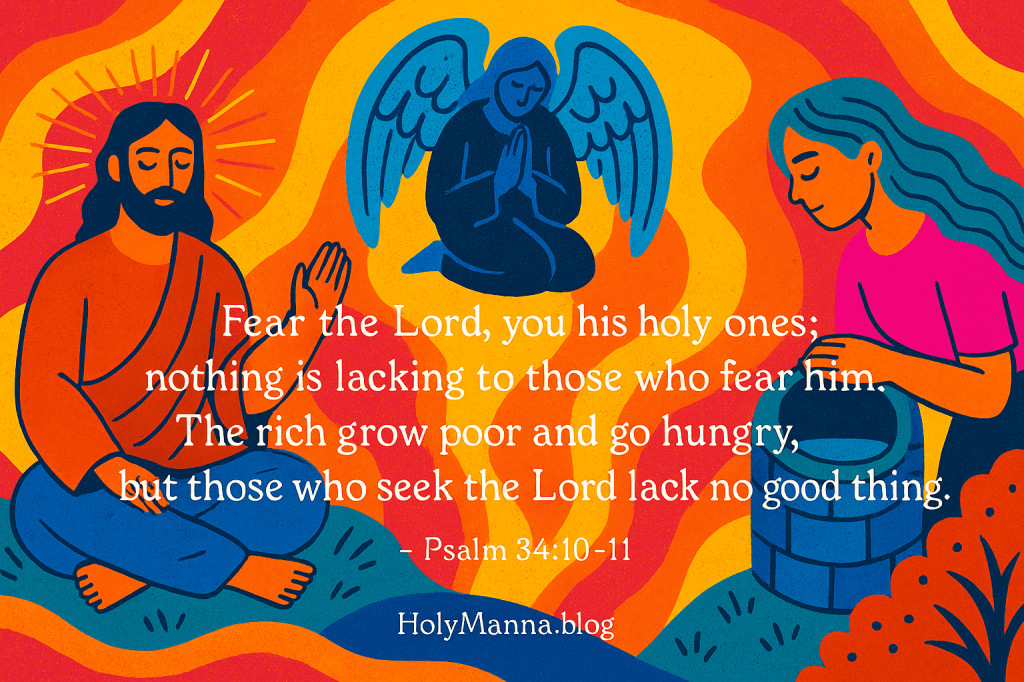
10 Fear the Lord, you his holy ones;
nothing is lacking to those who fear him.
11 The rich grow poor and go hungry,
but those who seek the Lord lack no good thing.
12 Come, children, listen to me;
I will teach you fear of the Lord.
13 Who is the man who delights in life,
who loves to see the good days?
Detailed Exegesis
Verse 7 – “This poor one cried out and the Lord heard, and from all his distress he saved him.”
David refers to himself as “this poor one,” adopting the posture of humility that opens the door to divine mercy. Poverty here is not just economic—it is spiritual need, total dependence on God. The psalmist’s confidence is not in his own strength but in the Lord’s faithfulness. This verse resonates strongly with Hagar’s experience, where God hears Ishmael’s cry and responds with salvation.
Verse 8 – “The angel of the Lord encamps around those who fear him, and he saves them.”
This image evokes divine protection, not from a distance but in close proximity. The word “encamps” suggests permanence and vigilance. The “angel of the Lord” was often seen in Jewish tradition as a visible sign of God’s intervention. For the righteous who “fear” Him—meaning those who revere and obey—God’s saving presence is as tangible as a fortress.
Verse 10 – “Fear the Lord, you his holy ones; nothing is lacking to those who fear him.”
This verse introduces an invitation to the community: to “fear the Lord” is to live in awe, obedience, and trust. The phrase “nothing is lacking” is an echo of God’s providential care, seen today in how He provides water for Hagar and healing for the possessed. True abundance is not measured in possessions, but in trust-filled communion with God.
Verse 11 – “The rich grow poor and go hungry, but those who seek the Lord lack no good thing.”
This is a divine reversal. Worldly wealth cannot secure lasting satisfaction or protection. In contrast, those who earnestly seek the Lord—like Hagar, like the demoniacs reaching out to Jesus—find themselves sustained in ways the world cannot understand. It is a call to reorient our desires and recognize where true wealth lies.
Verse 12 – “Come, children, listen to me; I will teach you fear of the Lord.”
The psalmist shifts to the role of teacher, inviting the next generation into wisdom. In Jewish tradition, fearing the Lord is the beginning of wisdom (Proverbs 1:7). This verse invites us into discipleship, into formation in reverence and trust—an antidote to spiritual wandering and fear.
Verse 13 – “Who is the man who delights in life, who loves to see the good days?”
This rhetorical question is an invitation to self-examination. Who among us does not want joy and peace? Yet the psalm implies that the path to such a life is not through self-indulgence or control but through the fear of the Lord, trust in His providence, and the pursuit of goodness. “Good days” are not trouble-free days, but days rooted in God’s presence.
Teachings
The Catechism of the Catholic Church reminds us that prayer begins with humility, just as this psalm begins with the cry of the poor: “Humility is the foundation of prayer. Only when we humbly acknowledge that ‘we do not know how to pray as we ought,’ are we ready to receive freely the gift of prayer” (CCC 2559). The poor one cries out—and the Lord hears—not because he is eloquent, but because he is empty enough to be filled.
St. Teresa of Avila beautifully echoes the spirit of Psalm 34 when she writes, “God withholds Himself from no one who perseveres. Little by little He will make His voice heard.” The psalm speaks of seeking the Lord, fearing Him, and lacking no good thing—all expressions of spiritual perseverance. It is often in our desolation, when we cry like David or Hagar or the demoniacs, that God speaks most clearly and acts most powerfully.
Finally, Pope Benedict XVI once reflected that “The Psalms teach us how to pray; they are God’s Word which we use to speak with God.” In Psalm 34, we find a school of trust, a liturgy of confidence in divine providence. It teaches that prayer is not a magical formula but a posture of the heart that opens the soul to God’s saving presence. This complements today’s readings by showing that no matter our state—banished, broken, or possessed—our cry is the threshold of grace.
Reflection
Have you ever been the “poor one” in today’s psalm—the one who cries out and waits to be heard? We all pass through seasons of dryness, fear, or uncertainty. The invitation today is to cry out without shame, to recognize our need not as weakness but as the very thing that draws God near. “The Lord hears”—not might, not maybe, but He does.
Let this psalm become your own prayer in times of distress. Take time to seek Him, to cultivate a holy fear that leads not to terror but to trust. What does it mean for you to “lack no good thing”? Where have you depended on worldly security instead of divine presence? Re-read this psalm slowly today. Let its words become a refuge and a challenge. And when you feel forgotten, remember that “The angel of the Lord encamps around those who fear Him”—and that means you are never alone.
Holy Gospel – Matthew 8:28–34
When Deliverance Is Uncomfortable
The Gospel of Matthew was written primarily for a Jewish-Christian audience, with the intent of revealing Jesus as the promised Messiah who fulfills the Law and the Prophets. In Matthew 8, we are in the midst of a series of miracles that showcase Jesus’ authority over sickness, nature, and now, the demonic. Today’s passage brings us to the Gentile territory of the Gadarenes, where Jesus is confronted by two men possessed by demons. This Gospel is a dramatic illustration of what happens when divine power enters into a place of spiritual exile. These men were literally living among the tombs—cut off from society, abandoned, feared, and tormented. And yet, they are not beyond Jesus’ reach. In the context of today’s theme—God’s unwavering providence in the face of rejection and abandonment—this Gospel reminds us that Christ goes even into the graveyards of our lives to restore what seems unredeemable.
Matthew 8:28-34
New American Bible (Revised Edition)
The Healing of the Gadarene Demoniacs. 28 When he came to the other side, to the territory of the Gadarenes, two demoniacs who were coming from the tombs met him. They were so savage that no one could travel by that road. 29 They cried out, “What have you to do with us, Son of God? Have you come here to torment us before the appointed time?” 30 Some distance away a herd of many swine was feeding. 31 The demons pleaded with him, “If you drive us out, send us into the herd of swine.” 32 And he said to them, “Go then!” They came out and entered the swine, and the whole herd rushed down the steep bank into the sea where they drowned. 33 The swineherds ran away, and when they came to the town they reported everything, including what had happened to the demoniacs. 34 Thereupon the whole town came out to meet Jesus, and when they saw him they begged him to leave their district.
Detailed Exegesis
Verse 28 – “When he came to the other side, to the territory of the Gadarenes, two demoniacs who were coming from the tombs met him. They were so savage that no one could travel by that road.”
This verse sets a scene of isolation and terror. The “other side” signals Jesus crossing from Jewish to Gentile lands—a movement often symbolic of crossing boundaries to bring the Good News. The demoniacs, living among tombs, are both ritually unclean and socially dead. Their savagery reflects the destructive nature of evil unchecked, and the inability of the community to control or heal them underscores humanity’s helplessness without divine intervention.
Verse 29 – “They cried out, ‘What have you to do with us, Son of God? Have you come here to torment us before the appointed time?’”
Remarkably, the demons immediately recognize Jesus’ divine identity. While others question who Jesus is, the spiritual realm knows without doubt. Their reference to “the appointed time” reveals eschatological awareness—demons know their end is inevitable. This scene exposes the cosmic battle between good and evil, and the sovereignty of Christ even over hellish forces.
Verse 30 – “Some distance away a herd of many swine was feeding.”
Swine were considered unclean animals under Jewish law, confirming the Gentile setting. Their presence also provides a vessel for the demons’ transfer, but more importantly, a visual demonstration of their destructive nature. That swine were being herded also suggests economic implications that will later trigger the townspeople’s reaction.
Verse 31 – “The demons pleaded with him, ‘If you drive us out, send us into the herd of swine.’”
The demons do not resist Jesus’ authority—they submit to it. Their plea not to be cast into the abyss (as other Gospel accounts note) shows their fear of divine judgment. That they ask for an alternative—swine—demonstrates their desperation and lack of power.
Verse 32 – “And he said to them, ‘Go then!’ They came out and entered the swine, and the whole herd rushed down the steep bank into the sea where they drowned.”
Jesus’ single word—“Go then!”—carries the power to break chains. The immediate destruction of the herd reveals the true intent of the demons: death. It is a visual lesson that evil, when unrestrained, consumes and destroys. The sea, in Jewish thought, often symbolized chaos and death. Evil returns to the void from which it came.
Verse 33 – “The swineherds ran away, and when they came to the town they reported everything, including what had happened to the demoniacs.”
Their report centers on the loss of the pigs—but also includes the healing of the men. What should have been a cause for joy becomes, instead, a source of disturbance. Human fear of disruption, even when caused by divine mercy, often outweighs rejoicing in the miraculous.
Verse 34 – “Thereupon the whole town came out to meet Jesus, and when they saw him they begged him to leave their district.”
This is perhaps the most heartbreaking verse. Instead of welcoming the healer, they cast Him out. The economic loss, the disruption of the status quo, and fear of the unknown all lead them to reject the very presence of God. The demons had begged to stay; now the people beg Jesus to go. In the end, Christ is the one exiled.
Teachings
The Catechism teaches that “Jesus’ exorcisms free some individuals from the domination of demons. They anticipate his great victory over ‘the ruler of this world.’ The kingdom of God will be definitively established through Christ’s cross” (CCC 550). This Gospel moment foreshadows that definitive victory. Jesus crosses cultural, spiritual, and physical boundaries to liberate, and in doing so, reveals the kingdom already breaking in. Though rejected, He does not retaliate—He respects human freedom, even the freedom to turn Him away.
St. Gregory the Great writes, “When the Lord works miracles, He does so not for ostentation but for our salvation.” The healing of the demoniacs was not a spectacle—it was an act of compassion. Their lives, forgotten by society, were still precious to Christ. Likewise, Pope Benedict XVI noted, “Christ wants us to see that no one is beyond redemption. The possessed men represent all of us in our sinfulness.” The exorcism is not just historical—it is symbolic of the spiritual liberation Christ offers every soul plagued by darkness.
Church tradition holds that demonic possession is real, though rare, but spiritual oppression is universal. The power of Christ to command demons reminds us that no spiritual force can withstand His authority. Yet what is most sobering is the town’s rejection of Jesus. The Fathers often noted that sin blinds us not only to evil but to grace. The people feared change more than they desired salvation. This calls to mind John 1:11: “He came to his own, and his own did not receive him.”
Reflection
What areas of your life feel like tombs—places of death, despair, or abandonment? Today’s Gospel reminds us that Jesus enters even those places. He is not afraid of our mess, our shame, or our chains. But His presence often demands change—and not everyone welcomes that. Have you ever pushed God away because His grace disrupted your comfort?
We can choose to be like the demoniacs—running to Jesus, even in our brokenness—or like the townspeople, clinging to comfort and security. What would you rather lose: your familiar habits, or the chance at healing? Let us be bold enough to let Jesus in, even if it costs us something. For what He gives in return is everything: peace, restoration, and the reclaiming of our humanity. “What have you to do with us, Son of God?”—everything. Everything.
Into the Wilderness, Into His Arms
Today’s readings take us to three very different landscapes: a desert where a mother weeps for her child, a battlefield of the soul where demons ravage human dignity, and a sacred song where the poor cry out to be heard. Yet in each place, God responds. He speaks, He acts, He saves. Genesis 21 reveals that even when the world casts us aside, God does not. Psalm 34 assures us that those who fear the Lord and seek Him will never be abandoned. And in Matthew 8, we witness Jesus stepping into unclean territory, confronting darkness head-on, and restoring two lost souls to freedom—only to be rejected Himself.
Together, these passages form a beautiful arc of divine fidelity. Whether you find yourself in the wilderness of sorrow, the struggle of spiritual bondage, or the silence of unanswered prayer, today’s message is clear: God hears you, God sees you, God is with you. He opens wells in dry places and brings light into tombs. But His presence may challenge our comfort zones. Sometimes, His mercy disrupts our ordinary lives, and we are tempted—like the townspeople—to push Him away. Yet even then, He stays close enough to be welcomed back.
Will you let Him into your wilderness today? What cry are you holding in that He longs to answer? The Lord is not afraid of your brokenness. He enters your pain, your exile, your confusion, and offers not only healing—but Himself. So cry out, like the psalmist. Walk into the unknown, like Hagar. And when He stands at the shore of your soul, speak the words He waits to hear: “Stay with me, Lord”.
Engage with Us!
We’d love to hear how today’s readings moved your heart. Share your reflections, prayers, or personal experiences in the comments below—your voice might be exactly what someone else needs to hear today. Let’s build a community rooted in the Word and uplifted by grace.
Reflection Questions:
First Reading – Genesis 21:5, 8–20
Have you ever felt like Hagar—unseen or abandoned? How did God show up for you in that moment? What “wells” might God be revealing in your life that you haven’t yet recognized?
Responsorial Psalm – Psalm 34:7–8, 10–13
What does it mean for you to “fear the Lord” in your daily life? When you feel spiritually poor, how do you cry out to God—and how does He respond?
Holy Gospel – Matthew 8:28–34
Are there parts of your life where Jesus wants to bring healing, but you’ve asked Him to leave? What tombs has Jesus entered in your heart, and what freedom has He already offered you?
Walk boldly today knowing that our God is not distant. He draws near to the abandoned, listens to the cries of the afflicted, and casts out every darkness. Live with faith, speak with mercy, and love with the strength and tenderness of Jesus—because you are never alone in the wilderness.
Follow us on Instagram and Facebook for more insights and reflections on living a faith-filled life.

 Holy Manna!
Leave a comment